
Report Feature
Civil Aircraft Fire Protection System Market Trends and Forecast
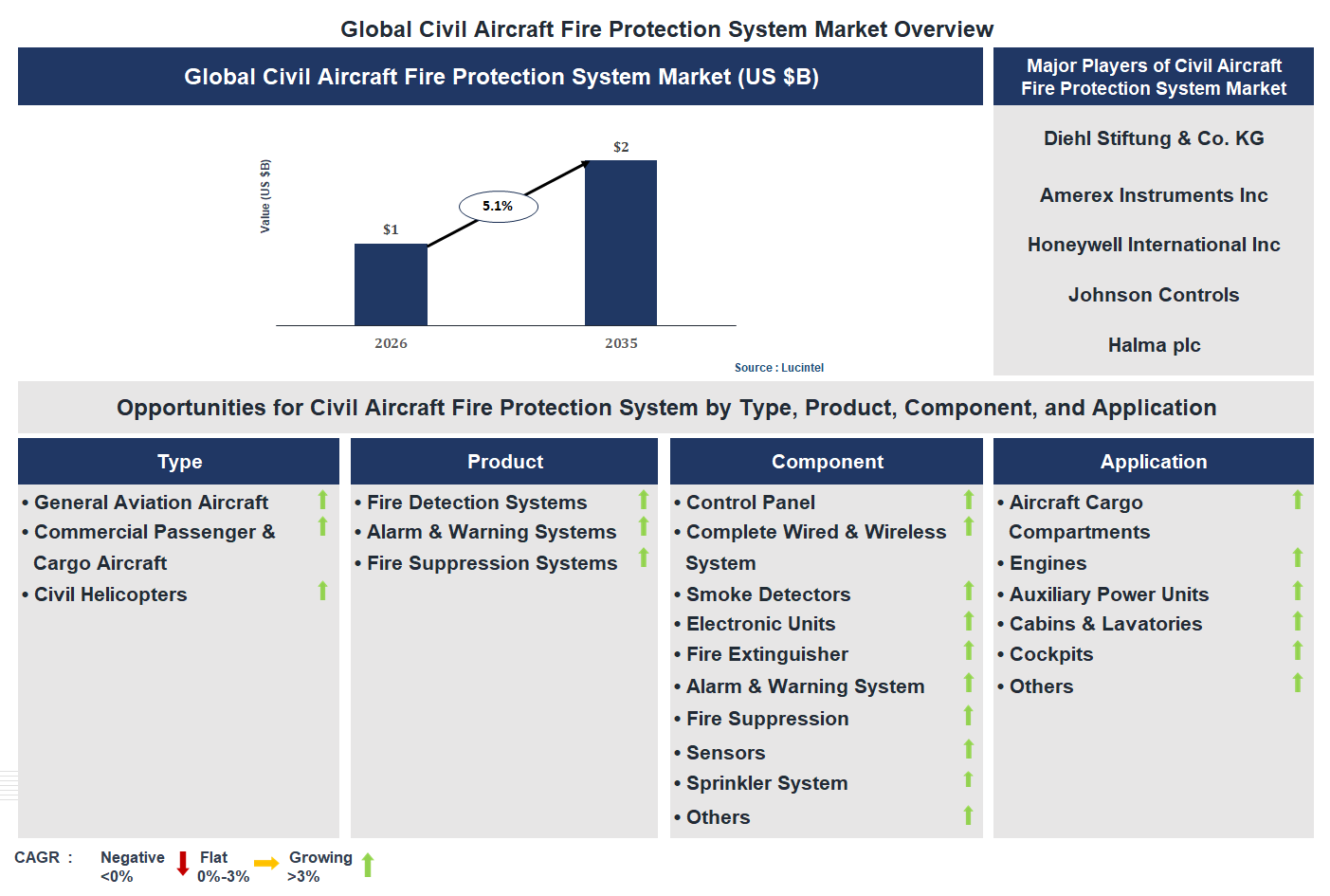
The future of the global civil aircraft fire protection system market looks promising with opportunities in the aircraft cargo compartment, engine, auxiliary power unit, cabin & lavatory, and cockpit markets. The global civil aircraft fire protection system market is expected to reach an estimated $2 billion by 2035 with a CAGR of 5.1% from 2026 to 2035. The major drivers for this market are the increasing demand for advanced aircraft fire safety systems, the rising adoption of automated fire detection technologies, and the growing need for enhanced onboard safety solutions.• Lucintel forecasts that, within the type category, commercial passenger & cargo aircraft is expected to witness the highest growth over the forecast period.
• Within the application category, engine is expected to witness the highest growth.
• In terms of region, APAC is expected to witness the highest growth over the forecast period. Gain valuable insights for your business decisions with our comprehensive 150+ page report. Sample figures with some insights are shown below.
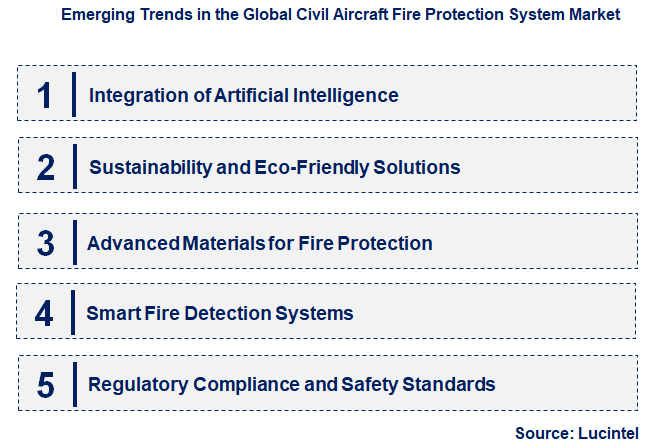
Emerging Trends in the Civil Aircraft Fire Protection System Market
The civil aircraft fire protection system market is undergoing a transformation as new technologies and global safety standards influence its development. The integration of AI, sustainable solutions, and advanced materials are just some of the key trends shaping the future of fire protection systems in the aviation industry. As the demand for safer and more efficient fire protection grows, these emerging trends are creating new opportunities and challenges. The following are some of the major trends impacting the market today.• Integration of Artificial Intelligence: AI is being integrated into fire detection and suppression systems to improve efficiency and response times. AI-based systems are capable of analyzing data from various sensors and cameras to identify potential fire hazards quickly, allowing for faster reaction times. These intelligent systems can also predict fire risks, enhancing overall safety. As AI technology becomes more advanced, it will play a crucial role in automating and improving fire safety on aircraft.
• Sustainability and Eco-Friendly Solutions: Sustainability is a key trend driving change in the civil aircraft fire protection system market. There is an increasing shift toward using environmentally friendly fire suppression agents, such as water-based solutions or eco-friendly halon alternatives. This shift is influenced by regulations aimed at reducing the environmental impact of aviation. Manufacturers are also exploring biodegradable materials and sustainable production practices to reduce the carbon footprint of fire protection systems in aircraft.
• Advanced Materials for Fire Protection: The use of advanced composite materials in aircraft design is improving fire resistance and reducing weight. Lightweight, fire-resistant composites are being used in fuselage and interior components, enhancing fire safety without compromising performance. These materials offer better heat resistance and are easier to integrate into aircraft structures. As the aerospace industry adopts new materials, the fire protection systems will need to be optimized to work in tandem with these innovations.
• Smart Fire Detection Systems: Traditional fire detection systems are being replaced by smarter, more advanced technologies. These new systems utilize sensors, cameras, and AI to detect fires at an earlier stage. They can identify temperature variations, smoke, and even subtle changes in pressure, all of which contribute to more accurate and faster detection. This development significantly enhances safety by ensuring that fire outbreaks are detected before they can escalate, giving crew members more time to respond.
• Regulatory Compliance and Safety Standards: Increasingly stringent regulations, such as those introduced by the FAA and other global aviation authorities, are pushing manufacturers to innovate in fire protection systems. Aircraft are being required to meet higher standards for fire safety, and this is driving investments in new technologies. With growing emphasis on passenger safety, compliance with these regulations is becoming a significant driver of market growth, prompting improvements in both detection and suppression systems. These emerging trends are reshaping the civil aircraft fire protection system market by pushing for safer, more sustainable, and technologically advanced solutions. As AI and eco-friendly solutions gain momentum, manufacturers are focused on integrating these features into next-generation systems. Regulatory changes and advancements in materials and detection technologies are helping to improve fire protection in the aviation sector. The combined effect of these trends is leading to a more robust and forward-thinking approach to fire safety in civil aircraft.
Recent Developments in the Civil Aircraft Fire Protection System Market
The civil aircraft fire protection system market has seen several key developments in recent years that are shaping its future. These advancements are driven by technological innovation, regulatory changes, and the increasing emphasis on passenger safety. As the global aviation industry continues to grow, these developments are improving fire safety standards and pushing the boundaries of what is possible in fire detection and suppression.• Introduction of Smart Fire Detection Systems: One of the major developments in recent years is the integration of smart fire detection systems in aircraft. These systems use a combination of sensors, AI, and machine learning to detect fires at the earliest stage. By analyzing multiple data points, these systems can predict fire risks and activate fire suppression systems automatically, reducing response times and enhancing safety.
• Eco-Friendly Fire Suppression Agents: The use of environmentally friendly fire suppression agents is gaining traction in the civil aircraft fire protection system market. Traditional agents, such as halon, are being phased out due to their harmful environmental impact. In their place, manufacturers are developing more sustainable solutions, such as water-based agents and biodegradable fire suppressants, which reduce the environmental footprint of aviation.
• Advanced Materials for Fire Resistance: Aircraft manufacturers are increasingly using advanced composite materials that are lighter and more fire-resistant. These materials offer superior heat resistance, making them ideal for enhancing fire safety. As the demand for fuel-efficient aircraft grows, the use of such materials will become more widespread, leading to better overall fire protection.
• Regulatory Push for Stricter Safety Standards: Regulatory bodies like the FAA and EASA are enforcing stricter fire safety standards, which is pushing the industry toward innovation. These regulations require more robust fire suppression and detection systems to ensure the safety of passengers and crew members. As these regulations evolve, they drive the development of more advanced and effective fire protection systems.
• Integration of Fire Safety Systems with Aircraft Design: Fire protection systems are becoming more integrated with aircraft design. Manufacturers are collaborating with fire protection experts to create systems that are specifically tailored to the aircraft’s structure and materials. This level of integration ensures that fire suppression systems are optimized for each model, improving both effectiveness and efficiency. These recent developments are pushing the civil aircraft fire protection system market toward greater efficiency, safety, and environmental sustainability. The integration of smart systems, eco-friendly fire agents, and advanced materials is transforming how fire safety is approached in the aviation sector. As regulatory bodies continue to raise safety standards, manufacturers are responding with innovative solutions that meet the evolving needs of the industry.
Strategic Growth Opportunities in the Civil Aircraft Fire Protection System Market
The civil aircraft fire protection system market presents significant growth opportunities across various applications, including commercial aviation, military aviation, and cargo aircraft. These opportunities are driven by the increasing demand for safer, more efficient fire protection systems. As the aviation sector continues to expand, particularly in emerging markets, new applications are emerging, requiring innovative fire safety solutions. The following outlines key growth opportunities within these applications.• Commercial Aviation: With the growing number of air passengers, the commercial aviation sector represents a large opportunity for fire protection systems. Airlines and manufacturers are investing heavily in advanced fire detection and suppression technologies to meet stricter safety regulations. The increasing demand for new aircraft, particularly in Asia and Africa, is driving the need for enhanced fire protection systems to ensure passenger safety.
• Military Aviation: Military aviation is another key application area for fire protection systems. Armed forces around the world are investing in advanced fire suppression technologies to protect both personnel and sensitive equipment. The integration of fire protection systems into military aircraft is becoming more sophisticated, with a focus on rapid response and minimizing collateral damage during fire-related incidents.
• Cargo Aircraft: As the global demand for air cargo grows, fire protection systems in cargo aircraft are becoming increasingly important. Cargo holds are often filled with combustible materials, making fire safety a critical concern. The development of specialized fire suppression systems for these aircraft is an area of significant growth, particularly in ensuring the safe transport of hazardous materials.
• Emerging Markets: The expansion of the aviation sector in emerging markets, particularly in Asia and the Middle East, presents growth opportunities for fire protection system providers. These markets are seeing rapid increases in air travel and the development of new airports and aircraft fleets, creating a high demand for state-of-the-art fire protection technologies.
• Sustainability in Aircraft Design: The shift toward more sustainable aircraft designs offers a significant opportunity for fire protection system providers. As manufacturers prioritize fuel efficiency and the use of environmentally friendly materials, fire protection systems must adapt to meet new challenges. The development of fire suppression agents that align with sustainability goals is a major growth area. The strategic growth opportunities outlined here are shaping the future of the civil aircraft fire protection system market. As demand for safer, more sustainable solutions increases, companies are focusing on providing advanced fire safety systems across commercial, military, and cargo aviation. These opportunities are driving technological innovation and expanding the market for fire protection systems globally.
Civil Aircraft Fire Protection System Market Driver and Challenges
The civil aircraft fire protection system market is influenced by various drivers and challenges that impact its growth. These factors include technological advancements, regulatory pressures, economic conditions, and evolving safety standards. Understanding these drivers and challenges helps stakeholders navigate the complexities of the market and identify opportunities for innovation and improvement. The following discusses the key drivers and challenges that are shaping the market. The factors responsible for driving the civil aircraft fire protection system market include• Technological Advancements: The rapid evolution of technology, particularly in AI, sensors, and fire suppression materials, is a major driver for the market. Innovations such as smart fire detection systems and eco-friendly suppression agents are helping to improve the efficiency and effectiveness of fire safety in aircraft.
• Regulatory Pressures: As global aviation regulatory bodies impose stricter fire safety standards, manufacturers are forced to innovate. These regulations, including those from the FAA and EASA, are driving the demand for more advanced fire protection systems that meet higher safety standards.
• Rising Demand for Air Travel: The increasing number of air passengers worldwide is driving demand for safer and more reliable fire protection systems. As airlines expand their fleets to accommodate growing travel demands, they must ensure their aircraft meet the highest fire safety standards.
• Sustainability Initiatives: The growing emphasis on sustainability in aviation is encouraging the development of environmentally friendly fire protection systems. Manufacturers are investing in green technologies and materials that align with environmental goals, offering a new growth area for the market.
• Global Expansion of Aviation Industry: The expansion of the aviation industry, particularly in emerging markets, is fueling demand for advanced fire protection systems. As new airports and fleets are developed, fire protection becomes a critical concern, driving market growth. The challenges facing the civil aircraft fire protection system market include:
• High Costs of Innovation: The development and implementation of advanced fire protection systems come with significant costs, which can be a barrier for smaller manufacturers. These systems require substantial investment in R&D and manufacturing, making them expensive for airlines and aircraft manufacturers.
• Integration with Existing Aircraft Designs: Integrating new fire protection systems into existing aircraft designs can be challenging, particularly in older fleets. Ensuring compatibility between new technologies and legacy systems requires careful planning and testing.
• Regulatory Compliance Complexity: Navigating the complex landscape of global fire safety regulations can be difficult for manufacturers, especially as different countries have varying standards. Compliance with these regulations requires continuous monitoring and adaptation of systems, adding complexity to the market. The major drivers and challenges in the civil aircraft fire protection system market are pushing the industry toward innovation and evolution. Technological advancements and regulatory pressures are driving the demand for more advanced and eco-friendly solutions, while challenges like cost and regulatory complexity remain significant hurdles. Despite these challenges, the market continues to grow as the need for safer and more efficient fire protection systems becomes more critical in the aviation industry.
List of Civil Aircraft Fire Protection System Companies
Companies in the market compete on the basis of product quality offered. Major players in this market focus on expanding their manufacturing facilities, R&D investments, infrastructural development, and leverage integration opportunities across the value chain. With these strategies civil aircraft fire protection system companies cater increasing demand, ensure competitive effectiveness, develop innovative products & technologies, reduce production costs, and expand their customer base. Some of the civil aircraft fire protection system companies profiled in this report include-• Diehl Stiftung & Co. KG
• Amerex Instruments Inc
• Honeywell International Inc
• Johnson Controls
• Halma plc
• Meggitt PLC.
• Gielle
• Aerocon Engineering
• Advanced Aircraft Extinguishers
• H3R Aviation Inc
Civil Aircraft Fire Protection System Market by Segment
The study includes a forecast for the global civil aircraft fire protection system market by type, product, component, application, and region.Civil Aircraft Fire Protection System Market by Type [Value from 2019 to 2035]:
• General Aviation Aircraft
• Commercial Passenger & Cargo Aircraft
• Civil Helicopters
Civil Aircraft Fire Protection System Market by Product [Value from 2019 to 2035]:
• Fire Detection Systems
• Alarm & Warning Systems
• Fire Suppression Systems
Civil Aircraft Fire Protection System Market by Component [Value from 2019 to 2035]:
• Control Panel
• Complete Wired & Wireless System
• Smoke Detectors
• Electronic Units
• Fire Extinguisher
• Alarm & Warning System
• Fire Suppression
• Sensors
• Sprinkler System
• Others
Civil Aircraft Fire Protection System Market by Application [Value from 2019 to 2035]:
• Aircraft Cargo Compartments
• Engines
• Auxiliary Power Units
• Cabins & Lavatories
• Cockpits
• Others
Civil Aircraft Fire Protection System Market by Region [Value from 2019 to 2035]:
• North America
• Europe
• Asia Pacific
• The Rest of the World
Country Wise Outlook for the Civil Aircraft Fire Protection System Market
The civil aircraft fire protection system market has witnessed significant developments across major aviation regions including the United States, China, Germany, India, and Japan. These countries are continuously investing in research and technology to enhance fire safety features in civil aviation. Technological advancements, regulatory changes, and increased demand for air travel are all shaping the evolution of fire protection systems. Additionally, global collaborations and innovations in material science, as well as fire detection technologies, are improving the effectiveness of fire protection systems in aircraft. This evolving landscape is driving the market growth and innovation in these key regions.• United States: In the United States, the civil aircraft fire protection system market is growing due to stringent safety regulations and technological advancements. The Federal Aviation Administration (FAA) continues to enforce regulations that push for better fire suppression systems in commercial aircraft. The market is seeing innovations in fire-resistant materials and advanced fire detection systems. Major aerospace companies in the U.S., such as Boeing, are increasingly adopting advanced technologies like microencapsulation and smart fire detection systems to improve aircraft safety. Additionally, the growing focus on sustainability is leading to the development of more eco-friendly fire protection solutions.
• China: China is rapidly advancing in the civil aircraft fire protection system market, driven by the expansion of its aviation sector and government support for safety standards. The Civil Aviation Administration of China (CAAC) has been introducing tighter safety regulations, leading to greater investments in fire protection technologies. Chinese aircraft manufacturers, such as COMAC, are prioritizing fire suppression systems in the design and development of their aircraft. Furthermore, China is focusing on the integration of artificial intelligence (AI) and machine learning into fire detection and suppression systems to enhance their effectiveness and response time in emergencies.
• Germany: Germany, a key player in Europe’s aviation sector, has seen significant advancements in fire protection systems for civil aircraft. German aerospace companies, including Lufthansa Technik, are developing cutting-edge technologies to improve fire suppression and detection systems. One of the major developments is the integration of more advanced composite materials into aircraft designs, which are both lighter and more fire-resistant. Additionally, Germany’s regulatory bodies have been pushing for stricter fire safety standards, encouraging innovations in fire protection systems. The market is also witnessing increased investments in green technologies, with eco-friendly fire suppression agents becoming more popular.
• India: In India, the civil aircraft fire protection system market is evolving as the aviation sector experiences rapid growth. The Directorate General of Civil Aviation (DGCA) is increasing its focus on safety, including fire protection standards for both commercial and cargo aircraft. Indian aerospace manufacturers and airlines are collaborating to improve fire detection and suppression technologies. India is also experiencing a surge in demand for upgraded fire protection systems as the country modernizes its fleet. These advancements are also driven by the increasing number of passengers and the need for higher safety standards, both of which are putting pressure on the market for innovation.
• Japan: Japan has seen a consistent rise in the demand for advanced fire protection systems in civil aircraft. The Japan civil aviation bureau has been progressively implementing stricter fire safety regulations, which are prompting the adoption of more effective fire suppression technologies. Japanese manufacturers, including Mitsubishi and Kawasaki Heavy Industries, are actively working on next-generation fire protection systems that utilize advanced materials and enhanced detection algorithms. Japan is also emphasizing the development of environmentally friendly fire suppression agents as part of its broader commitment to sustainability and environmental protection in aviation.

Features of the Global Civil Aircraft Fire Protection System Market
Market Size Estimates: Civil aircraft fire protection system market size estimation in terms of value ($B). Trend and Forecast Analysis: Market trends (2019 to 2025) and forecast (2026 to 2035) by various segments and regions. Segmentation Analysis: Civil aircraft fire protection system market size by various segments, such as by type, product, component, application, and region in terms of value ($B). Regional Analysis: Civil aircraft fire protection system market breakdown by North America, Europe, Asia Pacific, and Rest of the World. Growth Opportunities: Analysis of growth opportunities in different types, products, components, applications, and regions for the civil aircraft fire protection system market. Strategic Analysis: This includes M&A, new product development, and competitive landscape of the civil aircraft fire protection system market. Analysis of competitive intensity of the industry based on Porter’s Five Forces model.
FAQ
Q1. What is the civil aircraft fire protection system market size? Answer: The global civil aircraft fire protection system market is expected to reach an estimated $2 billion by 2035. Q2. What is the growth forecast for civil aircraft fire protection system market? Answer: The global civil aircraft fire protection system market is expected to grow with a CAGR of 5.1% from 2026 to 2035. Q3. What are the major drivers influencing the growth of the civil aircraft fire protection system market? Answer: The major drivers for this market are the increasing demand for advanced aircraft fire safety systems, the rising adoption of automated fire detection technologies, and the growing need for enhanced onboard safety solutions. Q4. What are the major segments for civil aircraft fire protection system market? Answer: The future of the civil aircraft fire protection system market looks promising with opportunities in the aircraft cargo compartment, engine, auxiliary power unit, cabin & lavatory, and cockpit markets. Q5. Who are the key civil aircraft fire protection system market companies? Answer: Some of the key civil aircraft fire protection system companies are as follows:• Diehl Stiftung & Co. KG
• Amerex Instruments Inc
• Honeywell International Inc
• Johnson Controls
• Halma plc
• Meggitt PLC.
• Gielle
• Aerocon Engineering
• Advanced Aircraft Extinguishers
• H3R Aviation Inc Q6. Which civil aircraft fire protection system market segment will be the largest in future? Answer: Lucintel forecasts that, within the type category, commercial passenger & cargo aircraft is expected to witness the highest growth over the forecast period. Q7. In civil aircraft fire protection system market, which region is expected to be the largest in next 8 years? Answer: In terms of region, APAC is expected to witness the highest growth over the forecast period. Q8. Do we receive customization in this report? Answer: Yes, Lucintel provides 10% customization without any additional cost.
Table of Contents
List of Figures
List of Tables
Methodology
- In-depth interviews of the major players in this market
- Detailed secondary research from competitors’ financial statements and published data
- Extensive searches of published works, market, and database information pertaining to industry news, company press releases, and customer intentions
- A compilation of the experiences, judgments, and insights of Lucintel’s professionals, who have analyzed and tracked this market over the years.


Buy Now
Choose a license that fits your team. Instant PDF delivery.
Prices exclude taxes. Instant delivery. Custom licensing available on request.
Key Questions
- • What are some of the most promising, high-growth opportunities for the civil aircraft fire protection system market by type (general aviation aircraft, commercial passenger & cargo aircraft, and civil helicopters), product (fire detection systems, alarm & warning systems, and fire suppression systems), component (control panel, complete wired & wireless system, smoke detectors, electronic units, fire extinguisher, alarm & warning system, fire suppression, sensors, sprinkler system, and others), application (aircraft cargo compartments, engines, auxiliary power units, cabins & lavatories, cockpits, and others), and region (North America, Europe, Asia Pacific, and the Rest of the World)?
- • Which segments will grow at a faster pace and why?
- • Which region will grow at a faster pace and why?
- • What are the key factors affecting market dynamics? What are the key challenges and business risks in this market?
- • What are the business risks and competitive threats in this market?
- • What are the emerging trends in this market and the reasons behind them?
- • What are some of the changing demands of customers in the market?
- • What are the new developments in the market? Which companies are leading these developments?
- • Who are the major players in this market? What strategic initiatives are key players pursuing for business growth?
- • What are some of the competing products in this market and how big of a threat do they pose for loss of market share by material or product substitution?
- • What M&A activity has occurred in the last 5 years and what has its impact been on the industry? For any questions related to Civil Aircraft Fire Protection System Market, Civil Aircraft Fire Protection System Market Size, Civil Aircraft Fire Protection System Market Growth, Civil Aircraft Fire Protection System Market Analysis, Civil Aircraft Fire Protection System Market Report, Civil Aircraft Fire Protection System Market Share, Civil Aircraft Fire Protection System Market Trends, Civil Aircraft Fire Protection System Market Forecast, Civil Aircraft Fire Protection System Companies, write Lucintel analyst at email: helpdesk@lucintel.com. We will be glad to get back to you soon.


