
Report Feature
Battery Swapping Charging Infrastructure Market Trends and Forecast
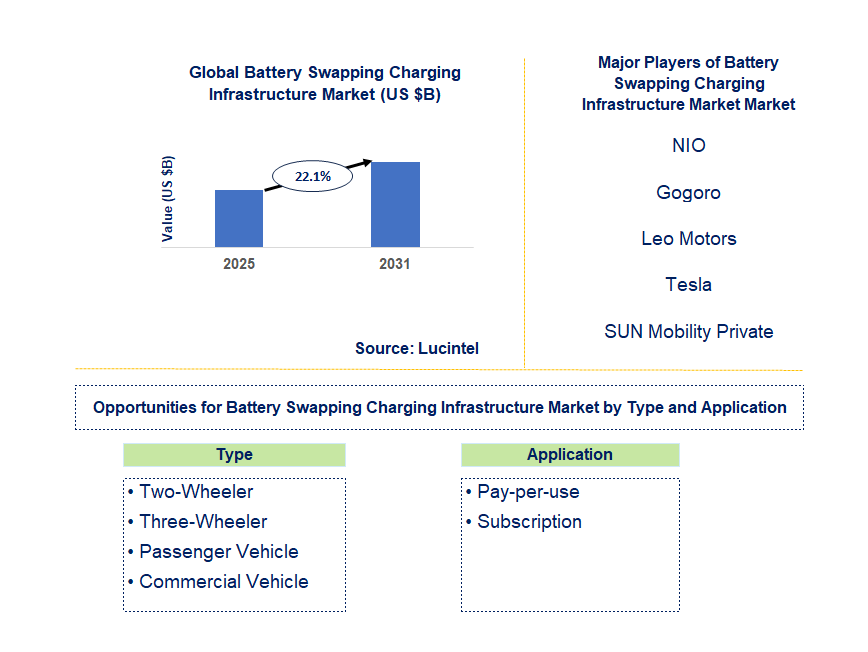
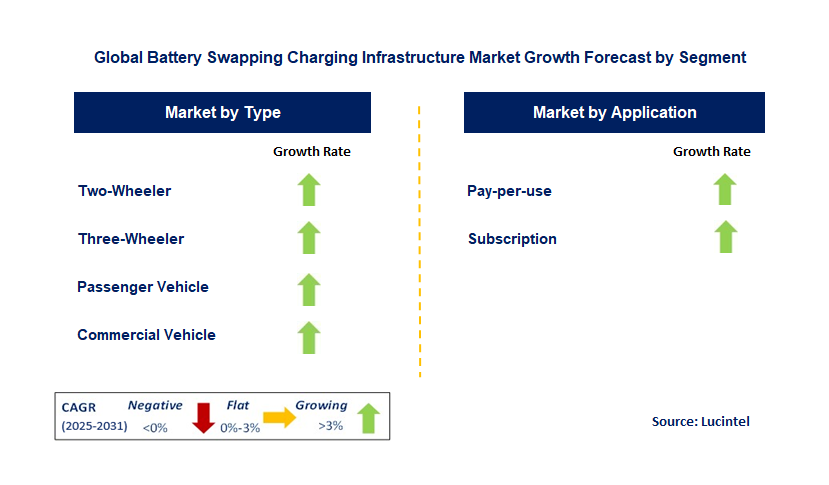
The future of the global battery swapping charging infrastructure market looks promising with opportunities in the pay-per-use and subscription markets. The global battery swapping charging infrastructure market is expected to grow with a CAGR of 22.1% from 2025 to 2031. The major drivers for this market are the increase in urbanization and demand for shared mobility and the rising consumer preference for fast charging solution.Lucintel forecasts that, within the type category, two-wheeler is expected to witness the highest growth over the forecast period due to rising demand for cost-effective and convenient urban mobility solutions is accelerating two-wheeler ev adoption.
Within the application category, subscription is expected to witness the higher growth due to rising demand for predictable and low-cost energy solutions is driving user preference for subscription-based battery swapping.
In terms of region, APAC is expected to witness the highest growth over the forecast period.
Gain valuable insights for your business decisions with our comprehensive 150+ page report. Sample figures with some insights are shown below.
Emerging Trends in the Battery Swapping Charging Infrastructure Market
As the battery swapping charging infrastructure market continues to evolve, several key trends are emerging that are shaping its future. These trends reflect the technological, regulatory, and market forces driving the development of battery swapping stations, particularly in regions like the United States, China, Germany, India, and Japan.• Smart Battery Swapping Stations: Smart battery swapping stations are becoming a central trend in the development of this infrastructure. These stations contain advanced technologies: AI, IoT, and even real-time analytics of data toward efficiency, observation of battery life, and enhancing station operations in general. Even AI-driven swap systems can guess the needs in batteries, drive the swapping autonomously, or even enhance end-user experience and provide accurate predictability of waits. As more stations become integrated with smart technologies, service reliability will be enhanced, making the process of battery swapping seamless, faster, and more efficient, which will make them more attractive to EV owners.
• Integration with Renewable Energy Sources: A trend that is on the rise in the integration of battery swapping charging infrastructure is the integration with renewable energy sources such as solar and wind power. A battery swapping station along with green energy solutions can combine to make more sustainable and environment-friendly charging networks. This is particularly important for regions like China, Germany, and India where environmental goals drive the adoption of electric vehicles. Renewable energy integration reduces the carbon footprint of the EV ecosystem while supporting the overall transition to cleaner transportation solutions.
• Government Incentives and Regulations: Government policies and regulations are playing a significant role in the development of battery swapping charging infrastructure. Countries like China and India are offering incentives, tax rebates, and subsidies to support the establishment of battery swapping stations. Moreover, clear regulatory frameworks are being developed to standardize battery swapping technologies, ensuring compatibility and safety across different EV brands and models. With increasing government support, the battery swapping charging infrastructure market will continue to expand, offering greater accessibility and affordability for EV owners to charge.
• Commercial Fleets and Public Transportation: Demand for battery swapping charging infrastructure is also high for commercial fleets and public transportation, including taxis, buses, and delivery vehicles. The battery swapping facility has a high-turnover vehicle which enjoys rapid turnaround times, so the vehicle spends less time under repair and in the garage and more time operating throughout the day. Companies such as Nio and Sun Mobility are focusing efforts on providing the battery swapping solutions for fleet operators in both urban and rural areas. This is expected to pick up pace with the need of business to minimize the cost of operation and efficiency in fleet management.
• Partnerships and Collaborations: The battery swapping charging infrastructure market is increasingly seeing strategic collaborations between automakers, energy companies, and technology providers. It is essential for the successful roll out of such networks to ensure the right amalgamation of expertise in EV technology, energy management, and infrastructure development. Companies such as Toyota, Honda, and Nio are collaborating with energy companies and infrastructure developers to set up large-scale battery swapping stations. This will make battery swapping more widespread through the creation of a more connected, reliable, and robust infrastructure.
These emerging trends shape the battery swapping charging infrastructure market by introducing new technologies, creating sustainable charging networks, and fostering collaboration among key stakeholders. As the market matures, these trends will help improve the efficiency, scalability, and accessibility of battery swapping services, contributing to the accelerated adoption of electric vehicles globally.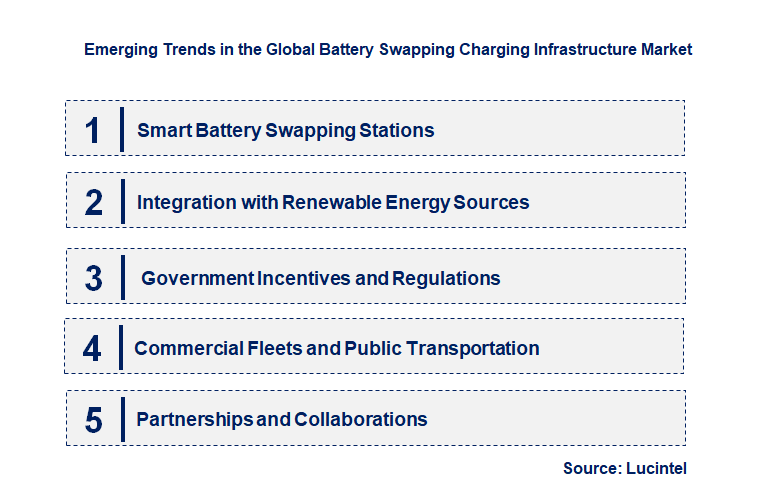
Recent Development in the Battery Swapping Charging Infrastructure Market
The battery swapping charging infrastructure market is witnessing crucial developments that shape its growth and adoption around the world. Such developments indicate new technologies, strategic collaborations, and increased investment in EV infrastructure.• Increase in Battery Swapping Stations in China: China has witnessed rapid growth in the installation of battery swapping stations, primarily led by Nio, which has developed an extensive network throughout the country. This development is addressing the growing need for fast and efficient charging solutions for EV owners. The expansion of battery swapping stations is critical in urban centers, where space for traditional charging stations is limited. China’s push for large-scale infrastructure development is positioning the country as a global leader in battery swapping technology and services, providing a model for other nations to follow.
• Government Backing and Policies in India: The Indian government has been proactive in promoting the growth of battery-swapping infrastructure with policies and incentives. In this regard, initiatives like the Faster Adoption and Manufacturing of Hybrid and Electric Vehicles (FAME) scheme have provided financial incentives to boost the adoption of electric vehicles and develop the associated infrastructure. Besides offering subsidies, the Indian government is working on developing regulatory frameworks to standardize the practices behind battery swapping. These developments are further expected to boom the battery swap stations across various parts of this country, including urban regions significantly.
• JV between Automaker and Charging Station Provider: Key development in terms of the business of battery-swapping infrastructure deals with a surging number of collaborations between several automakers as well as different charging infrastructure service providers. Auto majors like Nio, BAIC, or BYD collaborates with electricity companies for enlarging battery swaps in China. Similarly, in Japan, Honda and Toyota are working with technology companies to find a battery swapping solution for commercial and personal electric vehicles. This is very important to ensure the creation of a seamless and widespread network of battery swapping to help grow the market.
• Technological Advancements in Battery Management Systems: Technological innovations in battery management systems are driving the evolution of battery swapping charging infrastructure. These innovations are enhancing the efficiency and lifespan of batteries, making the swapping process faster and more reliable. With improved BMS, battery swapping stations can better monitor battery health, predict failures, and optimize the charging process. These advancements are also crucial in extending battery life, reducing costs for EV owners, and ensuring the reliability of swapping stations. Widespread acceptance and adoption will be through technological advancement in BMS.
• Standardized Battery Formats: Standardization of battery formats is a critical development in the battery swapping market. This ensures that more electric vehicle models could easily be served by a wider array of battery swapping stations, ensuring more compatibility between brands and making it cheaper for infrastructure to be built. Common battery formats would thus be necessary for developing consumer-centric seamless experiences, as it would enable consumers to swap the battery at any station, regardless of brand. In China, this is an initiative that is already underway, and thus, market maturity would benefit the same as a global standard.
These key developments are advancing the battery swapping charging infrastructure market by creating a more standardized, accessible, and efficient network. Growth in China and India, along with strategic collaborations and technological innovations, is setting the stage for battery swapping solutions to become a mainstream alternative to traditional charging methods, benefiting EV owners globally.Strategic Growth Opportunities in the Battery Swapping Charging Infrastructure Market
The battery swapping charging infrastructure market holds great opportunities for growth in key applications, especially in high-demand regions for the electric vehicle. Where governments, businesses, and consumers are seeking convenient solutions to accompany sustainability, such a market is the best place for investment and innovation.• Scaling up of EV Fleets for Courier Services and Public Transportation: Swapping infrastructure is particularly important for commercial fleets, including delivery and public transportation fleets. Electric buses, taxis, and delivery vehicles benefit from quick swapping to reduce down time. A business can easily ensure its vehicles are up and running during the day by putting swapping stations in strategic locations. This is most attractive in the dense urban regions where fleet use is the highest and there must be continuous availability.
• Rise in Two-Wheelers and Three-Wheelers in Emerging Markets: In India and other Southeast Asia, electric two-wheeled and three-wheeled electric vehicles are popular mainly due to low prices and increased efficiency in daily usage. These small size electric vehicles call for customized swapping stations that promise higher growth opportunity in terms of affordable battery swap operations, ensuring wider acceptance and rapid use of these two-wheelers and three-wheelers instead of conventional fuel internal combustion vehicles that generate large carbon emissions from transportation activities in such emerging regions.
• Urban Mobility Solutions: Battery swapping infrastructure is well-suited to urban mobility solutions, particularly for shared EV fleets. Car-sharing, bike-sharing, and scooter-sharing services can integrate battery swapping into their operations to ensure continuous availability of vehicles. This is particularly important in cities with high vehicle turnover and limited charging infrastructure. Providers who focus on building battery swapping stations in urban centers can tap into the growing demand for flexible, on-demand electric mobility.
• Cooperation with Energy Providers for Sustainable Charging: Collaborating with renewable energy providers will be an expansion opportunity for battery swapping charging infrastructure. Companies can integrate solar and wind energy into these stations to create a more sustainable and economical charging network. Such a model will attract environmentally conscious consumers as well as businesses looking to implement green energy solutions. As demand for clean energy increases, battery swapping stations that use renewable resources will have a competitive advantage in the market.
• Compatibility with Autonomous Electric Cars: As autonomous vehicles become more prevalent, integrating battery swapping charging infrastructure with autonomous electric vehicle fleets presents an exciting growth opportunity. Autonomous EVs, particularly in commercial applications like logistics and public transportation, require a continuous and fast charging solution to ensure they remain operational. Battery swapping stations could be tailored to accommodate these self-driving fleets, providing efficient charging solutions that allow for uninterrupted service and faster fleet turnover.
The growth opportunities in this market are forcing the development of the battery swapping charging infrastructure market through the creation of new applications, increasing access, and ensuring the long-term sustainability of electric vehicles. The demand for efficient and sustainable charging solutions will continue to rise as providers focus on emerging markets, commercial fleets, and urban mobility.Battery Swapping Charging Infrastructure Market Driver and Challenges
The battery swapping charging infrastructure market is influenced by a mix of technological, economic, and regulatory factors that significantly impact its development. As electric vehicles (EVs) become more popular, the demand for efficient and fast-charging solutions grows. Battery swapping, a potential alternative to traditional charging methods, offers numerous benefits such as shorter wait times and extended vehicle range. Yet, technological constraints, high infrastructures, and regulatory barriers may limit the further growth of the market. The understanding of the drivers and challenges by the stakeholders will help it to move in this emerging sector and contribute towards long-term success.The factors responsible for driving the battery swapping charging infrastructure market include:
1. Growing Adoption of Electric Vehicles: Electric vehicle adoption is growing at a fast pace all over the world. As governments, businesses, and consumers look to electric mobility as a means to reduce carbon emissions and dependence on fossil fuels, the demand for efficient charging solutions increases. Battery swapping will allow for faster and more convenient refueling of EVs, reduce time spent charging, and enhance the overall EV experience. As sales of EVs grow, the need for a robust battery swapping charging infrastructure will also grow.
2. Quick Charging Solutions: Traditional EV charging takes hours, which makes the battery swapping attractive. Battery swapping allows drivers to replace their depleted battery with a fully charged one within minutes. This faster turnaround time is helpful for fleet operators and long-distance travelers, thus making battery swapping an attractive solution. It will move its adoption into the market with increasing speed as battery swapping technology advances and becomes capable of charging faster and more efficiently.
3. Government Support and Policies: Governments of different countries have incentives and policies set in place to encourage electric mobility, thus promoting growth in battery swapping charging infrastructure. Such policies include tax rebates for purchasing EVs, subsidies on vehicles, and funding for charging infrastructure development that boosts investments in the market. Also, with increasing sustainability aims of governments and aims to reduce the increasing greenhouse gas emissions, battery swapping solutions receive further boost in adoption as part of greater green energy initiatives. In this way, regulatory support always creates a supportive environment for developing battery-swapping stations.
4. Technological Advancements in Battery Management: The growth of battery-swapping infrastructure is also influenced by technological advancements in battery technology and management systems. Superior designs of the batteries, more time on a charge, and bigger energy storage abilities will facilitate increased performance and effectiveness in the battery swapping stations. Standardization in the designs of the battery, along with management systems, enhances the simplicity and monitoring of swap and battery health. More effective, reliable, and inexpensive operations of swapping stations will spur on further expansion into the market due to improved advancements in technology.
5. Environmental Advantages and Sustainability Ambitions: Sustainability drives the market considerably, with concern for reducing the carbon footprint since battery swapping leads to lowering that footprint. Such a process affords an added energy-efficient process of recharging EVs besides being able to use renewable forms of energy - solar or wind power in this case. This aligns with global sustainability goals and makes the battery swapping charging infrastructure a desired alternative for an environmentally conscious consumer and business.
Challenges in the battery swapping charging infrastructure market are:
1. High Initial Infrastructure Costs: The major challenge to the battery swapping charging infrastructure market is the very high cost of establishing necessary infrastructure. The establishment of swapping stations requires capital investment in terms of land acquisition, station construction, and allocation of batteries. In addition, the cost to develop and maintain the technology-including battery management systems and charging equipment-can be very high. Such upfront expenses may discourage certain investors from the market and cause a delay in the mass penetration of battery-swapping solutions.
2. Standardization of Battery Designs: The greatest challenge for the battery-swapping market is that there are no universal standards in battery designs that are applicable in all vehicle-making companies. Every manufacturer has its own designs for batteries, making it difficult to standardize a swapping system. In the absence of standardization, consumers will face challenges in accessing compatible battery swapping stations, and infrastructure providers will find it challenging to offer a uniform service. Interoperability between different models of batteries and swapping stations is critical for the scalability and success of the market.
3. Battery Lifecycle Management and Recycling: The recycling of the used-up batteries following their lifecycle as another challenge for the battery swapping charging infrastructure market. The battery, like other products, has its shelf life; more batteries that are swapped and continually used mean a greater demand for proper disposal and recycling. Non-recycling infrastructure can result in environmental problems, including hazardous waste accumulation. It is crucial for long-term sustainability that the infrastructure model includes end-of-life management, and it also ensures proper recycling of batteries.
The rapid growth in electric vehicle adoption, a growing need for faster charging solutions, and the favorable government policies have been the key drivers of the battery swapping charging infrastructure market. Technological advancement in the area of battery management and sustainability have also been major growth contributors. However, the market needs to overcome some challenges, such as high infrastructure costs, lack of standardization, and battery lifecycle management, to fully realize its potential. Overall, the successful development of battery swapping charging infrastructure will depend on overcoming these hurdles while capitalizing on the growing demand for clean and efficient energy solutions.
List of Battery Swapping Charging Infrastructure Market Companies
Companies in the market compete on the basis of product quality offered. Major players in this market focus on expanding their manufacturing facilities, R&D investments, infrastructural development, and leverage integration opportunities across the value chain. With these strategies battery swapping charging infrastructure market companies cater increasing demand, ensure competitive effectiveness, develop innovative products & technologies, reduce production costs, and expand their customer base. Some of the battery swapping charging infrastructure market companies profiled in this report include-• NIO
• Gogoro
• Leo Motors
• Tesla
• SUN Mobility Private
• BYD
• BattSwap
Battery Swapping Charging Infrastructure Market by Segment
The study includes a forecast for the global battery swapping charging infrastructure market by type, application, and region.Battery Swapping Charging Infrastructure Market by Type [Value from 2019 to 2031]:
• Two-Wheeler
• Three-Wheeler
• Passenger Vehicle
• Commercial Vehicle
Battery Swapping Charging Infrastructure Market by Application [Value from 2019 to 2031]:
• Pay-per-use
• Subscription
Battery Swapping Charging Infrastructure Market by Region [Value from 2019 to 2031]:
• North America
• Europe
• Asia Pacific
• The Rest of the World
Country Wise Outlook for the Battery Swapping Charging Infrastructure Market
The battery swapping charging infrastructure market is an emerging key part of the electric vehicle ecosystem in regions like the United States, China, Germany, India, and Japan. This technology enables EV owners to quickly replace a depleted battery with a fully charged one, resulting in less downtime compared to traditional charging. Governments, companies, and technology providers are investing in developing battery swapping stations to facilitate further growth in the demand for electric vehicles. Improvements in convenience are driving expansion of driving infrastructure in key markets worldwide.• United States: Development of battery swapping charging infrastructure has been slower in the United States compared to other countries; however, developments are on their way. Companies like Tesla and start-ups such as Ample are actively exploring battery swapping as a viable solution for urban transportation and delivery fleets. The U.S. government is providing funding and incentives to promote EV adoption, and there is growing interest in battery swapping for commercial EVs, especially for logistics and public transportation. Although adoption is still in an early stage, the thrust remains on improving technology and honing a user-friendly experience to match the fast-charging solutions.
• China: China is ahead in the race in developing the swapping charging infrastructure for batteries. Many companies such as Nio, BAIC, and BYD have begun to develop massive swapping stations across the country. The government has been playing a crucial role in promoting the technology through subsidies and policies to accelerate the adoption of EVs. Nio, for instance, has received much attention due to its vast network of battery swapping stations, which provide a convenient and fast charging solution for EV owners. Consequently, China's battery swapping charging infrastructure is expanding rapidly, which provides a competitive edge over traditional charging methods as it reduces waiting time and encourages efficient energy usage.
• Germany: Germany is promoting the development of battery swapping charging infrastructure in its general plan to minimize carbon emissions and use clean energy. Although old ways of charging are more conventional, several firms are experimenting with the possibility of using battery swapping for electric vehicles, especially in fleets and business usage. The country's leading automakers-Volkswagen and BMW-are partnering with the country's energy suppliers to introduce the battery-swapping program in selected areas. Germany is investing in clean mobility solutions as it pursues sustainability and reduces fossil fuel dependency. Battery swapping has become a significant aspect of future urban mobility.
• India: India is looking into the battery swapping charging infrastructure to help tackle its rapidly growing electric vehicle market, especially in cities with heavy traffic and high pollution levels. Lithium Urban Technologies and Sun Mobility are actively building battery swapping stations for electric two-wheelers and three-wheelers. The Indian government is motivating the development of EV infrastructure with incentives and policies, especially in public transport and logistics. As India is facing infrastructure issues, battery swapping can be an important factor in the speedy promotion of electric mobility by providing an affordable and efficient alternative to the traditional charging solution.
• Japan: Japan is progressing steadily in the development of battery swapping charging infrastructure, focusing on consumer as well as commercial electric vehicles. Companies such as Honda and Toyota are at the forefront, piloting battery-swapping integration with their electric vehicle sales. The Japanese government has supported this transition by offering funding for technological development and policy frameworks that further encourage a shift to electric mobility. Battery swapping appears attractive in cities where these are the intended applications and high utilization in vehicles such as taxis and delivery fleets. Japan's commitment to innovation and environmental sustainability is driving the market toward further development of this infrastructure.

Features of the Global Battery Swapping Charging Infrastructure Market
Market Size Estimates: Battery swapping charging infrastructure market size estimation in terms of value ($B).Trend and Forecast Analysis: Market trends (2019 to 2024) and forecast (2025 to 2031) by various segments and regions.
Segmentation Analysis: Battery swapping charging infrastructure market size by type, application, and region in terms of value ($B).
Regional Analysis: Battery swapping charging infrastructure market breakdown by North America, Europe, Asia Pacific, and Rest of the World.
Growth Opportunities: Analysis of growth opportunities in different types, applications, and regions for the battery swapping charging infrastructure market.
Strategic Analysis: This includes M&A, new product development, and competitive landscape of the battery swapping charging infrastructure market.
Analysis of competitive intensity of the industry based on Porter’s Five Forces model.

FAQ
Q1. What is the growth forecast for battery swapping charging infrastructure market?Answer: The global battery swapping charging infrastructure market is expected to grow with a CAGR of 22.1% from 2025 to 2031.
Q2. What are the major drivers influencing the growth of the battery swapping charging infrastructure market?
Answer: The major drivers for this market are the increase in urbanization and demand for shared mobility and the rising consumer preference for fast charging solution.
Q3. What are the major segments for battery swapping charging infrastructure market?
Answer: The future of the battery swapping charging infrastructure market looks promising with opportunities in the pay-per-use and subscription markets.
Q4. Who are the key battery swapping charging infrastructure market companies?
Answer: Some of the key battery swapping charging infrastructure market companies are as follows:
• NIO
• Gogoro
• Leo Motors
• Tesla
• SUN Mobility Private
• BYD
• BattSwap
Q5. Which battery swapping charging infrastructure market segment will be the largest in future?Answer: Lucintel forecasts that two-wheeler is expected to witness the highest growth over the forecast period due to rising demand for cost-effective and convenient urban mobility solutions is accelerating two-wheeler ev adoption.
Q6. In battery swapping charging infrastructure market, which region is expected to be the largest in next 5 years?
Answer: APAC is expected to witness the highest growth over the forecast period.
Q7. Do we receive customization in this report?
Answer: Yes, Lucintel provides 10% customization without any additional cost.
Table of Contents
Methodology
- In-depth interviews of the major players in this market
- Detailed secondary research from competitors’ financial statements and published data
- Extensive searches of published works, market, and database information pertaining to industry news, company press releases, and customer intentions
- A compilation of the experiences, judgments, and insights of Lucintel’s professionals, who have analyzed and tracked this market over the years.


Buy Now
Choose a license that fits your team. Instant PDF delivery.
Prices exclude taxes. Instant delivery. Custom licensing available on request.
Key Questions
- • What are some of the most promising, high-growth opportunities for the battery swapping charging infrastructure market by type (two-wheeler, three-wheeler, passenger vehicle, and commercial vehicle), application (pay-per-use and subscription), and region (North America, Europe, Asia Pacific, and the Rest of the World)?
- • Which segments will grow at a faster pace and why?
- • Which region will grow at a faster pace and why?
- • What are the key factors affecting market dynamics? What are the key challenges and business risks in this market?
- • What are the business risks and competitive threats in this market?
- • What are the emerging trends in this market and the reasons behind them?
- • What are some of the changing demands of customers in the market?
- • What are the new developments in the market? Which companies are leading these developments?
- • Who are the major players in this market? What strategic initiatives are key players pursuing for business growth?
- • What are some of the competing products in this market and how big of a threat do they pose for loss of market share by material or product substitution?
- • What M&A activity has occurred in the last 5 years and what has its impact been on the industry? For any questions related to Battery Swapping Charging Infrastructure Market, Battery Swapping Charging Infrastructure Market Size, Battery Swapping Charging Infrastructure Market Growth, Battery Swapping Charging Infrastructure Market Analysis, Battery Swapping Charging Infrastructure Market Report, Battery Swapping Charging Infrastructure Market Share, Battery Swapping Charging Infrastructure Market Trends, Battery Swapping Charging Infrastructure Market Forecast, Battery Swapping Charging Infrastructure Companies, write Lucintel analyst at email: helpdesk@lucintel.com. We will be glad to get back to you soon.


