
Report Feature
Artificial Intelligence-Powered Voice Fraud Detection Market Trends and Forecast
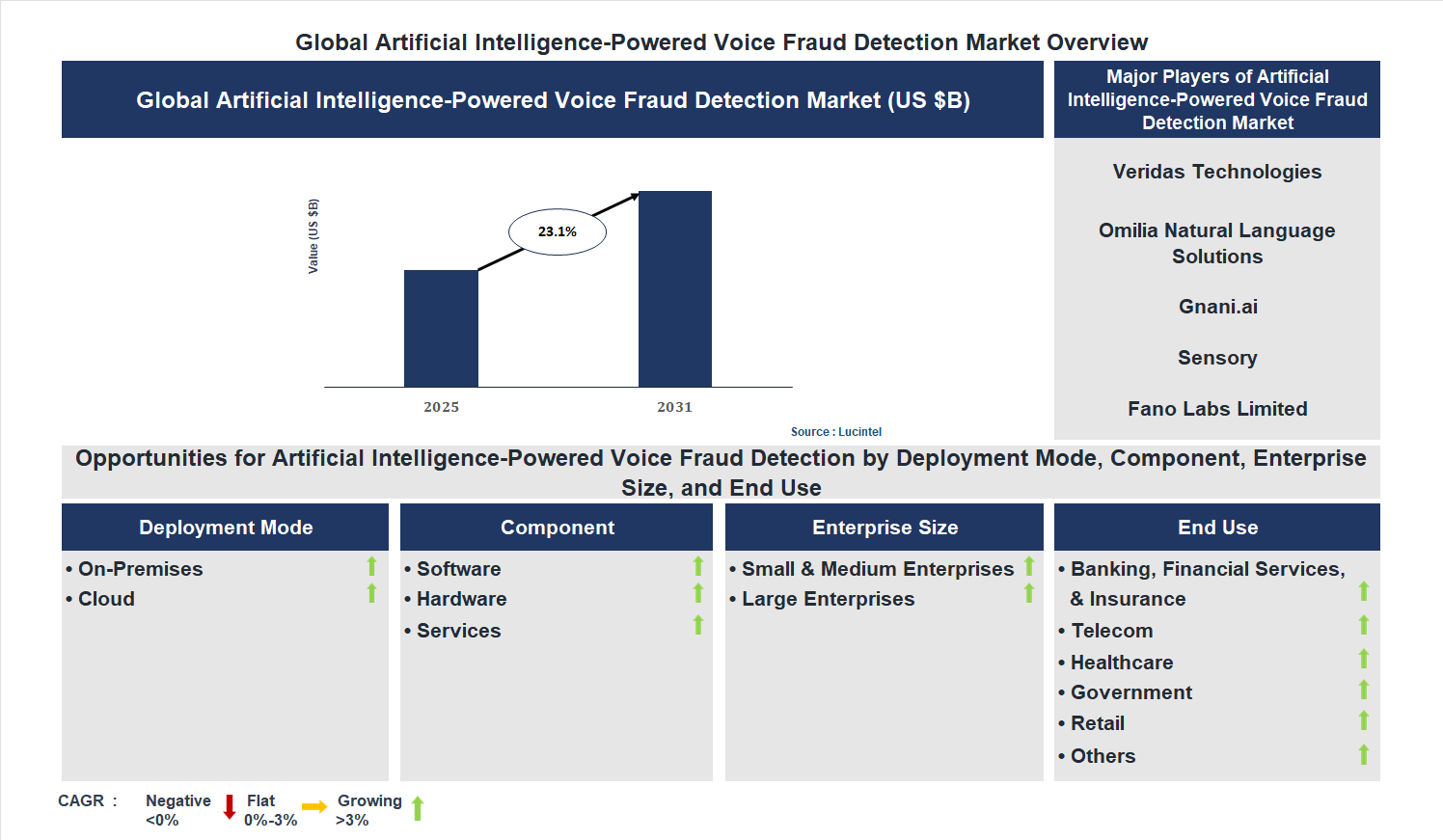
The future of the global artificial intelligence-powered voice fraud detection market looks promising with opportunities in the banking, financial service, & insurance, telecom, healthcare, government, and retail markets. The global artificial intelligence-powered voice fraud detection market is expected to grow with a CAGR of 23.1% from 2025 to 2031. The major drivers for this market are the increasing incidents of voice-based fraud, the rising demand for secure call verification, and the growing adoption of AI fraud detection.• Lucintel forecasts that, within the deployment mode category, cloud is expected to witness higher growth over the forecast period.
• Within the end use category, telecom is expected to witness the highest growth.
• In terms of region, APAC is expected to witness the highest growth over the forecast period. Gain valuable insights for your business decisions with our comprehensive 150+ page report. Sample figures with some insights are shown below.
Emerging Trends in the Artificial Intelligence-Powered Voice Fraud Detection Market
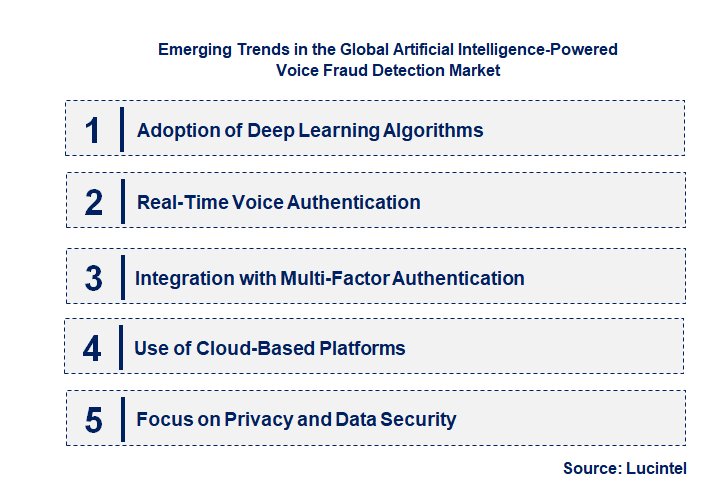
The artificial intelligence-powered voice fraud detection market is experiencing rapid growth driven by increasing concerns over voice-based security threats and advancements in AI technology. As organizations seek more effective ways to combat fraud, innovative solutions are emerging to enhance security measures. These developments are transforming the landscape of voice authentication and fraud prevention, making systems more intelligent, adaptive, and user-friendly. The market is characterized by a shift towards more sophisticated, real-time detection methods that leverage AI's capabilities. This evolution is not only improving security but also influencing customer trust and operational efficiency across various sectors, including banking, telecommunications, and government agencies.• Adoption of Deep Learning Algorithms: The integration of deep learning models enhances voice fraud detection accuracy by enabling systems to recognize subtle voice patterns and anomalies. These algorithms improve over time through continuous learning, making detection more reliable and reducing false positives. As a result, organizations can better identify sophisticated voice spoofing and synthetic voice attacks, strengthening overall security infrastructure.
• Real-Time Voice Authentication: The demand for instant verification processes is driving the development of real-time voice authentication solutions. These systems analyze voice inputs on the fly, providing immediate feedback and reducing the window for fraudulent activities. This trend improves user experience by enabling seamless, secure transactions and interactions, especially in banking and customer service sectors, where speed and security are paramount.
• Integration with Multi-Factor Authentication (MFA): Voice fraud detection is increasingly being integrated into multi-factor authentication frameworks. Combining voice biometrics with other authentication methods such as biometrics, PINs, or OTPs enhances security layers. This multi-faceted approach makes it more difficult for fraudsters to bypass security, thereby increasing trust and reducing fraud-related losses.
• Use of Cloud-Based Platforms: Cloud technology is facilitating scalable, flexible, and cost-effective deployment of voice fraud detection solutions. Cloud platforms enable organizations to access advanced AI tools without heavy infrastructure investments, allowing for rapid updates and integration across multiple channels. This trend supports widespread adoption, especially among small and medium-sized enterprises seeking robust security solutions.
• Focus on Privacy and Data Security: As voice data is highly sensitive, there is a growing emphasis on ensuring privacy and compliance with data protection regulations. Companies are adopting encryption, anonymization, and secure storage practices to protect user data. This focus not only builds customer trust but also ensures adherence to legal standards, which is critical for market growth and acceptance. In summary, these emerging trends are significantly reshaping the artificial intelligence-powered voice fraud detection market by making solutions more accurate, real-time, integrated, scalable, and secure. These developments are enhancing the ability of organizations to prevent voice-based fraud effectively, thereby increasing overall trust and efficiency in voice authentication systems across various industries.
Recent Development in the Artificial Intelligence-Powered Voice Fraud Detection Market
The artificial intelligence-powered voice fraud detection market has experienced rapid growth driven by increasing concerns over voice-based fraud and advancements in AI technology. As organizations seek more effective security measures, the integration of AI for voice authentication and fraud detection has become a priority. Recent developments reflect technological innovations, regulatory changes, and expanding applications across industries. These trends are shaping the future landscape of voice security, making it more robust and accessible. The following key developments highlight the major shifts and innovations in this evolving market, demonstrating its trajectory toward enhanced security solutions and broader adoption.• Technological Advancements in AI Algorithms: The development of more sophisticated machine learning models has significantly improved voice fraud detection accuracy. These algorithms can now better distinguish between genuine and fraudulent voices by analyzing subtle acoustic features and behavioral patterns. This enhancement reduces false positives and negatives, increasing trust in AI-powered systems. As a result, organizations are more confident in deploying these solutions, leading to wider adoption across banking, telecom, and healthcare sectors. The improved precision also enables real-time detection, minimizing potential financial losses and security breaches.
• Integration of Biometric Voice Authentication: Companies are increasingly integrating biometric voice authentication with fraud detection systems. This combination provides a multi-layered security approach, verifying user identity through voiceprints while simultaneously analyzing voice behavior for anomalies. The impact is a more secure and user-friendly experience, reducing reliance on traditional PINs or passwords. This development has driven adoption in high-security environments such as financial services and government agencies, where identity verification is critical. It also enhances customer experience by enabling seamless, voice-based authentication processes.
• Regulatory Frameworks and Data Privacy Policies: Governments and regulatory bodies are establishing clearer guidelines for AI-driven voice fraud detection systems. These regulations focus on data privacy, consent, and transparency, ensuring user rights are protected. The impact on the market includes increased compliance costs but also greater consumer trust. Companies investing in these solutions are now more cautious, ensuring their systems meet legal standards. This regulatory environment encourages responsible innovation and fosters market growth by addressing privacy concerns, which is crucial for widespread acceptance and deployment.
• Expansion into New Industry Verticals: The market is witnessing expansion beyond traditional sectors like banking and telecom into areas such as healthcare, insurance, and retail. AI-powered voice fraud detection is being tailored to meet specific industry needs, such as protecting patient data or preventing insurance fraud. This diversification broadens the market scope and creates new revenue streams. The impact includes increased competition and innovation, as vendors develop industry-specific solutions. It also enhances security across various sectors, reducing fraud-related losses and improving overall trust in voice-based interactions.
• Adoption of Cloud-Based Solutions and SaaS Models: The shift toward cloud deployment and Software-as-a-Service (SaaS) models has made AI-powered voice fraud detection more accessible and scalable. Cloud solutions offer easier integration, lower upfront costs, and faster deployment, enabling smaller organizations to adopt advanced security measures. This development has democratized access to sophisticated voice fraud detection tools, accelerating market growth. The impact is a broader customer base, increased flexibility, and continuous updates and improvements, which keep systems ahead of evolving fraud tactics. It also fosters innovation through collaborative cloud platforms. In summary, these recent developments are significantly transforming the artificial intelligence-powered voice fraud detection market by enhancing detection accuracy, expanding industry applications, ensuring regulatory compliance, and increasing accessibility through cloud solutions. These trends are driving market growth, fostering innovation, and strengthening security measures across various sectors, ultimately making voice interactions safer and more trustworthy.
Strategic Growth Opportunities in the Artificial Intelligence-Powered Voice Fraud Detection Market
The artificial intelligence-powered voice fraud detection market is experiencing rapid growth driven by increasing security concerns, technological advancements, and the rising adoption of digital communication channels. As organizations seek to protect sensitive information and enhance customer trust, AI-driven voice fraud detection solutions are becoming essential across various industries. This market's evolution is shaped by the need for real-time, accurate, and scalable fraud prevention methods. Key applications such as banking, telecommunications, insurance, government, and healthcare are witnessing significant opportunities for growth. These developments are transforming how organizations combat voice fraud, ensuring more secure and efficient communication ecosystems.• Banking: Enhanced Security Measures : AI-powered voice fraud detection helps banks identify and prevent fraudulent transactions in real-time, reducing financial losses and safeguarding customer assets. This increases customer confidence and compliance with regulatory standards.
• Telecommunications: Fraud Prevention and Customer Trust : Telecom providers utilize AI to detect suspicious voice activities, preventing identity theft and unauthorized access. This improves service integrity and customer satisfaction.
• Insurance: Fraudulent Claim Detection : In the insurance sector, AI-driven voice analysis identifies fraudulent claims by analyzing voice patterns and inconsistencies, leading to reduced payouts and improved claim processing efficiency.
• Government: National Security and Identity Verification : Governments deploy voice fraud detection to secure communication channels, verify identities, and prevent espionage or fraud, strengthening national security infrastructure.
• Healthcare: Secure Patient Communication : Healthcare providers adopt AI solutions to authenticate patient interactions over voice channels, ensuring privacy, reducing fraud, and maintaining compliance with health data regulations. These growth opportunities are significantly impacting the market by driving innovation, increasing adoption across sectors, and enhancing the overall effectiveness of fraud prevention strategies. As organizations recognize the value of AI-powered voice fraud detection, market expansion is expected to accelerate, fostering a more secure communication environment worldwide.
Artificial Intelligence-Powered Voice Fraud Detection Market Driver and Challenges
The artificial intelligence-powered voice fraud detection market is influenced by a range of technological, economic, and regulatory factors. Rapid advancements in AI and machine learning technologies have enabled more sophisticated voice fraud detection systems, driving market growth. Increasing concerns over security breaches and financial frauds have prompted organizations to adopt AI-driven solutions, creating a robust demand. Economic factors such as rising investments in cybersecurity and digital transformation initiatives further propel the market. However, regulatory challenges related to data privacy and ethical considerations pose significant hurdles. Balancing innovation with compliance remains critical for sustained growth in this dynamic landscape. The factors responsible for driving the artificial intelligence-powered voice fraud detection market include:• Technological Advancements: Rapid developments in AI, machine learning, and natural language processing have significantly enhanced voice fraud detection capabilities. These innovations enable real-time analysis, anomaly detection, and improved accuracy, making solutions more effective against evolving fraud tactics. As technology continues to evolve, the market benefits from increased adoption across various sectors, including banking, telecom, and government agencies. The integration of deep learning models and voice biometrics further boosts detection precision, fostering confidence among users and stakeholders. This ongoing technological progress ensures the market remains competitive and innovative, supporting long-term growth.
• Rising Incidence of Voice Fraud: The increasing frequency and sophistication of voice-based frauds, such as identity theft, account hacking, and scam calls, have heightened the need for advanced detection systems. Financial institutions and telecom providers face substantial losses due to voice fraud, prompting urgent adoption of AI-powered solutions. The growing awareness of security vulnerabilities among consumers and organizations accelerates demand for reliable voice authentication and fraud prevention tools. As fraud tactics become more complex, AI systems are essential for identifying subtle anomalies and preventing financial and reputational damage, thereby fueling market expansion.
• Growing Adoption of Digital Banking and Fintech: The surge in digital banking, mobile payments, and fintech services has expanded the attack surface for voice fraud. Customers increasingly rely on voice commands for transactions, account access, and customer support, making voice channels prime targets for fraudsters. AI-powered voice fraud detection solutions are crucial for safeguarding these digital interactions, ensuring secure and seamless user experiences. Financial institutions are investing heavily in these technologies to comply with regulatory standards and enhance customer trust. This trend significantly contributes to market growth, as the demand for secure voice authentication solutions continues to rise globally.
• Regulatory and Compliance Pressures: Governments and regulatory bodies are implementing stricter data privacy and security standards, such as GDPR and CCPA. These regulations compel organizations to adopt advanced fraud detection systems that ensure compliance while protecting user data. AI-driven voice fraud detection solutions help meet these legal requirements by providing transparent, auditable, and secure authentication processes. Additionally, regulatory pressures encourage organizations to proactively prevent fraud and avoid penalties, fostering market growth. However, navigating complex legal frameworks and ensuring data privacy remains a challenge, requiring continuous updates and compliance strategies.
• Increasing Investment in AI and Cybersecurity: The global surge in investments toward AI research and cybersecurity infrastructure directly benefits the voice fraud detection market. Governments, private enterprises, and venture capitalists recognize the importance of AI in combating fraud, leading to increased funding for innovative solutions. These investments facilitate the development of more sophisticated, scalable, and cost-effective voice fraud detection systems. As organizations prioritize cybersecurity to protect sensitive data and maintain customer trust, the market experiences accelerated growth. The influx of capital also drives research, development, and deployment of cutting-edge AI technologies, ensuring the market remains competitive and forward-looking. The challenges in the artificial intelligence-powered voice fraud detection market are:
• Data Privacy and Ethical Concerns: The deployment of AI-based voice fraud detection systems involves processing vast amounts of sensitive personal data, raising significant privacy issues. Organizations must navigate complex legal frameworks to ensure compliance with data protection laws, which can be resource-intensive and challenging. Ethical considerations around voice data usage, consent, and potential biases in AI algorithms also pose hurdles. If not managed properly, these concerns can lead to legal penalties, loss of customer trust, and reputational damage. Balancing effective fraud detection with strict privacy standards remains a critical challenge for market players.
• Evolving Fraud Tactics: Fraudsters continuously adapt their methods to bypass detection systems, making AI models obsolete quickly. Voice spoofing, deepfake technology, and synthetic voice generation are increasingly sophisticated, complicating detection efforts. AI systems require constant updates and training with new data to stay effective, which can be resource-intensive. Failure to keep pace with evolving tactics can result in false negatives, financial losses, and compromised security. This dynamic threat landscape demands ongoing innovation and agility from vendors, posing a significant challenge to maintaining high detection accuracy.
• High Implementation Costs and Complexity: Deploying AI-powered voice fraud detection solutions involves substantial initial investments in technology, infrastructure, and skilled personnel. Small and medium-sized organizations may find these costs prohibitive, limiting market penetration. Additionally, integrating these systems into existing legacy infrastructure can be complex and time-consuming, requiring specialized expertise. The ongoing maintenance, updates, and compliance requirements further add to operational costs. These factors can hinder widespread adoption, especially in regions with limited technological resources, constraining overall market growth. In summary, the artificial intelligence-powered voice fraud detection market is driven by rapid technological innovations, increasing voice fraud incidents, expanding digital banking, regulatory pressures, and substantial investments in AI and cybersecurity. However, challenges such as data privacy concerns, evolving fraud tactics, and high implementation costs pose significant hurdles. The interplay of these drivers and challenges shapes a competitive, rapidly evolving landscape that demands continuous innovation and strategic compliance. Overall, the market's growth prospects remain strong, provided stakeholders effectively address these challenges while leveraging technological advancements.
List of Artificial Intelligence-Powered Voice Fraud Detection Companies
Companies in the market compete on the basis of product quality offered. Major players in this market focus on expanding their manufacturing facilities, R&D investments, infrastructural development, and leverage integration opportunities across the value chain. With these strategies artificial intelligence-powered voice fraud detection companies cater increasing demand, ensure competitive effectiveness, develop innovative products & technologies, reduce production costs, and expand their customer base. Some of the artificial intelligence-powered voice fraud detection companies profiled in this report include-• Veridas Technologies
• Omilia Natural Language Solutions
• Gnani.ai
• Sensory
• Fano Labs Limited
• Phonexia
• Resemble AI
• Reality Defender
• Modulate.ai
• Illuma
Artificial Intelligence-Powered Voice Fraud Detection Market by Segment
The study includes a forecast for the global artificial intelligence-powered voice fraud detection market by deployment mode, component, enterprise size, end use, and region.Artificial Intelligence-Powered Voice Fraud Detection Market by Deployment Mode [Value from 2019 to 2031]:
• On-Premises
• Cloud
Artificial Intelligence-Powered Voice Fraud Detection Market by Component [Value from 2019 to 2031]:
• Software
• Hardware
• Services
Artificial Intelligence-Powered Voice Fraud Detection Market by Enterprise Size [Value from 2019 to 2031]:
• Small & Medium Enterprises
• Large Enterprises
Artificial Intelligence-Powered Voice Fraud Detection Market by End Use [Value from 2019 to 2031]:
• Banking, Financial Services, & Insurance
• Telecom
• Healthcare
• Government
• Retail
• Others
Artificial Intelligence-Powered Voice Fraud Detection Market by Region [Value from 2019 to 2031]:
• North America
• Europe
• Asia Pacific
• The Rest of the World
Country Wise Outlook for the Artificial Intelligence-Powered Voice Fraud Detection Market
The artificial intelligence-powered voice fraud detection market has experienced rapid growth driven by increasing digital transactions and the need for enhanced security measures. As financial institutions, telecom companies, and other sectors seek to combat voice-based fraud, technological advancements and regulatory support have accelerated market expansion. Countries are adopting AI-driven solutions to improve detection accuracy, reduce false positives, and ensure compliance with data privacy standards. The evolving landscape reflects a global push toward smarter, more reliable voice authentication systems, with significant investments in research and development. This dynamic environment presents new opportunities and challenges for stakeholders across the globe.• United States: The US market has seen significant advancements with major financial institutions integrating AI-powered voice fraud detection systems to combat rising voice scam incidents. Leading tech firms are developing sophisticated algorithms that improve detection accuracy and reduce false positives. Regulatory frameworks, such as the FTC guidelines, are encouraging adoption of secure voice authentication solutions. Additionally, increased investments in AI startups focusing on voice security are fueling innovation. The US government is also supporting research initiatives to enhance voice biometrics, making the market highly competitive and technologically advanced.
• China: China is rapidly expanding its voice fraud detection capabilities, driven by the surge in digital banking and telecom services. Domestic companies are deploying AI solutions that leverage big data and machine learning to identify fraudulent voice patterns in real-time. The government’s strong emphasis on cybersecurity and digital economy policies has fostered a conducive environment for market growth. Chinese firms are also collaborating with international technology providers to enhance their AI algorithms. The market is characterized by rapid adoption, with a focus on scalable, cost-effective solutions tailored to local consumer behaviors and regulatory requirements.
• Germany: Germany’s market is characterized by a focus on data privacy and security, aligning with the European Union’s GDPR regulations. Companies are adopting AI-powered voice fraud detection tools that emphasize transparency and user consent. The automotive and banking sectors are leading adopters, integrating voice authentication to enhance customer experience and security. German research institutions are actively involved in developing advanced AI models, contributing to the global innovation landscape. The market is also witnessing increased collaboration between industry and academia to address technical and ethical challenges associated with voice biometrics.
• India: India’s voice fraud detection market is experiencing rapid growth due to the expanding digital economy and increasing adoption of mobile banking and telecom services. Local startups and global players are deploying AI-driven solutions to combat voice scams prevalent in the region. The government’s push for digital inclusion and financial inclusion initiatives are boosting market penetration. AI solutions are being customized to address regional languages and dialects, improving detection accuracy. The market is also benefiting from increased investments and partnerships aimed at deploying scalable, affordable voice security systems across diverse sectors.
• Japan: Japan’s market is evolving with a focus on integrating AI-powered voice fraud detection into existing financial and telecom infrastructures. The country’s emphasis on technological innovation and high cybersecurity standards is driving adoption. Japanese firms are developing advanced AI algorithms that can detect subtle voice anomalies indicative of fraud. The government is supporting research and development through grants and collaborations with industry leaders. The market is also influenced by the aging population, prompting solutions that cater to elderly users with simplified, secure voice authentication methods. Overall, Japan is positioning itself as a leader in secure voice biometrics technology.

Features of the Global Artificial Intelligence-Powered Voice Fraud Detection Market
Market Size Estimates: Artificial intelligence-powered voice fraud detection market size estimation in terms of value ($B). Trend and Forecast Analysis: Market trends (2019 to 2024) and forecast (2025 to 2031) by various segments and regions. Segmentation Analysis: Artificial intelligence-powered voice fraud detection market size by various segments, such as by deployment mode, component, enterprise size, end use, and region in terms of value ($B). Regional Analysis: Artificial intelligence-powered voice fraud detection market breakdown by North America, Europe, Asia Pacific, and Rest of the World. Growth Opportunities: Analysis of growth opportunities in different deployment mode, components, enterprise sizes, end uses, and regions for the artificial intelligence-powered voice fraud detection market. Strategic Analysis: This includes M&A, new product development, and competitive landscape of the artificial intelligence-powered voice fraud detection market. Analysis of competitive intensity of the industry based on Porter’s Five Forces model.
FAQ
Q1. What is the growth forecast for artificial intelligence-powered voice fraud detection market? Answer: The global artificial intelligence-powered voice fraud detection market is expected to grow with a CAGR of 23.1% from 2025 to 2031. Q2. What are the major drivers influencing the growth of the artificial intelligence-powered voice fraud detection market? Answer: The major drivers for this market are the increasing incidents of voice-based fraud, the rising demand for secure call verification, and the growing adoption of ai fraud detection. Q3. What are the major segments for artificial intelligence-powered voice fraud detection market? Answer: The future of the artificial intelligence-powered voice fraud detection market looks promising with opportunities in the banking, financial service, & insurance, telecom, healthcare, government, and retail markets. Q4. Who are the key artificial intelligence-powered voice fraud detection market companies? Answer: Some of the key artificial intelligence-powered voice fraud detection companies are as follows:• Veridas Technologies
• Omilia Natural Language Solutions
• Gnani.ai
• Sensory
• Fano Labs Limited
• Phonexia
• Resemble AI
• Reality Defender
• Modulate.ai
• Illuma Q5. Which artificial intelligence-powered voice fraud detection market segment will be the largest in future? Answer: Lucintel forecasts that, within the deployment mode category, cloud is expected to witness higher growth over the forecast period. Q6. In artificial intelligence-powered voice fraud detection market, which region is expected to be the largest in next 5 years? Answer: In terms of region, APAC is expected to witness the highest growth over the forecast period. Q7. Do we receive customization in this report? Answer: Yes, Lucintel provides 10% customization without any additional cost.
Table of Contents
List of Figures
List of Tables
Methodology
- In-depth interviews of the major players in this market
- Detailed secondary research from competitors’ financial statements and published data
- Extensive searches of published works, market, and database information pertaining to industry news, company press releases, and customer intentions
- A compilation of the experiences, judgments, and insights of Lucintel’s professionals, who have analyzed and tracked this market over the years.


Buy Now
Choose a license that fits your team. Instant PDF delivery.
Prices exclude taxes. Instant delivery. Custom licensing available on request.
Key Questions
- • What are some of the most promising, high-growth opportunities for the artificial intelligence-powered voice fraud detection market by deployment mode (on-premises and cloud), component (software, hardware, and services), enterprise size (small & medium enterprises and large enterprises), end use (banking, financial services, & insurance, telecom, healthcare, government, retail, and others), and region (North America, Europe, Asia Pacific, and the Rest of the World)?
- • Which segments will grow at a faster pace and why?
- • Which region will grow at a faster pace and why?
- • What are the key factors affecting market dynamics? What are the key challenges and business risks in this market?
- • What are the business risks and competitive threats in this market?
- • What are the emerging trends in this market and the reasons behind them?
- • What are some of the changing demands of customers in the market?
- • What are the new developments in the market? Which companies are leading these developments?
- • Who are the major players in this market? What strategic initiatives are key players pursuing for business growth?
- • What are some of the competing products in this market and how big of a threat do they pose for loss of market share by material or product substitution?
- • What M&A activity has occurred in the last 5 years and what has its impact been on the industry? For any questions related to Artificial Intelligence-Powered Voice Fraud Detection Market, Artificial Intelligence-Powered Voice Fraud Detection Market Size, Artificial Intelligence-Powered Voice Fraud Detection Market Growth, Artificial Intelligence-Powered Voice Fraud Detection Market Analysis, Artificial Intelligence-Powered Voice Fraud Detection Market Report, Artificial Intelligence-Powered Voice Fraud Detection Market Share, Artificial Intelligence-Powered Voice Fraud Detection Market Trends, Artificial Intelligence-Powered Voice Fraud Detection Market Forecast, Artificial Intelligence-Powered Voice Fraud Detection Companies, write Lucintel analyst at email: helpdesk@lucintel.com. We will be glad to get back to you soon.


