
Report Feature
Argon Fluoride Laser Market Trends and Forecast
The technologies in the argon fluoride laser market have undergone considerable changes in the last few years, moving from traditional gas lasers to solid-state and liquid-based lasers. This shift has provided higher precision, increased efficiency, and greater flexibility in applications that are micro-processing and engraving-oriented. Laser technology continues to evolve through improved beam quality, higher power outputs, and tremendous capabilities for expansion in various industrial and scientific applications.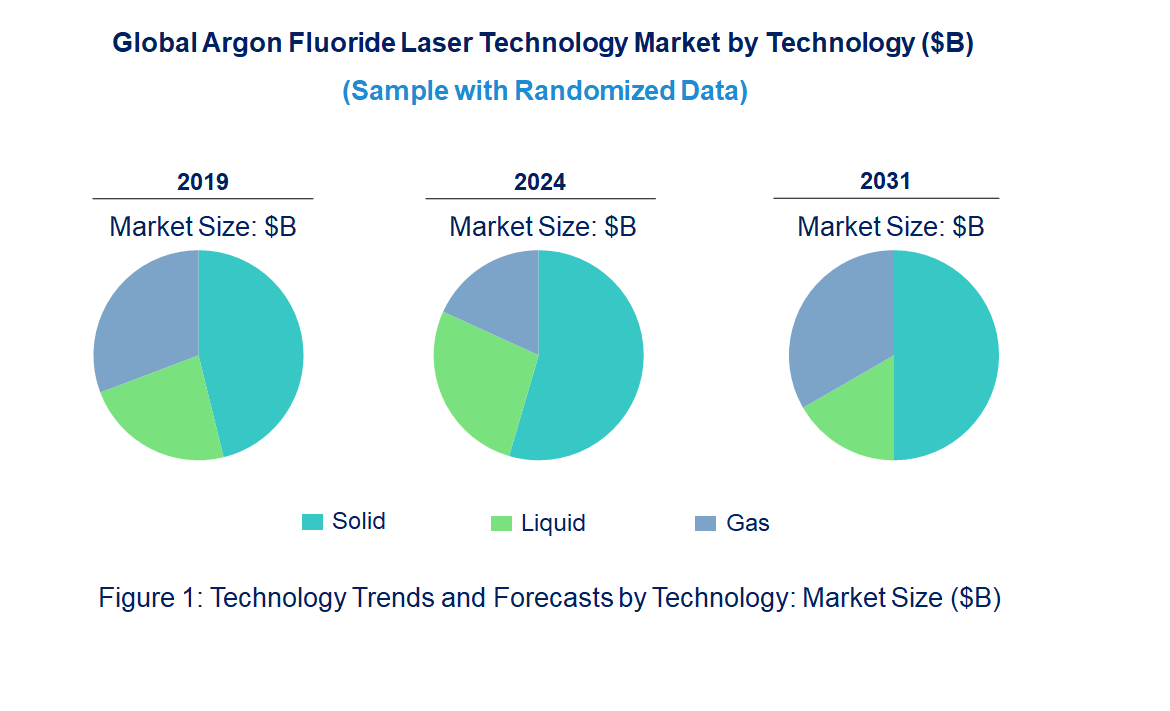
Emerging Trends in the Argon Fluoride Laser Market
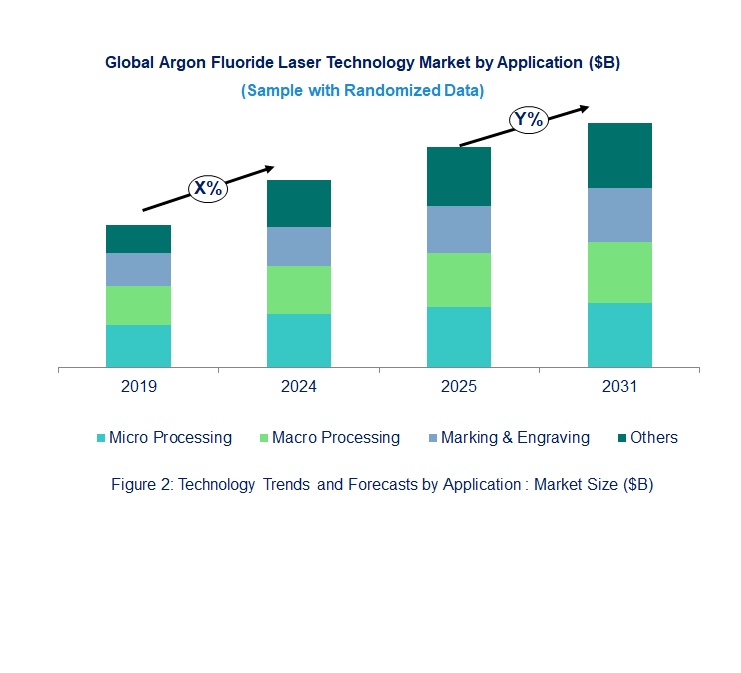
The argon fluoride laser market is witnessing rapid growth with advancements in laser technology and increasing usage. Below are five emerging trends in the market:• Solid-State Lasers for High-Performance Engagement: Solid-state lasers are increasingly becoming the preferred option in the argon fluoride Laser Market due to improved beam quality, reliability, and efficiency over traditional gas lasers. Solid-state lasers are extensively used in micro and macro processing, marking, and engraving applications.
• Miniaturization of Laser Systems. In the case of argon fluoride lasers, miniaturization is an emerging trend, mainly in applications involving small size, portability, and efficiency. Highly efficient laser systems are being designed by industries like electronics and medical device manufacturing to meet their needs while reducing systems' size and weight with no compromise on performance.
• High-Power Laser Systems are adopted: With increasing precision and speed requirements in industrial applications, the trend is inclined toward using high-power argon fluoride lasers. These allow for much faster processing speeds and higher precisions, especially in macro processing operations like cutting, welding, and engraving.
• Higher Use of Laser Systems in 3D Printing: argon fluoride lasers are being integrated progressively into additive manufacturing, also known as 3D printing systems, due to their capability for precise material processing. Their applications in 3D printing are leading to the production of very high-resolution prototypes and complex geometries in such fields as aerospace and automotive.
• Focus on Energy Efficiency and Sustainability: As industries are now shifting toward sustainability, energy-efficient laser systems are in great demand. The transition to more energy-efficient argon fluoride lasers minimizes operating costs and environmental impact, thereby appealing to the automotive and electronics industry, which focuses on green technologies. These new trends solid-state lasers, miniaturization, high-power systems, 3D printing applications, and energy efficiency are changing the argon fluoride laser market by enhancing performance, expanding applications, and improving sustainability. This is going to lead to the mass penetration of argon fluoride lasers in all industries.
Argon Fluoride Laser Market : Industry Potential, Technological Development, and Compliance Considerations
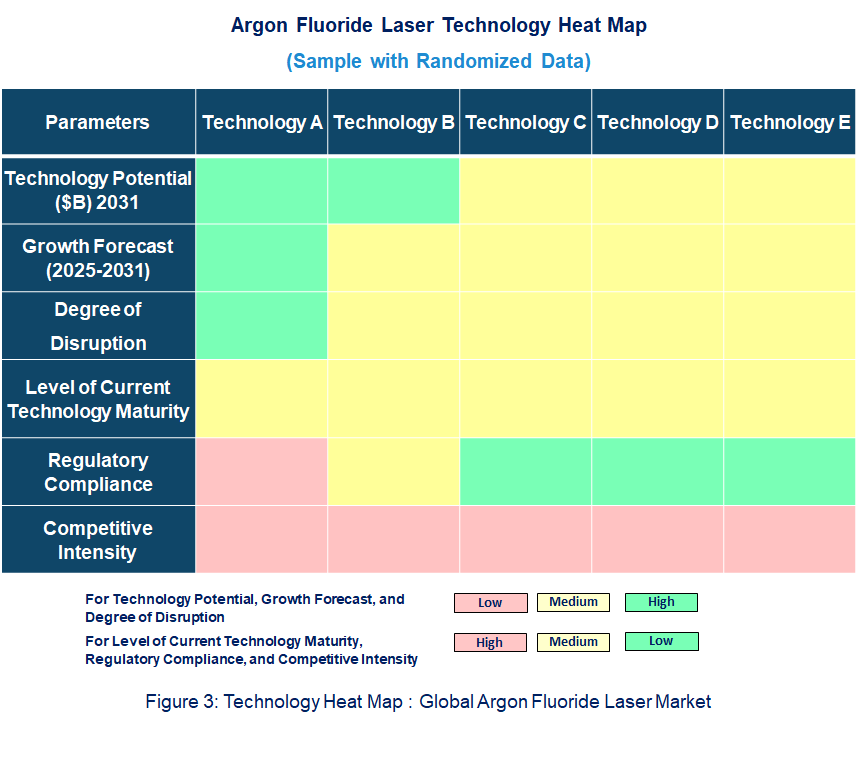
The argon fluoride lasers are a type of excimer laser characterized by the application of high precision in semiconductor manufacturing, photolithography, and scientific research. Advanced fabrication processes require such lasers for the creation of smaller yet more powerful electronic devices.• Technology Potential: The potential of argon fluoride laser technology is vast, particularly in the semiconductor and photolithography industries. As the demand for smaller, more complex microchips increases with advancements in AI, 5G, and IoT, the need for precise lithography tools using argon fluoride lasers is critical. Future developments in laser power, efficiency, and wavelength tuning could further expand its applications in areas like medical imaging, materials processing, and defense systems.
• Level of Disruption: argon fluoride lasers are already very disruptive in semiconductor manufacturing because they would enable chips to be created at smaller feature sizes, down to 7nm or even 3nm nodes. Yet this technology continues to force innovation in photolithography so that older means are simply replaced by newer ones. Their disruption is somewhat limited though to specifically high-precision industry sectors such as electronics and optics
• Level of Current Technology Maturity: argon fluoride lasers are mature in their applications, especially in semiconductor photolithography. Nevertheless, research and development are currently aimed at enhancing laser output power, lifespan, and cost-effectiveness.
• Regulatory Compliance: The high energy and ultraviolet radiation involved make argon fluoride lasers subject to strict safety standards. Furthermore, the application of argon fluoride lasers in semiconductor manufacturing is subject to industry regulations, including those on environmental impact, chemical handling, and radiation safety.
Recent Technological development in Argon Fluoride Laser Market by Key Players
The key players in this market include Coherent, IPG Photonics, Trumpf, Lumentum, Jenoptik, Novanta, Lumibird, Laser Star, and Epilog Laser. These companies are shaping the argon fluoride Laser Market by developing innovative products and solutions to meet the increasing demand for advanced laser technologies. Some of the recent developments from the key players are as follows:• Coherent: For the first time, high-power laser systems for precision applications have been pioneered by Coherent. Their ArF excimer lasers have been the most widely used within microelectronic and semiconductor manufacturing for photolithography to pattern circuits at microscopic levels with unmatched performance.
• IPG Photonics: Solid-state fiber lasers developed by IPG Photonics advance argon fluoride technology in gas lasers, offering a more efficient and compact alternative. Their lasers are used for various applications like micro-machining and marking while delivering high-quality outputs with precision.
• Trumpf: Trumpf has introduced a new series of high-power laser systems that provide improved energy efficiency and higher precision. Such lasers of Diode-Pumped Solid-State (DPSS) are critically meeting the demands in the aerospace, automotive, and medical device sectors, which have accelerated processing with improved accuracy.
• Lumentum: The development of high-precision lasers by Lumentum has done much in the argon fluoride market. Their lasers are broadly used in laser marking and engraving applications, providing excellent performance while consuming minimal energy.
• Jenoptik: Jenoptik has been at the forefront of innovation in laser marking and engraving technologies, producing advanced lasers with sophisticated processing abilities for the most precise handling of materials. Their argon fluoride laser systems are highly demanded in automotive industries to provide high-quality engravings and markings.
• Novanta: Novanta's recent innovations in solid-state laser systems have strengthened its market position in the argon fluoride laser space. Their areas of concentration in high-performance lasers have resulted in developing systems suitable for precision micro-processing applications.
• Lumibird: The group has announced next-generation laser solutions for high-power applications in macro-processing, like welding and cutting. The argon fluoride laser systems are characterized by the ability to provide excellent beam quality while maintaining high outputs.
• Laser Star: Laser Star has advanced the field of customized laser systems for industrial applications, especially in micro-processing and marking. Its argon fluoride lasers are renowned for precision and versatility in working with almost all kinds of materials
• Epilog Laser: Epilog Laser offers energy-efficient laser cutting systems with advanced argon fluoride laser technology for engraving and etching on various materials. Their solutions are especially popular in industries like jewelry manufacturing, signage, and custom fabrications. These new developments reflect the strategic uses of the advances that top players are making from solid-state lasers, high energy efficiency, and high-power systems for serving the increasing demand for precise laser applications and high-performance applications in several markets. The latest innovation expands the argon fluoride Laser Market horizon into semiconductor manufacturing, automotive, and aerospace.
Argon Fluoride Laser Market Driver and Challenges
Factors that drive growth and adoption and challenges to be overcome in the argon fluoride laser market The factors responsible for driving the argon fluoride laser market include:• Increasing Demand for Precision Manufacturing: With high-precision manufacturing on the rise in electronics and automotive, argon fluoride lasers are witnessing an increased adoption rate. They possess superior beam quality and accuracy, making them suitable for micro-processing and intricate engraving.
• Technology Developments of Laser Systems. Progression in laser technology is greatly accelerated through solid-state laser developments and higher power systems that provide fast processing and efficient work processes and versatile application use cases for everything from microelectronic industry applications to aerospace ones.
• Medical and Scientific Applications: argon fluoride lasers are increasingly being used in medical and scientific applications, such as surgery and research. Their ability to provide controlled and precise energy delivery is contributing to their growing use in the medical device industry.
• Increasing Use of Laser Systems in Additive Manufacturing: Addition of argon fluoride lasers into 3D printing devices is driving demand for these systems in the market. Laser-based 3D printing is the development of complex structures that can be of high precision especially in the sectors of aerospace and healthcare industries. Challenges in the argon fluoride laser market are:
• High Initial Investment Costs: High-power and precision argon fluoride laser systems come with a steep initial investment cost, which deters small- and medium-sized enterprises. The capital investment needed for these systems is one of the drawbacks in cost-sensitive markets.
• Complexity of Integration with Existing Systems: The installation of advanced argon fluoride lasers within existing lines and infrastructures is quite technically challenging. Compatibility of new laser systems with legacy equipment could be very problematic, leading to delay and costs.
• Lack of Skilled Operators and Technicians: Operating high-performance laser systems is a complex process that requires skilled labor and training, which may be a challenge for many businesses. The lack of trained technicians and operators may hinder the adoption and efficient use of advanced laser technologies. The argon fluoride laser market is emerging due to the demand for precision manufacturing, technological development, and increased applications. However, challenges such as high initial costs, integration complexities, and the need for skilled operators must be met to fully capitalize on these opportunities in this market.
List of Argon Fluoride Laser Companies
Companies in the market compete based on product quality offered. Major players in this market focus on expanding their manufacturing facilities, R&D investments, infrastructural development, and leverage integration opportunities across the value chain. With these strategies, argon fluoride laser companies cater to increasing demand, ensure competitive effectiveness, develop innovative products & technologies, reduce production costs, and expand their customer base. Some of the argon fluoride laser companies profiled in this report include.• Coherent
• IPG Photonics
• Trumpf
• Lumentum
• Jenoptik
• Novanta
Argon Fluoride Laser Market by Technology
• Different Technologies that Could Potentially Disrupt Argon Fluoride Laser Market: Argon Fluoride (ArF) lasers have areas of technology to disrupt: solids, liquids, and gas. Gas based ArF lasers are extremely efficient at use in semiconductor lithography applications while solid-state has become competitive mainly because of being smaller, low-maintenance devices; liquid based has only just arrived but the output is tunable. Better miniaturized power efficiency and cost performance can unlock improved performance and open new uses for the marketplace.
• Competitive Intensity and Regulatory Compliance of Various Technologies for the Argon Fluoride Laser Market: The ArF laser market is highly competitive in which gas lasers are leading as they have the highest powers and efficiencies for semiconductor applications. Solid-state lasers are gaining the attention for their cost benefits, even though they are less established. A key factor that cuts across all technologies is regulatory compliance, especially in semiconductor manufacturing, where precision and standards of safety are very tight. Laser safety regulations as well as environmental concerns over emissions impact competitiveness, driving companies to balance innovation with compliance.
• Technology Readiness by Type for Argon Fluoride Laser Market: Gas-based ArF lasers are fully mature and widely used, mainly in semiconductor lithography. Solid-state lasers are relatively new and offer compactness and possibly cost savings. Liquid lasers are mostly experimental and are mainly used for research purposes. Gas lasers lead in competitive intensity and usage in high-precision industries. Solid-state lasers also show promise in smaller uses. Regulatory compliance, mainly in safety and emissions, is essential for all technologies. Commercial use of liquid lasers is minimal but may grow with the future development of this technology.
Argon Fluoride Laser Market Trend and Forecast by Technology [Value from 2019 to 2031]:
• Solid
• Liquid
• Gas
Argon Fluoride Laser Market Trend and Forecast by Application [Value from 2019 to 2031]:
• Micro Processing
• Macro Processing
• Marking & Engraving
• Others
Argon Fluoride Laser Market by Region [Value from 2019 to 2031]:
• North America
• Europe
• Asia Pacific
• The Rest of the World
• Latest Developments and Innovations in the Argon Fluoride Laser Technologies
• Companies / Ecosystems
• Strategic Opportunities by Technology Type
Features of the Global Argon Fluoride Laser Market
Market Size Estimates: Argon fluoride laser market size estimation in terms of ($B). Trend and Forecast Analysis: Market trends (2019 to 2024) and forecast (2025 to 2031) by various segments and regions. Segmentation Analysis: Technology trends in the global argon fluoride laser market size by various segments, such as application and technology in terms of value and volume shipments. Regional Analysis: Technology trends in the global argon fluoride laser market breakdown by North America, Europe, Asia Pacific, and the Rest of the World. Growth Opportunities: Analysis of growth opportunities in different applications, technologies, and regions for technology trends in the global argon fluoride laser market. Strategic Analysis: This includes M&A, new product development, and competitive landscape for technology trends in the global argon fluoride laser market. Analysis of competitive intensity of the industry based on Porter’s Five Forces model.Table of Contents
Methodology
- In-depth interviews of the major players in this market
- Detailed secondary research from competitors’ financial statements and published data
- Extensive searches of published works, market, and database information pertaining to industry news, company press releases, and customer intentions
- A compilation of the experiences, judgments, and insights of Lucintel’s professionals, who have analyzed and tracked this market over the years.


Buy Now
Choose a license that fits your team. Instant PDF delivery.
Prices exclude taxes. Instant delivery. Custom licensing available on request.
Key Questions
- • What are some of the most promising potential, high-growth opportunities for the technology trends in the global argon fluoride laser market by technology (solid, liquid, and gas), application (micro processing, macro processing, marking & engraving, and others), and region (North America, Europe, Asia Pacific, and the Rest of the World)?
- • Which technology segments will grow at a faster pace and why?
- • Which regions will grow at a faster pace and why?
- • What are the key factors affecting dynamics of different technology? What are the drivers and challenges of these technologies in the global argon fluoride laser market?
- • What are the business risks and threats to the technology trends in the global argon fluoride laser market?
- • What are the emerging trends in these technologies in the global argon fluoride laser market and the reasons behind them?
- • Which technologies have potential of disruption in this market?
- • What are the new developments in the technology trends in the global argon fluoride laser market? Which companies are leading these developments?
- • Who are the major players in technology trends in the global argon fluoride laser market? What strategic initiatives are being implemented by key players for business growth?
- • What are strategic growth opportunities in this argon fluoride laser technology space?
- • What M & A activities did take place in the last five years in technology trends in the global argon fluoride laser market?


