
Report Feature
Airline Fleet Maintenance Service Market Trends and Forecast
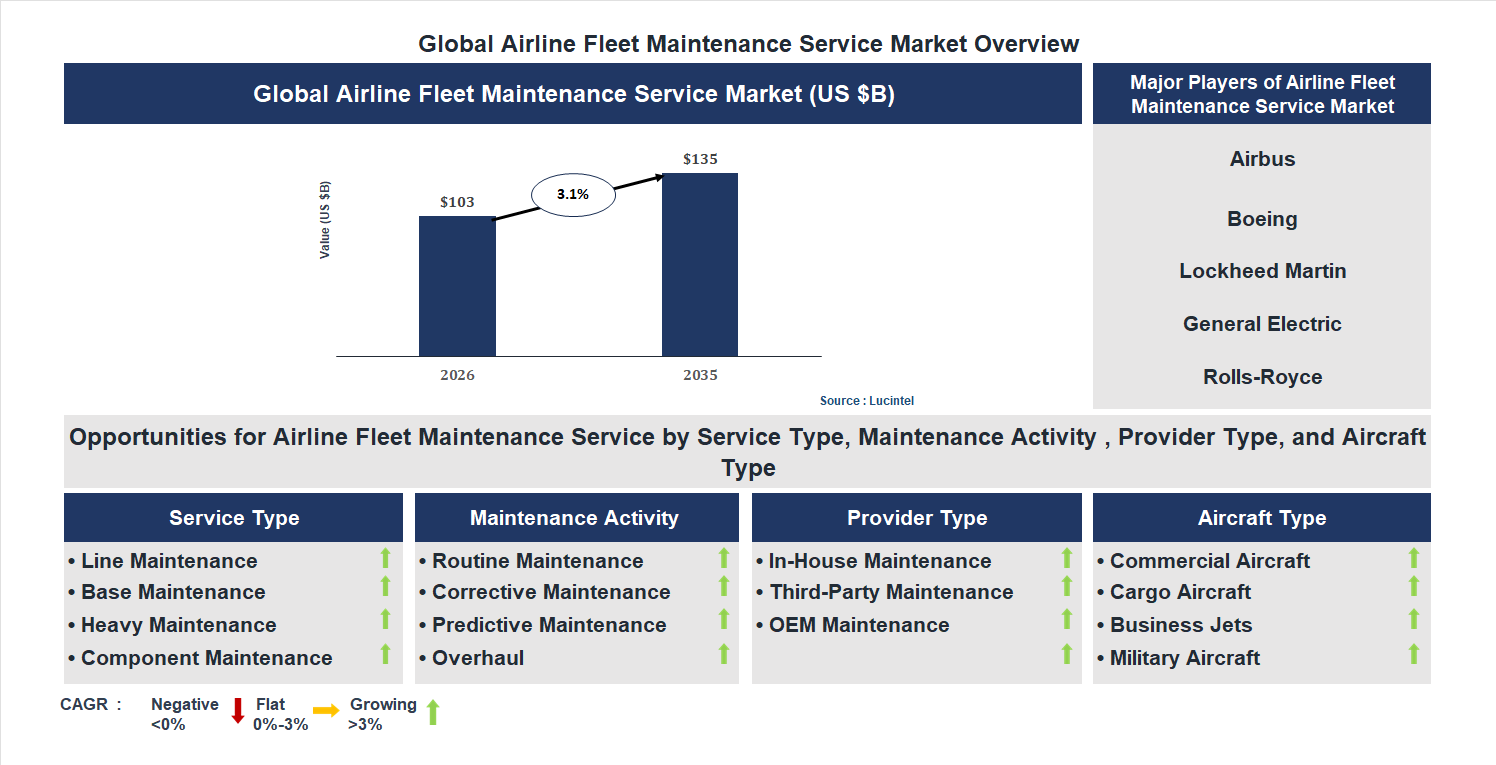
The future of the global airline fleet maintenance service market looks promising with opportunities in the commercial aircraft, cargo aircraft, business jet, and military aircraft markets. The global airline fleet maintenance service market is expected to reach an estimated $135 billion by 2035 with a CAGR of 3.1% from 2026 to 2035. The major drivers for this market are the increasing demand for efficient fleet maintenance services, the rising air passenger traffic driving service needs, and the growing focus on operational cost efficiency standards.• Lucintel forecasts that, within the service type category, line maintenance is expected to witness the highest growth over the forecast period.
• Within the aircraft type category, commercial aircraft is expected to witness the highest growth.
• In terms of region, APAC is expected to witness the highest growth over the forecast period. Gain valuable insights for your business decisions with our comprehensive 150+ page report. Sample figures with some insights are shown below.
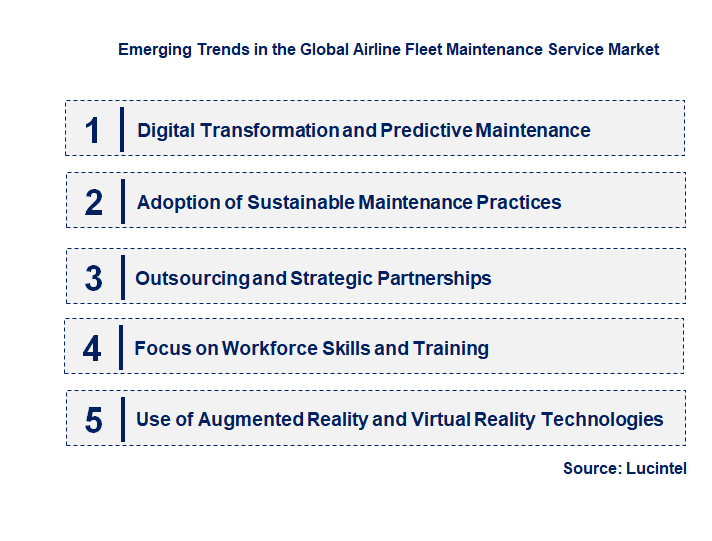
Emerging Trends in the Airline Fleet Maintenance Service Market
The airline fleet maintenance service market is experiencing rapid evolution driven by technological advancements, regulatory changes, and shifting customer expectations. As airlines seek to optimize operational efficiency, reduce costs, and enhance safety, the industry is adopting innovative solutions and sustainable practices. These developments are reshaping how maintenance services are delivered, creating new opportunities and challenges for service providers. The following key trends highlight the major directions in which the market is heading, reflecting a dynamic landscape that demands agility, technological integration, and a focus on sustainability.• Digital Transformation and Predictive Maintenance : The integration of digital technologies such as IoT, AI, and big data analytics is revolutionizing maintenance practices. Predictive maintenance enables airlines to forecast component failures before they occur, reducing downtime and maintenance costs. This shift from reactive to proactive maintenance improves aircraft availability and safety. Digital platforms also facilitate real-time monitoring, streamlined workflows, and enhanced data sharing among stakeholders, leading to more efficient and cost-effective operations.
• Adoption Of Sustainable Maintenance Practices : Environmental concerns and regulatory pressures are pushing airlines toward greener maintenance solutions. This includes the use of eco-friendly materials, waste reduction, and energy-efficient processes. Sustainable practices not only help airlines meet compliance standards but also reduce operational costs and carbon footprints. Innovations such as biodegradable lubricants and recycling of aircraft parts are gaining traction, aligning maintenance strategies with broader sustainability goals and enhancing corporate responsibility.
• Outsourcing And Strategic Partnerships : To optimize costs and access specialized expertise, airlines are increasingly outsourcing maintenance services to third-party providers and forming strategic alliances. This trend allows airlines to benefit from advanced technologies, economies of scale, and flexible service models. Outsourcing also enables airlines to focus on core activities while ensuring high standards of safety and compliance. Strategic partnerships foster innovation, improve service quality, and expand geographic reach, making maintenance more agile and responsive to market demands.
• Focus On Workforce Skills And Training : As maintenance processes become more complex with technological integration, there is a growing emphasis on workforce upskilling. Airlines and service providers are investing in advanced training programs, simulation tools, and certification courses to ensure technicians are proficient in new systems. This focus on skill development enhances safety, reduces errors, and ensures compliance with evolving regulations. A well-trained workforce is critical for implementing innovative maintenance solutions and maintaining high service standards in a competitive market.
• Use Of Augmented Reality (AR) And Virtual Reality (VR) Technologies : AR and VR are transforming maintenance procedures by providing immersive training and real-time assistance during repairs. These technologies improve accuracy, reduce training time, and minimize errors by offering technicians detailed visual guidance. AR and VR also facilitate remote diagnostics and support, enabling experts to assist on-site personnel from distant locations. The adoption of these tools enhances operational efficiency, safety, and technician confidence, ultimately leading to faster turnaround times and improved aircraft reliability. These trends are collectively reshaping the airline fleet maintenance service market by fostering innovation, sustainability, and operational efficiency. Digital and technological advancements are enabling predictive maintenance and immersive training, while strategic outsourcing and workforce development are optimizing resource utilization. Emphasizing sustainability aligns maintenance practices with environmental goals, and the adoption of AR and VR technologies enhances safety and speed. Together, these developments are creating a more resilient, efficient, and environmentally responsible maintenance ecosystem, positioning the market for sustained growth and improved service quality in a highly competitive industry.
Recent Developments in the Airline Fleet Maintenance Service Market
The airline fleet maintenance service market is experiencing rapid growth driven by technological advancements, increasing airline fleets, and heightened safety standards. As airlines seek to optimize operational efficiency and reduce downtime, innovative maintenance solutions are becoming essential. The market is also influenced by regulatory changes and the rising demand for sustainable practices. These developments are creating new opportunities for service providers and reshaping industry dynamics, ultimately enhancing safety, efficiency, and profitability across the aviation sector.• Technological Innovations in Maintenance: Advancements like predictive analytics and IoT are revolutionizing maintenance processes. These technologies enable real-time monitoring of aircraft health, reducing unexpected failures and minimizing downtime. Airlines can now schedule maintenance proactively, leading to cost savings and improved safety. The integration of AI-driven diagnostics enhances accuracy and efficiency, fostering a more reliable fleet management system. This shift toward digital solutions is transforming traditional maintenance practices and creating competitive advantages for early adopters.
• Growing Airline Fleets and Maintenance Demand: The expansion of global airline fleets, especially in emerging markets, is significantly increasing maintenance requirements. As airlines acquire new aircraft, the need for comprehensive maintenance services rises, creating substantial revenue opportunities. This growth supports the development of specialized maintenance facilities and workforce expansion. The increased fleet size also drives demand for spare parts and component servicing, fostering a robust supply chain. Overall, fleet expansion directly correlates with increased maintenance service needs, fueling market growth.
• Regulatory Standards and Safety Compliance: Stricter safety regulations and compliance standards are compelling airlines to invest more in maintenance services. Governments and international bodies enforce rigorous safety protocols, requiring airlines to adopt advanced maintenance practices. This regulatory environment ensures higher safety levels but also increases operational costs for airlines. Service providers offering compliant and certified maintenance solutions are gaining a competitive edge. The focus on safety and compliance is thus a key driver, encouraging innovation and higher quality standards within the market.
• Sustainability and Eco-Friendly Maintenance Practices: The push toward sustainability is influencing maintenance strategies, with a focus on reducing environmental impact. Eco-friendly practices include the use of sustainable materials, waste reduction, and energy-efficient processes. Airlines are increasingly adopting green maintenance solutions to meet environmental regulations and corporate social responsibility goals. This shift not only enhances brand reputation but also reduces long-term costs. The development of sustainable maintenance technologies is opening new market segments and encouraging industry-wide adoption of environmentally responsible practices.
• Rise of Outsourcing and Third-Party Maintenance Services: Airlines are increasingly outsourcing maintenance to specialized third-party providers to reduce costs and improve efficiency. This trend allows airlines to focus on core operations while leveraging expertise and advanced technologies from service providers. Outsourcing also offers flexibility in managing maintenance schedules and access to a broader range of services. The growth of third-party maintenance is fostering competitive pricing and innovation, expanding the market reach of service providers. This shift is fundamentally changing how maintenance services are delivered and managed across the industry. These developments are significantly transforming the airline fleet maintenance service market by enhancing safety, efficiency, and sustainability. Technological innovations, fleet expansion, regulatory compliance, eco-friendly practices, and outsourcing trends are collectively driving growth and competitiveness. As the industry adapts to these changes, market players are poised to benefit from new opportunities, ultimately leading to a more resilient, cost-effective, and environmentally responsible aviation sector.
Strategic Growth Opportunities in the Airline Fleet Maintenance Service Market
The airline fleet maintenance service market is experiencing rapid growth driven by increasing air travel demand, technological advancements, and the need for operational efficiency. Airlines seek cost-effective, reliable, and environmentally sustainable maintenance solutions to ensure safety and compliance. The expansion of low-cost carriers and the rise of regional airlines further fuel market opportunities. Strategic investments in digitalization, predictive maintenance, and skilled workforce development are shaping the future landscape, offering significant potential for industry players to innovate and capture new revenue streams.• Digitalization and Predictive Maintenance: The integration of IoT, AI, and data analytics enables airlines to shift from reactive to predictive maintenance, reducing downtime and operational costs. These technologies facilitate real-time monitoring of aircraft components, early fault detection, and optimized scheduling. As airlines aim for higher efficiency and safety standards, the adoption of digital tools becomes essential. This growth opportunity spans sub-segments like condition-based maintenance and remote diagnostics, transforming traditional maintenance practices.
• Expansion of Maintenance, Repair, and Overhaul (MRO) Facilities: The increasing fleet size and aging aircraft fleet drive demand for expanded MRO infrastructure. Investment in new facilities and modernization of existing ones enhances service capacity and turnaround times. Strategic location of MRO hubs near major airports reduces logistical costs and improves service delivery. This opportunity also includes specialized services such as engine overhaul, avionics upgrades, and component repairs, catering to both commercial and cargo airlines.
• Growing Demand for Sustainable Maintenance Solutions: Environmental regulations and rising fuel costs push airlines to adopt eco-friendly maintenance practices. This includes the use of sustainable materials, waste reduction, and energy-efficient processes. Innovations like green paints, biodegradable lubricants, and eco-friendly cleaning agents are gaining traction. The market for sustainable maintenance solutions is expanding, driven by airline commitments to carbon neutrality and regulatory compliance, creating opportunities for service providers to develop and offer environmentally responsible offerings.
• Increasing Adoption of Digital Twins and Simulation Technologies: Digital twin technology allows for virtual replication of aircraft systems, enabling detailed analysis and testing without physical intervention. This reduces maintenance time and costs while improving accuracy. Simulation tools assist in training technicians and optimizing maintenance procedures. As airlines seek to enhance safety and operational efficiency, the deployment of digital twins and simulation-based maintenance is expected to grow, especially in complex aircraft systems like engines and avionics.
• Rising Demand for Skilled Maintenance Workforce and Training Services: The complexity of modern aircraft necessitates highly skilled technicians and engineers. The market for specialized training programs, certification courses, and e-learning modules is expanding to meet this need. Investment in workforce development ensures compliance with safety standards and reduces errors. Collaborations between OEMs and training providers, along with virtual training platforms, are creating new opportunities to address the skills gap and support industry growth. These strategic growth opportunities are poised to significantly influence the airline fleet maintenance service market by fostering innovation, enhancing efficiency, and supporting sustainable practices. As airlines and service providers adapt to evolving technological and regulatory landscapes, the market is expected to experience robust expansion, offering lucrative prospects for industry stakeholders.
Airline Fleet Maintenance Service Market Driver and Challenges
The airline fleet maintenance service market is influenced by a complex interplay of technological advancements, economic conditions, and regulatory frameworks. As airlines seek to optimize operational efficiency and ensure safety, they increasingly rely on innovative maintenance solutions. Rapid technological developments such as predictive analytics and automation are transforming maintenance practices. Economic factors like fluctuating fuel prices and global travel demand impact investment levels and service offerings. Additionally, regulatory standards for safety and environmental compliance shape operational protocols. Navigating these dynamic drivers and overcoming associated challenges is crucial for market growth and sustainability in a highly competitive industry. The factors responsible for driving the airline fleet maintenance service market include:-• Technological Innovation: The integration of advanced technologies such as IoT, AI, and predictive analytics enhances maintenance efficiency, reduces downtime, and improves safety. Airlines are investing in digital solutions to monitor aircraft health in real-time, enabling proactive maintenance. This shift minimizes unexpected failures and extends aircraft lifespan, ultimately lowering operational costs. As technology continues to evolve, maintenance providers that adopt these innovations gain a competitive edge, fostering market growth.
• Rising Fleet Size and Age: The global expansion of airline fleets, coupled with aging aircraft, drives demand for comprehensive maintenance services. Older aircraft require more frequent inspections and repairs to meet safety standards, creating a steady revenue stream for maintenance providers. The increasing number of aircraft in operation worldwide necessitates scalable maintenance solutions, encouraging service providers to expand capabilities and infrastructure.
• Regulatory Compliance and Safety Standards: Stringent safety regulations and environmental standards compel airlines to adhere to rigorous maintenance protocols. Compliance with international aviation authorities such as FAA and EASA ensures safety and operational legitimacy. These regulations often mandate regular inspections, certifications, and upgrades, which sustain demand for specialized maintenance services. Meeting these standards is vital for market players to avoid penalties and maintain airline trust.
• Economic Growth and Travel Demand: Growing global economies and rising disposable incomes boost air travel, leading to increased aircraft utilization and maintenance needs. As passenger numbers surge, airlines expand their fleets and upgrade existing ones, fueling demand for maintenance services. Economic stability also enables airlines to invest in newer, more efficient aircraft, which require advanced maintenance solutions, further propelling the market.
• Cost Optimization and Outsourcing Trends: Airlines are increasingly outsourcing maintenance to specialized service providers to reduce costs and improve efficiency. Outsourcing allows airlines to focus on core operations while leveraging the expertise of dedicated maintenance firms. This trend encourages the development of third-party maintenance facilities and global service networks, expanding market reach and service offerings. The challenges facing the airline fleet maintenance service market include:-
• High Maintenance Costs: The complexity of modern aircraft and the need for specialized skills result in significant maintenance expenses. Rising costs of spare parts, labor, and compliance with evolving regulations strain airline budgets. Managing these costs without compromising safety or operational efficiency remains a key challenge for service providers and airlines alike.
• Rapid Technological Changes: While technological advancements drive growth, they also pose challenges in terms of integration and workforce training. Keeping up with new systems, software, and diagnostic tools requires substantial investment and continuous training. Failure to adapt quickly can lead to obsolescence and reduced competitiveness in the market.
• Regulatory and Environmental Pressures: Increasing regulatory requirements for safety, emissions, and noise standards impose additional operational constraints. Compliance often involves costly upgrades and modifications, which can delay maintenance schedules and increase expenses. Navigating these evolving regulations demands agility and significant resource allocation from market players. The airline fleet maintenance service market is shaped by technological progress, fleet expansion, regulatory demands, and economic factors that collectively foster growth. However, high costs, rapid technological changes, and stringent regulations pose substantial challenges. The market’s future depends on how effectively industry players innovate, adapt, and manage these drivers and hurdles. Successful navigation will determine the pace of growth and the ability to meet evolving airline and passenger expectations in a competitive landscape.
List of Airline Fleet Maintenance Service Companies
Companies in the market compete on the basis of product quality offered. Major players in this market focus on expanding their manufacturing facilities, R&D investments, infrastructural development, and leverage integration opportunities across the value chain. With these strategies airline fleet maintenance service companies cater increasing demand, ensure competitive effectiveness, develop innovative products & technologies, reduce production costs, and expand their customer base. Some of the airline fleet maintenance service companies profiled in this report include-• Airbus
• Boeing
• Lockheed Martin
• General Electric
• Rolls-Royce
• Honeywell
• MTU Aero Engines
• Safran
• Air France Industries KLM Engineering & Maintenance
• Lufthansa Technik
Airline Fleet Maintenance Service Market by Segment
The study includes a forecast for the global airline fleet maintenance service market by service type, maintenance activity, provider type, aircraft type, and region.Airline Fleet Maintenance Service Market by Service Type [Value from 2019 to 2035]:
• Line Maintenance
• Base Maintenance
• Heavy Maintenance
• Component Maintenance
Airline Fleet Maintenance Service Market by Maintenance Activity [Value from 2019 to 2035]:
• Routine Maintenance
• Corrective Maintenance
• Predictive Maintenance
• Overhaul
Airline Fleet Maintenance Service Market by Provider Type [Value from 2019 to 2035]:
• In-House Maintenance
• Third-Party Maintenance
• OEM Maintenance
Airline Fleet Maintenance Service Market by Aircraft Type [Value from 2019 to 2035]:
• Commercial Aircraft
• Cargo Aircraft
• Business Jets
• Military Aircraft
Airline Fleet Maintenance Service Market by Region [Value from 2019 to 2035]:
• North America
• Europe
• Asia Pacific
• The Rest of the World
Country Wise Outlook for the Airline Fleet Maintenance Service Market
The airline fleet maintenance service market is experiencing rapid growth driven by increasing air travel demand, technological advancements, and the need for enhanced safety and efficiency. As airlines seek to reduce downtime and operational costs, innovative maintenance solutions and digital tools are becoming essential. Regulatory standards are also evolving, prompting airlines worldwide to upgrade their maintenance practices. The markets expansion is particularly notable in major economies, where airline fleets are expanding and modernizing. This dynamic environment fosters competition among service providers and encourages technological innovation, shaping the future landscape of airline fleet maintenance globally.• United States: The US market is witnessing significant technological integration, including predictive maintenance using AI and IoT sensors, which improve efficiency and reduce costs. Major airlines are investing in digital platforms for real-time fleet monitoring, and regulatory agencies are emphasizing safety standards, prompting upgrades in maintenance protocols. The growth of low-cost carriers is also driving demand for streamlined maintenance services. Additionally, partnerships between airlines and maintenance providers are increasing to optimize fleet management and reduce downtime.
• China: China’s airline fleet is expanding rapidly, with a focus on modernizing and increasing capacity. The government is supporting the development of domestic maintenance facilities to reduce reliance on foreign providers. Innovations such as automated inspection systems and digital maintenance records are gaining traction. The market is also seeing increased investment from local companies aiming to compete globally, with a focus on cost-effective and scalable maintenance solutions. The rapid growth of budget airlines is further fueling demand for efficient maintenance services.
• Germany: Germany’s market is characterized by high standards of safety and technological innovation. The adoption of advanced diagnostic tools and predictive analytics is prominent among major carriers. The country’s strong aerospace industry supports the development of sophisticated maintenance solutions, including environmentally sustainable practices. Regulatory compliance remains stringent, encouraging continuous upgrades in maintenance procedures. German maintenance providers are also expanding their global footprint, offering specialized services to international clients, and integrating digital solutions to enhance operational efficiency.
• India: India’s airline industry is experiencing exponential growth, leading to increased demand for fleet maintenance services. The focus is on expanding maintenance infrastructure and adopting cost-effective, scalable solutions. Digitalization, including the use of AI and data analytics, is gradually being integrated into maintenance practices. The government’s initiatives to promote regional connectivity are also boosting the market. Local service providers are expanding capabilities to meet rising demand, and partnerships with international firms are becoming more common to improve service quality and technology adoption.
• Japan: Japan’s airline fleet maintenance market emphasizes safety, reliability, and technological innovation. The adoption of robotics and automation in inspection and repair processes is increasing. The country’s aerospace industry supports advanced maintenance solutions, including environmentally friendly practices. Regulatory standards are strict, ensuring high-quality maintenance services. Japanese providers are investing in digital tools for predictive maintenance and fleet management. The market is also characterized by collaborations with global aerospace firms, focusing on innovation and sustainability to maintain competitiveness in the evolving industry landscape.

Features of the Global Airline Fleet Maintenance Service Market
Market Size Estimates: Airline fleet maintenance service market size estimation in terms of value ($B). Trend and Forecast Analysis: Market trends (2019 to 2025) and forecast (2026 to 2035) by various segments and regions. Segmentation Analysis: Airline fleet maintenance service market size by various segments, such as by service type, maintenance activity, provider type, aircraft type, and region in terms of value ($B). Regional Analysis: Airline fleet maintenance service market breakdown by North America, Europe, Asia Pacific, and Rest of the World. Growth Opportunities: Analysis of growth opportunities in different service types, maintenance activity, provider types, aircraft types, and regions for the airline fleet maintenance service market. Strategic Analysis: This includes M&A, new product development, and competitive landscape of the airline fleet maintenance service market. Analysis of competitive intensity of the industry based on Porter’s Five Forces model.
FAQ
Q1. What is the airline fleet maintenance service market size? Answer: The global airline fleet maintenance service market is expected to reach an estimated $135 billion by 2035. Q2. What is the growth forecast for airline fleet maintenance service market? Answer: The global airline fleet maintenance service market is expected to grow with a CAGR of 3.1% from 2026 to 2035. Q3. What are the major drivers influencing the growth of the airline fleet maintenance service market? Answer: The major drivers for this market are the increasing demand for efficient fleet maintenance services, the rising air passenger traffic driving service needs, and the growing focus on operational cost efficiency standards. Q4. What are the major segments for airline fleet maintenance service market? Answer: The future of the airline fleet maintenance service market looks promising with opportunities in the commercial aircraft, cargo aircraft, business jet, and military aircraft markets. Q5. Who are the key airline fleet maintenance service market companies? Answer: Some of the key airline fleet maintenance service companies are as follows:• Airbus
• Boeing
• Lockheed Martin
• General Electric
• Rolls-Royce
• Honeywell
• MTU Aero Engines
• Safran
• Air France Industries KLM Engineering & Maintenance
• Lufthansa Technik Q6. Which airline fleet maintenance service market segment will be the largest in future? Answer: Lucintel forecasts that, within the service type category, line maintenance is expected to witness the highest growth over the forecast period. Q7. In airline fleet maintenance service market, which region is expected to be the largest in next 8 years? Answer: In terms of region, APAC is expected to witness the highest growth over the forecast period. Q8. Do we receive customization in this report? Answer: Yes, Lucintel provides 10% customization without any additional cost.
Table of Contents
List of Figures
List of Tables
Methodology
- In-depth interviews of the major players in this market
- Detailed secondary research from competitors’ financial statements and published data
- Extensive searches of published works, market, and database information pertaining to industry news, company press releases, and customer intentions
- A compilation of the experiences, judgments, and insights of Lucintel’s professionals, who have analyzed and tracked this market over the years.


Buy Now
Choose a license that fits your team. Instant PDF delivery.
Prices exclude taxes. Instant delivery. Custom licensing available on request.
Key Questions
- • What are some of the most promising, high-growth opportunities for the airline fleet maintenance service market by service type (line maintenance, base maintenance, heavy maintenance, and component maintenance), maintenance activity (routine maintenance, corrective maintenance, predictive maintenance, and overhaul), provider type (in-house maintenance, third-party maintenance, and OEM maintenance), aircraft type (commercial aircraft, cargo aircraft, business jets, and military aircraft), and region (North America, Europe, Asia Pacific, and the Rest of the World)?
- • Which segments will grow at a faster pace and why?
- • Which region will grow at a faster pace and why?
- • What are the key factors affecting market dynamics? What are the key challenges and business risks in this market?
- • What are the business risks and competitive threats in this market?
- • What are the emerging trends in this market and the reasons behind them?
- • What are some of the changing demands of customers in the market?
- • What are the new developments in the market? Which companies are leading these developments?
- • Who are the major players in this market? What strategic initiatives are key players pursuing for business growth?
- • What are some of the competing products in this market and how big of a threat do they pose for loss of market share by material or product substitution?
- • What M&A activity has occurred in the last 5 years and what has its impact been on the industry? For any questions related to Airline Fleet Maintenance Service Market, Airline Fleet Maintenance Service Market Size, Airline Fleet Maintenance Service Market Growth, Airline Fleet Maintenance Service Market Analysis, Airline Fleet Maintenance Service Market Report, Airline Fleet Maintenance Service Market Share, Airline Fleet Maintenance Service Market Trends, Airline Fleet Maintenance Service Market Forecast, Airline Fleet Maintenance Service Companies, write Lucintel analyst at email: helpdesk@lucintel.com. We will be glad to get back to you soon.


