
Report Feature
Air Traffic Flow Management Software Market Trends and Forecast
The future of the global air traffic flow management software market looks promising with opportunities in the air navigation service provider, commercial airline, ground handling service, and military markets. The global air traffic flow management software market is expected to reach an estimated $15 billion by 2035 with a CAGR of 11.1% from 2026 to 2035. The major drivers for this market are the increasing demand for efficient air traffic management solutions, the rising adoption of digitalization in aviation operations, and the growing need for optimized airspace utilization systems.• Lucintel forecasts that, within the solution category, collaborative decision making is expected to witness the highest growth over the forecast period.
• Within the end use category, commercial airline is expected to witness the highest growth.
• In terms of region, North America is expected to witness the highest growth over the forecast period. Gain valuable insights for your business decisions with our comprehensive 150+ page report. Sample figures with some insights are shown below.
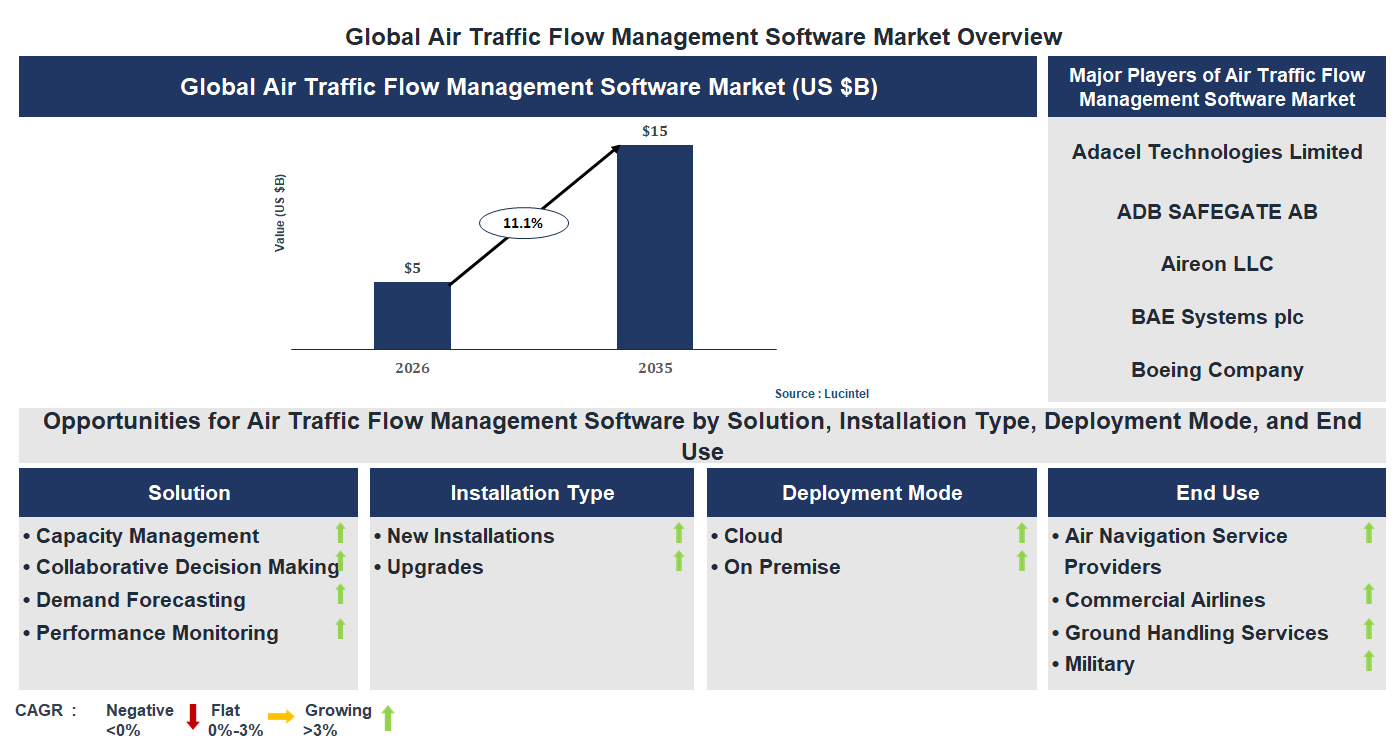
Emerging Trends in the Air Traffic Flow Management Software Market
Air traffic flow management software market is evolving rapidly due to rising air traffic, increasing complexity of airspace, and growing demand for efficient and sustainable aviation operations. Aviation authorities and stakeholders are focusing on digital transformation to enhance operational performance and reduce delays. The integration of intelligent systems, real time data processing, and collaborative frameworks is redefining traditional air traffic management approaches. These developments are enabling better coordination, improved safety, and optimized airspace utilization. As global aviation continues to expand, emerging trends are playing a critical role in shaping the future of air traffic flow management systems.• Artificial Intelligence Integration: Artificial intelligence is transforming air traffic flow management by enabling predictive analytics and automated decision making. Advanced algorithms analyze large volumes of data to forecast traffic demand, identify potential congestion, and optimize flight routes. This improves operational efficiency and reduces delays. The use of machine learning models enhances system adaptability by learning from historical and real time data. As a result, air traffic controllers can make more informed decisions, leading to improved airspace utilization, reduced workload, and enhanced safety across increasingly complex aviation environments.
• Cloud Based Deployment: Cloud based deployment is becoming a key trend as it offers scalability, flexibility, and cost efficiency. Aviation stakeholders are adopting cloud platforms to enable seamless data sharing and real time collaboration across airports and control centers. This approach reduces dependency on traditional infrastructure and allows remote access to critical information. Cloud solutions also support faster system updates and integration with other digital tools. As a result, organizations can improve operational efficiency, enhance coordination, and respond quickly to changing air traffic conditions, making cloud adoption a significant driver of market transformation.
• Real Time Data Analytics: Real time data analytics is playing a crucial role in enhancing situational awareness and decision making. Access to accurate and timely information allows air traffic controllers to monitor traffic conditions, anticipate disruptions, and implement corrective actions promptly. This leads to improved coordination and reduced delays. The ability to process and analyze data from multiple sources ensures better visibility across the airspace. As aviation systems become more data driven, real time analytics is helping to optimize operations, improve efficiency, and support proactive traffic management strategies.
• Sustainability Focus: Sustainability is becoming a major priority in air traffic management, driving the adoption of solutions that reduce environmental impact. Air traffic flow management software is being used to optimize flight paths, minimize fuel consumption, and lower emissions. Efficient airspace utilization contributes to reduced carbon footprint and supports global environmental goals. Aviation authorities are increasingly focusing on green operations and regulatory compliance. This trend is encouraging the development of environmentally responsible systems, helping the industry balance growth with sustainability while improving overall operational efficiency.
• Collaborative Decision Making: Collaborative decision making is gaining importance as it enhances coordination among airlines, airports, and air navigation service providers. Integrated systems enable seamless information sharing, allowing stakeholders to work together in managing air traffic efficiently. This improves planning, reduces uncertainty, and enhances response to disruptions. By fostering cooperation and transparency, collaborative frameworks help optimize resource utilization and improve overall system performance. This trend is creating a more connected aviation ecosystem, ensuring smoother operations and better handling of increasing air traffic demand. These trends are reshaping the air traffic flow management software market by improving efficiency, enhancing safety, and supporting sustainable aviation growth. The increasing adoption of intelligent systems, cloud platforms, and collaborative frameworks is enabling more effective management of complex airspace. As a result, the market is moving toward more integrated, data driven, and environmentally responsible solutions that can meet the evolving demands of global aviation.

Recent Developments in the Air Traffic Flow Management Software Market
Air traffic flow management software market is experiencing rapid transformation driven by increasing air traffic, modernization of aviation infrastructure, and the need for efficient airspace utilization. Aviation authorities are adopting advanced digital systems to enhance coordination, reduce delays, and improve safety. Integration of intelligent tools and real time analytics is strengthening operational capabilities. These developments are supporting the transition toward more scalable and data driven systems, enabling better management of complex airspace environments and meeting the growing demands of global aviation.• Artificial Intelligence Driven Systems Are Enhancing Predictive Traffic Management: Artificial intelligence driven systems are enabling more accurate prediction of air traffic patterns and congestion points. These solutions analyze historical and real time data to optimize routing and improve decision making. Enhanced predictive capabilities reduce delays and improve operational efficiency. Aviation authorities are leveraging machine learning models to support adaptive and dynamic traffic management. This development is strengthening system responsiveness and enabling better utilization of airspace, ensuring smoother operations and improved safety across increasingly complex aviation environments.
• Cloud Based Platforms Are Enabling Seamless Data Integration Across Stakeholders: Cloud based platforms are facilitating real time data sharing and collaboration among airlines, airports, and control centers. These systems provide scalability and flexibility, reducing dependency on traditional infrastructure. Improved accessibility to data enhances coordination and decision making across multiple locations. Cloud adoption also supports faster system updates and integration with other digital tools. This development is accelerating digital transformation and enabling more efficient management of air traffic operations in a cost effective and scalable manner.
• Advanced Analytics Tools Are Improving Operational Visibility and Efficiency: Advanced analytics tools are providing deeper insights into traffic patterns and system performance. These tools enable faster identification of disruptions and support proactive decision making. Improved situational awareness allows aviation stakeholders to optimize operations and reduce delays. The ability to process large volumes of data enhances efficiency and coordination. This development is driving the adoption of data driven strategies, helping organizations improve performance and maintain high levels of operational reliability in complex airspace conditions.
• Automation Technologies Are Reducing Manual Intervention In Traffic Control: Automation technologies are streamlining air traffic control processes by handling routine tasks such as conflict detection and route planning. This reduces the workload on controllers and minimizes the risk of human error. Automated systems enable faster response to dynamic traffic conditions and improve overall system reliability. Increased efficiency and consistency support better management of growing air traffic volumes. This development is enhancing safety and enabling aviation authorities to operate more effectively in high demand environments.
• Expansion of Digital Infrastructure is Supporting Scalable Airspace Management Systems: Expansion of digital infrastructure is enabling the deployment of advanced air traffic management systems capable of handling increasing traffic volumes. Investments in modern software solutions are improving coordination and optimizing airspace utilization. These systems provide greater flexibility and resilience in operations. Enhanced infrastructure supports integration of new technologies and improves system performance. This development is helping aviation authorities address capacity challenges and ensure efficient management of complex and expanding airspace networks. Air traffic flow management software market developments are significantly improving efficiency, safety, and scalability across aviation systems. The adoption of advanced technologies such as artificial intelligence, cloud platforms, analytics, and automation is enabling more effective traffic management. These developments are reducing delays, enhancing coordination, and supporting sustainable operations. As a result, the market is evolving toward more integrated and data driven solutions, ensuring improved performance and resilience in managing complex and high volume air traffic environments.
Strategic Growth Opportunities in the Air Traffic Flow Management Software Market
Air traffic flow management software market is expanding steadily due to rising air traffic, increasing need for efficient airspace utilization, and growing investments in aviation infrastructure. Market participants are focusing on advanced digital solutions to improve coordination, reduce delays, and enhance safety. The demand for intelligent and scalable systems is creating strong growth opportunities across multiple applications. These opportunities are enabling aviation stakeholders to optimize operations, improve resource utilization, and support sustainable growth in increasingly complex airspace environments.• Airport Operations Optimization is Driving Demand for Advanced Flow Management Solutions: Airport operations represent a major growth opportunity as increasing passenger volumes require efficient management of runways, gates, and ground movements. Advanced software solutions help optimize scheduling and reduce congestion, improving overall airport efficiency. These systems enhance coordination between different airport functions and minimize delays. Integration of real time data enables better decision making and smoother operations. As airports expand capacity, demand for intelligent flow management solutions is expected to increase significantly across global aviation markets.
• En Route Airspace Management is Enabling Efficient Flight Path Optimization: En route airspace management offers significant growth potential as airlines seek to optimize flight paths and reduce fuel consumption. Advanced flow management systems enable dynamic routing and better utilization of available airspace. This improves operational efficiency and reduces environmental impact. Real time monitoring and predictive analytics support proactive decision making and minimize disruptions. As air traffic volumes continue to rise, efficient en route management is becoming essential for maintaining smooth and cost effective flight operations across regions.
• Ground Operations Coordination is Improving Turnaround Efficiency at Airports: Ground operations coordination is emerging as a key application area, focusing on improving aircraft turnaround time and resource allocation. Advanced software solutions enable seamless coordination of fueling, baggage handling, and maintenance activities. This reduces delays and enhances operational efficiency. Real time data sharing ensures better communication among stakeholders and supports timely decision making. As airlines aim to improve on time performance, demand for efficient ground operations management systems is expected to grow steadily.
• Military Air Traffic Management is Enhancing Operational Readiness and Safety: Military aviation is creating growth opportunities as defense organizations adopt advanced flow management systems to improve coordination and situational awareness. These solutions enable efficient management of both routine and mission critical operations. Enhanced data integration supports better communication and decision making in complex environments. The ability to manage mixed airspace operations improves safety and operational readiness. Increasing defense investments and modernization programs are expected to drive adoption of advanced systems in military aviation applications.
• Unmanned Aerial Vehicle Traffic Integration is Creating New Market Opportunities: The integration of unmanned aerial vehicles into controlled airspace is generating new growth opportunities for flow management software. Increasing use of drones for commercial and industrial applications requires efficient traffic coordination systems. Advanced software solutions enable safe integration of unmanned and manned aircraft operations. Real time monitoring and automated control systems enhance safety and reduce risks. As drone adoption increases, demand for specialized traffic management solutions is expected to expand rapidly. Air traffic flow management software market growth opportunities across key applications are significantly enhancing operational efficiency and expanding market potential. The increasing adoption of advanced solutions in airport operations, en route management, ground handling, military aviation, and unmanned systems is driving demand for intelligent and scalable technologies. These opportunities are enabling better coordination, reduced delays, and improved safety. As aviation continues to evolve, these application driven advancements are expected to support sustained growth and innovation in the global market.
Air Traffic Flow Management Software Market Driver and Challenges
Air traffic flow management software market is influenced by a combination of technological, economic, and regulatory factors that shape its growth trajectory. Increasing air traffic volumes, advancements in digital technologies, and the need for efficient airspace utilization are driving adoption of advanced solutions. at the same time, regulatory complexities, high implementation costs, and cybersecurity concerns present challenges to market expansion. Aviation authorities and stakeholders are focusing on balancing innovation with compliance and cost efficiency. These dynamics are creating both opportunities and constraints, making it essential to understand the key drivers and challenges impacting the market. The factors responsible for driving the Air Traffic Flow Management Software Market include:-• Increasing Air Traffic Volumes Are Driving Demand For Efficient Flow Management Solutions: The continuous rise in global air passenger and cargo traffic is significantly increasing the pressure on existing airspace infrastructure. This growth is creating a strong need for advanced air traffic flow management software that can optimize traffic movement and reduce congestion. Efficient management of high traffic volumes helps minimize delays and improve operational reliability. Aviation authorities are increasingly adopting intelligent systems to manage peak demand and ensure seamless coordination. This driver is accelerating investments in modern solutions that enhance capacity utilization and improve overall system performance.
• Adoption of Advanced Digital Technologies is Enhancing Operational Efficiency: The integration of technologies such as artificial intelligence, machine learning, and real time data analytics is transforming air traffic management systems. These technologies enable predictive decision making, improve situational awareness, and enhance system responsiveness. Aviation stakeholders are leveraging digital tools to optimize flight routing, reduce delays, and improve safety. The ability to process large volumes of data in real time is supporting more accurate and efficient traffic management. This driver is encouraging continuous innovation and strengthening the capabilities of air traffic flow management software across global markets.
• Growing Focus On Sustainability is Encouraging Efficient Airspace Utilization: Environmental concerns and regulatory pressure to reduce carbon emissions are driving the adoption of solutions that optimize flight operations. Air traffic flow management software helps in reducing fuel consumption by enabling efficient routing and minimizing unnecessary delays. This contributes to lower emissions and supports sustainable aviation goals. Aviation authorities are increasingly prioritizing environmentally responsible operations, which is encouraging investment in advanced systems. This driver is aligning market growth with global sustainability initiatives and promoting the development of greener air traffic management solutions.
• Government Investments In Aviation Infrastructure Modernization Are Supporting Market Growth: Governments across major economies are investing heavily in upgrading aviation infrastructure to handle increasing air traffic demand. These investments include the deployment of advanced air traffic management systems and digital platforms. Modernization initiatives are improving coordination, enhancing safety, and increasing system capacity. Supportive policies and funding are accelerating the adoption of innovative solutions. This driver is creating favorable conditions for market expansion by enabling the implementation of advanced technologies and improving the efficiency of airspace management systems. The challenges in the Air Traffic Flow Management Software Market are:
• High Implementation and Maintenance Costs are Limiting Adoption: The deployment of advanced air traffic flow management software requires significant capital investment in infrastructure, hardware, and system integration. Ongoing maintenance and upgrade costs further increase the financial burden on aviation authorities and service providers. Smaller airports and developing regions often face budget constraints, which can delay or limit adoption. High costs also create barriers to entry for new market participants. This challenge is impacting the pace of market expansion and necessitating the development of cost effective solutions to improve accessibility.
• Regulatory Complexity and Lack of Standardization Are Hindering Integration: The air traffic management sector is governed by strict regulations that vary across regions, making system implementation complex. Differences in standards and protocols create challenges in integrating solutions across international airspaces. This lack of uniformity affects interoperability and limits seamless data exchange between stakeholders. Compliance with multiple regulatory frameworks increases operational complexity and costs. This challenge is slowing down the adoption of advanced systems and highlighting the need for global standardization to support efficient air traffic management.
• Cybersecurity Risks Are Raising Concerns Over System Reliability: Increasing reliance on digital and connected systems is exposing air traffic management infrastructure to potential cyber threats. Unauthorized access, data breaches, and system disruptions can have serious implications for safety and operations. Aviation authorities must invest in robust cybersecurity measures to protect sensitive information and ensure system integrity. Addressing these risks requires continuous monitoring and updates, which add to operational costs. This challenge is influencing technology adoption and emphasizing the importance of secure and resilient system design. The air traffic flow management software market is experiencing steady growth driven by increasing air traffic, technological advancements, sustainability goals, and government investments in modernization. These drivers are encouraging the adoption of intelligent and efficient solutions that enhance operational performance and safety. However, challenges such as high costs, regulatory complexities, and cybersecurity risks continue to impact market development. Balancing these factors is essential for sustained growth. Overall, the market is moving toward more integrated, secure, and scalable systems that can effectively address evolving aviation demands.
List of Air Traffic Flow Management Software Companies
Companies in the market compete on the basis of product quality offered. Major players in this market focus on expanding their manufacturing facilities, R&D investments, infrastructural development, and leverage integration opportunities across the value chain. With these strategies air traffic flow management software companies cater increasing demand, ensure competitive effectiveness, develop innovative products & technologies, reduce production costs, and expand their customer base. Some of the air traffic flow management software companies profiled in this report include-• Adacel Technologies Limited
• ADB SAFEGATE AB
• Aireon LLC
• BAE Systems plc
• Boeing Company
• CAS
• Collins Aerospace
• COMSOFT Solutions GmbH
• DFS Deutsche Flugsicherung GmbH
• ENAV S.p.A.
Air Traffic Flow Management Software Market by Segment
The study includes a forecast for the global air traffic flow management software market by solution, installation type, deployment mode, end use, and region.Air Traffic Flow Management Software Market by Solution [Value from 2019 to 2035]:
• Capacity Management
• Collaborative Decision Making
• Demand Forecasting
• Performance Monitoring
Air Traffic Flow Management Software Market by Installation Type [Value from 2019 to 2035]:
• New Installations
• Upgrades
Air Traffic Flow Management Software Market by Deployment Mode [Value from 2019 to 2035]:
• Cloud
• On Premise
Air Traffic Flow Management Software Market by End Use [Value from 2019 to 2035]:
• Air Navigation Service Providers
• Commercial Airlines
• Ground Handling Services
• Military
Air Traffic Flow Management Software Market by Region [Value from 2019 to 2035]:
• North America
• Europe
• Asia Pacific
• The Rest of the World
Country Wise Outlook for the Air Traffic Flow Management Software Market
Air traffic flow management software market is undergoing rapid transformation driven by increasing air traffic, modernization of aviation infrastructure, and the need for efficient airspace utilization. Aviation authorities across major economies are adopting advanced digital solutions to enhance operational efficiency and safety. Integration of artificial intelligence, cloud computing, and real time data analytics is enabling better decision making and predictive capabilities. These developments are helping to reduce congestion, minimize delays, and improve sustainability. As global air travel continues to expand, countries are focusing on upgrading their air traffic management systems to ensure seamless and efficient operations across increasingly complex airspaces.• United States: The United States is advancing its air traffic flow management capabilities through continuous modernization initiatives such as the Next Generation Air Transportation System program. Increasing adoption of data driven technologies and artificial intelligence is improving predictive traffic management and reducing delays. Strong collaboration between aviation authorities and technology providers is accelerating innovation in real time monitoring and analytics. The country is also focusing on enhancing airspace efficiency and safety while managing one of the busiest aviation networks in the world, ensuring better coordination across airports and air traffic control systems.
• China: China is rapidly strengthening its air traffic management infrastructure to support the expansion of its aviation sector. Significant investments in smart airport development and digital technologies are driving the adoption of advanced flow management software. Integration of big data analytics and automation is enhancing coordination across multiple airports and improving operational efficiency. Government initiatives aimed at increasing airspace capacity and modernizing aviation systems are supporting the deployment of intelligent traffic management solutions, enabling China to efficiently manage rising passenger traffic and growing flight operations.
• Germany: Germany is focusing on improving efficiency and sustainability in air traffic management through the adoption of advanced software solutions. The country is actively participating in European aviation programs that promote integrated and cross border airspace management. Implementation of digital technologies is supporting optimized routing, reduced fuel consumption, and improved operational performance. Germany emphasis on environmental sustainability and innovation is driving the use of modern flow management systems, enhancing coordination and efficiency across its well developed aviation infrastructure.
• India: India is experiencing strong growth in the adoption of air traffic flow management software due to rising passenger traffic and ongoing airport expansion projects. Government initiatives to modernize aviation infrastructure are accelerating the implementation of digital air traffic management systems. The use of cloud based platforms and real time analytics is improving coordination and reducing congestion at major airports. India focus on enhancing operational efficiency and managing increasing air traffic demand is driving investments in advanced technologies, supporting the development of a more efficient and scalable aviation ecosystem.
• Japan: Japan is enhancing its air traffic flow management systems through the adoption of advanced technologies and automation. Integration of artificial intelligence and predictive analytics is improving decision making and operational efficiency. The country is focusing on minimizing delays and ensuring high safety standards across its aviation network. Continuous investments in modernization and digital transformation are enabling Japan to efficiently handle growing air traffic demand while maintaining precision and reliability in its airspace management systems.

Features of the Global Air Traffic Flow Management Software Market
Market Size Estimates: Air traffic flow management software market size estimation in terms of value ($B). Trend and Forecast Analysis: Market trends (2019 to 2025) and forecast (2026 to 2035) by various segments and regions. Segmentation Analysis: Air traffic flow management software market size by various segments, such as by solution, installation type, deployment mode, end use, and region in terms of value ($B). Regional Analysis: Air traffic flow management software market breakdown by North America, Europe, Asia Pacific, and Rest of the World. Growth Opportunities: Analysis of growth opportunities in different solutions, installation types, deployment mode, end uses, and regions for the air traffic flow management software market. Strategic Analysis: This includes M&A, new product development, and competitive landscape of the air traffic flow management software market. Analysis of competitive intensity of the industry based on Porter’s Five Forces model.
FAQ
Q1. What is the air traffic flow management software market size? Answer: The global air traffic flow management software market is expected to reach an estimated $15 billion by 2035. Q2. What is the growth forecast for air traffic flow management software market? Answer: The global air traffic flow management software market is expected to grow with a CAGR of 11.1% from 2026 to 2035. Q3. What are the major drivers influencing the growth of the air traffic flow management software market? Answer: The major drivers for this market are the increasing demand for efficient air traffic management solutions, the rising adoption of digitalization in aviation operations, and the growing need for optimized airspace utilization systems. Q4. What are the major segments for air traffic flow management software market? Answer: The future of the air traffic flow management software market looks promising with opportunities in the air navigation service provider, commercial airline, ground handling service, and military markets. Q5. Who are the key air traffic flow management software market companies? Answer: Some of the key air traffic flow management software companies are as follows:• Adacel Technologies Limited
• ADB SAFEGATE AB
• Aireon LLC
• BAE Systems plc
• Boeing Company
• CAS
• Collins Aerospace
• COMSOFT Solutions GmbH
• DFS Deutsche Flugsicherung GmbH
• ENAV S.p.A. Q6. Which air traffic flow management software market segment will be the largest in future? Answer: Lucintel forecasts that, within the solution category, collaborative decision making is expected to witness the highest growth over the forecast period. Q7. In air traffic flow management software market, which region is expected to be the largest in next 8 years? Answer: In terms of region, North America is expected to witness the highest growth over the forecast period. Q8. Do we receive customization in this report? Answer: Yes, Lucintel provides 10% customization without any additional cost.
Table of Contents
List of Figures
List of Tables
Methodology
- In-depth interviews of the major players in this market
- Detailed secondary research from competitors’ financial statements and published data
- Extensive searches of published works, market, and database information pertaining to industry news, company press releases, and customer intentions
- A compilation of the experiences, judgments, and insights of Lucintel’s professionals, who have analyzed and tracked this market over the years.


Buy Now
Choose a license that fits your team. Instant PDF delivery.
Prices exclude taxes. Instant delivery. Custom licensing available on request.
Key Questions
- • What are some of the most promising, high-growth opportunities for the air traffic flow management software market by solution (capacity management, collaborative decision making, demand forecasting, and performance monitoring), installation type (new installations and upgrades), deployment mode (cloud and on premise), end use (air navigation service providers, commercial airlines, ground handling services, and military), and region (North America, Europe, Asia Pacific, and the Rest of the World)?
- • Which segments will grow at a faster pace and why?
- • Which region will grow at a faster pace and why?
- • What are the key factors affecting market dynamics? What are the key challenges and business risks in this market?
- • What are the business risks and competitive threats in this market?
- • What are the emerging trends in this market and the reasons behind them?
- • What are some of the changing demands of customers in the market?
- • What are the new developments in the market? Which companies are leading these developments?
- • Who are the major players in this market? What strategic initiatives are key players pursuing for business growth?
- • What are some of the competing products in this market and how big of a threat do they pose for loss of market share by material or product substitution?
- • What M&A activity has occurred in the last 5 years and what has its impact been on the industry? For any questions related to Air Traffic Flow Management Software Market, Air Traffic Flow Management Software Market Size, Air Traffic Flow Management Software Market Growth, Air Traffic Flow Management Software Market Analysis, Air Traffic Flow Management Software Market Report, Air Traffic Flow Management Software Market Share, Air Traffic Flow Management Software Market Trends, Air Traffic Flow Management Software Market Forecast, Air Traffic Flow Management Software Companies, write Lucintel analyst at email: helpdesk@lucintel.com. We will be glad to get back to you soon.


