
Report Feature
Ship Port Infrastructure Market Trends and Forecast
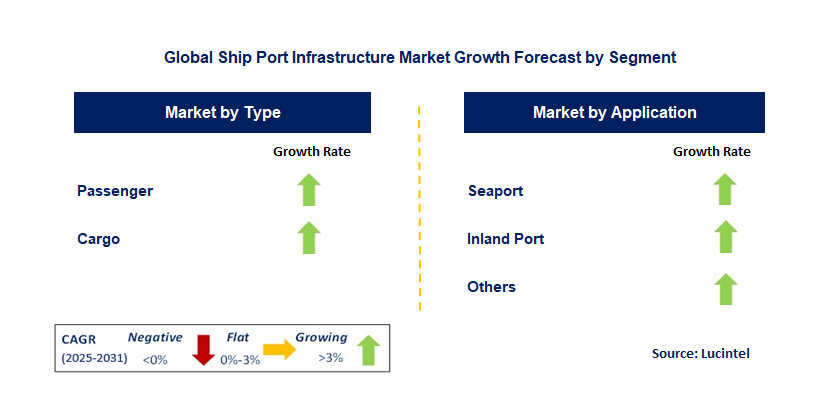
The future of the global ship port infrastructure market looks promising with opportunities in the seaport and inland port markets. The global ship port infrastructure market is expected to grow with a CAGR of 4.7% from 2025 to 2031. The major drivers for this market are the increasing adoption of automation & digitalization and the rising demand for efficient shipping routes. Lucintel forecasts that, within the type category, cargo is expected to witness higher growth over the forecast period due to rising international trade volumes are boosting demand for expanded and efficient cargo handling facilities at ports. Within the application category, seaport is expected to witness the higher growth due to growing demand for efficient large-scale cargo handling is driving the development of deep-water seaports. In terms of region, APAC is expected to witness the highest growth over the forecast period. Gain valuable insights for your business decisions with our comprehensive 150+ page report. Sample figures with some insights are shown below.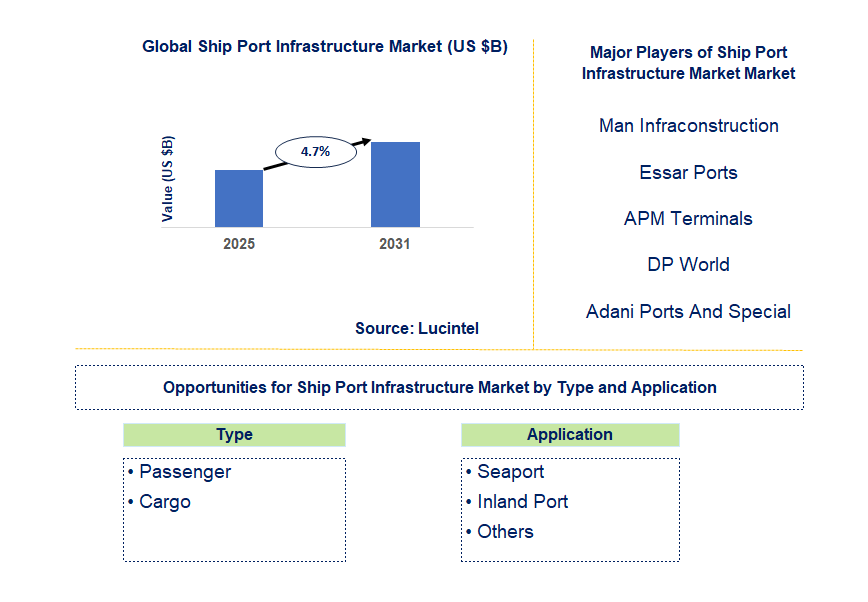
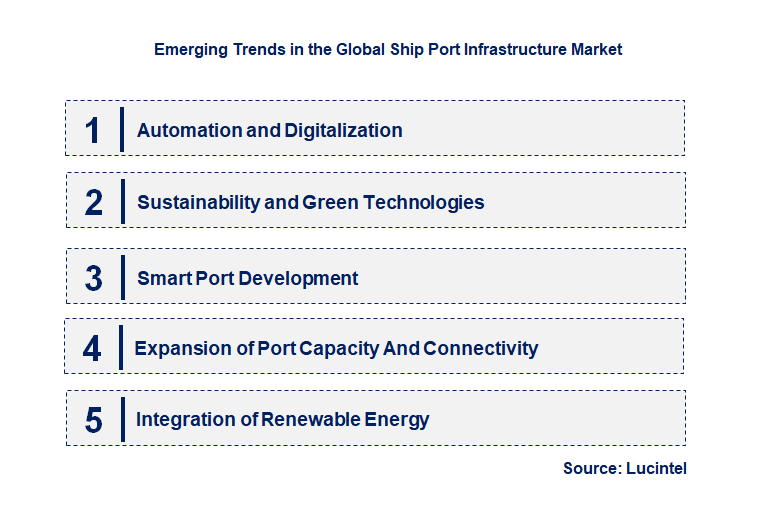
Emerging Trends in the Ship Port Infrastructure Market
The ship port infrastructure market is experiencing tremendous transformations that are driven by technological advancements, sustainability concerns, and the changing demands of global trade. Five trends are changing the market:• Automation and Digitalization: Worldwide ports continue to evolve as automation and digitalization gains dominance to efficiently eliminate human mistakes. Automated container terminals, cargo-handling machines in the name of autonomous equipment, and intelligent AI-powered platforms handling logistics, form a big presence at international hubs. Thus, with enhanced automation, efficiency improvements are brought out in an area that impacts upon increased worldwide volume in terms of trade and business.
• Sustainability and Green Technologies: With the increasing focus on environmental responsibility, sustainability is becoming a key focus for port infrastructure development. Ports are investing in green technologies, such as renewable energy systems (solar, wind), electrification of port equipment, and emission reduction measures. The integration of LNG-powered cranes and the development of eco-friendly facilities are part of a broader effort to minimize ports' environmental impact, helping to meet increasingly stringent international environmental regulations.
• Smart Port Development: The emergence of smart ports as a trend has been spurred by the integration of IoT, AI, and big data for optimization of port operations. Such technologies are utilized in monitoring and managing port infrastructure in real-time to enhance the efficiency of logistics and reduce congestion. Smart ports also allow better decision-making with respect to actionable insights into the movement of goods, predictive needs of maintenance, and overall performance of the port. This digital transformation is making ports more efficient, secure, and resilient to disruptions.
• Expansion of Port Capacity And Connectivity: With the growth of global trade, expanding ports' capacity to handle increased volumes of larger vessels and higher cargo throughput is immense. Deeper docks and wider berths coupled with bigger container handling facilities are being upgraded in ports to accommodate increasing sizes of ships. Enhancing connectivity between ports and inland transportation networks -- rail as well as road -- is an area of priority for better logistics efficiency and to reduce bottlenecks.
• Integration of Renewable Energy: Other ports are now looking at renewable sources of energy to power their operations and disengage from traditional energy grids. Major ports are already implementing solar panels, wind turbines, and other green energy technologies. The insertion of renewable energy helps ports become sustainable but reduces their operational cost while also in support of global decarbonization goals. This trend will continue to expand as ports begin to seek means of reducing environmental impacts and meet international sustainability standards. These emerging trends are transforming the ship port infrastructure market to make ports more efficient, sustainable, and resilient. Automation and digitalization are streamlining operations, while green technologies and renewable energy are reducing environmental impacts. Development of smart ports, increased capacity, and improved connectivity position ports to meet the growing demands of global trade. As these trends continue to evolve, they will shape the future of port infrastructure and global logistics networks.
Recent Development in the Ship Port Infrastructure Market
The key developments shaping the future of the ship port infrastructure market include focusing on improving efficiency, sustainability, and capacity for the demands of global trade. Technological innovation, increased investment, and focusing on sustainability have driven these developments.• Automation and Robotics in Ports: Ports are also investing heavily in automation and robotics around the world for making cargo handling at ports more efficient and safe. For this, automated cranes, autonomous trucks, robotic systems for cargo handling, etc., are increasingly being introduced to streamline port operations, minimize human error, and provide faster turnaround times. As ports continue to handle large quantities of cargo, ports around the world began to fully invest in automation because increasing demand warranted this necessity.
• Green Port Initiatives: Many ports are adopting green technologies to reduce their environmental impact. This includes the use of renewable energy sources, such as solar and wind, to power port operations, electrification of port equipment, and the implementation of low-emission technologies. For instance, some ports are investing in LNG-powered cranes and electric vehicles to replace diesel-powered equipment. These green initiatives help ports meet regulatory requirements and align with global sustainability goals.
• Port Expansion Projects: In light of the growth in global trade and larger container ships, most ports are engaged in massive expansion projects. Some of these expansion projects include deepening docks, expanding container yards, and upgrading terminals to fit modern vessels, which are getting bigger. Take the Port of Rotterdam and the Port of Singapore, for instance; they have upgraded their facilities and infrastructure in order to meet the increase in size of the container ship and to ensure the smooth operation of these vessels.
• Integration of Digital Technologies: The integration of IoT, AI, and blockchain in digital technologies transforms the way ports operate. Implementation of smart port systems is helping optimize logistics and monitor real-time data and make decisions automatically. Blockchain is being used to increase supply chain transparency and improve security in cargo transactions. These developments in digital space are driving efficiency and reducing delays, thus ensuring better performance for port operations.
• Resilience and Climate Adaptation: Against the challenges of climate change and increasing sea levels, port infrastructure is being adapted to be more resilient. That includes improving port facilities to withstand extreme weather conditions, coastal reinforcement, and investment in climate-adaptive infrastructure. Ports develop contingency plans for natural disasters, ensuring the continuity of operations and protection of their assets. The leading innovations are building operational efficiency, sustainability, and resilience in the ports, to better handle and manage the large volumes of international trade and remain responsive to issues related to globalization.
Strategic Growth Opportunities in the Ship Port Infrastructure Market
Technologies, increasing cargo volumes, as well as greater concerns for sustainable development, constitute strategic growth areas in the development of ship ports infrastructure market. Application and sectors areas include various modes of applications towards meeting the evolving demands of an increasingly globalizing economy.• Automation in Cargo Handling: Implementation of automation in cargo handling provides big growth opportunities in the ship port infrastructure market. Autonomous cranes and container-handling robots that improve efficiency as well as enhance safety in operations are improving this automation system in ports. It is expected to create a large growth opportunity because the demand to achieve faster turnaround times and also higher throughput within ports is constantly increasing.
• Investment in Green Technologies: The ship port infrastructure market is becoming increasingly focused on sustainability, providing growth opportunities for green technologies. Ports are beginning to invest in renewable energy sources, such as solar and wind power, which will reduce their emissions and contribute to a cleaner environment. Other opportunities include the electrification of port equipment, such as cranes and trucks, where companies specializing in clean energy solutions and energy-efficient technologies can grow in the market.
• Smart Ports: The growth in the ship port infrastructure market has significant potential in the development of smart ports, that align with IoT, AI, and data analytics. These technologies help optimize operations, improve decision-making, and reduce the operational costs of a port. As more ports worldwide adapt to smart technologies, the growth of companies providing digital solutions, sensors, and data management will be experienced because it allows more efficiency and resilience in ports.
• Expansion of Port Capacity: Continued growth in global trade will call for greater port capacity to handle bigger ships and higher volumes of cargo, creating growth opportunities within the construction and engineering industries. Such ports shall need to invest in terminal space expansion, deeper docks, and larger container handling facilities. Companies focused on port infrastructure development will be the beneficiaries as such increases seek to include the growing size of modern vessels.
• Port Resilience and Climate Adaptation: In response to the increased threats of climate change and rising sea levels, ports are investing in resilience and climate adaptation measures. Companies offering climate-resilient infrastructure, like flood protection systems and coastal reinforcement solutions, are going to gain a huge number of opportunities for growth in the ship port infrastructure market. Since ports will have to face climatic challenges, the demand for innovative solutions for protecting infrastructure against extreme weather conditions will increase day by day. These strategic growth opportunities are changing the ship port infrastructure market through innovation, improved sustainability, and increased port capacity. As ports invest in automation, green technologies, smart systems, and climate resilience, they are better equipped to handle the increasing demands of global trade and ensure the continued smooth flow of goods across the world.
Ship Port Infrastructure Market Driver and Challenges
A number of technological, economic, and regulatory developments shape the development of ship port infrastructure. Efficient port infrastructure is necessary to continue smooth maritime transport under continuous increase in global trade and shipping activities. The main drivers of the market include technological advancement, an increase in international trade, and a growing desire to handle more containerized cargo. However, there is still a major challenge of having high capital investment, environmental regulation, and the integration of technological issues. Addressing these drivers and challenges has to be well considered by the port authorities and stakeholders to better enhance operational efficiency, reduce cost, and improve compliance with the international regulations. The factors responsible for driving the ship port infrastructure market include: 1. Continuous Growth in World Trade: The increased volumes to be handled require ports to be of larger capacities and more efficient. A fast approach has been the need for hastened shipping times, larger vessels, and better cargo management systems, thus demanding the modernization and expansion of port infrastructures. Improving these facilities and upgrading handling equipment with expanded storage should be conducive to smooth operation and maintaining competitiveness in global markets. 2. Technical Advancements: Technical innovations are driven to improve ship port infrastructures such that operations are efficient, secure, and more sustainable. The handling of cargo is improved, turnaround times reduced, and speed and fluidity in the movement of goods enhanced. Technologies include the Internet of Things, artificial intelligence, and blockchain, especially in optimizing logistics, monitoring port traffic, and security aspects. These technologies increase the efficiency of operations, reduce costs, and allow ports to better manage large volumes of cargo. 3. Containerized Cargo: The growth in containerized shipping has greatly affected the ship port infrastructure market. As global trade increasingly relies on containers for transporting goods, ports must develop specialized infrastructure, including container terminals and handling equipment, to accommodate larger ships and higher volumes of cargo. Container ports need advanced cranes, automated systems, and better storage facilities to maintain smooth operations. This shift towards containerization is driving investment in port infrastructure, especially in regions with high volumes of international trade. 4. Environmental Regulations and Sustainability Goals: Environmental regulations and the need for sustainable operations are important drivers in the ship port infrastructure market. The trend nowadays is that more and more ports are embracing green initiatives to minimize their environmental impact. These initiatives include renewable sources of energy, electrification of port equipment, and eco-friendly technologies. Rules and regulations on emissions standards, carbon reduction targets, and waste management policies force ports to upgrade their infrastructure and invest in green technologies to meet the sustainability objectives. These regulations must be complied with to avoid fines and increase the environmental responsibility of the ports. 5. Public and Private Investments: Development and modernization of ship port infrastructure depend on public and private sector investments. Investments from governments have taken the form of port expansions, upgrading logistics facilities, and the development of multimodal transportation systems. Private investors are also investing in infrastructure projects, especially in emerging markets. Increased funding helps ports upgrade their capabilities, enhance their cargo handling capacities, and introduce the latest technological advancements. The investments facilitate efficiency in ports, promote international trade, and help ports continue to be competitive in a dynamic global economy. Challenges in the ship port infrastructure market are: 1. High capital costs: Major challenge in the ship port infrastructure market. It is quite expensive to develop and upgrade port facilities. Building new terminals, buying heavy cargo handling machinery, and enlarging storage areas require large investments. In addition, maintenance of existing structures along with updating for technological improvements becomes costly. Sometimes, such costs are high for some ports that may avoid important infrastructure developments necessary to increase cargo volumes, reduce congestion, or enhance the level of services against other competing ports. 2. Environmental Impact and Compliance: Ports are subject to very stringent environmental regulations, which challenge their development and operation. The construction and expansion of port facilities disrupt ecosystems and damage the local environment. In addition, ports must comply with various international, national, and local environmental standards, including emissions, noise pollution, and waste management. Often, environmental standards come with expensive upgrading and changes in already existing infrastructures, increasing the cost. 3. Technological Integration and Cybersecurity Risks: New technologies do much to support the port operation activities, but sometimes it becomes tough to integrate with the older existing infrastructure. Ports have to ensure their technologies are compatible, secure, and in a position to handle huge volumes of information. In addition, as ports have digitalized and become more connected, the likelihood of cyberattacks increases. Therefore, the port ought to invest in cybersecurity measures to safeguard sensitive information and ensure that their operations are not compromised. Integration of new technologies while concurrently mitigating cybersecurity risks is one of the major challenges. The growth of global trade, technological advancements, the increase in containerized cargo, environmental regulations, and massive investments from the public and private sectors are some of the main drivers of the ship port infrastructure market. All these factors enhance the operational efficiency and competitiveness of ports. Challenges such as high capital costs, environmental compliance, and integration of new technologies have to be addressed to ensure growth in the market. With the overcoming of these challenges, ports can enhance their capabilities, meet sustainability goals, and continue to support international trade effectively. The future of ship port infrastructure will be a balancing act between technological innovation, financial investment, and environmental responsibility.List of Ship Port Infrastructure Market Companies
Companies in the market compete on the basis of product quality offered. Major players in this market focus on expanding their manufacturing facilities, R&D investments, infrastructural development, and leverage integration opportunities across the value chain. With these strategies ship port infrastructure market companies cater increasing demand, ensure competitive effectiveness, develop innovative products & technologies, reduce production costs, and expand their customer base. Some of the ship port infrastructure market companies profiled in this report include-• Man Infraconstruction
• Essar Ports
• APM Terminals
• DP World
• Adani Ports and Special Economic Zone
• Larsen and Toubro
• Starlog Entrprises
Ship Port Infrastructure Market by Segment
The study includes a forecast for the global ship port infrastructure market by type, application, and region.Ship Port Infrastructure Market by Type [Value from 2019 to 2031]:
• Passenger
• Cargo
Ship Port Infrastructure Market by Application [Value from 2019 to 2031]:
• Seaport
• Inland Port
• Others
Ship Port Infrastructure Market by Region [Value from 2019 to 2031]:
• North America
• Europe
• Asia Pacific
• The Rest of the World
Country Wise Outlook for the Ship Port Infrastructure Market
The ship port infrastructure market is essential in global trade and transportation because it allows goods to be transported efficiently around the world. In the face of growing maritime trade, ports have to evolve with increasing demands that focus on modernization, sustainability, and more efficient operations. This evolution has been driven by new technologies, the need for improved environmental sustainability, and increasing volumes of trade. In the United States, China, Germany, India, and Japan, there is significant investment in upgrading ports. These include investments in automation, environmental innovations, and infrastructure for larger vessels, thereby enhancing the logistics network.• United States: The ship port infrastructure developments that have taken place recently in the United States involve modernization and improvement of facilities to accommodate large vessels, along with improvements in operational efficiency. The Port of Los Angeles and Port of Long Beach are already undergoing major transformations to accommodate this increase in volumes of international trade. Automation, for instance, is taking its place through automated container terminals, digitalized logistics systems, streamlined cargo handling processes, and, most importantly, sustainability initiatives aimed at reducing the emissions and overall environmental performance, such as port electrification and improved waste management systems. Other investments currently being focused include deeper docks and expanded facilities, which support increased vessel size sizes.
• China: The largest world market is from China, investing continuously in ship port infrastructure capacities and modernizing. The bigger ports such as the Port of Shanghai and Shenzhen are fully upgrading their facilities to meet up with the emerging demand for good, especially imported goods. Other technologies such as automation, digital port management systems, and AI-driven logistics are now playing an important role in port operations. China is also upgrading its shipping network to connect more regions, improve intermodal connectivity, and develop green technologies, such as LNG-powered cranes, to cut emissions. These developments are fast-tracked through the Chinese government's Belt and Road Initiative.
• Germany: The investment in upgrading modern port infrastructures to handle logistics and the maritime industry for the country, Germany, is intensive. As ports like Port Hamburg and Bremerhaven strive to accommodate deeper-draft and more massive container vessels, improve throughput, and create more direct sea routes from East Asia and Asia to Western and Northern Europe, automation of all operations by ports is another critical trend taking hold. The German government and private sector are focusing on sustainability, with an emphasis on reducing emissions and improving the environmental footprint of port operations. Green technologies like renewable energy sources and electrification of port equipment are playing a key role in the future development of German ports.
• India: India is rapidly expanding and modernizing its ship port infrastructure to handle increasing trade volumes and facilitate economic growth. Ports like Jawaharlal Nehru Port and Mumbai Port are upgradation work going on in their capacities and efficiencies. The government is investing in world-class facility development with cargo handling automation, which would help the port get good connectivity with the inland transport networks. Sustainability would be an added focus to this by the use of reduced carbon emissions by complete electrification of port operations, use of renewable energy sources, and many other measures. Additionally, the development of new ports in underutilized areas is part of India’s effort to enhance its maritime trade capacity.
• Japan: Japan is continuously enhancing its port infrastructure to maintain its position as a major player in global shipping and trade. The country is investing in the modernization of major ports such as the Port of Tokyo and Osaka, focusing on automation, digitalization, and reducing environmental impact. Japan is an innovation leader for the integration of smart port technology by using IoT and AI, to optimize processes and reduce port delay. Further efforts are on upgrading container handling facilities and their capacities to ensure large ships accommodate growing sizes of vessels. Japan also focuses much on sustainability efforts by using LNG-powered port equipment and renewable sources of energy to promote its development in ports.

Features of the Global Ship Port Infrastructure Market
Market Size Estimates: Ship port infrastructure market size estimation in terms of value ($B). Trend and Forecast Analysis: Market trends (2019 to 2024) and forecast (2025 to 2031) by various segments and regions. Segmentation Analysis: Ship port infrastructure market size by type, application, and region in terms of value ($B). Regional Analysis: Ship port infrastructure market breakdown by North America, Europe, Asia Pacific, and Rest of the World. Growth Opportunities: Analysis of growth opportunities in different types, applications, and regions for the ship port infrastructure market. Strategic Analysis: This includes M&A, new product development, and competitive landscape of the ship port infrastructure market. Analysis of competitive intensity of the industry based on Porter’s Five Forces model.
FAQ
Q1. What is the growth forecast for ship port infrastructure market? Answer: The global ship port infrastructure market is expected to grow with a CAGR of 4.7% from 2025 to 2031. Q2. What are the major drivers influencing the growth of the ship port infrastructure market? Answer: The major drivers for this market are the increasing adoption of automation & digitalization and the rising demand for efficient shipping routes. Q3. What are the major segments for ship port infrastructure market? Answer: The future of the ship port infrastructure market looks promising with opportunities in the seaport and inland port markets. Q4. Who are the key ship port infrastructure market companies? Answer: Some of the key ship port infrastructure market companies are as follows:• Man Infraconstruction
• Essar Ports
• APM Terminals
• DP World
• Adani Ports and Special Economic Zone
• Larsen and Toubro
• Starlog Entrprises Q5. Which ship port infrastructure market segment will be the largest in future? Answer: Lucintel forecasts that cargo is expected to witness higher growth over the forecast period due to rising international trade volumes are boosting demand for expanded and efficient cargo handling facilities at ports. Q6. In ship port infrastructure market, which region is expected to be the largest in next 5 years? Answer: APAC is expected to witness the highest growth over the forecast period. Q7. Do we receive customization in this report? Answer: Yes, Lucintel provides 10% customization without any additional cost.
Table of Contents
Methodology
- In-depth interviews of the major players in this market
- Detailed secondary research from competitors’ financial statements and published data
- Extensive searches of published works, market, and database information pertaining to industry news, company press releases, and customer intentions
- A compilation of the experiences, judgments, and insights of Lucintel’s professionals, who have analyzed and tracked this market over the years.


Buy Now
Choose a license that fits your team. Instant PDF delivery.
Prices exclude taxes. Instant delivery. Custom licensing available on request.
Key Questions
- • What are some of the most promising, high-growth opportunities for the ship port infrastructure market by type (passenger and cargo), application (seaport, inland port, and others), and region (North America, Europe, Asia Pacific, and the Rest of the World)?
- • Which segments will grow at a faster pace and why?
- • Which region will grow at a faster pace and why?
- • What are the key factors affecting market dynamics? What are the key challenges and business risks in this market?
- • What are the business risks and competitive threats in this market?
- • What are the emerging trends in this market and the reasons behind them?
- • What are some of the changing demands of customers in the market?
- • What are the new developments in the market? Which companies are leading these developments?
- • Who are the major players in this market? What strategic initiatives are key players pursuing for business growth?
- • What are some of the competing products in this market and how big of a threat do they pose for loss of market share by material or product substitution?
- • What M&A activity has occurred in the last 5 years and what has its impact been on the industry? For any questions related to Ship Port Infrastructure Market, Ship Port Infrastructure Market Size, Ship Port Infrastructure Market Growth, Ship Port Infrastructure Market Analysis, Ship Port Infrastructure Market Report, Ship Port Infrastructure Market Share, Ship Port Infrastructure Market Trends, Ship Port Infrastructure Market Forecast, Ship Port Infrastructure Companies, write Lucintel analyst at email: helpdesk@lucintel.com. We will be glad to get back to you soon.


