
Report Feature
Semiconductor Package Heat Sink Material Market Trends and Forecast
The technologies in the semiconductor package heat sink material market have seen a significant shift in the last few years from organic substrates and lead frames to advanced solutions like ceramic packages and TIMs. This is primarily due to the growing need for higher thermal conductivity, more efficient heat dissipation, and miniaturized semiconductor packages in high-performance applications such as automotive electronics and aerospace & defense.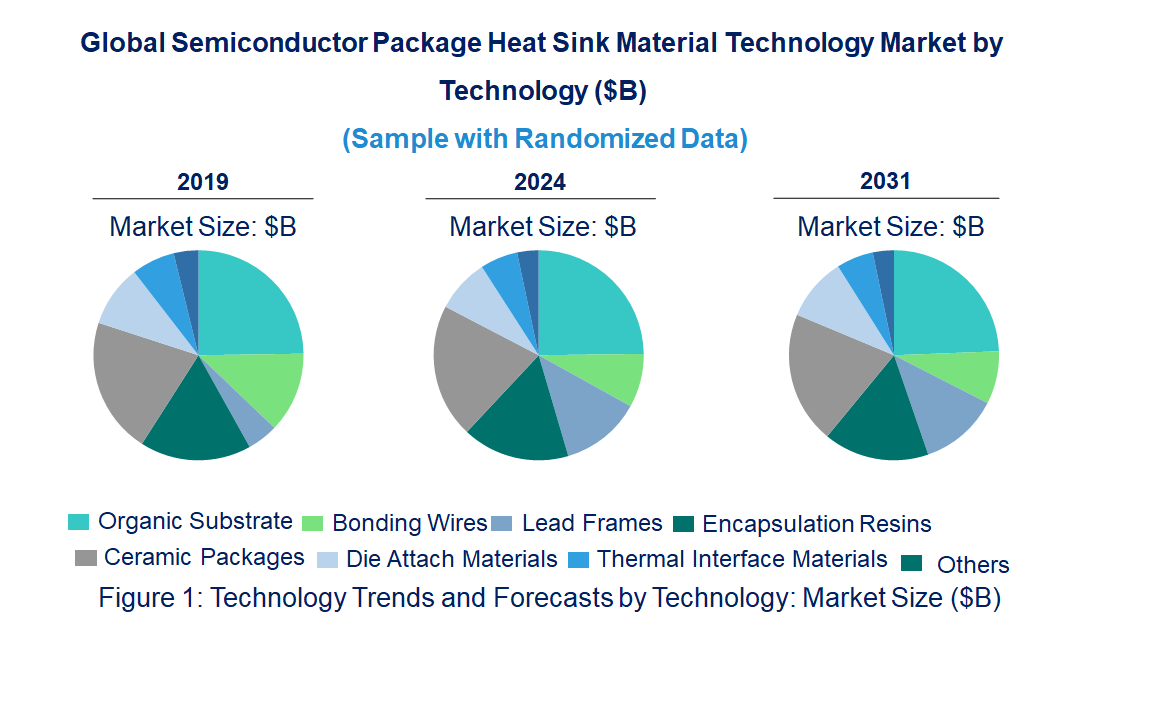
Emerging Trends in the Semiconductor Package Heat Sink Material Market
The semiconductor package heat sink material market is emerging dramatically, where manufacturers are using new materials and novel technologies to face increasing power density and miniaturization occurring in semiconductor devices. For this reason, several changes are observed in this area.• Transition to High-Performance Thermal Interface Materials (TIMs): Liquid metals and graphene-based materials are becoming widely adopted in the market because they offer superior thermal conductivity, which ensures better management of heat in high-power semiconductor packages. This technology will help improve performance, mainly in high-demand sectors like automotive and aerospace.
• Miniaturization and Compact Packaging Solutions: The trend towards miniaturization of electronics requires advanced die attach materials and encapsulation resins that can function effectively in small spaces. These must possess high thermal efficiency and allow for compact and lightweight designs for mobile and consumer electronics.
• Ceramic and Hybrid Packages: The use of ceramic packages, such as aluminum nitride (AlN) and silicon carbide (SiC), is gaining popularity for their higher thermal conductivity and electrical insulation. They are well suited for applications in aerospace, automotive, and industrial electronics where the semiconductor devices have to deliver high performance.
• Sustainable and Eco-friendly Materials: With the main trend lying in sustainability, the use of encapsulation resins and organic substrate will be more eco-friendly, and less aggressive to the environment, while sustaining remarkable heat dissipation strength with mechanical strength.
• Improved Bonding Technologies: There is a trend toward enhanced bonding wires and die attach materials such as epoxy-based adhesives and silver sintering technologies, offering better heat dissipation properties and improving the long-term reliability of semiconductor packages. The emerging trends in material technologies are redefining the semiconductor package heat sink material market, which is improving performance, sustainability, and efficiency. This helps semiconductor devices meet increasingly complex and high-performance applications.
Semiconductor Package Heat Sink Material Market : Industry Potential, Technological Development, and Compliance Considerations
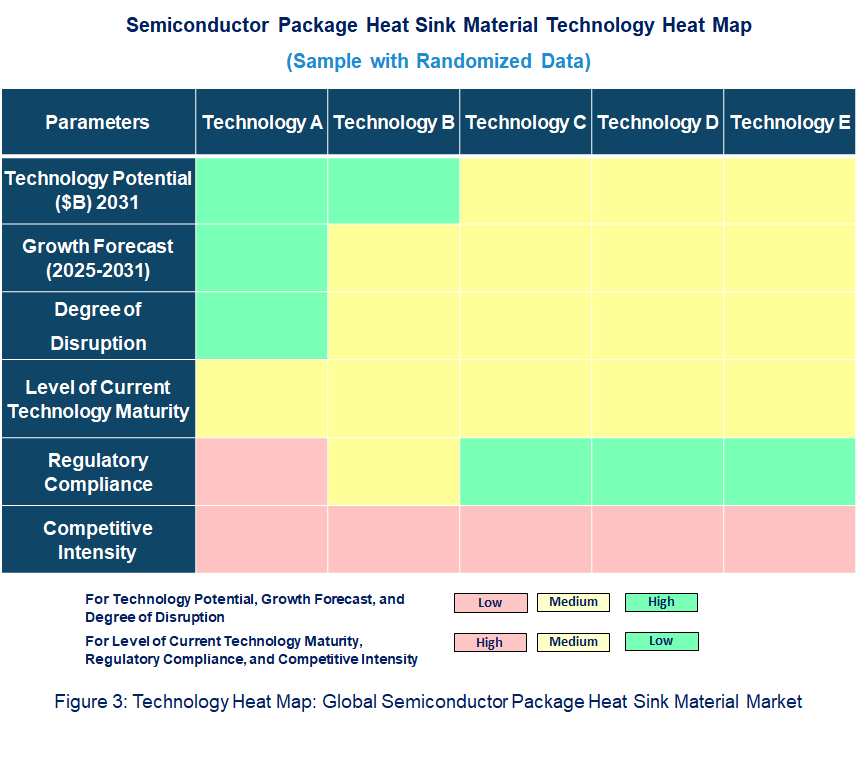
The semiconductor package heat sink material market plays a crucial role in ensuring semiconductor devices have efficient thermal management as semiconductor devices are essentially part of all electronics. With devices getting more powerful and more compact, there is an ever-increasing requirement for advanced heat sink materials to handle even higher densities of heat.• Technology Potential: The technological potential is enormous for innovation in semiconductor heat sink material, where advanced solutions are increasingly focused on improving thermal conductivity, reducing weight, and generally enhancing overall performance. The superior thermal properties of materials such as graphene, carbon nanotubes, and metal matrix composites make them promising elements to be used for considerable improvement in heat dissipation as well as device longevity.
• Level of Disruption: Medium in that aluminum and copper remain market leaders; yet new materials and designs hold open the promise of radical efficiency gains in terms of heat, which would make it possible to shrink even more powerful semiconductor packages. Next-generation cooling will likely be transformative for high-performance applications such as 5G, AI, and automotive electronics.
• Current Technology Maturity: Traditional materials for heat sinks are already mature, but phase-change materials (PCMs) and diamond-based solutions are still under research or in the very early stages of adoption. It is not yet fully commercialized.
• Regulatory Compliance: The semiconductor packaging industry faces stringent regulations regarding environmental impact, material safety, and recyclability. New materials, therefore, will need to meet these standards for adoption.
Recent Technological development in Semiconductor Package Heat Sink Material Market by Key Players
Several key players in the semiconductor package heat sink material market have made notable advancements in their products, focusing on improving heat dissipation, packaging efficiency, and overall material performance. Below are some of the recent developments:• DuPont: DuPont has been driving advancement in the TIMs segment, with its main interest in graphene-based solutions. Graphene-based materials feature excellent thermal conductivity, meaning that they highly enhance heat transfer in power semiconductor devices for automotive and consumer electronics.
• Henkel: Liquid metal-based TIMs developed by Henkel for future generations of semiconductors provide better thermal efficiency compared to traditional solutions. They are particularly useful in the context of high-power electronics where efficient heat dissipation is critical for device lifespan and performance.
• Hitachi High-Tech: Hitachi has been innovating in attaching materials by launching epoxy-based adhesives that not only provide good adhesion but also facilitate heat dissipation in semiconductor packages. This innovation has been particularly useful in high-temperature applications, such as aerospace and automotive.
• Samsung Electro-Mechanics has focused on developing ceramic packages with AlN (aluminum nitride) substrates. These materials ensure enhanced thermal conductivity and electrical insulation for high-performance devices that find their applications in the automotive and aerospace industries.
• Shin-Etsu Chemical: Shin-Etsu Chemical has developed highly advanced encapsulation resins with excellent thermal resistance and environmental durability. These are widely applied in automotive electronics and consumer electronics, ensuring the stability of packages under severe thermal stress.
• Sumitomo Chemical: Sumitomo Chemical has produced lead-free bonding wires and silver sintering die-attach materials that have enhanced heat dissipation, improved mechanical strength, and reliability, thus satisfying the needs of high-performance semiconductor packaging applications.
• Texas Instruments: Texas Instruments has introduced new organic substrates with high thermal conductivity for consumer electronics and healthcare applications. These substrates provide better thermal management, thus enabling compact and high-efficiency semiconductor packages. These innovations will prove how the materials science of heat sink materials for semiconductor packaging continues to advance. Players like DuPont, Henkel, and Samsung are pushing the boundary of their materials science, bringing closer solutions to semiconductor applications increasingly complex and widely diversified through various industries.
Semiconductor Package Heat Sink Material Market Driver and Challenges
The semiconductor package heat sink material market is subject to several growth drivers and challenges that shape its overall landscape. The factors responsible for driving the semiconductor package heat sink material market include:• Growing Demand for High-Performance Electronics: The increasing application of semiconductor devices in industries such as automotive, aerospace, and consumer electronics has increased the demand for more efficient heat management materials. High-power applications, including electric vehicles and 5G infrastructure, are primarily driving this demand.
• Miniaturization of electronic components. As devices get smaller, the producers need more efficient and compact heat dissipation solutions. This has resulted in the development of advanced die attach materials, encapsulation resins, and thermal interface materials for improved performance in smaller packages.
• Increased Emphasis on Energy Efficiency: As the world focuses more on energy efficiency in various industries, the demand for materials that minimize power loss and maximize thermal management is on the rise. This has created an increased demand for advanced ceramic packages, TIMs, and bonding wires that have higher thermal conductivity and reliability.
• Technological Advancements in the Packaging of Semiconductors: Hybrid and ceramic substrates are innovative packaging technologies that are helping improve the thermal management of semiconductor devices. These innovations are pushing the market toward more advanced materials with higher thermal and mechanical properties. Challenges in the semiconductor package heat sink material market are:
• High Material and Manufacturing Costs: Graphene-based TIMs, ceramic substrates, and liquid metal-based solutions are expensive to manufacture, which can be an important barrier for manufacturers who intend to maintain competitive prices.
• Material Compatibility Issues: New materials are to be integrated with existing semiconductor package designs, which may sometimes involve compatibility issues regarding thermal expansion, bonding, and adhesion properties. This creates a delay in product development and increases manufacturing complexity.
• Supply Chain Constraints: There may be a limitation on the availability of key materials such as graphene, silver, and aluminum nitride, and this could bring about a supply chain interruption. Manufacturers need to source them while overcoming cost and availability challenges. The drivers of technological advancement, miniaturization, and energy efficiency keep the semiconductor package heat sink material market going. However, material costs are too high, and compatibility and supply chain remain significant hurdles for the industry.
List of Semiconductor Package Heat Sink Material Companies
Companies in the market compete based on product quality offered. Major players in this market focus on expanding their manufacturing facilities, R&D investments, infrastructural development, and leverage integration opportunities across the value chain. With these strategies semiconductor package heat sink material companies cater to increasing demand, ensure competitive effectiveness, develop innovative products & technologies, reduce production costs, and expand their customer base. Some of the semiconductor package heat sink material companies profiled in this report include.• DuPont
• Henkel
• Hitachi High-Tech
• Samsung Electro-Mechanics
• Shin-Etsu Chemical
• Sumitomo Chemical
Semiconductor Package Heat Sink Material Market by Technology
• Technology Readiness by Technology Type: Organic substrates, bonding wires, and lead frames are mature and inexpensive but have limited heat dissipation. Ceramic packages and die-attached materials are established in high-performance applications. Encapsulation resins are used widely but have thermal limitations. TIMs are rapidly improving, offering better heat management. Emerging nanomaterial-based solutions are promising but still in development. Compliance with regulations and market pressure provide a constant impetus for innovation.
• Competitive Intensity and Regulatory Compliance: It is a competitive market in which organic substrates, bonding wires, and lead frames are the dominant traditional materials. However, ceramic packages and TIMs are acquiring due to better thermal properties. Regulatory compliance, especially RoHS and REACH, is critical to the lead in bonding wires and resins. Environmental regulations also prevail for TIMs. All innovations must meet safety and sustainability standards to remain competitive.
• Disruption Potential of Technologies for Semiconductor Package Heat Sink Material: Organic substrates, bonding wires, and lead frames serve more for structural and electrical functions but are less successful in heat dissipation, ceramic packages and die attach material offer high thermal management for applications on high power, TIMs are improving with lower resistance, better performance, encapsulation resins protect components, but limit heat conduction. This includes emerging solutions like nanomaterial-based TIMs that can bring potential disruption by enhancing heat transfer while simplifying packaging.
Semiconductor Package Heat Sink Material Market Trend and Forecast by Technology [Value from 2019 to 2031]:
• Organic Substrate
• Bonding Wires
• Lead Frames
• Encapsulation Resins
• Ceramic Packages
• Die Attach Materials
• Thermal Interface Materials
• Others
Semiconductor Package Heat Sink Material Market Trend and Forecast by End Use Industry [Value from 2019 to 2031]:
• Aerospace & Defense
• Automotive
• Consumer Electronics
• Healthcare
• IT & Telecommunication
• Others
Semiconductor Package Heat Sink Material Market by Region [Value from 2019 to 2031]:
• North America
• Europe
• Asia Pacific
• The Rest of the World
• Latest Developments and Innovations in the Semiconductor Package Heat Sink Material Technologies
• Companies / Ecosystems
• Strategic Opportunities by Technology Type
Features of the Global Semiconductor Package Heat Sink Material Market
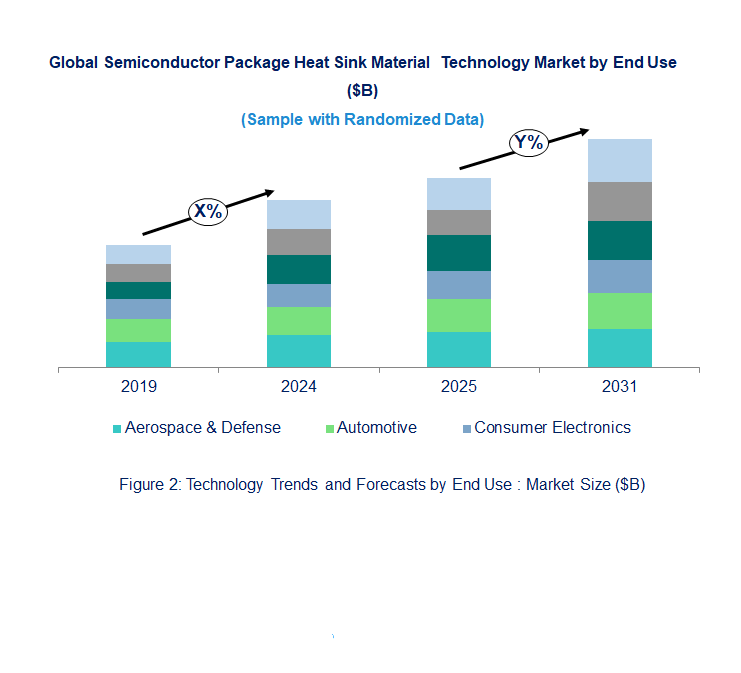
Market Size Estimates: Semiconductor package heat sink material market size estimation in terms of ($B). Trend and Forecast Analysis: Market trends (2019 to 2024) and forecast (2025 to 2031) by various segments and regions. Segmentation Analysis: Technology trends in the global semiconductor package heat sink material market size by various segments, such as end use industry and technology in terms of value and volume shipments. Regional Analysis: Technology trends in the global semiconductor package heat sink material market breakdown by North America, Europe, Asia Pacific, and the Rest of the World. Growth Opportunities: Analysis of growth opportunities in different end use industries, technologies, and regions for technology trends in the global semiconductor package heat sink material market. Strategic Analysis: This includes M&A, new product development, and competitive landscape for technology trends in the global semiconductor package heat sink material market. Analysis of competitive intensity of the industry based on Porter’s Five Forces model.Table of Contents
Methodology
- In-depth interviews of the major players in this market
- Detailed secondary research from competitors’ financial statements and published data
- Extensive searches of published works, market, and database information pertaining to industry news, company press releases, and customer intentions
- A compilation of the experiences, judgments, and insights of Lucintel’s professionals, who have analyzed and tracked this market over the years.


Buy Now
Choose a license that fits your team. Instant PDF delivery.
Prices exclude taxes. Instant delivery. Custom licensing available on request.
Key Questions
- • What are some of the most promising potential, high-growth opportunities for the technology trends in the global semiconductor package heat sink material market by technology (organic substrate, bonding wires, lead frames, encapsulation resins, ceramic packages, die attach materials, thermal interface materials, and others), end use industry (aerospace & defense, automotive, consumer electronics, healthcare, it & telecommunication, and others), and region (North America, Europe, Asia Pacific, and the Rest of the World)?
- • Which technology segments will grow at a faster pace and why?
- • Which regions will grow at a faster pace and why?
- • What are the key factors affecting dynamics of different technology? What are the drivers and challenges of these technologies in the global semiconductor package heat sink material market?
- • What are the business risks and threats to the technology trends in the global semiconductor package heat sink material market?
- • What are the emerging trends in these technologies in the global semiconductor package heat sink material market and the reasons behind them?
- • Which technologies have potential of disruption in this market?
- • What are the new developments in the technology trends in the global semiconductor package heat sink material market? Which companies are leading these developments?
- • Who are the major players in technology trends in the global semiconductor package heat sink material market? What strategic initiatives are being implemented by key players for business growth?
- • What are strategic growth opportunities in this semiconductor package heat sink material technology space?
- • What M & A activities did take place in the last five years in technology trends in the global semiconductor package heat sink material market?


