
Report Feature
Multibeam Sonar Market Trends and Forecast
The technologies in the multibeam sonar market have experienced a lot of changes in recent times, especially from low-frequency sonar to high-frequency sonar for more accurate, high-resolution data gathering, especially in commercial and scientific applications. Moreover, improvements in signal processing and data interpretation technologies have improved the performance and usability of multibeam sonar systems.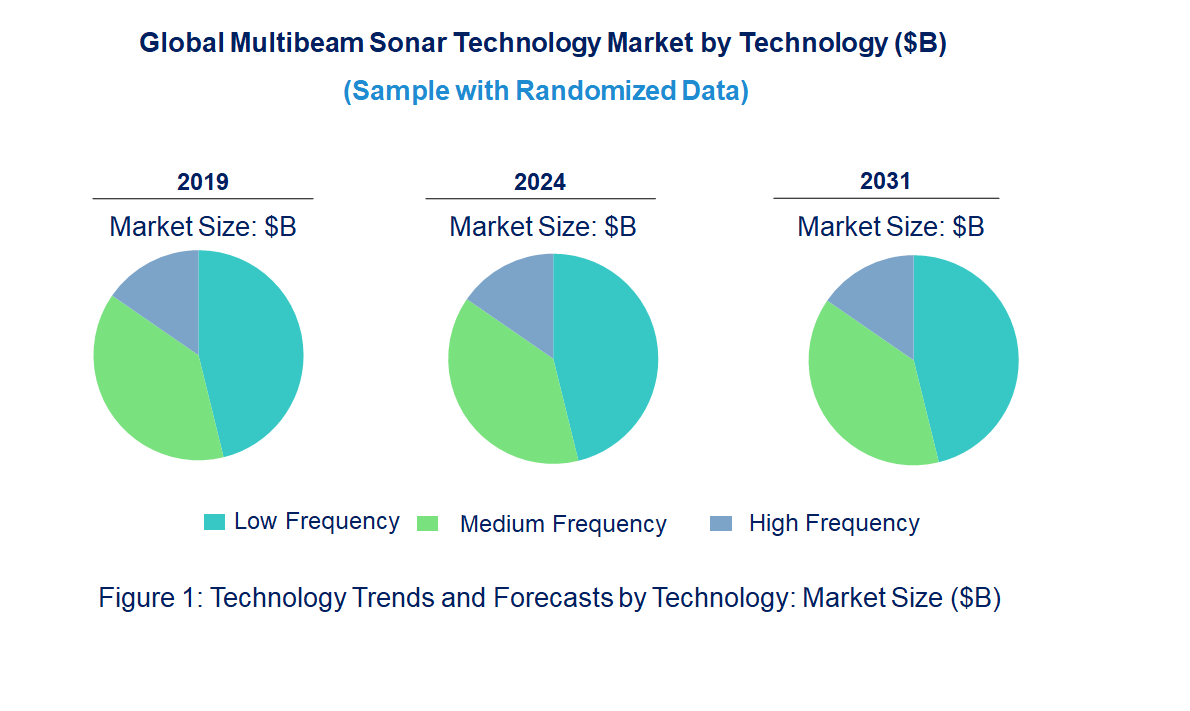
Emerging Trends in the Multibeam Sonar Market
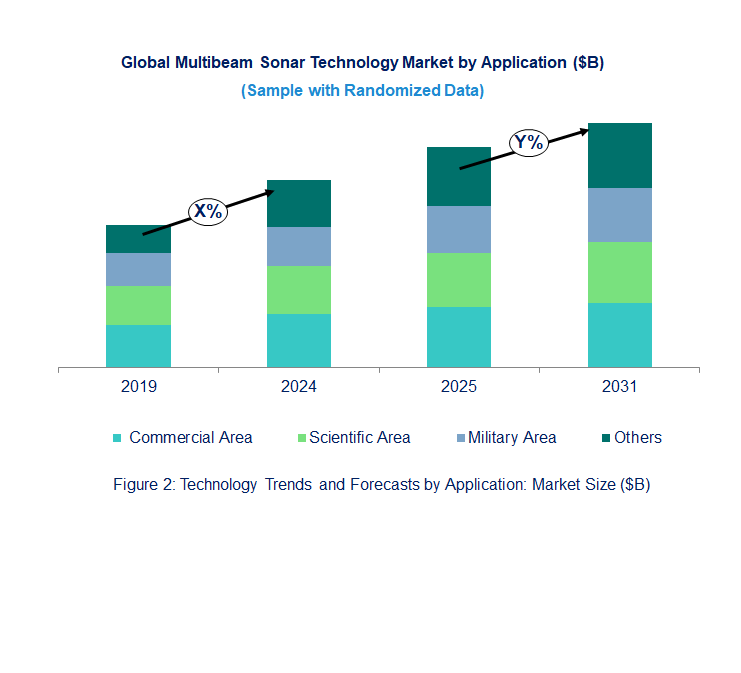
The multibeam sonar market is witnessing several exciting technological developments driven by increasing demand across commercial, scientific, and military sectors. These trends are transforming sonar capabilities, improving accuracy, and expanding the applications of multibeam sonar systems. Here are five key trends:• Miniaturization of Sonar Systems: The trend towards smaller and more compact multibeam sonar systems is gaining traction. This miniaturization is driven by the need for lightweight, portable equipment that can be used in various environments, such as small vessels and unmanned underwater vehicles (UUVs), without sacrificing performance.
• High Resolution and High-Frequency Sonar: The market is moving toward high-frequency sonar systems that have improved resolution and better clarity in shallow waters. This technology allows for more detailed imaging and mapping, particularly beneficial in scientific research and environmental monitoring, where precision is critical. Integration with Autonomous Underwater Vehicles (AUVs): Multibeam sonar systems are increasingly being integrated with AUVs and ROVs. This trend enables autonomous acquisition in places hard to access or at particular risk to human beings, thereby achieving efficiency and safety in underwater exploration, marine surveying, and military applications.
• Advances in Signal Processing Technology: The improvement in signal processing algorithms is now making multibeam sonar systems highly accurate and reliable. Advances in signal processing technology allow better interpretation of sonar data, giving more detailed, actionable insights into underwater mapping and resource exploration.
• Real-Time Data Transmission and Cloud-Based Integration: With connectivity improving, there is a shift toward real-time data transmission and cloud-based processing. It enables faster decision-making and better data sharing among the various stakeholders, including military, scientific, and commercial applications. The ability to process and analyze sonar data in real time opens new possibilities for dynamic decision-making and operational efficiency. These technologies are reshaping the multibeam sonar market by making systems more compact, powerful, and efficient with broader applications in the commercial, scientific, and military sectors. Because of this, the market is turning dynamic and can meet the diversification needs of various industries.
Multibeam Sonar Market : Industry Potential, Technological Development, and Compliance Considerations
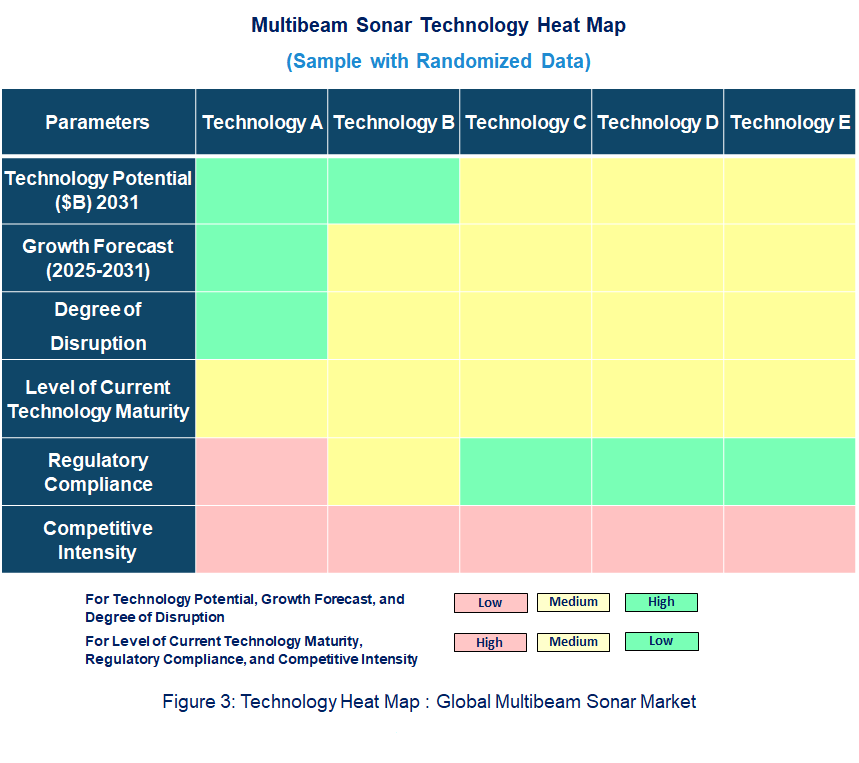
Multibeam sonar technology is popularly used in marine exploration and underwater mapping, as well as defense applications. It provides high-resolution, 3D mapping of the seafloor, offering data collection for commercial and scientific use.• Technology Potential: Multibeam sonar has significant potential for expanding underwater exploration capabilities. It is capable of detailed seafloor mapping, environmental monitoring, and resource exploration, with applications in oil and gas, marine biology, and geophysical surveying. As improvements in signal processing and sensor technology continue, multibeam sonar is expected to be more accurate, have higher resolution, and reach greater depths, making it even more useful in deep-water exploration and AUVs.
• Degree of Disruption: Since the technology is already mature, one might expect disruptions from advances in alternative sensing technologies like LiDAR and remote sensing. However, multibeam sonar remains a dominant tool because it offers comprehensive data across large areas efficiently.
• Current Technology Maturity: Multibeam sonar technology is highly mature, with commercial systems available from a variety of manufacturers. Ongoing improvements focus on enhancing system resolution, reducing system size, and integrating advanced software for data analysis.
• Regulatory Compliance: Maritime safety, environmental, and data privacy regulations have to be adhered to. Multibeam sonar systems sometimes require compliance with international standards on acoustic emissions as well as government regulations pertaining to underwater exploration and mapping in jurisdictions.
Recent Technological development in Multibeam Sonar Market by Key Players
Exciting times in the multibeam sonar market with developments across the leading players like Kongsberg, Teledyne, Wartsila, and others, at the forefront of innovation to enhance sonar systems by making them more accurate, efficient, and capable of integrating into modern technologies. Here are the recent developments reported by the key players:• Kongsberg: Kongsberg has introduced a range of advanced multibeam sonar systems, such as the EM 304 series, with high-resolution, real-time mapping. The systems are used in deep-sea exploration and resource mapping, with increased data clarity and accuracy for marine research and commercial surveying.
• Teledyne: It has significantly integrated multibeam sonar with advanced signal processing technologies. Their Reson series is a favorite in the market and portrays high-frequency sonar systems, providing detailed bathymetric data for environmental monitoring and offshore operations.
• Wartsila: Wartsila has developed new multibeam sonar systems for precision navigation and underwater mapping. Their systems are specially designed for complex, variable underwater environments, such as ports and harbors, offering real-time mapping capabilities that improve marine safety.
• Klein Marine Systems: Klein's 5000 Series multibeam sonar now features finer resolution and better efficiency in shallow water operations. This system widely spreads to include marine surveys and archaeological mapping where detailed imagery is required in assessments and monitoring.
• Tritech: Tritech has developed advanced sonar systems with higher power output and penetration depth. Their sonar systems are integrated into AUVs that offer remote inspection and mapping of seafloor features, especially in military and research applications.
• Ixblue: Ixblue has done very well in its Phins series of sonar systems, which give a high level of performance in severe underwater environments. They are used widely in marine exploration, especially deep-sea research and oil and gas surveying.
• WASSP: WASSP has developed high-frequency sonar systems for shallow-water surveys and fisheries management. Their systems offer highly accurate seabed mapping and fish detection capabilities, which are very critical for sustainable marine resource management.
• Imagenex: Imagenex has upgraded its sonar technologies to improve the imaging resolution in shallow water and coastal surveys. Their systems are applied to a wide range of applications, from environmental monitoring to marine archaeology.
• Norbit: Norbit introduced integrated sonar systems with AI-driven analytics. The innovations help in smart data processing and more accurate target detection, making the sonar systems suitable for both commercial and defense applications, particularly security and search-and-rescue operations.
• R2Sonic: R2Sonic has developed leading-edge sonar technology that is specifically focused on high-resolution, wide-bandwidth multibeam sonar. Their systems are designed to provide highly detailed bathymetric mapping for both shallow and deep-water applications, supporting industries such as offshore oil and gas exploration. In conclusion, these innovations underscore the ongoing innovation in the multibeam sonar market. Improvement in sonar accuracy is being driven by key players. Integration with autonomous systems and real-time data processing are also making the systems indispensable for marine surveying, military applications, and scientific research.
Multibeam Sonar Market Driver and Challenges
The multibeam sonar market is influenced by a variety of drivers and challenges that shape its growth and evolution. Among the key drivers and challenges impacting the market are as follows: The factors responsible for driving the multibeam sonar market include:• Growth in marine exploration and mapping: Advances in multibeam sonar have met growing demands for accurate underwater mapping. The commercial sectors, for example, oil and gas explorations, require such advanced sonar systems to provide the finest bathymetric data needed to assess environmental impacts, resource mapping, and navigation.
• Advancements in Autonomous Marine Vehicles: The integration of multibeam sonar with Autonomous Underwater Vehicles (AUVs) is opening up new opportunities in marine surveying and research. AUVs equipped with sonar systems can collect data in hard-to-reach areas, improving the efficiency and safety of underwater operations.
• Increased Naval and Defense Applications: Multibeam sonar systems are being increasingly adopted by military organizations for surveillance, reconnaissance, and anti-submarine warfare. Its high-resolution imaging capabilities are critical for naval security and effectiveness in operations.
• Technological Advancements in Sonar Systems: Continuous innovation in sonar technology, including better signal processing, higher resolution, and integration with AI, is driving market growth. These improvements enhance the overall performance of sonar systems, making them more reliable and versatile for various applications. Challenges in the multibeam sonar market are:
• High Initial Cost: A main disadvantage is the high cost of new-generation advanced multibeam sonar. Companies or governments with small budgets have problems justifying the necessary expenditures and paying for those investments in purchasing and maintaining these kinds of sonars.
• Environmental Limitations: The performance of multibeam sonar systems can be affected by environmental factors such as water salinity, temperature, and bottom composition. These factors can lead to challenges in obtaining accurate data, particularly in shallow or challenging underwater environments.
• Competition from Alternative Technologies: Technologies such as LiDAR (Light Detection and Ranging) and side-scan sonar are emerging as alternatives to traditional multibeam sonar. While these technologies may not fully replace multibeam sonar, their growing capabilities in certain applications present a challenge to the market. The multibeam sonar market boasts benefits of advancements in technology, coupled with a growing demand for varying segments. Its cost and environmental limitations stand out as challenges to such developments. The drivers and challenges outlined above will continue to shape the market because companies will aim to enhance performance and extend their applications further.
List of Multibeam Sonar Companies
Companies in the market compete based on product quality offered. Major players in this market focus on expanding their manufacturing facilities, R&D investments, infrastructural development, and leverage integration opportunities across the value chain. With these strategies multibeam sonar companies cater to increasing demand, ensure competitive effectiveness, develop innovative products & technologies, reduce production costs, and expand their customer base. Some of the multibeam sonar companies profiled in this report include.• Kongsberg
• Teledyne
• Wartsila
• Klein Marine Systems
• Tritech
• Ixblue
Multibeam Sonar Market by Technology
• Technology Readiness by Type: Low-frequency sonars are mature and very much used in defense and deep-sea exploration with long range, but not so much resolution. Medium-frequency sonars are versatile in use; they apply to underwater navigation and environmental monitoring. High-frequency sonars are advanced for shallow waters and high resolution, but yet evolving to be applied widely. The competition is at the high-frequency systems, and the low-frequency sonars dominate deep-water applications. The most important consideration is regulatory compliance, especially for high-frequency systems in sensitive marine areas. The main applications are defense, shipping, and research.
• Competitive Intensity and Regulatory Compliance: Competition intensity differs in low, medium, and high frequency sonars. Low frequency sonars are dominant for long-range sectors but are subject to new technologies such as AUVs. Medium frequency sonars are widely used in commercial marine sectors and, therefore, face moderate competition. High frequency sonars are specialty and, therefore, lead to high competition in niche markets. All of them require regulatory compliance; however, low frequency systems have relatively fewer restrictions, whereas high frequency sonars are subjected to strict emission and interference regulations, especially in marine environments.
• Disruption Potential of Sonar Technologies: Low, medium, and high frequency sonars bring forth unique disruption potential in the multibeam sonar market. Low-frequency sonars are best at long-range, deep-water probing and can be used to disrupt defense mapping and deep-sea maps. Medium-frequency sonars compromise between range and resolution, which has been useful for commercial and environmental applications. High-frequency sonars have high resolutions for shallow water mapping, that can be used to disrupt fisheries management and precision imaging. Advances in signal processing and miniaturization may further expand these technologies' applications in autonomous underwater vehicles and marine research.
Multibeam Sonar Market Trend and Forecast by Technology [Value from 2019 to 2031]:
• Low Frequency
• Medium Frequency
• High Frequency
Multibeam Sonar Market Trend and Forecast by Application [Value from 2019 to 2031]:
• Commercial Area
• Scientific Area
• Military Area
• Others
Multibeam Sonar Market by Region [Value from 2019 to 2031]:
• North America
• Europe
• Asia Pacific
• The Rest of the World
• Latest Developments and Innovations in the Multibeam Sonar Technologies
• Companies / Ecosystems
• Strategic Opportunities by Technology Type
Features of the Global Multibeam Sonar Market
Market Size Estimates: Multibeam sonar market size estimation in terms of ($B). Trend and Forecast Analysis: Market trends (2019 to 2024) and forecast (2025 to 2031) by various segments and regions. Segmentation Analysis: Technology trends in the global multibeam sonar market size by various segments, such as application and technology in terms of value and volume shipments. Regional Analysis: Technology trends in the global multibeam sonar market breakdown by North America, Europe, Asia Pacific, and the Rest of the World. Growth Opportunities: Analysis of growth opportunities in different applications, technologies, and regions for technology trends in the global multibeam sonar market. Strategic Analysis: This includes M&A, new product development, and competitive landscape for technology trends in the global multibeam sonar market. Analysis of competitive intensity of the industry based on Porter’s Five Forces model.Table of Contents
Methodology
- In-depth interviews of the major players in this market
- Detailed secondary research from competitors’ financial statements and published data
- Extensive searches of published works, market, and database information pertaining to industry news, company press releases, and customer intentions
- A compilation of the experiences, judgments, and insights of Lucintel’s professionals, who have analyzed and tracked this market over the years.


Buy Now
Choose a license that fits your team. Instant PDF delivery.
Prices exclude taxes. Instant delivery. Custom licensing available on request.
Key Questions
- • What are some of the most promising potential, high-growth opportunities for the technology trends in the global multibeam sonar market by technology (low frequency, medium frequency, and high frequency), application (commercial area, scientific area, military area, and others), and region (North America, Europe, Asia Pacific, and the Rest of the World)?
- • Which technology segments will grow at a faster pace and why?
- • Which regions will grow at a faster pace and why?
- • What are the key factors affecting dynamics of different technology? What are the drivers and challenges of these technologies in the global multibeam sonar market?
- • What are the business risks and threats to the technology trends in the global multibeam sonar market?
- • What are the emerging trends in these technologies in the global multibeam sonar market and the reasons behind them?
- • Which technologies have potential of disruption in this market?
- • What are the new developments in the technology trends in the global multibeam sonar market? Which companies are leading these developments?
- • Who are the major players in technology trends in the global multibeam sonar market? What strategic initiatives are being implemented by key players for business growth?
- • What are strategic growth opportunities in this multibeam sonar technology space?
- • What M & A activities did take place in the last five years in technology trends in the global multibeam sonar market?


