
Report Feature
DJ Hardware and Software Market Trends and Forecast
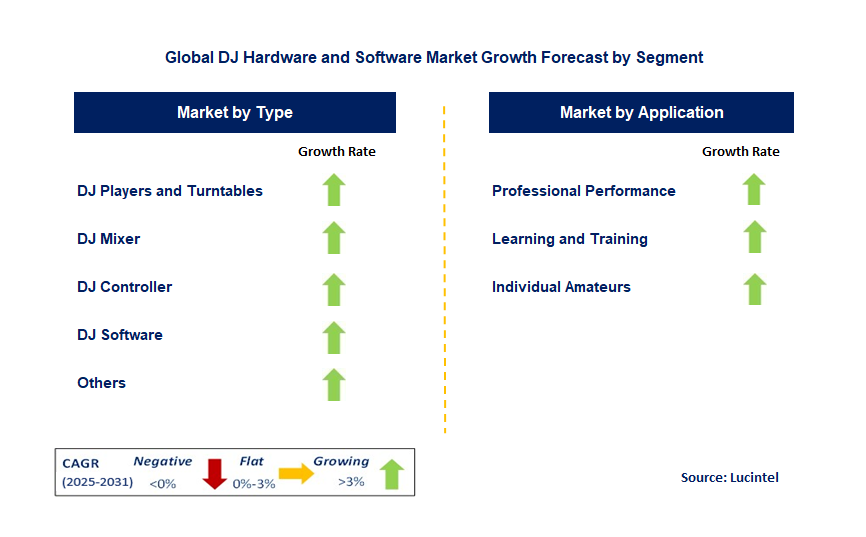
The future of the global DJ hardware and software market looks promising with opportunities in the professional performance, learning and training, and individual amateur markets. The global DJ hardware and software market is expected to grow with a CAGR of 7.5% from 2025 to 2031. The major drivers for this market are the increasing popularity of live events, festivals, and entertainment experiences has led to greater demand for DJ hardware and software, growing trend of digital music platforms and streaming services has influenced DJs to use advanced software for seamless integration, and integration of DJ software with advanced features such as ai-based mixing, automated beat matching, and real-time collaboration. Lucintel forecasts that, within the type category, DJ controller is expected to witness the highest growth over the forecast period due to the all-in-one design simplifies setup and operation, contributing to its popularity. Within the application category, professional performance is expected to witness the highest growth due to the high demand for advanced, high-quality equipment, larger budgets for investment, and the need for reliable tools. In terms of region, North America is expected to witness the highest growth over the forecast period due to a global leader in the music industry, with its influence extending to DJing and electronic music. Gain valuable insights for your business decisions with our comprehensive 150+ page report. Sample figures with some insights are shown below.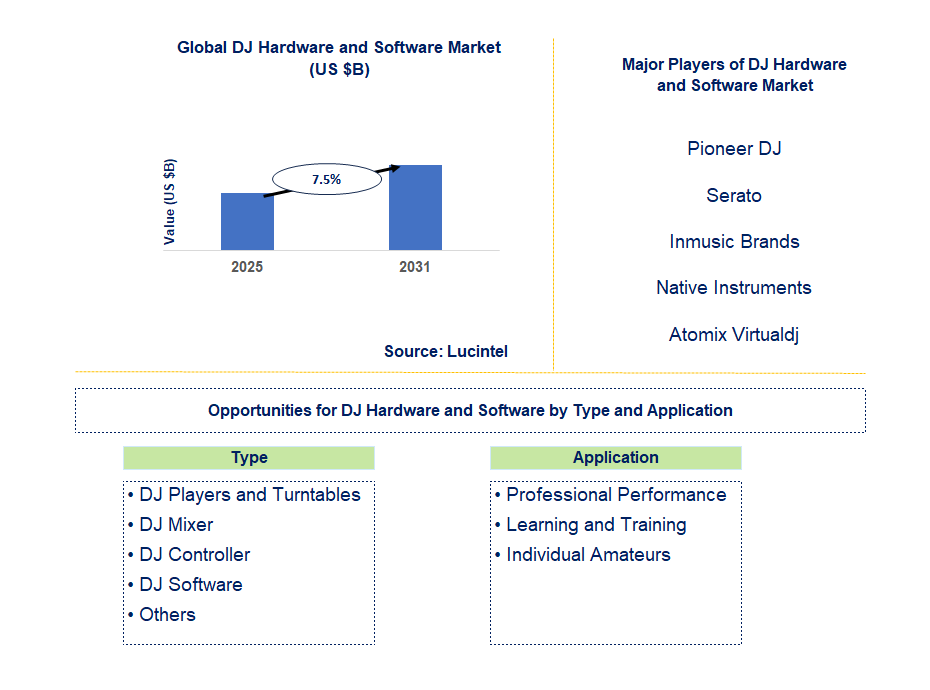
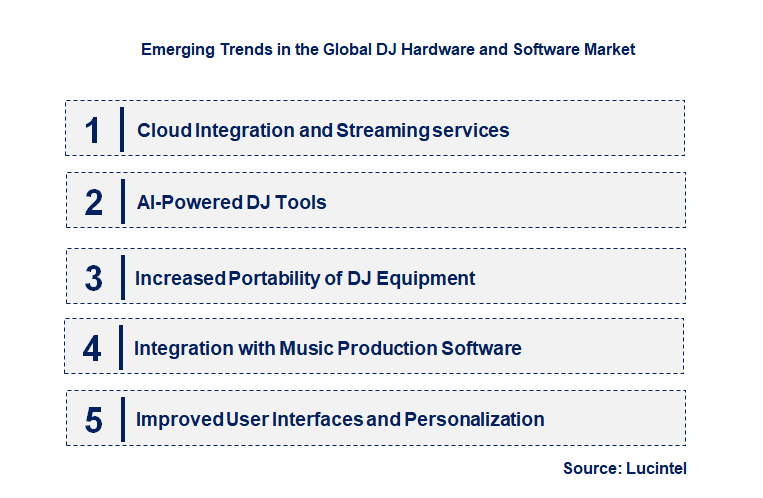
Emerging Trends in the DJ Hardware and Software Market
The DJ hardware and software market is rapidly changing because of new technology integrations into it, user demand for an even more intuitive solution, and the wide acceptability of digital DJing. As DJing continues to advance, a few emerging trends are changing the overall landscape. It will showcase advancement in the aspects of hardware, software, and performance capacities in order to be provided for use by the DJ and music producer. Keeping oneself updated regarding the trends may mean a means to staying up in the very fast-changing landscape that exists in DJ-related businesses.• Cloud Integration and Streaming services: Cloud integration is an important trend; many DJ software providers offer cloud-based storage, live streaming, and real-time collaboration features. Services like Spotify and SoundCloud have also become a part of DJ software and enable DJs to stream music live. This pattern lessens the dependence on local storage and promotes greater access to a greater number of tracks, creating greater flexibility for DJs, as well as decreasing preparation before their gigs. As streaming becomes more reliable and accessible, cloud-based DJing will certainly continue to grow.
• AI-Powered DJ Tools: Artificial intelligence is slowly entering DJ software, with tools that can automatically mix tracks, suggest transitions, or analyze the energy levels of a performance. This trend is enabling DJs to experiment with new ways of performing while also easing the technical challenges involved in live mixing. The AI-powered features enable DJs to be more creative and perform rather than spending time on the technical aspects of beatmatching and track selection. This is changing the role of the DJs, as they can now concentrate more on their artistry.
• Increased Portability of DJ Equipment: The portability aspect is still an increasing trend in the DJ hardware market, where compact and lightweight controllers and mixers are increasingly being introduced. This is particularly of interest to mobile DJs and entertainers who regularly travel or entertain in different locations. The portability of gear has created devices that are strong on power, flexible, but not at the expense of sound quality. Currently, there is DJ hardware that one can easily stow in a backpack or small carry case without necessarily sacrificing features.
• Integration with Music Production Software: There is an ever-increasing interest in the blending of DJ hardware with music production software. Integration blurs boundaries between live performances and studio production. With it, a DJ can edit tracks on the spot during performance to provide unique customized sets. Software such as Ableton Live and FL Studio integrates more and more with DJ controllers, using these so DJs can develop new creativity or elements in their show. With this, using DJ controllers creates more important creativity and flexibility for these artists, providing a complete and one-stop toolbox to add effects of dexterity for their performances.
• Improved User Interfaces and Personalization: More and more DJ software and hardware have intuitive user interfaces, making it easier for DJs to interact with their equipment. Customizable controls in many devices let DJs tailor their setups to unique preferences. This emphasis on UX design has brought about streamlined workflows and reduced learning curves. This is democratizing DJing, so it‘s both accessible to the beginner and, at the same time, features professional-level offerings for experienced users who require precision and flexibility in their setup. These changes are broadly redefining the DJ hardware and software market to be even more accessible, versatile, and innovative. Integration of cloud services, AI, portability, music production software, and enhanced user interface is changing the way DJs move, interact, and perform around their hardware. As these trends go forward, they will provide new creative possibilities and richly enhance the experience of DJing, bringing the market even further out towards growth.
Recent Development in the DJ Hardware and Software Market
Technology, as well as changing demand of consumers is witnessed in new developments in DJ hardware and software market. Nowadays, DJing is easier since inventions in its hardware and especially soft wares ensure ease in mixing tracks for rookies, yet experienced disc jockeys. In the future of DJing, constant and integrated features like AI, cloud technology, and more are helping DJing and pushing the boundaries of performance and creativity. These development changes influence the way DJs work with equipment and with themselves, thereby improving the DJ experience.• AI Integration for Intelligent Mixing: There is also AI-powered DJ software and hardware that can automatically select tracks, beat match, and transition between tracks. This leaves the DJ with more time to focus on his performance and creativity while the software takes care of the technical side. AI also enhances the precision and speed of live mixes, allowing for smoother transitions. The tools are also opening up new avenues for beginners who want to make DJing less daunting, hence making it accessible to a broader audience.
• Cloud-Based Streaming and Storage Platforms: Cloud-based DJing platforms have become popular, allowing DJs to stream music directly from services like SoundCloud, Spotify, and Apple Music during live performances. These platforms provide storage solutions that allow DJs to access and manage their music libraries from any location. Cloud integration also facilitates remote collaboration, enabling DJs to share sets, tracks, and creative ideas with others. This means cloud technology is going to be even more instrumental in shaping DJing futures.
• Portable, Compact DJ Equipment: Portable DJ equipment continues to evolve, offering more compact and travel-friendly options without sacrificing performance. Portable DJ controllers and mixers now feature smaller form factors, making them easier for mobile DJs to transport. These devices often feature strong capabilities like built-in audio interfaces and the control of multiple software platforms. This development provides greater convenience and ease of use for DJs who perform at different locations because they are more flexible in demand.
• Integration of DJing with Music Production: DJing and music production are increasingly being combined into one thing, with software and hardware that combine both functions. New DJ controllers and software are designed to allow live remixing and production during performances, opening up new possibilities for DJs who also create their own tracks. This integration allows DJs to manipulate sound on the fly and offers a seamless blend of performance and production, pushing the boundaries of creativity and innovation.
• User-friendly interfaces and customization: The last developments in DJ software and hardware are always about making interfaces user-friendly, with options for personalization. New controllers and software bring new concepts and usability in terms of intuitive touchscreens, streamlined layouts, and customizable control settings to support users in their workflow, thus giving faster performances and mainly to professionals. It reinforces the idea about improving the user experience without sacrificing professional-grade functions. These changes in the market for DJ hardware and software are making all the differences in how DJs produce, play, and engage with their gear. AI integration into cloud-based platforms, portable solutions, and seamless music production tools expand creative possibilities while pushing usability to the next level. With these trends continually modifying the market, DJs will enjoy even more powerful and flexible tools, which is good for the growth and diversity of an already blossoming industry.
Strategic Growth Opportunites in the DJ Hardware and Software Market
The DJ hardware and software market is highly innovative at the moment, and hence, strategic growth opportunities are available across applications. Since demand for digital DJing solutions is rising, various emerging trends are driving the growth in this segment. The live performance setup, mobile DJing, music production, educational tools, and the increasing integration of streaming platforms are few key applications. These opportunities are being shaped by technological advancements, shifting consumer preferences, and the expanding global interest in electronic music. Identifying and capitalizing on these growth areas is crucial for stakeholders in the DJ industry.• Live Performance Setups: Live DJ performances continue to be a significant driver of growth in the hardware and software market. Digital controllers, mixers, and software solutions that plug into live performance environments are in high demand. Moreover, the rise of virtual and hybrid events where DJs perform to global audiences online with live performances is further fueling growth in this area, because giving more flexibility, portability, and feature packings of equipment to DJs enables them to deliver dynamic, high-energy performances. New innovations in live performance tools are opening up new opportunities for established as well as new artists.
• Music Production: With more focus on music production, modern DJ software isn‘t limited solely to live performance. As DJs are now not only performing but also making original tracks, production and DJing functions appear and disappear seemingly seamlessly in Ableton Live, Tractor, and Recardo. This provides an opportunity for the creation of hardware and software to enable DJs to remix, edit, and produce live music while on the sets. This coming together of DJing and production is something that appeals to those who would like to introduce fresh, personalized content into their live shows, creating new market avenues for production-centric tools and equipment.
• Mobile DJing: With the advent of smartphones and tablets, mobile DJing has opened a new growth opportunity in the DJ hardware and software market. Compact and portable DJ controllers, along with mobile DJ apps, allow DJs to perform from virtually anywhere. This is especially attractive for smaller events, parties, and those who work in tight spaces. The opportunity in this market lies in developing high-performance yet affordable mobile DJing solutions. The increasing young, tech-aware DJs also further fuel the demand for a mobile-friendly unit that is straightforward and easy to use on-the-go.
• Educational Tools and Software: This is because DJing continues to become easily accessible, meaning the demand for educational tools and software is increasing. Tutorials are now available at platforms offering apps and online courses for DJing. The DJ hardware and software market can tap into the burgeoning interest from aspiring DJs by providing educational resources. Software companies can innovate by providing tools that assist users in learning key skills, such as beatmatching, mixing, and track selection. Further market expansion is the key opportunity, especially in regions with increasing youth engagement in electronic music.
• Integration with Streaming Platforms: With streaming services, the possibility of integration of DJ hardware and software with Spotify, SoundCloud, and Apple Music is tremendous. Hardware and software manufacturers will be able to reach a whole new audience because, without local music libraries, it becomes possible for the DJs to stream music directly from the above-mentioned streaming platforms. Also, an unlimited catalog of tracks can be accessed in real time during live performances. As more DJs and fans rely on streaming, integrating these services into DJing tools presents a promising growth opportunity for the industry. These strategic growth opportunities reveal the evolving nature of the DJ hardware and software market. Live performance, music production, mobile DJing, education, and streaming integration are all pushing the boundaries in terms of innovative changes in the market. As the industry grows further, it is these applications that will be central to businesses in fulfilling emerging consumer needs, with the aim of offering greater user experiences and propelling further expansion in the industry.
DJ Hardware and Software Market Driver and Challenges
The DJ hardware and software market is shaped by a variety of drivers and challenges. Technological advancements, economic conditions, and evolving consumer preferences play crucial roles in shaping the industry’s trajectory. On the other hand, challenges such as regulatory issues, competition, and the high cost of innovation can present obstacles for companies in the market. Understanding these factors is key to navigating the rapidly changing landscape of DJ technology and making informed decisions. The factors responsible for driving the DJ hardware and software market include: 1. Technological Advancements: Technological progress in hardware and software is a major driver in the DJ market. The integration of AI, cloud, and better audio quality is changing the DJing experience. Automatic beatmatching, intelligent track selection, and real-time cloud streaming make user experiences richer and open up more creative avenues. Moreover, compact yet powerful devices are helping DJs perform more efficiently and flexibly. These innovations continue to provide room for new product differentiation and growing in the market because technology is advancing. 2. Increasing Popularity of EDM and Live Music: The growth in the global electronic dance music (EDM) and live music has greatly contributed to the high demand for DJ hardware and software. With EDM now reaching every corner of the world-from festivals to clubs-the requirement for high-quality, innovative DJ tools has also increased. The number of DJs now performing for more people and at times, in live events that are streamed, requires more sophisticated equipment. Thus, there is increased investment in DJ gear and software to support professional and amateur DJs coming into the market. 3. More Demand for Personalized DJ Experience: Consumers are increasingly looking for personalized, interactive experiences in their entertainment. This trend has spurred growth in DJing tools that allow for greater customization and flexibility. DJs are now able to modify their setups, integrate personalized sounds, and create unique mixes, which adds value to live performances. Rise of platforms like Twitch and YouTube, through which DJs can engage fans, has also brought calls for customization of DJ gear to reflect unique style and creativity. This demand for personalization continues in the DJ market, resulting in continuous innovations. 4. Streaming Services: Spotify, SoundCloud, or Apple Music streaming services have risen to be inevitable in the DJing world. These platforms give DJs access to enormous music libraries in real-time, giving them much more flexibility during live performances. As these services expand their catalogs and improve their integration with DJ hardware and software, they drive innovation in the market. DJs are increasingly relying on streaming platforms to find tracks, collaborate, and share their sets. This trend is changing the way DJs work and opens up new opportunities for developing integrated tools that are connected to streaming services. 5. Mobile and Cloud-Based DJing Adoption: Mobile and cloud-based DJing are on the rise with the adoption of mobile devices and cloud-based platforms. Compact controllers, apps, and cloud storage allow DJs to perform anywhere without the need for bulky equipment. This trend is particularly attractive to younger DJs who want portability and ease of use. Cloud-based tools are also enhancing collaboration by enabling DJs to share music, sets, and ideas more easily. As mobile and cloud-based solutions become more advanced, they are expected to expand the market and provide more opportunities for growth. Challenges in the DJ hardware and software market are: 1. High Cost of Innovation: High investment in research and development is required to keep up with the fast pace of technological innovation in the DJ hardware and software market. With an increasing aspiration to include AI and cloud computing into their products, the production cost goes higher and higher. A small firm may not manage to compete with the leader because a big company can invest more in innovation. This would mean that the ability of smaller players to enter or remain competitive may be limited and potentially stall the overall market growth in certain areas. 2. Market Saturation and Competition: The DJ hardware and software market is saturated with a myriad of products for all types of consumers. As such, companies need to find differentiation in unique features, branding, and pricing strategies. There is high competition in the market due to the presence of established players like Pioneer DJ, Native Instruments, and Denon DJ, which makes it hard for new players to enter the market and acquire market share. The competition often leads to price wars and reduced profit margins, making it difficult for companies to achieve sustainable growth. 3. Regulatory and Licensing Issues: Regulatory issues, including copyright infringement and licensing issues, pose challenges in the DJ hardware and software market. The rules governing the use of music and intellectual property are complex, and DJs are usually subjected to these complexities when they stream or remix songs during live performances. This legal complexity may affect how software developers include music libraries and streaming services in their platforms. It is a costly and time-consuming process for companies to comply with international copyright laws and navigate these regulatory hurdles, which may limit the growth of the market. The big drivers include technological developments, growth in EDM, and the expansion of streaming services; the risks encompass high innovation costs, market saturation, and regulations. Those firms best positioned to tackle these evolving landscape risks and benefits are likely those which best find balance among drivers and challenges for DJ equipment and software.List of DJ Hardware and Software Companies
Companies in the market compete on the basis of product quality offered. Major players in this market focus on expanding their manufacturing facilities, R&D investments, infrastructural development, and leverage integration opportunities across the value chain. With these strategies DJ hardware and software companies cater increasing demand, ensure competitive effectiveness, develop innovative products & technologies, reduce production costs, and expand their customer base. Some of the DJ hardware and software companies profiled in this report include-• Pioneer DJ
• Serato
• Inmusic Brands
• Native Instruments
• Atomix VirtualDJ
• Algoriddim
• PCDJ
• Hercules
• Reloop
• Gemini Sound
DJ Hardware and Software Market by Segment
The study includes a forecast for the global DJ hardware and software market by type, application, and region.DJ Hardware and Software Market by Type [Value from 2019 to 2031]:
• DJ Players and Turntables
• DJ Mixer
• DJ Controller
• DJ Software
• Others
DJ Hardware and Software Market by Application [Value from 2019 to 2031]:
• Professional Performance
• Learning and Training
• Individual Amateurs
DJ Hardware and Software Market by Region [Value from 2019 to 2031]:
• North America
• Europe
• Asia Pacific
• The Rest of the World
Country Wise Outlook for the DJ Hardware and Software Market
DJing equipment, as far as software and hardware go, is quite growing rapidly because of advanced technologies in both fronts, especially given that fans in this culture expand and keep rising as more digital cultures advance worldwide. Every market, including the United States, China, Germany, India, and Japan, has its own unique set of developments and trends, influenced by local demand, cultural preferences, and technological adoption. It is important to understand these regional variations to identify growth opportunities and respond to changing market needs.• United States: However, the United States still holds pole position in terms of dominance in the global DJ hardware and software market on account of this vibrant music environment and technological breakthroughs. More recent DJing software has focused on innovation of new features ranging from cloud integration to better-quality sound and using AI for auto-management. Hardware manufacturers like Pioneer DJ, Native Instruments, and Denon DJ have brought devices that are more portable and less complicated, making it easily accessible to professionals and new starters. The role of streaming services, for instance, SoundCloud and Spotify, has definitely changed the dynamics of a DJ‘s mixing and live performance.
• China: DJ hardware and software has been rapidly growing in China. The growing entertainment industry, coupled with an increased interest in EDM, has boosted the demand for these products. Companies from China are emerging as significant players, providing affordable DJ controllers, mixers, and software solutions. There is a rise in the number of music festivals and clubs in cities like Beijing and Shanghai. The emergence of streaming services like Tencent Music has also boosted the demand for digital DJing. International software developers are localizing their products to suit the preferences of Chinese consumers, which is driving the market forward.
• Germany: Germany, home to one of the most influential techno scenes in the world, remains a key hub for DJ culture. The market here is marked by high demand for professional-grade hardware and software. Other firms, like Berlin-based Native Instruments and Pioneer DJ, have brought new hardware aimed at enhancing live DJing experience. Improving integration of hardware and software means one can use such equipment much more flexibly on stage. Well-established electronic music festival culture, such as events like Love Parade or Berlin‘s club Bergheim, demand high-quality gear. Besides, strong German representation in music production and engineering puts it ahead of the rest in DJ industry.
• India: The Indian DJ hardware and software market has been growing rapidly with an increasing number of young professionals interested in DJing and electronic music. The popularity of EDM and music festivals has driven in demand for affordable equipment of high quality. Companies like Numara, Pioneer DJ, and domestic brands are experiencing increased sales for entry-level DJ controllers and software. Coupled with the availability of streaming services such as Gaana and Jio Savan, digital music production and performance are really supported and can provide strong growth in the technology of DJ, and considering the growth of cities like Mumbai and Bangalore, India has a lot to offer in this market too.
• Japan: Japan‘s DJ hardware and software market has a rich balance of both classic and contemporary inspirations. A strong cultural background for music technology exists, coupled with an influx of international brands like Pioneer DJ, Roland, and Denon. Most local consumers prefer the Japanese hardware due to its durability, and there is increased interest in software for digital DJing. Further, Japan has the club scene culture as well as major music festivals held annually, leading to sustained need for professional as well as amateur DJ equipment. The country also loves both its physical and digital media, therefore providing a different market for the DJ products.

Features of the Global DJ Hardware and Software Market
Market Size Estimates: DJ hardware and software market size estimation in terms of value ($B). Trend and Forecast Analysis: Market trends (2019 to 2024) and forecast (2025 to 2031) by various segments and regions. Segmentation Analysis: DJ hardware and software market size by type, application, and region in terms of value ($B). Regional Analysis: DJ hardware and software market breakdown by North America, Europe, Asia Pacific, and Rest of the World. Growth Opportunities: Analysis of growth opportunities in different type, application, and regions for the DJ hardware and software market. Strategic Analysis: This includes M&A, new product development, and competitive landscape of the DJ hardware and software market. Analysis of competitive intensity of the industry based on Porter’s Five Forces model.
FAQ
Q1. What is the growth forecast for DJ hardware and software market? Answer: The global DJ hardware and software market is expected to grow with a CAGR of 7.5% from 2025 to 2031. Q2. What are the major drivers influencing the growth of the DJ hardware and software market? Answer: The major drivers for this market are the increasing popularity of live events, festivals, and entertainment experiences has led to greater demand for DJ hardware and software, growing trend of digital music platforms and streaming services has influenced DJs to use advanced software for seamless integration, and integration of DJ software with advanced features such as ai-based mixing, automated beat matching, and real-time collaboration. Q3. What are the major segments for DJ hardware and software market? Answer: The future of the DJ hardware and software market looks promising with opportunities in the professional performance, learning and training, and individual amateur markets. Q4. Who are the key DJ hardware and software market companies? Answer: Some of the key DJ hardware and software companies are as follows:• Pioneer DJ
• Serato
• Inmusic Brands
• Native Instruments
• Atomix VirtualDJ
• Algoriddim
• PCDJ
• Hercules
• Reloop
• Gemini Sound Q5. Which DJ hardware and software market segment will be the largest in future? Answer: Lucintel forecasts that DJ controller is expected to witness the highest growth over the forecast period due to the all-in-one design simplifies setup and operation, contributing to its popularity. Q6. In DJ hardware and software market, which region is expected to be the largest in next 5 years? Answer: North America is expected to witness the highest growth over the forecast period due to a global leader in the music industry, with its influence extending to DJing and electronic music. Q7. Do we receive customization in this report? Answer: Yes, Lucintel provides 10% customization without any additional cost.
Table of Contents
Methodology
- In-depth interviews of the major players in this market
- Detailed secondary research from competitors’ financial statements and published data
- Extensive searches of published works, market, and database information pertaining to industry news, company press releases, and customer intentions
- A compilation of the experiences, judgments, and insights of Lucintel’s professionals, who have analyzed and tracked this market over the years.


Buy Now
Choose a license that fits your team. Instant PDF delivery.
Prices exclude taxes. Instant delivery. Custom licensing available on request.
Key Questions
- • What are some of the most promising, high-growth opportunities for the DJ hardware and software market by type (DJ players and turntables, DJ mixer, DJ controller, DJ software, and others), application (professional performance, learning and training, and individual amateurs), and region (North America, Europe, Asia Pacific, and the Rest of the World)?
- • Which segments will grow at a faster pace and why?
- • Which region will grow at a faster pace and why?
- • What are the key factors affecting market dynamics? What are the key challenges and business risks in this market?
- • What are the business risks and competitive threats in this market?
- • What are the emerging trends in this market and the reasons behind them?
- • What are some of the changing demands of customers in the market?
- • What are the new developments in the market? Which companies are leading these developments?
- • Who are the major players in this market? What strategic initiatives are key players pursuing for business growth?
- • What are some of the competing products in this market and how big of a threat do they pose for loss of market share by material or product substitution?
- • What M&A activity has occurred in the last 5 years and what has its impact been on the industry? For any questions related to DJ Hardware and Software Market, DJ Hardware and Software Market Size, DJ Hardware and Software Market Growth, DJ Hardware and Software Market Analysis, DJ Hardware and Software Market Report, DJ Hardware and Software Market Share, DJ Hardware and Software Market Trends, DJ Hardware and Software Market Forecast, DJ Hardware and Software Companies, write Lucintel analyst at email: helpdesk@lucintel.com. We will be glad to get back to you soon.


