
Report Feature
Cloud Infrastructure In Chemical Market Trends and Forecast
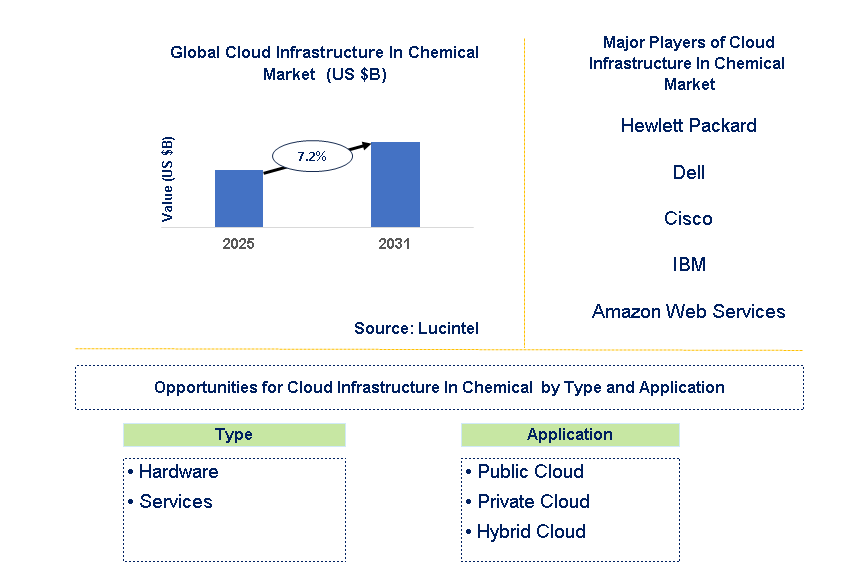
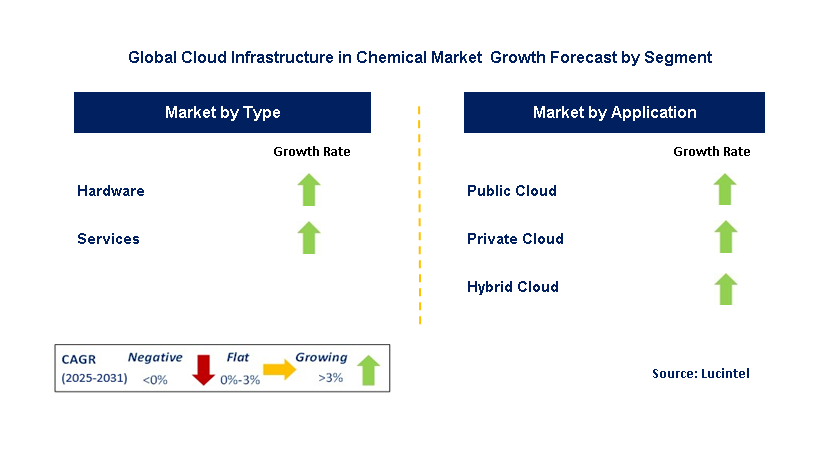
The future of the global cloud infrastructure in chemical market looks promising with opportunities in the public cloud, private cloud and hybrid cloud markets. The global cloud infrastructure in chemical market is expected to grow with a CAGR of 7.2% from 2025 to 2031. The major drivers for this market are growing adoption of iot and ai, increasing operational efficiency, and rising regulatory demands, cloud infrastructure.Lucintel forecasts that, within the type category, services is expected to witness higher growth over the forecast period.
Within the application category, hybrid cloud is expected to witness the highest growth.
In terms of region, In terms of region, APAC is expected to witness the highest growth over the forecast period.
Gain valuable insights for your business decisions with our comprehensive 150+ page report. Sample figures with some insights are shown below.
Emerging Trends in the Cloud Infrastructure in Chemical Market
As the chemical industry continues to shift towards cloud-based solutions, some key trends emerge. The trend reflects an increased reliance of the industry on digital technologies in pursuit of growth, optimization of operations, and enhancement of innovation.• Data-Driven Decision Making: Cloud-based platforms enable chemical companies to harness large volumes of data for real-time decision-making. With data analytics, machine learning, and artificial intelligence in the cloud, companies are now able to predict demand, optimize production schedules, and streamline their supply chains. Advanced data analytics will allow chemical companies to make decisions more quickly and in a more informed manner to drive efficiency and competitiveness.
• Internet of Things (IoT) integration: The chemical industry is now witnessing the integration of cloud infrastructure with IoT devices. This helps in collecting real-time data from equipment, machinery, and sensors, thus enhancing monitoring, predictive maintenance, and overall operational efficiency. The availability of this data in the cloud enables chemical companies to make faster adjustments to their processes and reduce downtime.
• Digital Twin Technologies: Digital twin technologies are being increasingly adopted in the chemical industry, powered by cloud infrastructure. These virtual replicas of physical assets allow chemical companies to simulate and monitor real-world processes and optimize performance without the risk of disruption. By using cloud-based digital twin models, companies can forecast issues, optimize designs, and improve efficiency across the production process.
• Collaborative Innovation and Research: The cloud is enabling collaborative innovation among chemical companies, research institutions, and partners. Companies can share data, research findings, and development processes via cloud-based environments, which is accelerating the release of new products and solutions to the market. This alone makes the trend crucial for chemical industries whose success is driven by innovation and speed.
• Cloud for Sustainability and Compliance: More recently, chemical companies are using the cloud to enhance sustainability activities and ensure regulatory compliance. Cloud technologies are introducing agility in terms of monitoring environmental impacts, resource utilization, and minimizing waste throughout the supply chain. It also helps the company adhere to ever-strict regulations due to its ability to simplify reporting and compliance processes.
These trends are remodeling the cloud infrastructure market in the chemical industry as it enhances efficiency, fosters innovation, and promotes sustainability and compliance.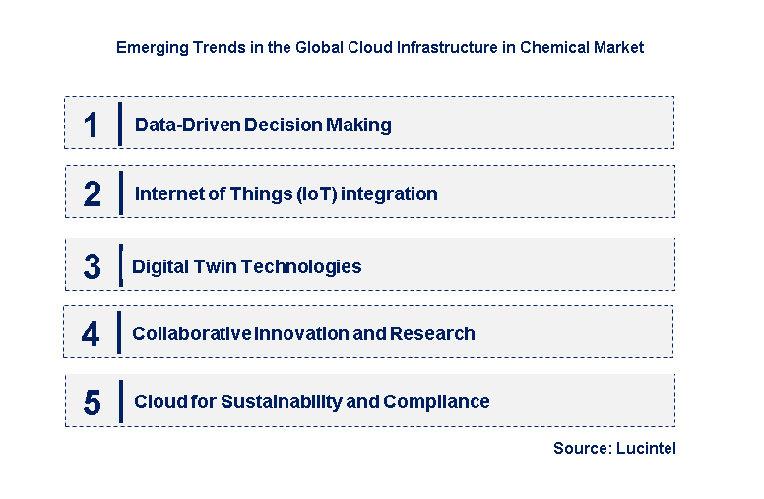
Recent Development in the Cloud Infrastructure in Chemical Market
Recent advancements in cloud infrastructure for the chemical market illustrate that digital technologies have become of high importance for operations optimization and innovation promotion. Some of the developments driving this change in the market are described below:• Cloud-Based ERP Systems: Chemical companies are increasingly adopting cloud-based Enterprise Resource Planning (ERP) systems to streamline their operations. These systems help integrate various business functions, from procurement to production to distribution, making processes more efficient and allowing for real-time data access across departments. This development enhances collaboration, reduces inefficiencies, and improves decision-making across the chemical value chain.
• Adoption of Advanced Analytics and AI: Most chemical companies are using advanced analytics and AI on cloud infrastructure to optimize production, reduce costs, and predict market trends. Companies have the ability to make better product formulations, reduce manufacturing processes, and minimize waste through big data analytics. In addition, AI-based application helps companies optimize their supply chain; it also helps in demand forecasting and maintenance prediction.
• More Emphasis on Cybersecurity: With more chemical companies shifting their operations to the cloud, cybersecurity has become a much more important issue. Companies are investing in advanced cloud security solutions to protect sensitive data and ensure compliance with industry regulations. This includes using encryption, multi-factor authentication, and other advanced security protocols to protect cloud-based systems and data.
• Cloud for R&D and Innovation: Cloud infrastructure is playing a central role in accelerating research and development in the chemical industry. Companies are using cloud-based platforms to store and analyze large volumes of R&D data, collaborate with global research teams, and simulate product development. This has led to faster innovation cycles and the development of new, more efficient chemicals and materials.
• Rapid Growth of Cloud-Based Collaboration Tools: Chemical companies are getting improved internal communication and collaboration with external organizations due to the shift towards cloud-based collaboration tools. It allows teams to collaborate in real-time, share files, and monitor project progress, which becomes crucial for global teams working in different geographies.
All these developments point out how cloud infrastructure is enabling the chemical industry to be more efficient, secure, and innovative in the way the market grows.Strategic Growth Opportunites in the Cloud Infrastructure in Chemical Market
The adoption of cloud infrastructure in the chemical industry has many strategic growth opportunities. This can be across a range of applications and sectors where companies are trying to optimize operations, innovate, and remain competitive.• Supply Chain Optimization: Cloud-based solutions have delivered in the hands of chemical organizations the tools to optimize their supply chain. Companies are equipped with real-time data analytics that allow them to track inventory, predict demand and enhance distribution efficiency. Improved supply chain management results in cost savings, better resource utilization, and faster market response.
• Product Development and Innovation: It hastens product innovation and development processes in the chemical industry. A cloud infrastructure system allows companies to collaborate more cohesively in leveraging big data analytics, helps companies develop a new, novel product, as well as quicken the already existing formulation-which is pertinent in staying current in an innovate-driven market.
• Sustainability and Environmental Monitoring: Cloud platforms are enabling chemical companies to track and manage their environmental impact more efficiently. Companies are using cloud-based tools to monitor emissions, waste, and energy consumption, thereby ensuring that they meet sustainability goals. This helps improve environmental performance, comply with regulations, and reduce operational costs.
• Regulatory Compliance Management: Regulatory compliance is a significant challenge for the chemical industry. Cloud infrastructure is providing chemical companies with tools to streamline compliance processes, manage regulatory reporting, and adhere to industry standards. The cloud makes complex regulatory requirements easy to manage, thereby enabling faster and more accurate compliance reporting.
• IOT and Predictive Maintenance: Integrating cloud infrastructure with IoT devices is helping chemical companies monitor equipment health and predict when maintenance will be required. Using real-time data from sensors and connected devices allows companies to prevent downtime, extend the life of equipment, and lower maintenance costs. This trend is expected to grow as more companies adopt IoT technologies.
These strategic opportunities show how cloud infrastructure can drive growth and innovation within the chemical sector, offering companies the ability to improve efficiency, collaborate better, and address industry-specific challenges.Cloud Infrastructure in Chemical Market Driver and Challenges
Various drivers and challenges determine the shape of the growth of cloud infrastructure market in the chemical industry. Some of them include technological progress as well as extrinsic drivers of how a firm operates or innovates.The factors responsible for driving the cloud infrastructure in chemical market include:
1. Digital Transformation: This is an essential driver to adopt cloud technology due to continuous digitalization happening within the chemical industry. Most firms are switching towards cloud infrastructure for process automation, bettering the supply chain, and having a real-time decision-making approach.
2. Cost Efficiency: Cloud infrastructure helps chemical companies reduce the costs of maintaining on-premise systems and hardware. With cloud-based solutions, companies can access the latest technologies without large upfront investments, leading to greater cost efficiency.
3. Advanced Analytics and AI: The cloud has revolutionized how chemical companies analyze production data, forecast market trends, and improve product quality by using artificial intelligence and data analytics.
4. Increased Collaboration: Cloud infrastructure enables better collaboration among internal teams and external partners. Chemical companies are using cloud-based tools to share research, improve communication, and develop new products, thereby boosting overall productivity.
5. Regulatory Compliance: With increasing regulatory pressure on the chemical industry, cloud-based solutions help companies maintain compliance with safety and environmental standards. The cloud simplifies reporting and tracking, ensuring that companies meet necessary regulatory requirements.
Challenges in the cloud infrastructure in chemical market are:
1. Cybersecurity Risks: As chemical companies migrate sensitive data to the cloud, ensuring robust cybersecurity becomes critical. Protecting intellectual property and maintaining compliance with industry standards pose significant challenges for companies.
2. Integration Complexity: Integrating cloud systems with existing legacy systems is complex, especially in large, established chemical companies. The need to ensure smooth integration and avoid operational disruptions is a key challenge.
3. Data Privacy Concerns: The management of sensitive data in the cloud raises privacy concerns, particularly in regions with strict data protection laws. Chemical companies need to ensure that their cloud solutions comply with data privacy regulations.
The cloud infrastructure market in the chemical industry is pushed by technological innovation, cost saving, and the need for compliance with regulations. However, these challenges include the risk of cyber attacks, the complexity of integrating with other services, and issues of data privacy.
List of Cloud Infrastructure In Chemical Companies
Companies in the market compete on the basis of product quality offered. Major players in this market focus on expanding their manufacturing facilities, R&D investments, infrastructural development, and leverage integration opportunities across the value chain. With these strategies cloud infrastructure in chemical companies cater increasing demand, ensure competitive effectiveness, develop innovative products & technologies, reduce production costs, and expand their customer base. Some of the cloud infrastructure in chemical companies profiled in this report include-• Hewlett Packard Enterprise
• Dell
• Cisco
• IBM
• Amazon Web Services
• Salesforce
• Alphabet
• NetApp
• Intel
• Lenovo
Cloud Infrastructure In Chemical Market by Segment
The study includes a forecast for the global Cloud Infrastructure In Chemical Market by type, application, and region.Cloud Infrastructure In Chemical Market by Type [Value from 2019 to 2031]:
• Hardware
• Services
Cloud Infrastructure In Chemical Market by Application [Value from 2019 to 2031]:
• Public Cloud
• Private Cloud
• Hybrid Cloud
Cloud Infrastructure In Chemical Market by Region [Value from 2019 to 2031]:
• North America
• Europe
• Asia Pacific
• The Rest of the World
Country Wise Outlook for the Cloud Infrastructure in Chemical Market
The chemical industry is undergoing significant transformation as cloud infrastructure solutions play an increasingly important role in driving operational efficiency, innovation, and data management. Companies in the United States, China, Germany, India, and Japan are investing in cloud technologies to streamline their supply chains, improve data analytics, and enable real-time decision-making. These advancements not only help chemical companies respond to market dynamics faster but also foster collaboration and improve scalability. This cloud transition is redefining the way chemical companies manage everything from research and development to manufacturing and logistics, helping them stay ahead in a rapidly changing global marketplace.• United States: In the United States, chemical companies are resorting to cloud technologies to enhance their R&D capabilities and improve supply chain management. Industry leaders are moving their enterprise resource planning (ERP) and manufacturing operations to the cloud, an evolution that allows for better integration and visibility of data across the different functions. The advent of digital twin technologies and artificial intelligence has further accelerated this transition, making it possible to optimize processes in real time and predict maintenance needs. Cloud-based platforms also ensure regulatory compliance, as reporting and monitoring can be done faster. This simplifies the complex chemical industry standards and requirements.
• China: Cloud infrastructure is being adopted rapidly in China's chemical industry. Companies are using cloud computing for everything from R&D to production and distribution. Many of China's largest chemical producers have adopted cloud-based technologies to help enhance the efficiency of their operations, especially in product development and innovation. The ongoing drive for digital transformation initiated by the Chinese government is further nudging chemical companies to embrace cloud infrastructure solutions. Moreover, the application of big data analytics in the cloud is helping companies to predict market demands more accurately, optimize supply chains, and improve decision-making processes at all levels of production.
• Germany: Germany's chemical industry is known for its strong emphasis on technological innovation, and cloud infrastructure is increasingly being adopted to enhance productivity and reduce operational costs. Companies in Germany are using cloud-based solutions for everything from predictive analytics to chemical manufacturing process safety. The trend towards cloud-based solutions has also helped chemical sector companies manage their energy consumption better and reduce waste more effectively. In addition, German chemical companies are integrating cloud technologies with Industry 4.0 solutions to enhance automation, collaboration, and overall supply chain management.
• India: The momentum in cloud infrastructure in the chemical industry is seen to be building up in India. Companies want to modernize their operations and streamline supply chains. Indian chemical firms are using cloud-based systems to improve data analytics, enhance decision-making, and facilitate communication between departments. Digitalization has been increasing, helping Indian chemical companies to deal with process optimization and resource management challenges. In addition, the cloud is also facilitating better regulatory compliance, which is a significant aspect of the chemical industry in India, as government regulations on environmental impact and safety are becoming increasingly stringent.
• Japan: Japan's chemical industry is embracing cloud infrastructure to improve operational efficiency and encourage innovation. Cloud technologies are assisting chemical companies in Japan in streamlining their R&D processes and speeding up the time-to-market for new products. Production efficiencies and supply chain management are being collectively understood through the integration of artificial intelligence and machine learning with cloud platforms. Digital transformation in the industry is further being supported by cloud-based platforms and thus improving collaboration among different business units, along with more effective response to globalization and the trends and demands of consumers.

Features of the Global Cloud Infrastructure In Chemical Market
Market Size Estimates: Cloud infrastructure in chemical market size estimation in terms of value ($B).Trend and Forecast Analysis: Market trends (2019 to 2024) and forecast (2025 to 2031) by various segments and regions.
Segmentation Analysis: Cloud infrastructure in chemical market size by type, application, and region in terms of value ($B).
Regional Analysis: Cloud infrastructure in chemical market breakdown by North America, Europe, Asia Pacific, and Rest of the World.
Growth Opportunities: Analysis of growth opportunities in different type, application, and regions for the cloud infrastructure in chemical market .
Strategic Analysis: This includes M&A, new product development, and competitive landscape of the cloud infrastructure in chemical market .
Analysis of competitive intensity of the industry based on Porter’s Five Forces model.

FAQ
Q1. What is the growth forecast for cloud infrastructure in chemical market ?Answer: The global cloud infrastructure in chemical market is expected to grow with a CAGR of 7.2% from 2025 to 2031.
Q2. What are the major drivers influencing the growth of the cloud infrastructure in chemical market ?
Answer: The major drivers for this market are growing adoption of iot and ai, increasing operational efficiency, and rising regulatory demands, cloud infrastructure.
Q3. What are the major segments for cloud infrastructure in chemical market ?
Answer: The future of the cloud infrastructure in chemical market looks promising with opportunities in the public cloud, private cloud and hybrid cloud markets.
Q4. Who are the key cloud infrastructure in chemical market companies?
Answer: Some of the key cloud infrastructure in chemical companies are as follows:
• Hewlett Packard Enterprise
• Dell
• Cisco
• IBM
• Amazon Web Services
• Salesforce
• Alphabet
• NetApp
• Intel
• Lenovo
Q5. Which cloud infrastructure in chemical market segment will be the largest in future?Answer: Lucintel forecasts that, within the type category, services is expected to witness higher growth over the forecast period.
Q6. In cloud infrastructure in chemical market , which region is expected to be the largest in next 5 years?
Answer: In terms of region, APAC is expected to witness the highest growth over the forecast period.
Q7. Do we receive customization in this report?
Answer: Yes, Lucintel provides 10% customization without any additional cost.
Table of Contents
Methodology
- In-depth interviews of the major players in this market
- Detailed secondary research from competitors’ financial statements and published data
- Extensive searches of published works, market, and database information pertaining to industry news, company press releases, and customer intentions
- A compilation of the experiences, judgments, and insights of Lucintel’s professionals, who have analyzed and tracked this market over the years.


Buy Now
Choose a license that fits your team. Instant PDF delivery.
Prices exclude taxes. Instant delivery. Custom licensing available on request.
Key Questions
- • What are some of the most promising, high-growth opportunities for the cloud infrastructure in chemical market by type (hardware and services), application (public cloud, private cloud, and hybrid cloud), and region (North America, Europe, Asia Pacific, and the Rest of the World)?
- • Which segments will grow at a faster pace and why?
- • Which region will grow at a faster pace and why?
- • What are the key factors affecting market dynamics? What are the key challenges and business risks in this market?
- • What are the business risks and competitive threats in this market?
- • What are the emerging trends in this market and the reasons behind them?
- • What are some of the changing demands of customers in the market?
- • What are the new developments in the market? Which companies are leading these developments?
- • Who are the major players in this market? What strategic initiatives are key players pursuing for business growth?
- • What are some of the competing products in this market and how big of a threat do they pose for loss of market share by material or product substitution?
- • What M&A activity has occurred in the last 5 years and what has its impact been on the industry? For any questions related to Cloud Infrastructure In Chemical Market, Cloud Infrastructure In Chemical Market Size, Cloud Infrastructure In Chemical Market Growth, Cloud Infrastructure In Chemical Market Analysis, Cloud Infrastructure In Chemical Market Report, Cloud Infrastructure In Chemical Market Share, Cloud Infrastructure In Chemical Market Trends, Cloud Infrastructure In Chemical Market Forecast, Cloud Infrastructure In Chemical Companies, write Lucintel analyst at email: helpdesk@lucintel.com. We will be glad to get back to you soon.


