
Report Feature
Isothermal Nucleic Acid Amplification Technology Market Trends and Forecast
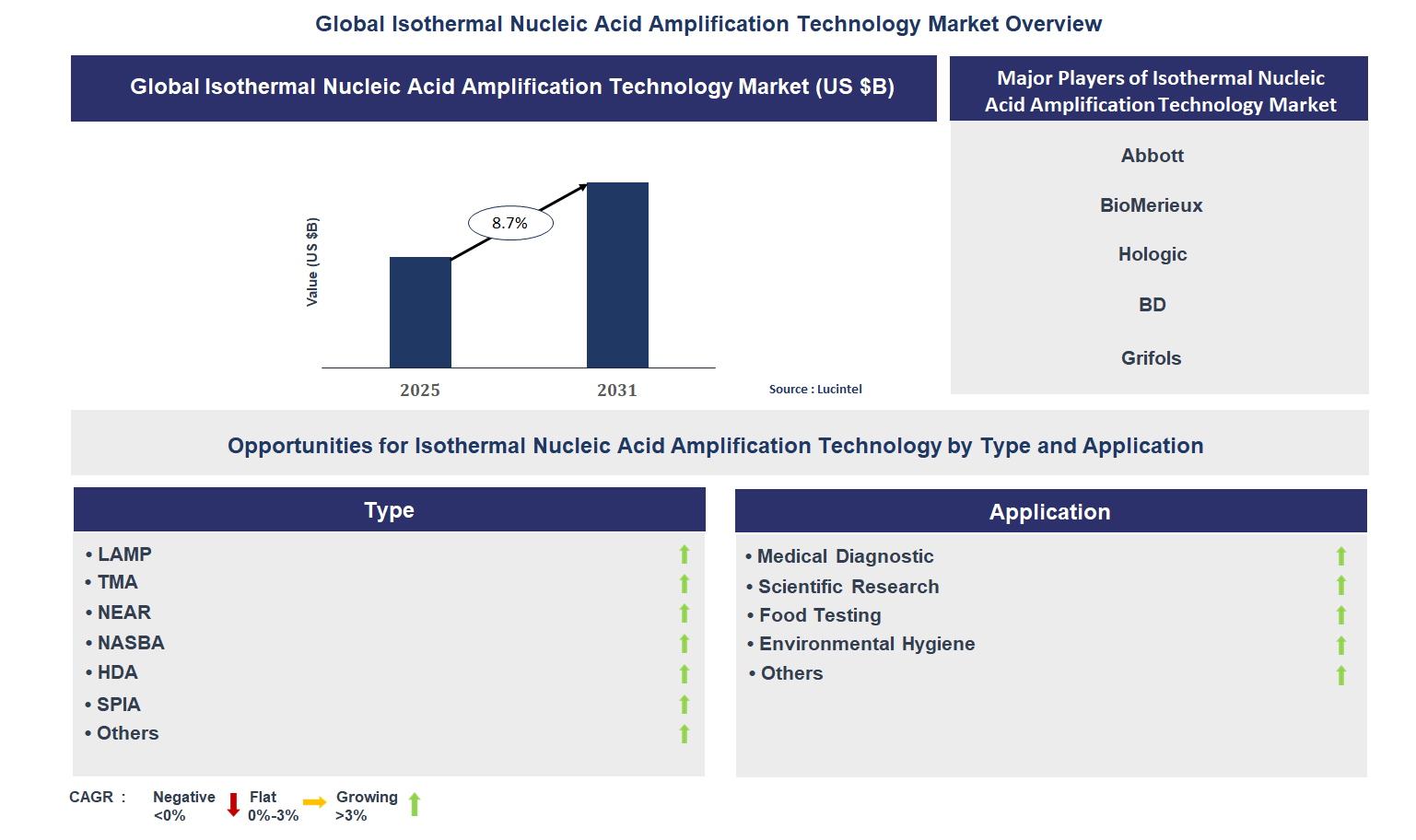
The future of the global isothermal nucleic acid amplification technology market looks promising with opportunities in the medical diagnostic, scientific research, food testing, and environmental hygiene markets. The global isothermal nucleic acid amplification technology market is expected to grow with a CAGR of 8.7% from 2025 to 2031. The major drivers for this market are the increasing demand for rapid disease diagnosis, the rising adoption of point-of-care testing, and the growing advancements in molecular diagnostic methods.• Lucintel forecasts that, within the type category, LAMP is expected to witness the highest growth over the forecast period.
• Within the application category, medical diagnostic is expected to witness the highest growth.
• In terms of region, APAC is expected to witness the highest growth over the forecast period. Gain valuable insights for your business decisions with our comprehensive 150+ page report. Sample figures with some insights are shown below.
Emerging Trends in the Isothermal Nucleic Acid Amplification Technology Market
Emerging trends in isothermal nucleic acid amplification technology market reshape diagnostics landscape through innovations enabling faster, portable, and versatile testing beyond traditional labs. Integration with cutting-edge tools amplifies accessibility and precision across diverse applications.• Point-of-Care Expansion: Point-of-care dominance surges with battery-powered devices requiring no thermal cycling, enabling on-site testing in remote or emergency settings. This trend slashes diagnostic delays, empowers frontline healthcare, and revolutionizes outbreak responses by delivering results in under an hour, broadening global health equity.
• CRISPR Integration Boost: CRISPR pairing enhances specificity and multiplexing, allowing simultaneous pathogen detection from crude samples. Impact includes superior antimicrobial resistance tracking and epidemic surveillance, driving adoption in high-burden regions while minimizing false positives for reliable clinical decisions.
• Automation Surge Ahead: Full automation in high-throughput systems streamlines workflows, cutting manual errors and labor costs. Hospitals benefit from scalable testing for transplants and blood screening, accelerating throughput and supporting precision medicine advancements in busy clinical environments.
• Portable Device Rise: Smartphone-linked instruments facilitate field-deployable assays for viruses like Zika from minimal samples. This portability transforms public health monitoring, enabling real-time data in low-resource areas and fostering decentralized diagnostics for immediate intervention.
• Oncology Application Shift: Expansion into cancer via stool-RNA and liquid biopsy tests enables early, non-invasive detection. Impacts include improved survival rates through accessible screening, shifting paradigms from invasive procedures to routine, patient-friendly molecular profiling. These trends collectively propel isothermal technology toward ubiquitous, decentralized diagnostics, diminishing PCR reliance and unlocking versatile applications from epidemics to personalized medicine, ultimately redefining accessible, efficient global healthcare delivery.
Recent Development in the Isothermal Nucleic Acid Amplification Technology Market
Recent developments underscore isothermal nucleic acid amplification technology market‘s pivotal role in diagnostics evolution, marked by regulatory nods, novel integrations, and strategic moves amplifying speed, accuracy, and reach across healthcare sectors.• Cancer Screening Assay: Regulatory clearance for stool-based RNA test pioneers non-invasive colorectal detection, transforming screening accessibility. Impact elevates early intervention rates, reduces procedural burdens, and integrates seamlessly into routine checkups for broader population coverage.
• Transplant Pathogen Assays: New quantitative assays for cytomegalovirus, EBV, and BKV gain approvals, optimizing monitoring in transplant patients. This enhances graft survival through timely viral load tracking, streamlining post-operative care and minimizing complications in critical settings.
• Malaria Blood Screening: CE-marked assay targets Plasmodium in donors, bolstering transfusion safety. Impact fortifies blood banks against overlooked infections, ensuring reliable supplies and protecting vulnerable recipients worldwide.
• LAMP Master Mixes: Lyophilized mixes for saliva and direct samples simplify workflows. Enables robust amplification in diverse matrices, accelerating research and point-of-care deployment for infectious agents.
• Strategic Firm Acquisition: Acquisition bolsters platform for next-gen diagnostics, merging detection expertise. Accelerates innovation pipelines, fortifying market positions and hastening commercialization of advanced tools. These advancements catalyze market maturation by embedding isothermal solutions into routine practice, elevating diagnostic efficacy, and paving pathways for sustained innovation in precision health.
Strategic Growth Opportunities in the Isothermal Nucleic Acid Amplification Technology Market
Strategic growth in isothermal nucleic acid amplification technology market hinges on application-specific expansions, capitalizing on rapid testing needs across diagnostics, screening, and emerging therapeutic monitoring for transformative healthcare impacts.• Infectious Diagnostics Boom: Dominates with kits targeting HIV, hepatitis, and respiratory pathogens, addressing outbreak urgency. Surge in adoption curbs spread via swift, field-ready results, fortifying public health defenses and antimicrobial stewardship.
• Blood Screening Expansion: Rising transfusions demand pathogen-free validation, spurring INAAT integration. Enhances supply chain safety, prevents transmissions, and supports high-volume processing for reliable clinical transfusions.
• Cancer Detection Rise: Liquid biopsy and stool assays enable early molecular profiling. Revolutionizes oncology by facilitating non-invasive monitoring, improving outcomes through timely interventions and personalized strategies.
• Point-of-Care Testing: Portable platforms empower decentralized labs and homes. Transforms access in remote areas, slashing delays and enabling real-time decisions for improved patient management.
• Transplant Monitoring Tools: Viral load assays track pathogens post-procedure. Optimizes immunosuppression, boosts graft longevity, and reduces rejection risks via precise, frequent assessments. These application-focused avenues propel market diversification, embedding isothermal tech as diagnostics cornerstone, driving efficiency gains and equitable health advancements globally.
Isothermal Nucleic Acid Amplification Technology Market Driver and Challenges
Major drivers and challenges in isothermal nucleic acid amplification technology market encompass technological edges, economic efficiencies, regulatory landscapes, alongside hurdles like reimbursement gaps and entrenched competitors shaping adoption trajectories. The factors responsible for driving the isothermal nucleic acid amplification technology market include: 1. Infectious Disease Rise: Escalating outbreaks of HIV, hepatitis, influenza fuel demand for swift diagnostics. Amplifies market penetration as governments prioritize containment, spurring kit deployments and public health investments for resilient surveillance networks. 2. Cost Efficiency Edge: Lower operational needs versus PCR attract budget-conscious labs. Enables widespread affordability, particularly in emerging markets, accelerating transitions to scalable, high-throughput testing paradigms. 3. Blood Transfusion Demand: Surging donations require rigorous screening. Positions INAAT as preferred for rapid, reliable pathogen detection, safeguarding supplies and expanding into transfusion-dependent therapies. 4. Point-of-Care Push: Portable, inhibitor-tolerant tech suits decentralized use. Revolutionizes remote and emergency care, bridging infrastructure gaps and empowering non-specialists for immediate action. 5. Research Funding Surge: Investments fuel novel assay development. Accelerates innovations like CRISPR hybrids, broadening applications and fostering startup ecosystems for sustained technological leaps. Challenges in the isothermal nucleic acid amplification technology market are: 1. Reimbursement Barriers: Limited coverage hampers clinical uptake. Slows adoption in fee-for-service models, necessitating policy advocacy to unlock full market potential. 2. PCR Technology Dominance: Established infrastructure resists shifts. Challenges market share gains, demanding superior demonstrations in speed and simplicity to sway entrenched users. 3. Regulatory Hurdles: Stringent approvals delay launches. Prolongs timelines for innovators, particularly startups, requiring streamlined pathways to match pace with diagnostic needs. Drivers overwhelmingly outpace challenges, propelling robust expansion through superior accessibility and versatility, while hurdles spur refinements in policy and proof-of-value, ensuring resilient, innovation-led trajectory for isothermal dominance.List of Isothermal Nucleic Acid Amplification Technology Companies
Companies in the market compete on the basis of product quality offered. Major players in this market focus on expanding their manufacturing facilities, R&D investments, infrastructural development, and leverage integration opportunities across the value chain. With these strategies isothermal nucleic acid amplification technology companies cater increasing demand, ensure competitive effectiveness, develop innovative products & technologies, reduce production costs, and expand their customer base. Some of the isothermal nucleic acid amplification technology companies profiled in this report include-• Abbott
• BioMerieux
• Hologic
• BD
• Grifols
• Quidel
• Meridian Bioscience
• Qiagen
• Eiken Chemical
• OptiGene
Isothermal Nucleic Acid Amplification Technology Market by Segment
The study includes a forecast for the global isothermal nucleic acid amplification technology market by type, application, and region.Isothermal Nucleic Acid Amplification Technology Market by Type [Value from 2019 to 2031]:
• LAMP
• TMA
• NEAR
• NASBA
• HDA
• SPIA
• Others
Isothermal Nucleic Acid Amplification Technology Market by Application [Value from 2019 to 2031]:
• Medical Diagnostic
• Scientific Research
• Food Testing
• Environmental Hygiene
• Others
Isothermal Nucleic Acid Amplification Technology Market by Region [Value from 2019 to 2031]:
• North America
• Europe
• Asia Pacific
• The Rest of the World
Country Wise Outlook for the Isothermal Nucleic Acid Amplification Technology Market
The isothermal nucleic acid amplification technology market witnesses accelerated growth driven by point-of-care diagnostics demand, infectious disease outbreaks, and technological integrations enhancing rapid testing capabilities across key regions. Advancements in portable devices and regulatory approvals bolster adoption in healthcare settings worldwide.• United States: United States leads with robust FDA clearances for innovative assays targeting cytomegalovirus in transplants and stool-based cancer screening, enabling non-invasive oncology diagnostics. Launches of automated high-volume systems and point-of-care platforms reduce turnaround times, empowering clinics and hospitals to enhance patient outcomes through faster, accurate molecular testing.
• China: China dominates Asia-Pacific through streamlined regulatory approvals and local manufacturing, securing supply chains for tuberculosis and dengue surveillance kits. Government healthcare investments support widespread deployment in public health programs, fostering affordable, scalable solutions that improve outbreak response and population-level disease management.
• Germany: Germany anchors Europe with strong hospital networks and harmonized standards promoting energy-efficient systems over traditional methods. Translational research drives adoption in reference labs, enhancing infectious disease diagnostics and cost containment, positioning the country as a hub for advanced molecular testing infrastructure.
• India: India advances via government-backed programs supplying low-cost kits for tuberculosis and dengue monitoring in resource-limited areas. Rising healthcare awareness accelerates point-of-care integration, enabling rapid field testing that strengthens epidemic control and expands access to diagnostics for underserved populations.
• Japan: Japan leverages aging demographics and universal reimbursement to promote home-based testing solutions. Advanced infrastructure supports portable devices for chronic disease monitoring, reducing hospital burdens while ensuring precise, user-friendly diagnostics that align with national health priorities.

Features of the Global Isothermal Nucleic Acid Amplification Technology Market
Market Size Estimates: Isothermal nucleic acid amplification technology market size estimation in terms of value ($B). Trend and Forecast Analysis: Market trends (2019 to 2024) and forecast (2025 to 2031) by various segments and regions. Segmentation Analysis: Isothermal nucleic acid amplification technology market size by type, application, and region in terms of value ($B). Regional Analysis: Isothermal nucleic acid amplification technology market breakdown by North America, Europe, Asia Pacific, and Rest of the World. Growth Opportunities: Analysis of growth opportunities in different types, applications, and regions for the isothermal nucleic acid amplification technology market. Strategic Analysis: This includes M&A, new product development, and competitive landscape of the isothermal nucleic acid amplification technology market. Analysis of competitive intensity of the industry based on Porter’s Five Forces model.
FAQ
Q1. What is the growth forecast for isothermal nucleic acid amplification technology market? Answer: The global isothermal nucleic acid amplification technology market is expected to grow with a CAGR of 8.7% from 2025 to 2031. Q2. What are the major drivers influencing the growth of the isothermal nucleic acid amplification technology market? Answer: The major drivers for this market are the increasing demand for rapid disease diagnosis, the rising adoption of point-of-care testing, and the growing advancements in molecular diagnostic methods. Q3. What are the major segments for isothermal nucleic acid amplification technology market? Answer: The future of the isothermal nucleic acid amplification technology market looks promising with opportunities in the medical diagnostic, scientific research, food testing, and environmental hygiene markets. Q4. Who are the key isothermal nucleic acid amplification technology market companies? Answer: Some of the key isothermal nucleic acid amplification technology companies are as follows:• Abbott
• BioMerieux
• Hologic
• BD
• Grifols
• Quidel
• Meridian Bioscience
• Qiagen
• Eiken Chemical
• OptiGene Q5. Which isothermal nucleic acid amplification technology market segment will be the largest in future? Answer: Lucintel forecasts that, within the type category, LAMP is expected to witness the highest growth over the forecast period. Q6. In isothermal nucleic acid amplification technology market, which region is expected to be the largest in next 5 years? Answer: In terms of region, APAC is expected to witness the highest growth over the forecast period. Q7. Do we receive customization in this report? Answer: Yes, Lucintel provides 10% customization without any additional cost.
Table of Contents
List of Figures
List of Tables
Methodology
- In-depth interviews of the major players in this market
- Detailed secondary research from competitors’ financial statements and published data
- Extensive searches of published works, market, and database information pertaining to industry news, company press releases, and customer intentions
- A compilation of the experiences, judgments, and insights of Lucintel’s professionals, who have analyzed and tracked this market over the years.


Buy Now
Choose a license that fits your team. Instant PDF delivery.
Prices exclude taxes. Instant delivery. Custom licensing available on request.
Key Questions
- • What are some of the most promising, high-growth opportunities for the isothermal nucleic acid amplification technology market by type (LAMP, TMA, NEAR, NASBA, HDA, SPIA, and others), application (medical diagnostic, scientific research, food testing, environmental hygiene, and others), and region (North America, Europe, Asia Pacific, and the Rest of the World)?
- • Which segments will grow at a faster pace and why?
- • Which region will grow at a faster pace and why?
- • What are the key factors affecting market dynamics? What are the key challenges and business risks in this market?
- • What are the business risks and competitive threats in this market?
- • What are the emerging trends in this market and the reasons behind them?
- • What are some of the changing demands of customers in the market?
- • What are the new developments in the market? Which companies are leading these developments?
- • Who are the major players in this market? What strategic initiatives are key players pursuing for business growth?
- • What are some of the competing products in this market and how big of a threat do they pose for loss of market share by material or product substitution?
- • What M&A activity has occurred in the last 5 years and what has its impact been on the industry? For any questions related to Isothermal Nucleic Acid Amplification Technology Market, Isothermal Nucleic Acid Amplification Technology Market Size, Isothermal Nucleic Acid Amplification Technology Market Growth, Isothermal Nucleic Acid Amplification Technology Market Analysis, Isothermal Nucleic Acid Amplification Technology Market Report, Isothermal Nucleic Acid Amplification Technology Market Share, Isothermal Nucleic Acid Amplification Technology Market Trends, Isothermal Nucleic Acid Amplification Technology Market Forecast, Isothermal Nucleic Acid Amplification Technology Companies, write Lucintel analyst at email: helpdesk@lucintel.com. We will be glad to get back to you soon.


