
Market Report · July 29, 2026

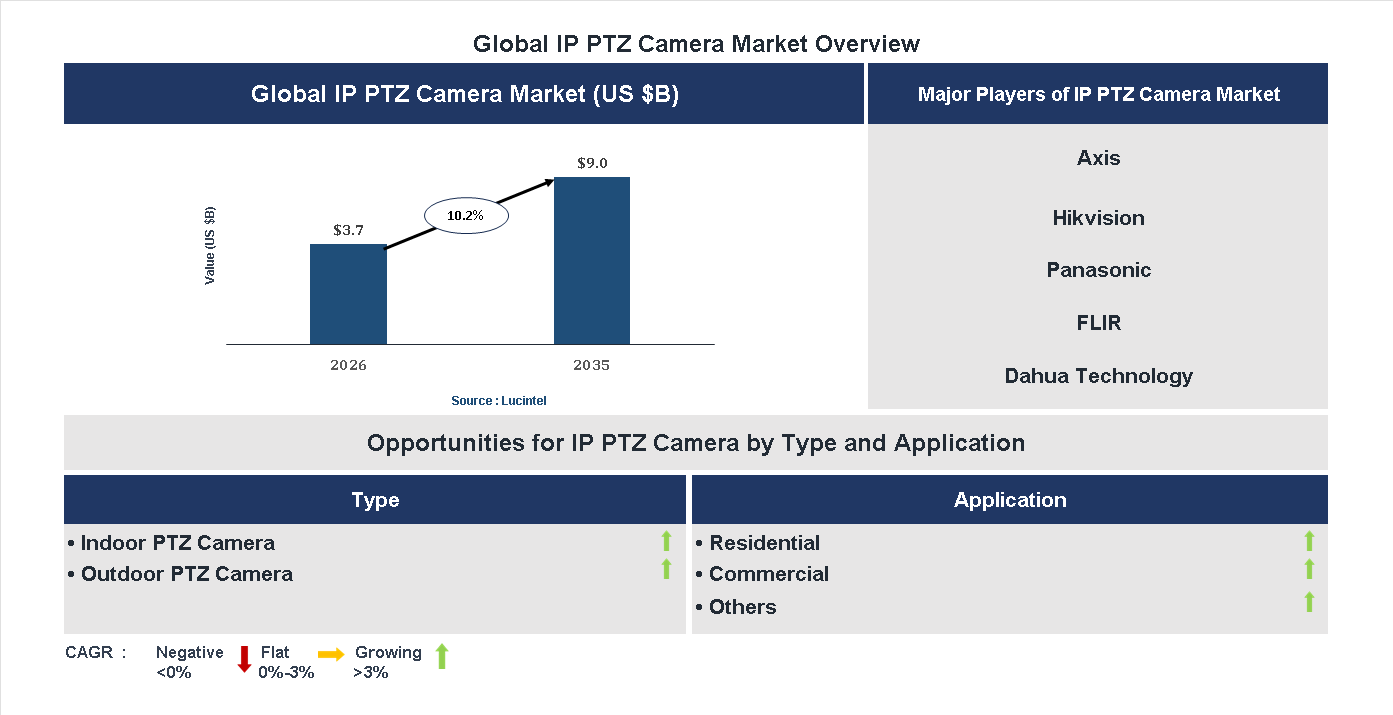
Key data points: The market size in 2035 = $9 billion, growth forecast = 10.2% annually for the next 8 years. Scroll below to get more insights. This market report covers trends, opportunities and forecasts in IP PTZ camera market to 2035 by type (indoor PTZ camera and outdoor PTZ camera), application (residential, commercial, and others), and region (North America, Europe, Asia Pacific, and the Rest of the World)
We'll send your sample report shortly.
• Lucintel forecasts that, within the type category, outdoor PTZ camera is expected to witness higher growth over the forecast period.
• Within the application category, commercial is expected to witness higher growth.
• In terms of region, APAC is expected to witness the highest growth over the forecast period. Gain valuable insights for your business decisions with our comprehensive 150+ page report. Sample figures with some insights are shown below.
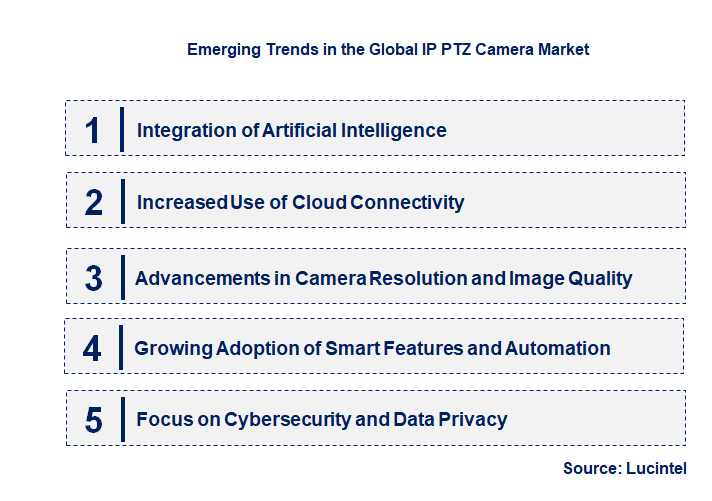
• Integration of Artificial Intelligence: AI-powered IP PTZ cameras are transforming surveillance by enabling real-time analytics, facial recognition, and behavior analysis. This trend enhances security by providing proactive threat detection and reducing false alarms. AI integration also facilitates automation, allowing cameras to track moving objects or individuals automatically, improving response times. As AI technology becomes more affordable and sophisticated, its adoption is expected to grow, making surveillance systems smarter, more efficient, and capable of delivering actionable insights.
• Increased Use of Cloud Connectivity: Cloud-based IP PTZ cameras are gaining popularity due to their ease of access, scalability, and remote management capabilities. Cloud connectivity allows users to view live feeds, store footage, and manage multiple cameras from any location via internet-enabled devices. This trend reduces the need for extensive on-premises infrastructure and simplifies maintenance. It also enhances data security through encrypted storage and access controls. As internet penetration and bandwidth improve globally, cloud-enabled surveillance solutions are becoming a preferred choice for various sectors, including retail, transportation, and government.
• Advancements in Camera Resolution and Image Quality: The demand for high-definition (HD) and ultra-high-definition (UHD) IP PTZ cameras is rising, driven by the need for clearer images for identification and detailed analysis. Enhanced resolution improves the effectiveness of surveillance in large areas and complex environments. Innovations in sensor technology and image processing algorithms contribute to better low-light performance and reduced noise. These improvements enable more accurate monitoring, forensic investigations, and evidence collection, making high-resolution cameras a critical component in modern security systems.
• Growing Adoption of Smart Features and Automation: Modern IP PTZ cameras are equipped with smart features such as motion detection, auto-tracking, and scene analytics. Automation capabilities allow cameras to respond automatically to specific events, reducing the need for constant human oversight. These features improve operational efficiency and security response times. Integration with other security systems, such as alarms and access controls, further enhances their functionality. As organizations seek cost-effective and reliable security solutions, the adoption of smart, automated cameras is expected to accelerate, transforming traditional surveillance into intelligent security ecosystems.
• Focus on Cybersecurity and Data Privacy: As IP cameras are connected to networks, cybersecurity becomes a critical concern. Market players are investing in robust encryption, secure firmware, and regular updates to protect against hacking and data breaches. Data privacy regulations are also influencing product development, ensuring compliance with standards like GDPR. This trend emphasizes the importance of secure deployment and management of surveillance systems, fostering trust among users. Enhanced cybersecurity measures are vital for safeguarding sensitive footage and maintaining the integrity of surveillance operations, especially in critical infrastructure and government applications. In summary, these trends are collectively reshaping the IP PTZ camera market by making surveillance systems more intelligent, connected, high-quality, automated, and secure. They are enabling organizations to achieve higher levels of security, operational efficiency, and data protection, thereby driving market growth and innovation in the evolving landscape of security technology.
• Growing Adoption of IP PTZ Cameras: Increasing security needs and technological improvements are driving the adoption of IP PTZ cameras across various sectors. These cameras offer high-resolution imaging, remote control, and real-time monitoring, making them ideal for surveillance in public spaces, transportation, and commercial facilities. The shift from analog to digital systems enhances security effectiveness and operational efficiency. As organizations prioritize safety, the demand for advanced IP PTZ solutions continues to surge, fueling market growth.
• Integration of Artificial Intelligence and Analytics: The incorporation of AI and analytics into IP PTZ cameras is revolutionizing surveillance capabilities. These features enable real-time threat detection, facial recognition, and behavior analysis, significantly improving security response times. AI-driven analytics reduce false alarms and provide actionable insights, making surveillance smarter and more efficient. This technological integration attracts sectors like retail, banking, and transportation, expanding market applications and increasing demand for intelligent surveillance systems.
• Expansion of Cloud-Based Surveillance Solutions: Cloud technology is transforming IP PTZ camera deployment by offering scalable, cost-effective, and remote access options. Cloud-based solutions facilitate easy storage, management, and sharing of surveillance footage, reducing infrastructure costs. They enable centralized control and real-time monitoring from any location, enhancing operational flexibility. As organizations seek more efficient and accessible security systems, the adoption of cloud-enabled IP PTZ cameras is accelerating, broadening market reach and capabilities.
• Rising Demand in Smart Cities and Infrastructure Projects: Governments and urban planners are investing in smart city initiatives that require comprehensive surveillance networks. IP PTZ cameras are integral to these projects, providing high-quality, real-time monitoring for traffic management, public safety, and infrastructure security. The integration with IoT devices and data analytics enhances city management efficiency. This trend is expected to significantly boost market growth, as urban areas worldwide prioritize intelligent security solutions to improve safety and operational efficiency.
• Technological Advancements in Camera Features: Continuous innovations in camera technology, such as 4K resolution, optical zoom, and low-light performance, are expanding the capabilities of IP PTZ cameras. These advancements enable clearer images, better zoom capabilities, and effective operation in challenging lighting conditions. Enhanced durability and weather resistance also broaden application scopes, including outdoor and harsh environments. These technological improvements increase the value proposition for end-users, driving higher adoption rates and expanding the market landscape. Conclusion (80 Words) – The recent developments in the IP PTZ camera market, including technological innovations, AI integration, cloud solutions, and urban security projects, are significantly transforming the industry. These opportunities are driving increased adoption, expanding application areas, and enhancing surveillance effectiveness. As a result, the market is poised for substantial growth, with stakeholders benefiting from advanced, scalable, and intelligent security solutions that meet evolving safety and operational demands worldwide.
• Increasing Adoption of IP PTZ Cameras in Commercial Security: The rising need for comprehensive security solutions in retail, hospitality, and corporate sectors is boosting demand for IP PTZ cameras. These cameras offer high-resolution imaging, remote control, and advanced analytics, making them ideal for large-scale surveillance. As organizations seek cost-effective, scalable, and flexible security systems, the adoption of IP PTZ cameras is expected to grow significantly, driven by the need for real-time monitoring and threat detection.
• Integration of Artificial Intelligence for Enhanced Surveillance Capabilities: The incorporation of AI and machine learning into IP PTZ cameras is transforming surveillance by enabling intelligent features such as facial recognition, behavior analysis, and automatic threat detection. These capabilities improve response times and reduce false alarms, making surveillance more proactive and efficient. As AI technology becomes more affordable and accessible, its integration into IP PTZ cameras will open new opportunities for security providers and end-users seeking smarter, more autonomous systems.
• Growth of Cloud-Based Surveillance Solutions: Cloud technology is revolutionizing IP PTZ camera management by offering remote access, centralized control, and scalable storage options. Cloud-based solutions facilitate easier deployment, maintenance, and updates, reducing operational costs. The increasing preference for remote monitoring and data analytics is driving the adoption of cloud-enabled IP PTZ cameras across various industries, enabling real-time insights and seamless integration with other security systems.
• Expansion in Public Safety and Smart City Projects: Governments and municipalities are investing heavily in smart city initiatives, integrating IP PTZ cameras for traffic management, public safety, and law enforcement. These projects require high-capacity, reliable, and intelligent surveillance systems capable of handling large data volumes. The deployment of IP PTZ cameras in public spaces enhances situational awareness, crime prevention, and emergency response, creating substantial growth opportunities for vendors specializing in large-scale, integrated security solutions.
• Advancements in Connectivity and Network Infrastructure: The development of 5G and improved network infrastructure is enabling faster, more reliable transmission of high-definition video streams from IP PTZ cameras. Enhanced connectivity supports real-time monitoring, remote operation, and integration with other IoT devices. As network capabilities expand, the deployment of IP PTZ cameras in remote, challenging, or large-area environments will become more feasible, broadening market reach and enabling innovative surveillance applications. Conclusion: These strategic growth opportunities are poised to significantly influence the IP PTZ camera market by fostering innovation, expanding application areas, and improving operational efficiencies. As technology advances and security needs evolve, companies that leverage these opportunities will strengthen their market positions, meet increasing demand, and contribute to safer, smarter environments worldwide. The markets future will be shaped by the successful integration of AI, cloud, and connectivity innovations.
• Technological Innovation: The continuous development of high-resolution imaging, AI integration, and remote control capabilities enhances the functionality and appeal of IP PTZ cameras. These innovations enable better surveillance, real-time analytics, and improved user experience, driving adoption across sectors like retail, transportation, and government. As technology advances, manufacturers can offer more sophisticated, cost-effective solutions, fueling market growth and expanding application scope.
• Increasing Security Concerns: Growing concerns over crime, terrorism, and vandalism globally have heightened the demand for advanced surveillance systems. IP PTZ cameras provide comprehensive coverage, remote monitoring, and high-quality imaging, making them ideal for security purposes. Governments and private organizations are investing heavily in these solutions to safeguard assets, infrastructure, and public spaces, thereby propelling market expansion.
• Urbanization and Infrastructure Development: Rapid urban growth and infrastructure projects necessitate robust surveillance systems for safety and management. IP PTZ cameras are integral to smart city initiatives, traffic management, and public safety networks. The increasing deployment of these cameras in urban environments supports efficient monitoring and response, significantly contributing to market growth.
• Regulatory and Compliance Standards: Stringent regulations regarding surveillance, data privacy, and security standards are driving the adoption of compliant IP PTZ camera solutions. Manufacturers are innovating to meet these standards, which in turn boosts market confidence and adoption rates. Regulatory frameworks also encourage the integration of advanced features like encryption and access controls, fostering market development. The challenges facing this IP PTZ camera market include:
• High Installation and Maintenance Costs: The initial investment for IP PTZ camera systems, including hardware, installation, and ongoing maintenance, can be substantial. This financial barrier limits adoption among small and medium-sized enterprises. Additionally, the need for specialized personnel for installation and upkeep further escalates costs, potentially hindering market growth in cost-sensitive regions.
• Cybersecurity Risks: As IP PTZ cameras are connected to networks, they are vulnerable to hacking, data breaches, and cyber-attacks. These security concerns pose significant risks to organizations relying on these systems for critical surveillance. Ensuring robust cybersecurity measures increases complexity and costs, and any breach can undermine trust and hinder market expansion.
• Regulatory and Privacy Concerns: Evolving privacy laws and data protection regulations create compliance challenges for IP PTZ camera providers and users. Balancing surveillance needs with privacy rights requires sophisticated solutions and can limit deployment in certain regions. Navigating these complex legal landscapes can delay projects and increase operational risks. In summary, the IP PTZ camera market is driven by technological advancements, rising security needs, urbanization, and regulatory compliance, which collectively foster growth and innovation. However, high costs, cybersecurity vulnerabilities, and privacy concerns pose significant hurdles. These factors create a dynamic environment where market players must innovate continuously and address regulatory and security challenges to sustain growth. Overall, the markets future depends on balancing technological progress with effective risk management and cost optimization strategies.
• Axis
• Hikvision
• Panasonic
• FLIR
• Dahua Technology
• Honeywell
• Canon
• Pelco
• Sony
• Vaddio
• Indoor PTZ Camera
• Outdoor PTZ Camera
• Residential
• Commercial
• Others
• North America
• Europe
• Asia Pacific
• The Rest of the World
• United States: The US market has seen rapid adoption of AI-powered IP PTZ cameras, with increased integration into smart city projects and enterprise security systems. Leading companies are focusing on high-resolution imaging, cloud connectivity, and advanced analytics for real-time threat detection. Regulatory standards are evolving to address privacy concerns, influencing product development and deployment strategies. The demand for remote monitoring solutions has surged, especially in critical infrastructure and public safety sectors. Additionally, government initiatives promote the adoption of intelligent surveillance systems to enhance urban security.
• China: China remains a dominant player in the IP PTZ camera market, driven by government investments in surveillance infrastructure and smart city initiatives. Innovations in AI and facial recognition technologies are prominent, with many domestic manufacturers offering cost-effective, feature-rich solutions. The market is characterized by rapid product development cycles and extensive deployment across urban areas, transportation, and public spaces. Regulatory policies support technological innovation while emphasizing data security. The integration of 5G connectivity is further accelerating the deployment of real-time, high-quality surveillance systems across the country.
• Germany: Germanys market emphasizes high-quality, reliable, and privacy-compliant IP PTZ cameras, driven by strict EU data protection regulations. The focus is on integrating advanced analytics, such as license plate recognition and crowd monitoring, into security systems for urban and industrial applications. German manufacturers are known for their precision engineering and durability, catering to both domestic and European markets. The adoption of energy-efficient and environmentally sustainable solutions is gaining momentum. Additionally, collaborations with technology firms are fostering innovations in AI and machine learning to enhance surveillance capabilities while ensuring compliance with privacy laws.
• India: The Indian market is experiencing rapid growth due to increasing urbanization, rising security concerns, and government initiatives like Smart Cities and Digital India. Affordable IP PTZ cameras with basic analytics are widely adopted in public safety, transportation, and commercial sectors. The market is characterized by a mix of domestic and international players offering cost-effective solutions tailored to local needs. The adoption of cloud-based management and remote monitoring is expanding, supported by improving internet infrastructure. Regulatory frameworks are evolving to balance security needs with privacy considerations, encouraging innovation and deployment of smarter surveillance systems.
• Japan: Japans market focuses on high-end, technologically advanced IP PTZ cameras with a strong emphasis on cybersecurity and data privacy. The adoption of AI-driven analytics, such as facial recognition and behavior analysis, is prominent in public safety and transportation sectors. Japanese manufacturers prioritize durability, energy efficiency, and seamless integration with existing security infrastructure. The market is also influenced by government policies promoting smart city projects and disaster management systems. Innovations in sensor technology and 4K resolution cameras are enhancing surveillance precision. The country’s emphasis on privacy and security standards shapes the development and deployment of these advanced surveillance solutions.


• Axis
• Hikvision
• Panasonic
• FLIR
• Dahua Technology
• Honeywell
• Canon
• Pelco
• Sony
• Vaddio Q6. Which IP PTZ camera market segment will be the largest in future? Answer: Lucintel forecasts that, within the type category, outdoor PTZ camera is expected to witness higher growth over the forecast period. Q7. In IP PTZ camera market, which region is expected to be the largest in next 5 years? Answer: In terms of region, APAC is expected to witness the highest growth over the forecast period. Q8. Do we receive customization in this report? Answer: Yes, Lucintel provides 10% customization without any additional cost.


Choose a license that fits your team. Instant PDF delivery.
Prices exclude taxes. Instant delivery. Custom licensing available on request.
Market Report · July 29, 2026
Market Report · July 20, 2026
Market Report · July 20, 2026
Trusted partner for strategic intelligence and business growth


Receive a complimentary market analysis tailored to your industry. Our analysts will identify key growth opportunities and competitive dynamics specific to your business.

Market size, growth rate, and key trend analysis for your specific sector.

Top competitor positioning and market share analysis.

Strategic recommendations backed by data-driven insights.
Get curated market intelligence and competitive moves straight to your inbox.
By subscribing, you agree to receive our monthly insights. Unsubscribe anytime.
Receive a complimentary market analysis tailored to your industry. Our analysts will identify key growth opportunities and competitive dynamics specific to your business.
Market size, growth rate, and key trend analysis for your specific sector.
Top competitor positioning and market share analysis.
Strategic recommendations backed by data-driven insights.
Get curated market intelligence, emerging trends, and competitive moves straight to your inbox each month.
By subscribing, you agree to receive our monthly insights. Unsubscribe anytime.
We'll send your sample report shortly.