
Market Report · July 31, 2026

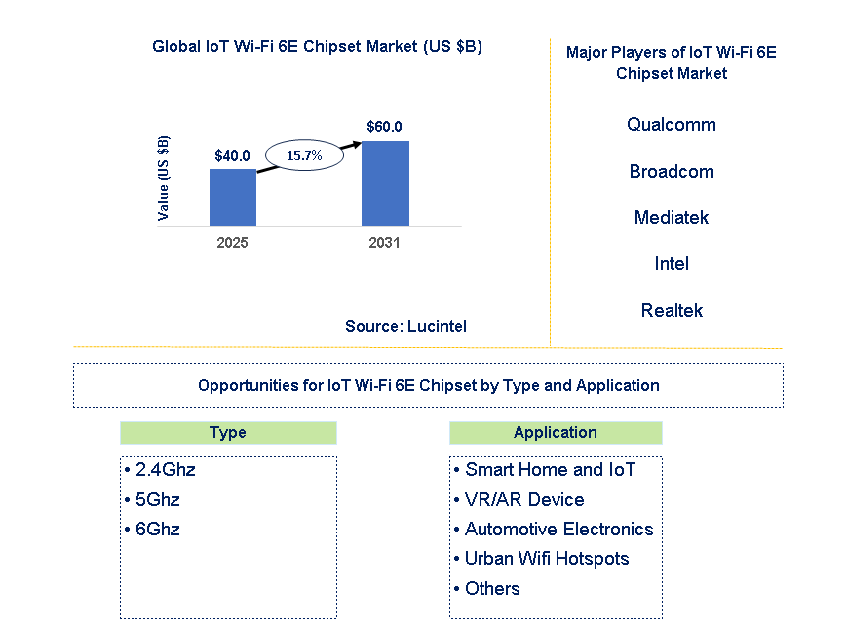
Key data points: The growth forecast = 15.7% annually for the next 7 years. Scroll below to get more insights. This market report covers Trends, opportunities and forecasts in IoT Wi-Fi 6E chipset market to 2031 by type (2.4ghz, 5ghz, and 6ghz), application (smart home and iot, vr/ar device, automotive electronics, urban wifi hotspots, and others), and region (North America, Europe, Asia Pacific, and the Rest of the World)
We'll send your sample report shortly.
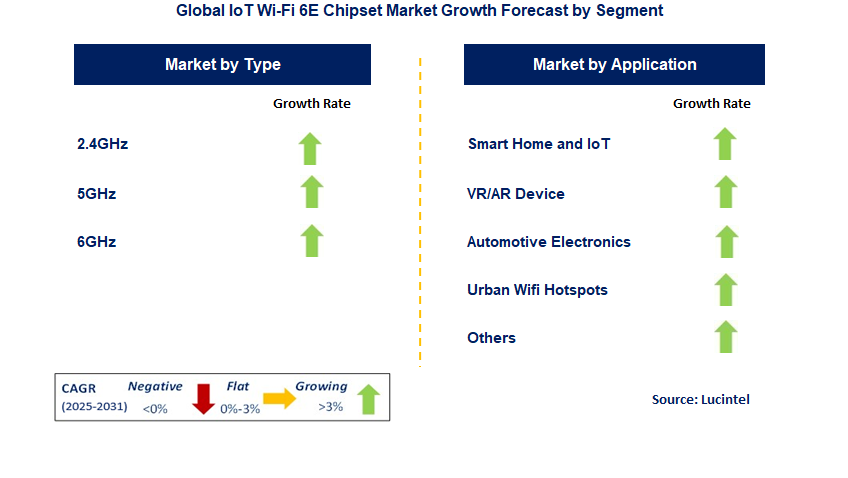
• Lucintel forecasts that, within the type category, 5ghz is expected to witness the highest growth over the forecast period due to provides a good balance between range and speed.
• Within the application category, smart home and iot is expected to witness the highest growth due to leading in terms of the overall market size and growth rate.
• In terms of region, North America is expected to witness the highest growth over the forecast period due to leader in deploying next-generation wireless technologies.
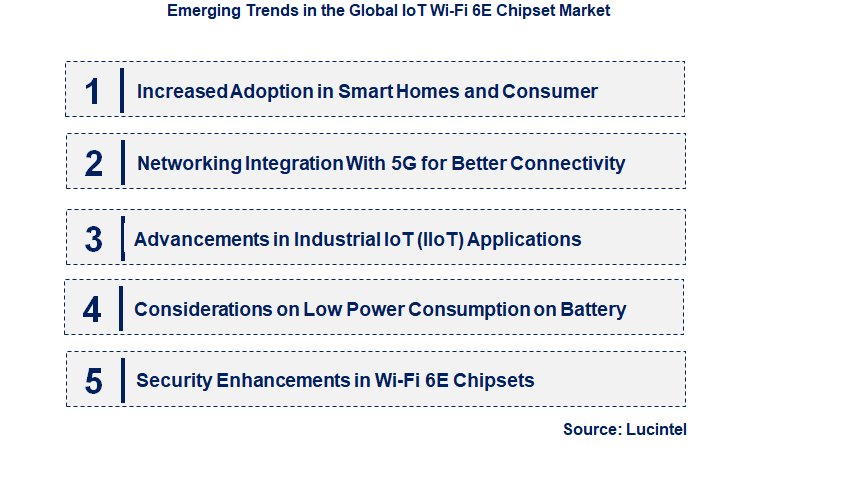
• Increased Adoption in Smart Homes and Consumer: The need for fast and reliable internet is increasingly becoming common in smart homes and consumer electronics, leading to increased acceptance of Wi-Fi 6E chipsets. Devices such as voice assistants, security cameras and smart appliances need to be connected for them to function well. The 6E way of Wi-Fi is useful because it can work in the 6 GHz bandwidth which has less congestion and more available bandwidth which is needed for most applications. The connectivity requirements of these devices in the IoT ecosystem will see Wi-Fi 6E take center stage.
• Networking Integration With 5G for Better Connectivity: Merger of 5G networks into wireless systems is one of the most remarkable developments for players in the IoT Wi-Fi 6E chipset market. The performance of both technologies improves with the integration of greater data transfer rates lower latency, and enhanced capacity. Autonomous vehicles, smart cities, and industrial environments will benefit tremendously from Wi-Fi 6E and 5G integration. The widening scope of integration gives rise to the growing demand for Wi-Fi 6E chipsets, as well as the 5G infrastructure. The parallel development of these solutions was also achieved to meet a possibility of seamless connections in IoT devices application environments.
• Advancements in Industrial IoT (IIoT) Applications: IIoT is another major factor influencing the growth of the IoT Wi-Fi 6E chipset market. The demand for dependable and low-latency connections in industries such as manufacturing, energy, and logistics leads to the adoption of Wi-Fi 6E technology. Characteristics of Wi-Fi 6E like high throughput, ultra-low latency, and ability to accommodate large volumes of device connections makes it perfect for IIoT applications. Smart factories, predictive maintenance, and real-time monitoring of industrial assets are increasingly adopting Wi-Fi 6E technology to enhance operational efficiency and minimize resource downtimes.
• Considerations on Low Power Consumption on Battery: The increase in the use of IoT devices in remote and difficult areas has significantly raised the demand for power-efficient chipsets. Like Wi-Fi 6E, which consumes a minimal amount of energy in comparison to its predecessors, is being integrated for use in wearable devices, sensors, and smart electric meters. This is indicative of the increasing appeal of sustainable IoT devices capable of operating for long durations without the need for power replenishment. Manufacturers are working on reducing power consumption without losing the high quality and speed of Wi-Fi 6E, which is a key contributor to its dominance in the IoT market.
• Security Enhancements in Wi-Fi 6E Chipsets: The increase in connected devices has created more issues for concerned IoT sectors such as healthcare, finance, crucial infrastructure, and more. For use with these devices, there is a need for better security features, which Wi-Fi 6E chipsets are being constructed with, featuring devices like WPA3 encryption. With the upgraded security features, Wi-Fi 6E will be the main requirement of IoT systems operating in high data privacy and protection environments. The need for secure cyber systems will only increase as the cyber threat environment evolves, thus increasing the demand for these secure Wi-Fi 6E chipsets especially in industries that handle sensitive data. New areas of connectivity, security, and speed are remodeling the IoT Wi-Fi 6E chipsets market. Hybrid work structures, smart homes, industrial IoT, and 5G adoption translates to an increased need for efficient, dependable, and secure communication infrastructure and with such demand comes the critical importance of Wi-Fi 6E. The application of Wi-Fi 6E in consumer electronics, industrials, and even battery-operated IoT devices forecasts an optimistic future for the technology and signals its prominence in the connected world.
• Prominent Players Design and Build Wi-Fi 6E Chipsets: Qualcomm, Intel, and Broadcom are some of the well-known Wi-Fi 6E chipsets manufacturers, and they have recently adjusted their supply to include newer versions optimized for IoT functions. These chipsets have unique designs aimed at IoT devices that have high power and low latency demand. The chipsets are anticipated to contribute to the transformation of smart homes, automation of industries, and enhance the use of devices in healthcare by ensuring reliable connections in highly interfered environments.
• Expansion of Wi-Fi 6E Coverage to New Markets: With the global adoption of Wi-Fi 6E, businesses are opening new market segments and regions. The supply chain for Wi-Fi 6E chipsets is wide enough for manufacturers to incorporate these devices into consumer electronics, automotive, and industrial IoT systems. The expansion of Wi-Fi 6E into new areas will improve these regions’ connectivity, which is particularly beneficial to areas increasingly clamoring for high speed internet.
• Collaborations to Drive Wi-Fi 6E Integration in IoT Applications: Innovation in wireless communication technology is encouraging businesses across different sectors to integrate Wi-Fi 6E chipsets into IoT applications. Some examples include collaborations between IoT device manufacturers and chipset manufacturers that permit Wi-Fi 6E enabled smart home and industrial sensors integration. Such collaborations facilitate IoT technology innovations in smart cities, healthcare, and manufacturing industries.
• Advancements in Power-Efficient Wi-Fi 6E Chipsets: Power efficiency is becoming more prevalent in the Internet of Things (IoT) industry, especially for devices that are battery operated. Companies are working on Wi-Fi 6E chipsets that are both high performing and low consuming. These low power chipsets are intended for use in remote IoT devices, wearables, and sensors, which helps improve battery life and decreases the need for recharging or maintenance.
• Security Aspects of Wi-Fi 6E Chipsets: Due to the issues surrounding IoT security, chipset developers are adding more features on their Wi-Fi 6E solutions. Some of these features are WPA3 encryption, secured boot, and other protocols to safeguard connected device data. With security being a priority in the IoT sector, it is anticipated that the addition of such security measures in Wi-Fi 6E chipsets will improve adoption rates by both consumers and enterprises. New changes in the IoT Wi-Fi 6E chipset market, particularly in the design, power optimization, and security features of the chipset are propelling enormous growth. These changes greatly enhance the capability of IoT devices to connect quicker, more securely, and reliably, which is crucial for smart homes, industrial IoT, and most other interdependent ecosystems. In the era of rising demand for high-grade connectivity, these innovations will certainly fuel the future of the IoT Wi-Fi 6E chipset market.
• Smart Homes: The Smart Homes segment has emerged as one of the main growth drivers for IoT Wi-Fi 6E chipsets. In the present high-speed internet era, an increasing number of households contain a variety of connected devices such as smart thermostats, security cameras, voice assistants, etc. Hence, the need for high-speed and low-latency connectivity is growing. Wa-Fi 6E, with its higher speed and less interference, is indeed helpful in better performance of these devices. Therefore, there is a wonderful opportunity for growth for the chipset manufacturers.
• Industrial IoT (Iao): The addition of Automation, Predictive Maintenance, and Advanced Real-time Data Analysis are leading companies to enhance operational efficiencies through the Industrial Internet of Things. We are witnessing rapid growth in the Industrial IoT sector. The demanding features of smart factories, automated production lines, and remote monitoring are increasing the needs towards Wi-Fi 6E chipsets within the industrial sector. For industries that require dependably fast connections, Wi-Fi 6E is the perfect solution as it has increased throughput as well as decreased latency.
• Healthcare: The use of the Internet of Things in the healthcare sector, especially in remote patient monitoring and diagnosis, is expected to dramatically increase. Healthcare IoT applications greatly benefit from Wi-Fi 6E's capacity to transfer huge amounts of data quickly and reliably. This opens up many possibilities for the integration of Wi-Fi 6E in medical devices and hospital information technology systems.
• Automotive and Connected Vehicles: Wi-Fi 6E chipsets are needed most in connected cars, making the automotive sector another major beneficiary. The car entertainment industry, as well as navigation and self driving technologies will grow with faster adoption of Wi-Fi 6E. As the automotive industry moves towards more IoT integration, the new Wi-Fi 6E chipsets will contribute to the emerging advanced technological features of the automobiles.
• Retail and Smart Retail Solutions: Wi-Fi 6E is increasingly being incorporated into solutions such as digital signage, stock control systems, and self-ordering kiosks which are all aimed at customers. Traffic at retail outlets and the need for fast and secure network for transaction as well as operational efficiency makes the retail sector embrace IoT. IoT Wi-Fi 6E Industry Growth Drivers Analysis Opportunities in smart homes, IIoT, healthcare, automotive, and retail are driving the expansion of the IoT Wi-Fi 6E chipset market. The need for reliable, fast, and secure wireless connectivity will market these opportunities. Adoption of Wi-Fi 6E technology will support innovation adoption in many areas which in turn will improve the overall growth potential of the market.
• Qualcomm
• Broadcom
• Mediatek
• Intel
• Realtek
• Marvell
• Celeno
• 2.4Ghz
• 5Ghz
• 6Ghz
• Smart Home And Iot
• VR/AR Device
• Automotive Electronics
• Urban Wifi Hotspots
• Others
• North America
• Europe
• Asia Pacific
• The Rest of the World
• United States: The United States has been at the forefront in the adoption of IoT Wi-Fi 6E chipsets. Qualcomm and Intel, two of the largest American companies, are currently working on new cutting edge chipsets for IoT devices. Strong government support towards infrastructural initiatives like 5G and IoT are greatly encouraging the adoption of Wi-Fi 6E. Moreover, increasing adoption of smart homes and commercial IoT applications in healthcare and manufacturing are propelling the adoption even further. With the growing need for high-speed, low latency connectivity for multi-purpose functions, the market is expected to grow at a significant rate.
• China: There’s an overwhelming demand for Wi-Fi 6E chipsets in China, and local firms like MediaTek and Huawei are spearheading the development of these technologies. There is a shift in focus because of the government push towards smarter city projects, and the increasing need for high speed connectivity in healthcare, manufacturing, and retail. Furthermore, the introduction of 5G and IoT infrastructure by the Chinese government is supporting the use of Wi-Fi 6E chipsets. The Wi-Fi 6E IoT market will grow rapidly as China becomes the leading powerhouse in the tech industry.
• Germany: Germany is at the forefront of adopting the IoT Wi-Fi 6E infrastructure within Europe, especially in the automotive and industrial fields. The Industry 4.0 policy, which emphasizes the use of IoT and automation in production processes, is also a good source of demand for the Wi-Fi 6E chipsets. Moreover, many German firms like Siemens and Bosch are known to integrate new technologies, and are therefore expected to use Wi-Fi 6E in their products. Increased deployment of smart cities and the need for sophisticated wireless connections in factories will drive the growth of the market.
• India: India is integrating IoT Wi-Fi 6E chipsets at an unprecedented rate with a special emphasis on smart homes, agriculture, and urban infrastructural development. The Digital India program and smart city initiatives have significantly raised the need for reliable and improved internet services. Domestic semiconductor firms are working with foreign companies to commercialize Wi-Fi 6E solutions that are targeted towards a broad range of affordable applications. Due to India’s increasing device penetration, the IoT Wi-Fi 6E chipset will be in high demand in coming years.
• Japan: Japan has always been a leader in the adopting of new technologies, and that includes the IoT Wi-Fi 6E chipset market. The development of smart cities, automation of industries, and the buildout of new generation telecommunication networks is increasing the need for performant chipsets; and Japan spearheads that innovation. Companies like Sony and Panasonic are expanding their lines of IoT enabled appliances and cars with Wi-Fi 6E integrated smart devices. While Japan continues to lead in innovation for robotics and precision manufacturing which require high speed and low delta connectivity, the market will continue to grow.


• Qualcomm
• Broadcom
• Mediatek
• Intel
• Realtek
• Marvell
• Celeno Q5. Which IoT Wi-Fi 6E chipset market segment will be the largest in future? Answer: Lucintel forecasts that, within the type category, 5ghz is expected to witness the highest growth over the forecast period due to provides a good balance between range and speed. Q6. In IoT Wi-Fi 6E chipset market, which region is expected to be the largest in next 5 years? Answer: In terms of region, North America is expected to witness the highest growth over the forecast period due to leader in deploying next-generation wireless technologies. Q7. Do we receive customization in this report? Answer: Yes, Lucintel provides 10% customization without any additional cost.


Choose a license that fits your team. Instant PDF delivery.
Prices exclude taxes. Instant delivery. Custom licensing available on request.
Market Report · July 31, 2026
Market Report · July 31, 2026
Market Report · July 31, 2026
Trusted partner for strategic intelligence and business growth


Receive a complimentary market analysis tailored to your industry. Our analysts will identify key growth opportunities and competitive dynamics specific to your business.

Market size, growth rate, and key trend analysis for your specific sector.

Top competitor positioning and market share analysis.

Strategic recommendations backed by data-driven insights.
Get curated market intelligence and competitive moves straight to your inbox.
By subscribing, you agree to receive our monthly insights. Unsubscribe anytime.
Receive a complimentary market analysis tailored to your industry. Our analysts will identify key growth opportunities and competitive dynamics specific to your business.
Market size, growth rate, and key trend analysis for your specific sector.
Top competitor positioning and market share analysis.
Strategic recommendations backed by data-driven insights.
Get curated market intelligence, emerging trends, and competitive moves straight to your inbox each month.
By subscribing, you agree to receive our monthly insights. Unsubscribe anytime.
We'll send your sample report shortly.