
Report Feature
Inverting Regulator Trends and Forecast
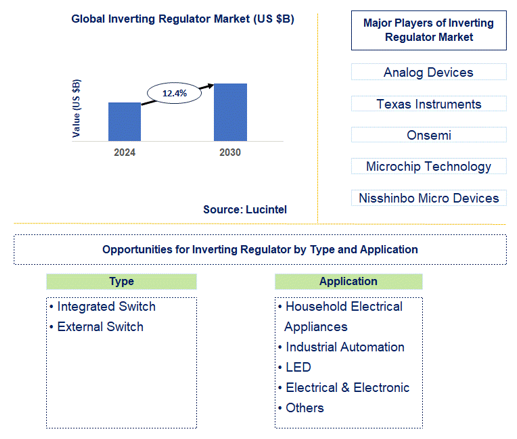
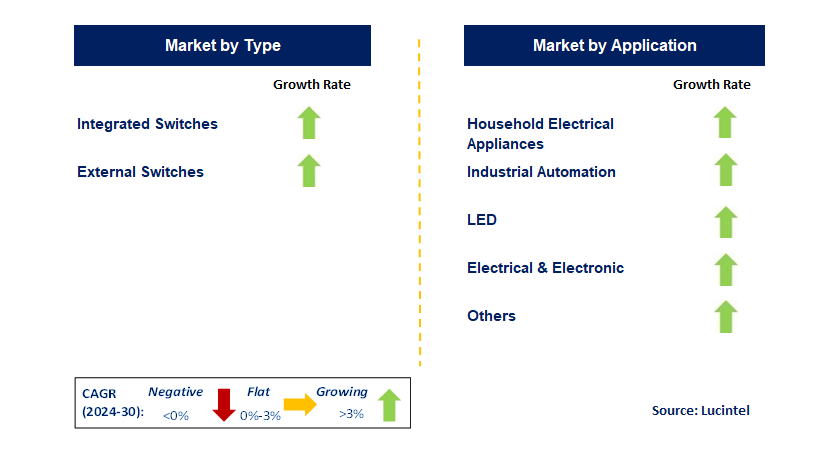
The future of the global inverting regulator market looks promising with opportunities in the household electrical appliance, industrial automation, led, and electrical & electronic markets. The global inverting regulator market is expected to grow with a CAGR of 12.4% from 2024 to 2030. The major drivers for this market are growing demand for efficient power management solutions in industrial automation, increasing adoption of renewable energy sources like solar and wind, requiring inverters for voltage conversion and grid compatibility, and growing integration of inverters in consumer electronics.• Lucintel forecasts that, within the type category, within the type category, within the type category integrated switch is expected to witness higher growth over the forecast period.
• Within the application category, household electrical appliance is expected to witness the highest growth.
• In terms of regions, APAC is expected to witness the highest growth over the forecast period. Gain valuable insights for your business decisions with our comprehensive 150+ page report.
Emerging Trends in the Inverting Regulator Market
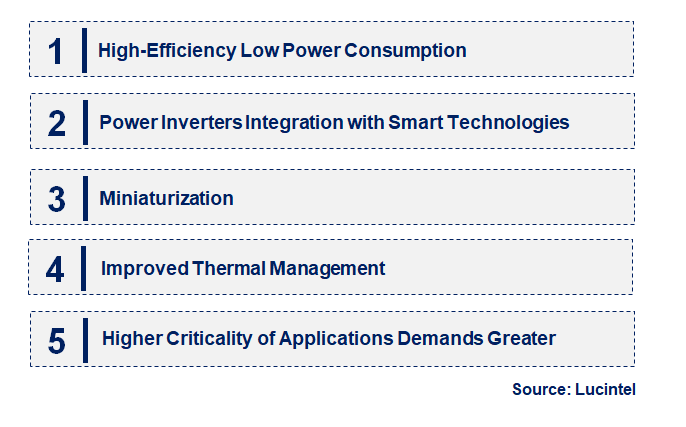
Several key trends are currently reshaping the landscape of power regulation solutions in the evolving inverting regulator market, reflecting ongoing technological advancements and changing market needs.• High-Efficiency, Low Power Consumption: There is significant demand for high-efficiency, low-power-consumption inverting regulators. Advances in semiconductor technology and circuit design have enabled better performance with reduced energy use, catering to the demand for greener solutions.
• Integration with Smart Technologies: Inverters are increasingly integrating with smart technologies, such as IoT and adaptive control systems. This trend allows for dynamic adjustments in power output based on real-time data, optimizing efficiency and system reliability.
• Miniaturization: There is strong momentum toward the miniaturization of inverting regulators to meet the needs of compact and portable electronic devices. Innovations in packaging and component design are enabling smaller yet powerful regulators suitable for modern, space-constrained applications.
• Improved Thermal Management: Advances in thermal management solutions have enhanced the performance and reliability of inverting regulators. New materials and design techniques are being developed to dissipate heat effectively, reducing the risk of overheating and ensuring stable operation.
• Emphasis on Reliability: As applications become increasingly critical, there is a growing demand for higher levels of reliability and robustness in inverting regulators. Upgraded testing methods during manufacturing and the incorporation of robust design features are essential for long-term performance in demanding conditions. These dynamics are driving significant changes in the inverting regulator market, focusing on achieving more efficient, reliable, and compact solutions.
Recent Developments in the Inverting Regulator Market
Recent developments in the inverting regulator market showcase new technologies that enhance performance and broaden application possibilities.• Advanced Semiconductor Materials: The use of advanced materials like silicon carbide (SiC) and gallium nitride (GaN) is improving the performance of inverting regulators. These materials offer higher efficiency, greater thermal resistance, and the capacity to handle higher voltages, leading to more robust and reliable products.
• Enhanced Power Density: Innovations in circuit design and packaging are resulting in regulators with higher power density. This allows for more compact designs without sacrificing performance, catering to the increasing demand for smaller and lighter electronic devices.
• Improved Thermal Management Solutions: New thermal management techniques are being integrated to enhance the performance of inverting regulators. Advanced technologies for heat dissipation maintain stability and reliability even under high-load conditions.
• Increased Integration Capabilities: Modern inverting regulators are designed with integrated features such as protection circuits and feedback mechanisms. These integrations improve overall functionality and reduce the need for additional components, thereby streamlining design and reducing system costs.
• Smart Regulation Technologies: The introduction of smart regulation technologies allows for adaptive power management. Regulators equipped with intelligent control systems can make real-time output adjustments, further optimizing efficiency and performance across a range of applications. These advancements are poised to further propel growth in the inverting regulator market by enhancing efficiency, compactness, and functionality.
Strategic Growth Opportunities for Inverting Regulator Market
Several strategic growth opportunities can be identified across various applications within the inverting regulator market. Capitalizing on these opportunities could enhance growth and innovation.• Automotive Applications: The expanding automotive sector creates high demand for inverting regulators, particularly for electric vehicles and advanced driving automation systems. Innovations that meet automotive standards for reliability and efficiency are in high demand.
• Consumer Electronics: This broad segment has significant potential for inverting regulators, especially those designed for smaller, efficient devices. Trends toward miniaturization and enhanced performance in gadgets like smartphones and wearables are driving demand.
• Renewable Energy Systems: Inverting regulators play a vital role in renewable energy systems, such as solar panels and wind turbines. Solutions that enhance energy conversion and management are essential for advancing sustainable energy efforts.
• Telecommunications: The growth of the telecommunications industry presents opportunities for inverting regulators in network equipment and infrastructure. High reliability and efficiency are crucial to support the expanding demands of network operations.
• Industrial Automation: The rise of industrial automation and smart manufacturing necessitates the use of inverting regulators to provide stable power supply and control for automation systems. Innovations that improve performance and minimize downtime are essential in this expanding industry. These emerging growth avenues are propelling the inverting regulator market forward, opening new applications and increasing demand for more reliable solutions.
Inverting Regulator Market Driver and Challenges
The inverting regulator market is influenced by various drivers and challenges that shape its development and adoption. Understanding these factors is crucial for navigating the market landscape. The factors responsible for driving the inverting regulator market include:• Rising Efficiency Demands: Growing pressure for energy efficiency is driving demand for high-performance inverting regulators, as decision-makers seek better power conversion and management solutions.
• Miniaturization Trends: The demand for miniaturized inverting regulators that can perform effectively in compact electronic devices is critical. Advances in packaging and design support improved performance without sacrificing size.
• Regulatory Compliance: Increased regulations and standards for electronic components influence the development of inverting regulators. Meeting these regulations ensures product quality and safety, fostering innovation and market growth.
• Growth in Electronics and Automotive Industries: The thriving electronics and automotive sectors are increasing demand for inverting regulators. The integration of advanced technologies in these industries offers substantial growth opportunities. Challenges in the inverting regulator market are:
• High Cost of Advanced Materials: Advanced semiconductor materials like SiC and GaN may be highly expensive. High material and production costs can make the technology unaffordable and thus less adoptable.
• Integration Difficulty: Integrating these new inverting regulators into systems can be really tricky. Compatibility and seamless operation may require proper designing and implementation, which may get pretty fiddly for both the manufacturer and the user.
• Regulatory Challenges: Diverse and changing regulatory requirements have their challenges. Ensuring compliance with a variety of standards and regulations complicates the development and market entry of the inverting regulator. The inverting regulator market is driven by technological advancements, the demand for efficiency, miniaturization, and regulatory adherence, while facing challenges related to material costs, integration complexity, and regulatory compliance. Balancing these drivers and challenges is essential for continued growth and innovation.
List of Inverting Regulator Companies
Companies in the market compete on the basis of product quality offered. Major players in this market focus on expanding their manufacturing facilities, R&D investments, infrastructural development, and leverage integration opportunities across the value chain. Through these strategies inverting regulator companies cater increasing demand, ensure competitive effectiveness, develop innovative products & technologies, reduce production costs, and expand their customer base. Some of the inverting regulator companies profiled in this report include-• Analog Devices
• Texas Instruments
• Onsemi
• Microchip Technology
• Nisshinbo Micro Devices
• Torex Semiconductor
• TSMC
• STMicroelectronics
• Renesas Electronics
• ABB
Inverting Regulator by Segment
The study includes a forecast for the global inverting regulator market by type, application, and region.Inverting Regulator Market by Type [Analysis by Value from 2018 to 2030]:
• Integrated Switches
• External Switches
Inverting Regulator Market by Application [Analysis by Value from 2018 to 2030]:
• Household Electrical Appliances
• Industrial Automation
• LED
• Electrical & Electronic
• Others
Inverting Regulator Market by Region [Analysis by Value from 2018 to 2030]:
• North America
• Europe
• Asia Pacific
• The Rest of the World
Country Wise Outlook for the Inverting Regulator Market
The inverting regulator market has seen significant developments driven by innovations in electronics and a growing demand for efficient power management solutions. As various industries adopt advanced technologies, the design, performance, and application of inverting regulators are evolving in key global markets.• United States: The U.S. is experiencing strong growth in innovative designs for high-efficiency inverting regulators, targeting advanced power management in consumer electronics and the automotive sector. Innovations include improved thermal management, higher power density, and enhanced efficiency.
• China: In China, there is a focus on scaling up production capabilities to reduce costs and improve reliability in inverting regulators. Recent developments include integrating advanced semiconductor materials and refining manufacturing processes to meet growing domestic and international demand.
• Germany: Germany is at the forefront of integrating inverting regulators into the latest automotive and industrial technologies, designing them to meet stringent European energy efficiency standards and enabling high-frequency switching for improved performance.
• India: Cost-effective inverting regulators are gaining traction in India, particularly for applications in telecommunications and industrial automation. Development efforts focus on reliable performance while maintaining affordability to capture the growing technology sector.
• Japan: Japan continues to lead in innovating inverting regulators with value-added features for high-precision applications. New advancements include integrating smart technologies for adaptive power management and enhancing operational reliability, reinforcing Japan's dominance in precision engineering and advanced electronics.

Features of the Global Inverting Regulator Market
Market Size Estimates: Inverting regulator market size estimation in terms of value ($B). Trend and Forecast Analysis: Market trends (2018 to 2023) and forecast (2024 to 2030) by various segments and regions. Segmentation Analysis: Inverting regulator market size by type, application, and region in terms of value ($B). Regional Analysis: Inverting regulator market breakdown by North America, Europe, Asia Pacific, and Rest of the World. Growth Opportunities: Analysis of growth opportunities in different types, applications, and regions for the inverting regulator market. Strategic Analysis: This includes M&A, new product development, and competitive landscape of the inverting regulator market. Analysis of competitive intensity of the industry based on Porter’s Five Forces model.If you are looking to expand your business in this market or adjacent markets, then contact us. We have done hundreds of strategic consulting projects in market entry, opportunity screening, due diligence, supply chain analysis, M & A, and more.

FAQ
Q1. What is the growth forecast for inverting regulator market? Answer: The global inverting regulator market is expected to grow with a CAGR of 12.4% from 2024 to 2030. Q2. What are the major drivers influencing the growth of the inverting regulator market? Answer: The major drivers for this market are growing demand for efficient power management solutions in industrial automation, increasing adoption of renewable energy sources like solar and wind, requiring inverters for voltage conversion and grid compatibility, and growing integration of inverters in consumer electronics. Q3. What are the major segments for inverting regulator market? Answer: The future of the inverting regulator market looks promising with opportunities in the household electrical appliance, industrial automation, led, and electrical & electronic markets. Q4. Who are the key inverting regulator market companies? Answer: Some of the key inverting regulator companies are as follows:• Analog Devices
• Texas Instruments
• Onsemi
• Microchip Technology
• Nisshinbo Micro Devices
• Torex Semiconductor
• TSMC
• STMicroelectronics
• Renesas Electronics
• ABB Q5. Which inverting regulator market segment will be the largest in future? Answer: Lucintel forecasts that, within the type category integrated switch is expected to witness higher growth over the forecast period. Q6. In inverting regulator market, which region is expected to be the largest in next 5 years? Answer: In terms of regions, APAC is expected to witness the highest growth over the forecast period. Q.7 Do we receive customization in this report? Answer: Yes, Lucintel provides 10% customization without any additional cost.
Table of Contents
Methodology
- In-depth interviews of the major players in this market
- Detailed secondary research from competitors’ financial statements and published data
- Extensive searches of published works, market, and database information pertaining to industry news, company press releases, and customer intentions
- A compilation of the experiences, judgments, and insights of Lucintel’s professionals, who have analyzed and tracked this market over the years.


Buy Now
Choose a license that fits your team. Instant PDF delivery.
Prices exclude taxes. Instant delivery. Custom licensing available on request.
Key Questions
- • What are some of the most promising, high-growth opportunities for the inverting regulator market by type (integrated switches and external switches), application (household electrical appliances, industrial automation, led, electrical & electronic, and others), and region (North America, Europe, Asia Pacific, and the Rest of the World)?
- • Which segments will grow at a faster pace and why?
- • Which region will grow at a faster pace and why?
- • What are the key factors affecting market dynamics? What are the key challenges and business risks in this market?
- • What are the business risks and competitive threats in this market?
- • What are the emerging trends in this market and the reasons behind them?
- • What are some of the changing demands of customers in the market?
- • What are the new developments in the market? Which companies are leading these developments?
- • Who are the major players in this market? What strategic initiatives are key players pursuing for business growth?
- • What are some of the competing products in this market and how big of a threat do they pose for loss of market share by material or product substitution?
- • What M&A activity has occurred in the last 5 years and what has its impact been on the industry? For any questions related to Inverting Regulator Market, Inverting Regulator Market Size, Inverting Regulator Market Growth, Inverting Regulator Market Analysis, Inverting Regulator Market Report, Inverting Regulator Market Share, Inverting Regulator Market Trends, Inverting Regulator Market Forecast, Inverting Regulator Market Companies, write Lucintel analyst at email: helpdesk@lucintel.com. We will be glad to get back to you soon.


