
Report Feature
Invasive Ventilator Market Trends and Forecast
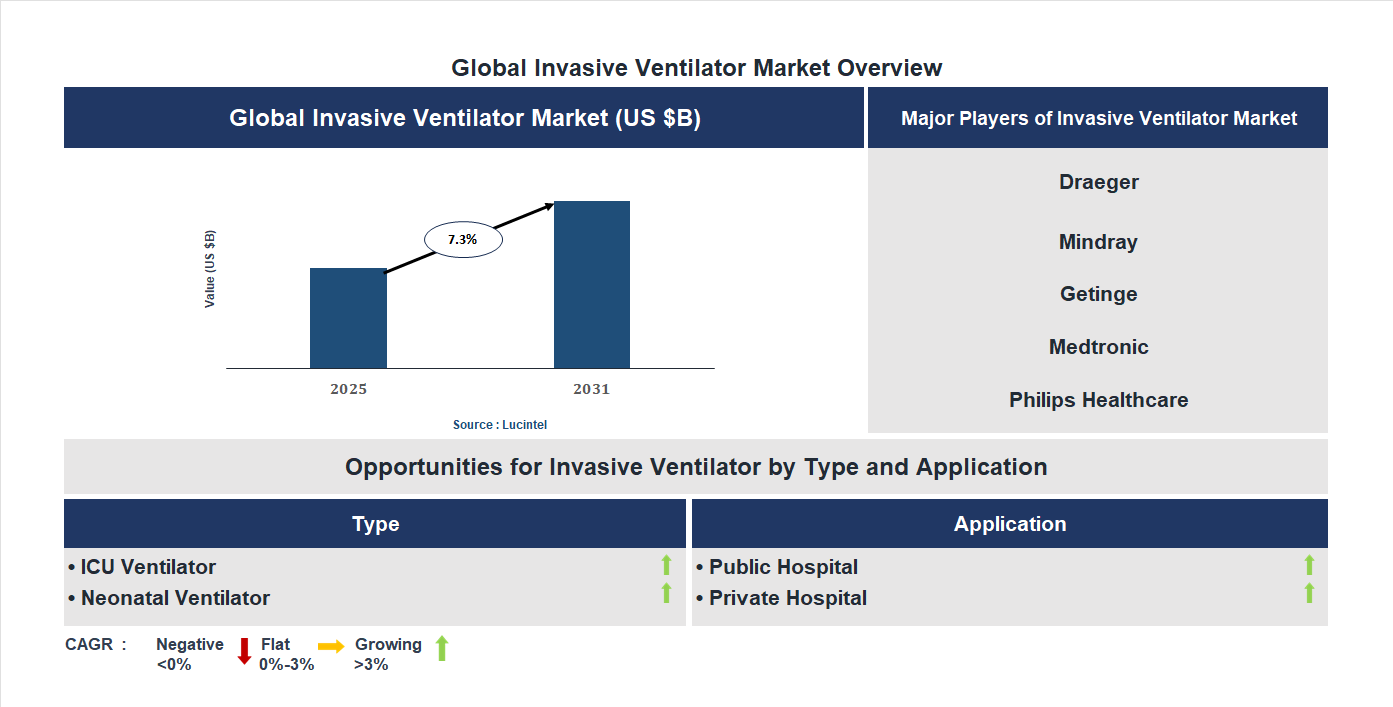
The future of the global invasive ventilator market looks promising with opportunities in the public hospital and private hospital markets. The global invasive ventilator market is expected to grow with a CAGR of 7.3% from 2025 to 2031. The major drivers for this market are the increasing demand for critical care & ICU support, the rising prevalence of respiratory diseases & covid cases, and the growing adoption in hospitals & healthcare facilities.• Lucintel forecasts that, within the type category, ICU ventilator is expected to witness higher growth over the forecast period.
• Within the application category, private hospital is expected to witness higher growth.
• In terms of region, APAC is expected to witness the highest growth over the forecast period. Gain valuable insights for your business decisions with our comprehensive 150+ page report. Sample figures with some insights are shown below.
Emerging Trends in the Invasive Ventilator Market
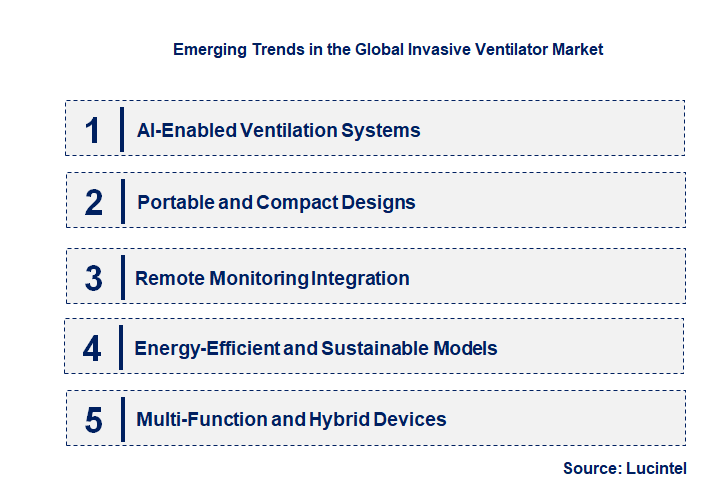
Emerging trends in the invasive ventilator market are driven by technological innovation, healthcare infrastructure expansion, and patient-centric design. Developments focus on automation, integration, and adaptability to improve treatment outcomes and operational efficiency in critical care environments.• AI-Enabled Ventilation Systems: AI-driven ventilators are optimizing respiratory support through adaptive algorithms. They automatically adjust ventilation parameters based on patient data, enhancing outcomes and reducing clinician workload in ICUs.
• Portable And Compact Designs: Development of smaller, portable ventilators allows for use in emergency, transport, and home care settings. Compact designs improve accessibility and rapid deployment in resource-limited or high-demand environments.
• Remote Monitoring Integration: Ventilators are increasingly equipped with remote monitoring capabilities. Clinicians can track patient data and ventilator performance in real-time, improving response times and treatment efficiency.
• Energy-Efficient And Sustainable Models: Manufacturers are focusing on energy-saving ventilators with lower power consumption. This reduces operational costs and supports hospitals in managing resources sustainably.
• Multi-Function And Hybrid Devices: Ventilators are integrating multiple respiratory support modes, including invasive and non-invasive functions. Hybrid designs enhance versatility, allowing healthcare providers to treat diverse patient needs with a single device. Trends are reshaping the invasive ventilator market toward smarter, compact, and energy-efficient solutions. Integration of AI, remote monitoring, and hybrid functionality enhances patient care and healthcare system resilience.
Recent Development in the Invasive Ventilator Market
Recent developments in the invasive ventilator market reflect increased focus on technology, reliability, and accessibility. Manufacturers are advancing device functionality, production capacity, and patient safety features to meet the growing needs of hospitals and critical care units.• AI Integration And Smart Controls: Advanced ventilators now include AI-assisted controls that adjust settings based on real-time patient data, improving treatment outcomes and reducing clinician intervention.
• Manufacturing Capacity Expansion: Companies are scaling production to meet rising demand. Increased capacity ensures supply stability for hospitals, emergency care units, and healthcare networks.
• Enhanced Monitoring Capabilities: Ventilators feature improved sensors and integrated monitoring systems. Real-time tracking of respiratory parameters enhances patient safety and facilitates early intervention in critical conditions.
• Compact And Portable Device Development: Smaller, transportable ventilators are being designed for emergency, mobile ICU, and home care applications. Portability increases accessibility and rapid deployment in critical situations.
• Hybrid Ventilation Mode Innovation: Devices now offer both invasive and non-invasive modes. Multi-functionality improves versatility, reducing the need for multiple separate devices in healthcare facilities. Developments in AI, portability, monitoring, and hybrid functionality are strengthening the invasive ventilator market. Improved device performance, accessibility, and safety are enhancing critical care delivery worldwide.
Strategic Growth Opportunities in the Invasive Ventilator Market
Growth opportunities in the invasive ventilator market are driven by critical care demand, ICU expansion, and emergency preparedness. Application-specific innovations enable improved patient outcomes and operational efficiency across hospital, transport, and home care settings.• ICU And Hospital Applications: Advanced ventilators with precise monitoring and AI-assisted controls are enhancing patient care in critical care units. Hospitals are investing in high-performance devices for better outcomes.
• Emergency And Transport Usage: Portable and compact ventilators support rapid deployment in ambulances, field hospitals, and disaster response scenarios. Devices enable life-saving interventions during transport and emergency care.
• Home Care And Chronic Support: Compact, user-friendly ventilators support long-term respiratory care at home. Devices improve patient quality of life and reduce hospital dependency.
• Telemedicine And Remote Monitoring: Ventilators with integrated remote monitoring enable clinicians to manage multiple patients remotely. This enhances efficiency and allows continuous oversight in critical care situations.
• Pediatric And Neonatal Applications: Specialized ventilators for pediatric and neonatal care address unique respiratory needs. Advanced controls and monitoring ensure safety and effective treatment for vulnerable patients. Application-driven growth is expanding the invasive ventilator market. ICU, emergency, home care, remote monitoring, and pediatric segments are driving adoption, innovation, and healthcare accessibility.
Invasive Ventilator Market Driver and Challenges
The invasive ventilator market is influenced by technological innovation, rising healthcare demand, and regulatory support. Drivers enhance adoption and device functionality, while challenges such as cost, complexity, and operational training affect deployment and growth strategies. The factors responsible for driving the invasive ventilator market include: 1. Critical Care Demand Growth: Increasing prevalence of respiratory illnesses and ICU expansion drives demand for invasive ventilators. Hospitals require reliable, high-performance devices for effective patient management. 2. Technological Innovation Advancement: Integration of AI, remote monitoring, and hybrid functions enhances ventilator performance, improving patient outcomes and operational efficiency in hospitals and emergency settings. 3. Healthcare Infrastructure Expansion: Investments in hospitals, ICUs, and emergency response systems increase ventilator deployment, supporting widespread adoption in developed and emerging markets. 4. Emergency Preparedness Focus: Governments and healthcare providers prioritize stockpiling and rapid deployment of ventilators for pandemics, natural disasters, and critical events, boosting market growth. 5. Regulatory Support And Approval: Streamlined approvals and supportive policies enable faster market entry and adoption of advanced invasive ventilators in healthcare systems. Challenges in the invasive ventilator market are: 1. High Device Cost Pressure: Advanced ventilators are expensive to manufacture and procure. High costs can limit accessibility in resource-constrained settings or emerging markets. 2. Operational Complexity Management: Complex devices require trained personnel for operation and maintenance. Lack of skilled staff can hinder optimal deployment and usage. 3. Maintenance And Reliability Concerns: Ensuring continuous performance and timely maintenance is critical. Device failure or downtime can impact patient safety and hospital operations. The invasive ventilator market is driven by critical care demand, technological innovation, infrastructure expansion, and regulatory support. High costs, operational complexity, and maintenance challenges must be managed to ensure broad adoption and effective patient care.List of Invasive Ventilator Companies
Companies in the market compete on the basis of product quality offered. Major players in this market focus on expanding their manufacturing facilities, R&D investments, infrastructural development, and leverage integration opportunities across the value chain. With these strategies invasive ventilator companies cater increasing demand, ensure competitive effectiveness, develop innovative products & technologies, reduce production costs, and expand their customer base. Some of the invasive ventilator companies profiled in this report include-• Draeger
• Mindray
• Getinge
• Medtronic
• Philips Healthcare
• Hamilton Medical
• Vyaire Medical
• GE Healthcare
• Aeonmed
• Comen
Invasive Ventilator Market by Segment
The study includes a forecast for the global invasive ventilator market by type, application, and region.Invasive Ventilator Market by Type [Value from 2019 to 2031]:
• ICU Ventilator
• Neonatal Ventilator
Invasive Ventilator Market by Application [Value from 2019 to 2031]:
• Public Hospital
• Private Hospital
Invasive Ventilator Market by Region [Value from 2019 to 2031]:
• North America
• Europe
• Asia Pacific
• The Rest of the World
Country Wise Outlook for the Invasive Ventilator Market
The invasive ventilator market is experiencing dynamic growth driven by rising demand for critical care and respiratory support in hospitals and ICUs. Advancements in technology, increased healthcare infrastructure, and emergency preparedness strategies are influencing product innovation, manufacturing expansion, and regulatory approvals across major global markets.• United States: The U.S. is focusing on high-performance invasive ventilators for ICUs and emergency care. Innovations include AI-assisted ventilation, real-time monitoring, and integration with electronic health records. Hospitals are upgrading fleets to enhance patient outcomes and operational efficiency in critical care settings.
• China: China is scaling domestic production of invasive ventilators to meet rising healthcare demand. Emphasis is on improving reliability, affordability, and automation capabilities. Government support and local collaborations are accelerating R&D and production of advanced models for hospitals and emergency response.
• Germany: Germany emphasizes high-quality ventilator development with advanced sensors and control systems. Efforts focus on enhancing precision, patient safety, and integration with ICU monitoring systems. Manufacturers collaborate with healthcare institutions to ensure robust performance in critical care environments.
• India: India is expanding ventilator availability in public and private hospitals. Focus is on affordable, robust, and easy-to-use models suitable for critical care and emergency settings. Partnerships with global manufacturers are supporting technology transfer and domestic production capabilities.
• Japan: Japan maintains leadership in high-precision invasive ventilators. Emphasis is on reliability, compact designs, and advanced monitoring features. Manufacturers focus on integrating AI-assisted functions and energy-efficient operation for hospital and home ICU applications.

Features of the Global Invasive Ventilator Market
Market Size Estimates: Invasive ventilator market size estimation in terms of value ($B). Trend and Forecast Analysis: Market trends (2019 to 2024) and forecast (2025 to 2031) by various segments and regions. Segmentation Analysis: Invasive ventilator market size by type, application, and region in terms of value ($B). Regional Analysis: Invasive ventilator market breakdown by North America, Europe, Asia Pacific, and Rest of the World. Growth Opportunities: Analysis of growth opportunities in different types, applications, and regions for the invasive ventilator market. Strategic Analysis: This includes M&A, new product development, and competitive landscape of the invasive ventilator market. Analysis of competitive intensity of the industry based on Porter’s Five Forces model.
FAQ
Q1. What is the growth forecast for invasive ventilator market? Answer: The global invasive ventilator market is expected to grow with a CAGR of 7.3% from 2025 to 2031. Q2. What are the major drivers influencing the growth of the invasive ventilator market? Answer: The major drivers for this market are the increasing demand for critical care & ICU support, the rising prevalence of respiratory diseases & covid cases, and the growing adoption in hospitals & healthcare facilities. Q3. What are the major segments for invasive ventilator market? Answer: The future of the invasive ventilator market looks promising with opportunities in the public hospital and private hospital markets. Q4. Who are the key invasive ventilator market companies? Answer: Some of the key invasive ventilator companies are as follows:• Draeger
• Mindray
• Getinge
• Medtronic
• Philips Healthcare
• Hamilton Medical
• Vyaire Medical
• GE Healthcare
• Aeonmed
• Comen Q5. Which invasive ventilator market segment will be the largest in future? Answer: Lucintel forecasts that, within the type category, ICU ventilator is expected to witness higher growth over the forecast period. Q6. In invasive ventilator market, which region is expected to be the largest in next 5 years? Answer: In terms of region, APAC is expected to witness the highest growth over the forecast period. Q7. Do we receive customization in this report? Answer: Yes, Lucintel provides 10% customization without any additional cost.
Table of Contents
List of Figures
List of Tables
Methodology
- In-depth interviews of the major players in this market
- Detailed secondary research from competitors’ financial statements and published data
- Extensive searches of published works, market, and database information pertaining to industry news, company press releases, and customer intentions
- A compilation of the experiences, judgments, and insights of Lucintel’s professionals, who have analyzed and tracked this market over the years.


Buy Now
Choose a license that fits your team. Instant PDF delivery.
Prices exclude taxes. Instant delivery. Custom licensing available on request.
Key Questions
- • What are some of the most promising, high-growth opportunities for the invasive ventilator market by type (ICU ventilator and neonatal ventilator), application (public hospital and private hospital), and region (North America, Europe, Asia Pacific, and the Rest of the World)?
- • Which segments will grow at a faster pace and why?
- • Which region will grow at a faster pace and why?
- • What are the key factors affecting market dynamics? What are the key challenges and business risks in this market?
- • What are the business risks and competitive threats in this market?
- • What are the emerging trends in this market and the reasons behind them?
- • What are some of the changing demands of customers in the market?
- • What are the new developments in the market? Which companies are leading these developments?
- • Who are the major players in this market? What strategic initiatives are key players pursuing for business growth?
- • What are some of the competing products in this market and how big of a threat do they pose for loss of market share by material or product substitution?
- • What M&A activity has occurred in the last 5 years and what has its impact been on the industry? For any questions related to Invasive Ventilator Market, Invasive Ventilator Market Size, Invasive Ventilator Market Growth, Invasive Ventilator Market Analysis, Invasive Ventilator Market Report, Invasive Ventilator Market Share, Invasive Ventilator Market Trends, Invasive Ventilator Market Forecast, Invasive Ventilator Companies, write Lucintel analyst at email: helpdesk@lucintel.com. We will be glad to get back to you soon.


