
Market Report · July 16, 2026

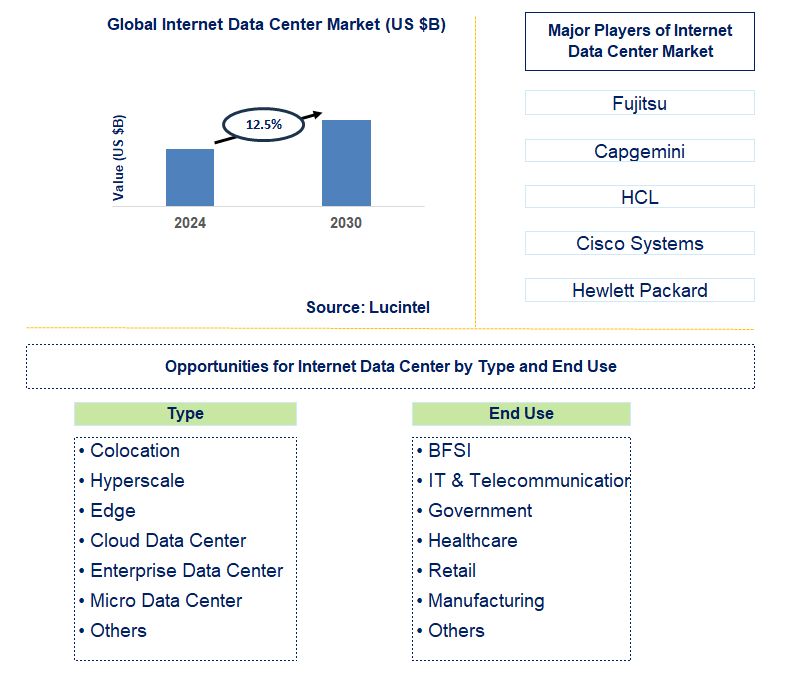
Key data points: The growth forecast = 12.5% annually for the next 6 years. Scroll below to get more insights. This market report covers trends, opportunities, and forecasts in the global internet data center market to 2030 by type (colocation, hyperscale, edge, cloud data center, enterprise data center, micro data center, and others), end use (BFSI, IT & telecommunication, government, healthcare, retail, manufacturing, and others), and region (North America, Europe, Asia Pacific, and the Rest of the World)
We'll send your sample report shortly.
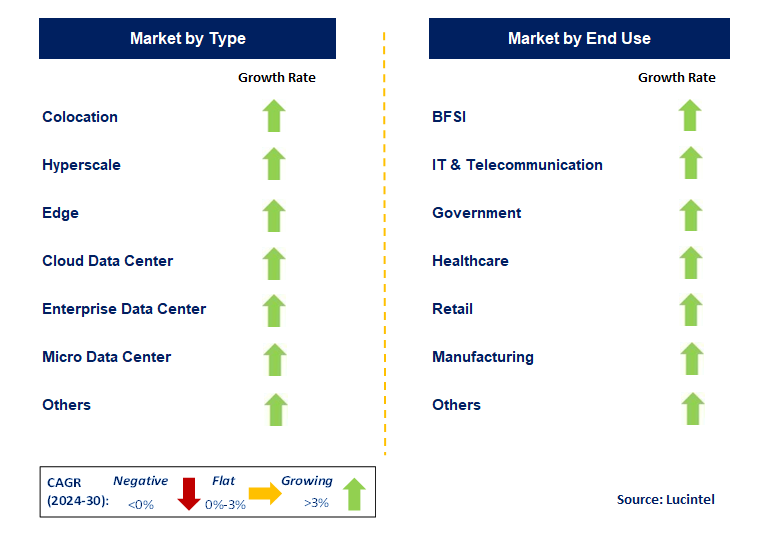
The future of the global internet data center market looks promising with opportunities in the BFSI, IT & telecommunication, government, healthcare, retail, and manufacturing sectors. The global internet data center market is expected to grow with a CAGR of 12.5% from 2024 to 2030. The major drivers for this market are growth of the digital economy, increasing preference for hybrid data centers, and expanding adoption of IoT technology among various industries.
• Lucintel forecasts that, within the type category, enterprise data center is expected to witness the highest growth over the forecast period.
• In terms of region, North America is expected to witness the highest growth over the forecast period.
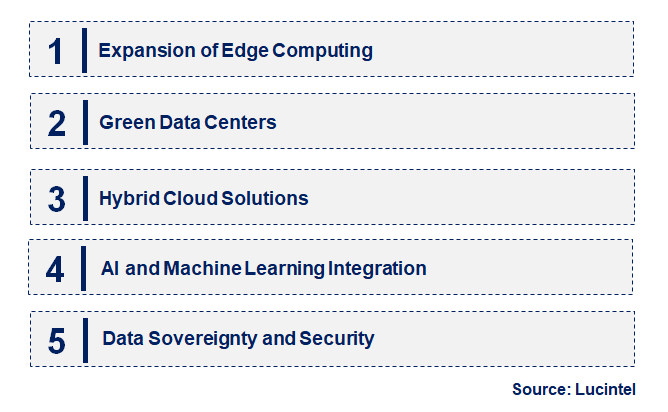
• Expansion of Edge Computing: Edge computing is becoming increasingly common among users as it improves user experience by offering services with reduced latency. This is especially important for real-time data processing in IoT, autonomous vehicles, and smart appliances. More edge data centers are being installed at various sites to improve service provision and reduce operational costs for clients.
• Green Data Centers: There is a growing emphasis on green initiatives in the IDC industry. Green data centers are utilizing renewable energy, intelligent cooling solutions, and energy-efficient equipment to minimize their greenhouse gas (GHG) emissions. This practice is driven by regulatory requirements as well as corporations’ aspirations to be environmentally friendly, encouraging the construction of more eco-friendly data centers.
• Hybrid Cloud Solutions: Businesses are increasingly adopting hybrid solutions that combine physical data centers with commercial cloud services, including both public and private clouds. This approach offers greater flexibility, scalability, and cost efficiency. Heterogeneous resource management further enhances the allocation of workloads and data across different infrastructures.
• AI and Machine Learning Integration: Artificial intelligence (AI) and machine learning algorithms are being integrated into data center management practices to improve performance and efficiency. Equipment is used for predictive maintenance, energy-efficient management, and workload optimization, leading to lower operating costs and higher service quality.
• Data Sovereignty and Security: With growing concerns over data privacy and security, there is increasing attention on data sovereignty and regulatory compliance. Data centers are upgrading their systems to meet enhanced security requirements and adopt local data compliance measures, safeguarding the integrity and confidentiality of data.
• Expansion of Hyperscale Data Centers: There is a rapid expansion of hyperscale data centers due to the rising demand for cloud services. These large facilities, mainly run by well-known cloud providers, are designed to be more scalable and efficient. They meet significant data and high computing power demands, thus stimulating sector growth.
• Advancements in Cooling Technologies: With the challenge of high heat loads in modern data centers, new cooling technologies, such as liquid cooling and advanced air cooling systems, are being implemented. These technologies enable administrators to ensure maximum energy efficiency and optimal operational expenditure, supporting green practices in data center operations.
• Increased Adoption of Modular Data Centers: Modular data centers offer enhanced flexibility in scaling data storage and processing capacities. These pre-manufactured structures can be quickly built and added to existing systems, allowing data volume and business operations demands to be met swiftly.
• Enhanced Disaster Recovery Solutions: Some companies are developing advanced disaster recovery solutions to ensure business continuity. This includes establishing data centers in multiple locations and enabling real-time data replication, which improves overall performance during disasters or man-made events, such as terrorist attacks.
• Implementation of 5G Technology: The growing demand for 5G networks has created the need for data centers that can accommodate increased data traffic and low-latency applications. The advent of 5G technology has prompted data centers to upgrade their infrastructure to meet the demand for higher data and connectivity capabilities.
• Expansion into Emerging Markets: Fast-developing emerging markets, where digital infrastructure is actively being implemented, hold great potential for growth. Developing data center services in such markets will take advantage of the rising internet usage and data service demand, opening up new revenue and market opportunities.
• Development of Edge Data Centres: There is an opportunity to deploy smaller, localized data centres to cater to the increasing demand for edge computing and, therefore, low latencies in real-time applications. Investments in edge data centres will help meet the rising demand for low latency and support future technologies such as the Internet of Things and smart cities.
• Focus on Sustainability and Green Technologies: The market for sustainable data centres has been growing rapidly. Green investments, such as renewable energy sources and energy-efficient cooling systems, provide opportunities to attract environmentally conscious clients and comply with regulatory standards, improving competitiveness and compliance in the market.
• Integration with AI and Automation: Data centre efficiency in terms of operations management can be boosted by using AI and other automation techniques. These technologies help provide predictive maintenance, better energy utilization, and enhanced security, enabling new ways of delivering services and reducing operational costs.
• Adoption of Hybrid and Multi-Cloud Strategies: The rise in the use of hybrid and multi-cloud environments presents opportunities for data centres to offer flexible, scalable solutions. Data centres will be able to integrate various customer needs by connecting with different providers of both public and private cloud services.
• Growing Data Demand: The rising data consumption and the increasing use of digital services call for more data center capacity. Data generation continues to grow among businesses and individual consumers, forcing data centers to expand, grow, and upgrade, which in turn fuels market growth.
• Advancements in Cloud Computing: The increasing implementation of cloud computing technologies across companies is strongly influencing the growth of the IDC market. Cloud services require substantial data center infrastructure, leading to the construction and development of data centers to meet the needs of cloud providers.
• Technological Innovations: These improvements include green computing technologies, improved cooling techniques, distributed capabilities, and the incorporation of AI technologies. Such investments are expected to drive and foster growth in the data center market.
• Increasing Edge Computing Requirements: Along with the rise in IoT devices, edge computing also requires the geographic deployment of smaller data centers for faster decision-making. This trend is contributing to the development of the edge data center market.
• Regulatory Compliance and Data Sovereignty: The need for local data centers is crucial to reinforce compliance with legal and data protection obligations. When regulatory standards are maintained, they act as a safety net for data in more regulated markets and promote business opportunities.
• High Capital and Ongoing Operational Expenditures: The cost factor can pose challenges to the construction and day-to-day management of data centers. Controlling these expenses while offering competitive pricing is a challenge for many players in the market.
• Energy Consumption and Sustainability: Data centers and the central resources used for computations and information storage consume large volumes of energy, which could be considered an unsustainable practice. It is necessary to regulate energy consumption by employing efficient technologies and using renewable energy sources.
• Concerns about Data Security and Privacy: Achieving robust security and privacy for data is difficult, given the known data attacks and the need for additional policies and rules. Data centers cannot afford to be passive in this regard and require enhanced security measures, as data breaches can erode trust and lead to the loss of clients.
• Fujitsu
• Capgemini
• HCL
• Cisco Systems
• Hewlett Packard Enterprise
• Colocation
• Hyperscale
• Edge
• Cloud Data Center
• Enterprise Data Center
• Micro Data Center
• Others
• BFSI
• IT & Telecommunication
• Government
• Healthcare
• Retail
• Manufacturing
• Others
• North America
• Europe
• Asia Pacific
• The Rest of the World
• United States: The IDC market in the U.S. is growing due to the shift towards cloud services and the construction of multiple data centers. Important developments include the creation of edge computing zones designed to reduce latency, alongside performance enhancements through AI and machine learning. Furthermore, there is significant progress in facilitating green initiatives, with nearly every data center adopting various renewable energy technologies and optimal cooling systems.
• China: China’s geography and demand make it the largest IDC market in the world. Recent developments include the capacity expansion of existing service providers while addressing regional needs and upgrading cooling solutions to accommodate the growing IT density. Additionally, there is a growing trend towards the preservation of local data and ensuring greater security.
• Germany: Germany is strengthening its IDC capabilities, with a particular focus on sustainability and meeting legal requirements for environmental protection. The latest trends include the use of novel energy-efficient cooling systems and high-density server technologies. Another key trend is the rise of hybrid data centers that combine colocation and cloud services, allowing businesses to meet various needs without compromising on security and data protection.
• India: Driven by the growth of internet usage and digitalization efforts by the government and businesses, India’s IDC market is growing rapidly. Notable developments include the construction of new data centers in key markets and the establishment of supercomputing centers. Ongoing efforts to improve efficiency include consolidating data management systems (DMS) and enabling advancements in the fields of artificial intelligence and machine learning for data management.
• Japan: Regarding IDC market trends in Japan, most projects focus on backup and disaster recovery due to the frequent occurrence of natural phenomena in the region. These projects involve constructing facilities designed to withstand natural disasters and adopting low-energy-consuming sources. In addition to telecommunications companies’ core activities of data provision, cloud services and edge computing are becoming significant areas of investment.


• Fujitsu
• Capgemini
• HCL
• Cisco Systems
• Hewlett Packard Enterprise
Q5. Which internet data center market segment will be the largest in future?• Fujitsu
• Capgemini
• HCL
• Cisco Systems
• Hewlett Packard Enterprise
Q6. In internet data center market, which region is expected to be the largest in next 6 years?

Choose a license that fits your team. Instant PDF delivery.
Prices exclude taxes. Instant delivery. Custom licensing available on request.
Market Report · July 16, 2026
Market Report · May 18, 2026
Market Report · May 18, 2026
Trusted partner for strategic intelligence and business growth


Receive a complimentary market analysis tailored to your industry. Our analysts will identify key growth opportunities and competitive dynamics specific to your business.

Market size, growth rate, and key trend analysis for your specific sector.

Top competitor positioning and market share analysis.

Strategic recommendations backed by data-driven insights.
Get curated market intelligence and competitive moves straight to your inbox.
By subscribing, you agree to receive our monthly insights. Unsubscribe anytime.
Receive a complimentary market analysis tailored to your industry. Our analysts will identify key growth opportunities and competitive dynamics specific to your business.
Market size, growth rate, and key trend analysis for your specific sector.
Top competitor positioning and market share analysis.
Strategic recommendations backed by data-driven insights.
Get curated market intelligence, emerging trends, and competitive moves straight to your inbox each month.
By subscribing, you agree to receive our monthly insights. Unsubscribe anytime.
We'll send your sample report shortly.