
Market Report · July 31, 2026

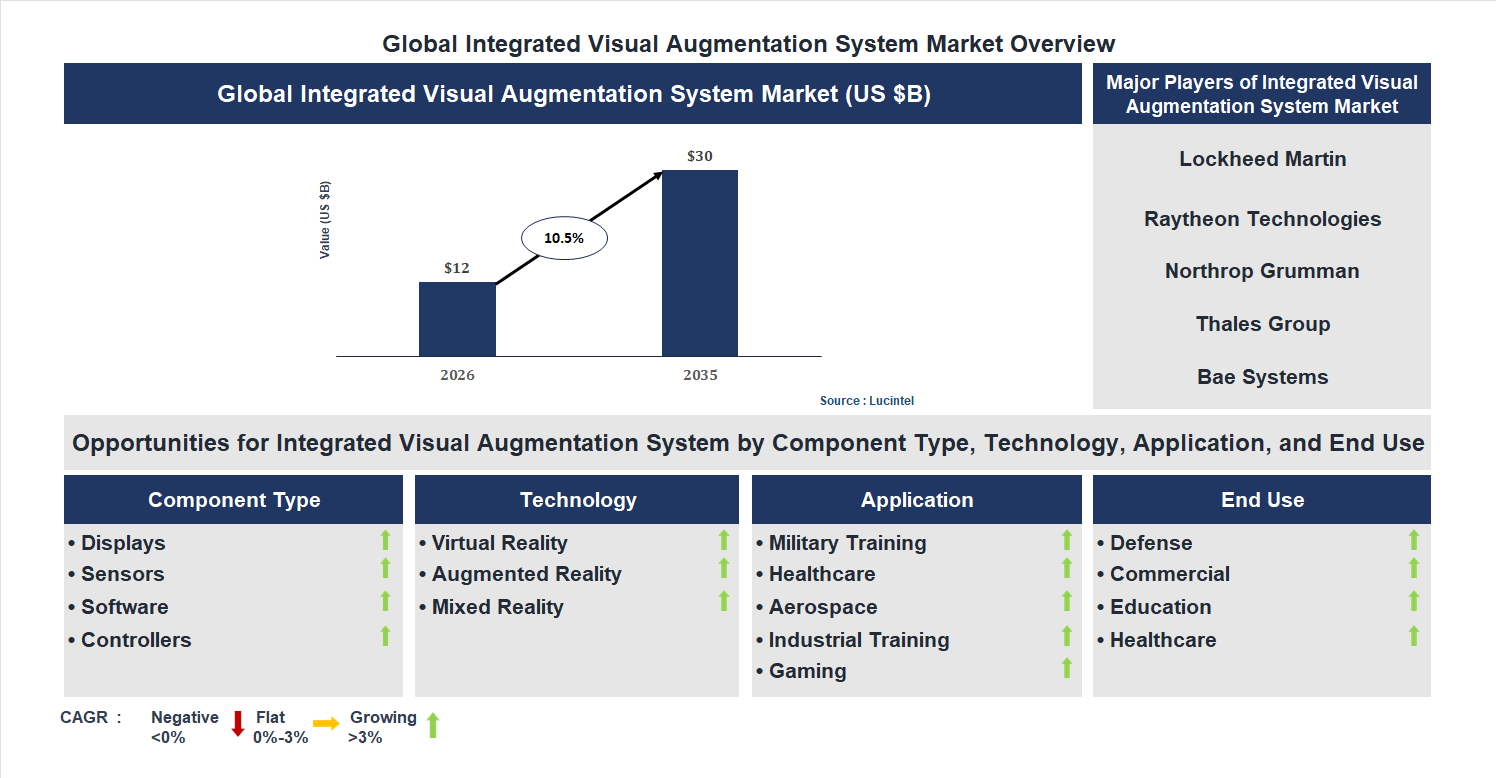
Key data points: The market size in 2035 = $30 billion, growth forecast = 10.5% annually for the next 8 years. Scroll below to get more insights. This market report covers trends, opportunities and forecasts in integrated visual augmentation system market to 2035 by component type (displays, sensors, software, and controllers), technology (virtual reality, augmented reality, and mixed reality), application (military training, healthcare, aerospace, industrial training, and gaming), end use (defense, commercial, education, and healthcare), and region (North America, Europe, Asia Pacific, and the Rest of the World)
We'll send your sample report shortly.
• Lucintel forecasts that, within the component type category, display is expected to witness the highest growth over the forecast period.
• Within the end use category, defense is expected to witness the highest growth.
• In terms of region, APAC is expected to witness the highest growth over the forecast period. Gain valuable insights for your business decisions with our comprehensive 150+ page report. Sample figures with some insights are shown below.
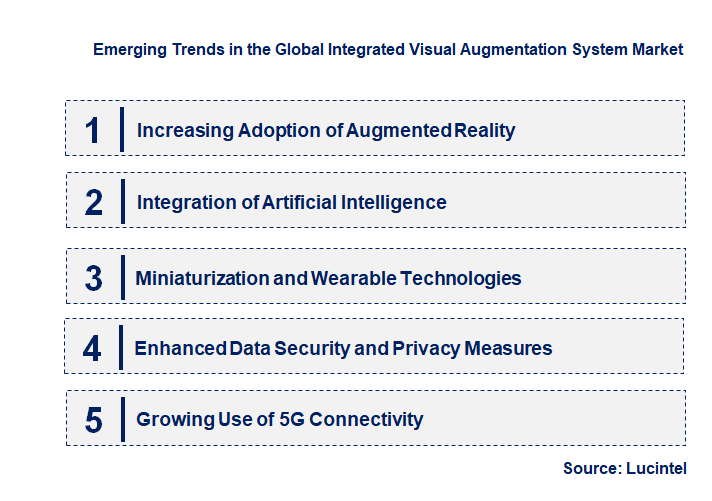
• Increasing Adoption of Augmented Reality (AR): The integration of AR into visual augmentation systems is expanding across sectors such as healthcare, manufacturing, and military. AR enhances real-world environments with digital overlays, improving decision-making, training, and maintenance processes. This trend is driven by advancements in display technology and decreasing hardware costs, making AR more accessible. The impact includes improved operational efficiency, better user engagement, and new application possibilities, such as remote assistance and real-time data visualization.
• Integration of Artificial Intelligence (AI): AI is becoming a core component of visual augmentation systems, enabling real-time image processing, object recognition, and predictive analytics. AI-driven systems can adapt to user needs, provide contextual information, and enhance situational awareness. This trend significantly improves system responsiveness and accuracy, especially in complex environments like military combat zones or medical diagnostics. The integration of AI is also facilitating personalized user experiences and automating routine tasks, thereby reducing cognitive load and increasing safety.
• Miniaturization and Wearable Technologies: The development of compact, lightweight, and comfortable wearable devices is a key trend. These systems are designed for extended use in various environments, including tactical operations and medical procedures. Miniaturization allows for seamless integration into daily life and operational workflows, broadening the user base. The impact includes increased mobility, improved user comfort, and the potential for continuous, real-time visual augmentation, which enhances productivity and safety in demanding scenarios.
• Enhanced Data Security and Privacy Measures: As visual augmentation systems handle sensitive data, there is a growing emphasis on cybersecurity and privacy protocols. Advanced encryption, secure data transmission, and user authentication are being integrated to protect against cyber threats. This trend is crucial for sectors like defense and healthcare, where data breaches can have serious consequences. Strengthening security measures builds user trust, ensures compliance with regulations, and supports the broader adoption of these systems in sensitive environments.
• Growing Use of 5G Connectivity: The deployment of 5G networks is facilitating faster data transfer and low-latency communication for visual augmentation systems. This connectivity enables real-time data sharing, remote operation, and cloud-based processing, significantly enhancing system capabilities. The impact includes improved responsiveness, scalability, and the ability to support large-scale, multi-user environments. 5G integration is particularly transformative for applications such as remote surgeries, military operations, and collaborative training exercises, where instant data access and communication are critical. These emerging trends are collectively reshaping the integrated visual augmentation system market by making systems more intelligent, portable, secure, and connected. They are expanding the scope of applications, improving user experiences, and driving innovation across multiple industries. As these trends continue to evolve, the market is poised for significant growth, offering new opportunities for developers, users, and investors alike.
• Growing Adoption of Augmented Reality in Healthcare: The integration of AR in medical training, diagnostics, and surgical procedures is revolutionizing healthcare. Surgeons can now visualize complex anatomy in 3D during operations, improving precision and outcomes. Medical students benefit from immersive training modules, enhancing learning experiences. This trend is expanding the market by attracting hospitals and educational institutions seeking advanced visualization tools. As AR technology becomes more affordable and accurate, its adoption is expected to accelerate, significantly impacting patient care and medical education.
• Advancements in Military and Defense Applications: The defense sector is increasingly utilizing visual augmentation systems for enhanced situational awareness, target identification, and mission planning. Modern soldiers benefit from AR helmets that overlay critical data in real-time, improving operational efficiency and safety. These systems also support training simulations, reducing costs and risks associated with live exercises. As military budgets grow and technology advances, the demand for sophisticated visual augmentation solutions is rising, driving innovation and market expansion in defense applications globally.
• Development of Consumer Wearable Devices: Consumer demand for AR glasses and headsets is fueling market growth. Companies are launching lightweight, stylish, and affordable devices that integrate seamlessly with smartphones and other gadgets. These wearables enhance gaming, navigation, and social interactions, broadening their appeal. The proliferation of 5G connectivity further boosts adoption by enabling real-time data processing. As consumer preferences shift towards immersive experiences, the market for wearable visual augmentation devices is expected to expand rapidly, creating new revenue streams for manufacturers.
• Integration with Artificial Intelligence and Machine Learning: Incorporating AI and ML into visual augmentation systems enhances their capabilities, such as real-time object recognition, environment mapping, and predictive analytics. This integration improves system responsiveness and accuracy, making applications more effective across industries. For example, AI-powered AR in manufacturing can assist workers with assembly instructions, reducing errors. The convergence of AI and visual augmentation is fostering smarter, more adaptive systems, which are attracting investments and expanding market opportunities in sectors like retail, logistics, and public safety.
• Increasing Focus on Smart Cities and Urban Planning: Visual augmentation systems are increasingly used in urban development projects for planning, visualization, and public engagement. AR models help architects and city planners simulate infrastructure changes, optimize layouts, and communicate ideas effectively. Public participation is enhanced through immersive experiences, fostering transparency and collaboration. As cities aim for sustainable growth and smart infrastructure, the demand for advanced visualization tools is rising. This trend is creating a significant market segment dedicated to urban development, infrastructure management, and environmental monitoring. These recent developments are significantly transforming the integrated visual augmentation system market by expanding its applications across healthcare, defense, consumer electronics, urban planning, and more. The integration of AI, advancements in wearable technology, and increased adoption in various sectors are driving market growth and innovation. As these opportunities continue to evolve, they are fostering a competitive environment that promises to deliver more sophisticated, accessible, and impactful visual augmentation solutions, shaping the future of the industry.
• Enhanced Military Training and Combat Systems: The integration of visual augmentation in military applications offers real-time battlefield data, improved situational awareness, and immersive training environments. These systems enable soldiers to access critical information without distraction, increasing operational efficiency and safety. Advancements in AR headsets and heads-up displays (HUDs) are making these solutions more accessible and effective, leading to widespread adoption in defense forces globally. The segment is expected to grow as governments prioritize modernizing defense capabilities.
• Medical Visualization and Surgical Assistance: Visual augmentation systems are revolutionizing healthcare by providing surgeons with real-time, 3D imaging during procedures. These systems improve precision, reduce errors, and enhance patient outcomes. Applications include augmented reality-guided surgeries, diagnostics, and training simulations. The development of lightweight, sterile, and user-friendly devices is expanding adoption in hospitals and clinics. As medical professionals seek innovative solutions for complex procedures, this segment is poised for significant growth.
• Industrial and Manufacturing Process Optimization: Visual augmentation enhances industrial workflows by overlaying digital information onto physical environments, facilitating maintenance, assembly, and quality control. AR-enabled glasses and headsets allow workers to access instructions hands-free, reducing errors and increasing productivity. The integration of AI and IoT further improves system intelligence and responsiveness. As industries aim for smart manufacturing and Industry 4.0 initiatives, the demand for integrated visual augmentation solutions is expected to surge, transforming traditional processes.
• Consumer Entertainment and Gaming Experiences: The entertainment industry is leveraging visual augmentation to create immersive gaming, virtual concerts, and interactive media experiences. AR glasses and headsets enable users to engage with digital content seamlessly integrated into their real-world environment. This enhances user engagement, social interaction, and content personalization. The proliferation of 5G connectivity and affordable devices is driving consumer adoption. As content creators innovate, this segment will continue to expand, offering new monetization opportunities and redefining entertainment paradigms.
• Retail and E-Commerce Transformation: Visual augmentation is reshaping retail by enabling virtual try-ons, interactive displays, and personalized shopping experiences. Customers can visualize products in their environment before purchase, reducing return rates and increasing satisfaction. Retailers benefit from increased engagement and data-driven insights. The integration of AR with mobile apps and smart mirrors is making shopping more convenient and engaging. As e-commerce grows, these solutions will become essential for competitive differentiation and customer loyalty. These growth opportunities collectively are set to significantly influence the integrated visual augmentation system market, fostering innovation and expanding application domains. The convergence of advanced technologies and increasing user demand will accelerate market penetration across sectors. Stakeholders investing in R&D, strategic partnerships, and market expansion will be well-positioned to capitalize on these trends. Overall, these opportunities will drive market growth, enhance user experiences, and support the development of smarter, more intuitive visual augmentation solutions.
• Technological Innovation: The rapid development of AR, VR, and sensor technologies enhances system capabilities, providing more immersive and precise visual augmentation. These innovations enable applications across defense, healthcare, and industrial sectors, driving market growth. As technology becomes more sophisticated and affordable, adoption rates increase, fostering a competitive environment that encourages continuous improvement and diversification of offerings.
• Increasing Defense and Military Spending: Governments worldwide are investing heavily in advanced military systems to improve battlefield awareness and soldier safety. Integrated visual augmentation systems are critical for training, situational awareness, and combat operations. This sustained investment boosts demand for cutting-edge solutions, encouraging manufacturers to develop more robust, reliable, and versatile systems tailored to military needs.
• Healthcare and Medical Applications: The rising adoption of visual augmentation in healthcare, such as surgical visualization, diagnostics, and rehabilitation, significantly contributes to market expansion. These systems improve precision, reduce errors, and enhance patient outcomes. Growing healthcare expenditure and technological acceptance in medical fields propel the integration of visual augmentation solutions into routine medical practices.
• Regulatory and Standardization Frameworks: The establishment of regulatory standards and safety protocols ensures the reliability and interoperability of visual augmentation systems. These frameworks facilitate market entry, build user confidence, and promote widespread adoption. As regulatory bodies develop comprehensive guidelines, manufacturers are encouraged to innovate within compliant boundaries, fostering a stable growth environment.
• Growing Industrial Automation and Training Needs: The increasing adoption of automation in manufacturing and industrial processes necessitates advanced visual systems for training, maintenance, and quality control. Augmented reality enhances operational efficiency and safety, making it a vital component of Industry 4.0 initiatives. This trend drives demand for integrated visual augmentation solutions across various industrial sectors. The challenges facing the integrated visual augmentation system market include:
• High Development and Implementation Costs: Developing advanced integrated visual augmentation systems requires significant investment in research, hardware, and software. These costs can be prohibitive for smaller companies and may slow down innovation and deployment. Additionally, high implementation costs can limit adoption among end-users, especially in cost-sensitive sectors, thereby restraining market growth.
• Regulatory and Compliance Barriers: Navigating complex regulatory landscapes and obtaining necessary certifications can delay product launches and increase costs. Variations in standards across regions create additional hurdles for global deployment. Compliance issues may also hinder innovation, as companies must balance technological advancements with regulatory requirements, potentially stifling progress.
• Technological Integration and Compatibility Issues: Integrating new visual augmentation technologies with existing systems poses technical challenges. Compatibility issues can lead to increased complexity, reduced reliability, and higher maintenance costs. Ensuring seamless interoperability across diverse platforms and devices remains a significant obstacle, impacting user experience and limiting widespread adoption. The integrated visual augmentation system market is driven by rapid technological advancements, increased defense and healthcare investments, supportive regulatory frameworks, and industrial automation needs. However, high costs, regulatory complexities, and integration challenges present notable barriers. These factors collectively influence market growth, requiring stakeholders to innovate strategically and navigate regulatory landscapes carefully. Overall, the market holds substantial potential for expansion, provided these drivers are harnessed effectively and challenges addressed proactively.
• Lockheed Martin
• Raytheon Technologies
• Northrop Grumman
• Thales Group
• Bae Systems
• Elbit Systems
• Leonardo S.P.A.
• Displays
• Sensors
• Software
• Controllers
• Virtual Reality
• Augmented Reality
• Mixed Reality
• Military Training
• Healthcare
• Aerospace
• Industrial Training
• Gaming
• Defense
• Commercial
• Education
• Healthcare
• North America
• Europe
• Asia Pacific
• The Rest of the World
• United States: The US has made significant strides in IVAS development, with military agencies like the Army investing in AR-enabled systems for enhanced battlefield awareness. Recent advancements include the integration of AI for real-time data processing and improved user interfaces. The US government has increased funding for research collaborations with tech firms, aiming to deploy more sophisticated systems for combat and training purposes. Commercial sectors are also exploring IVAS for applications in gaming, healthcare, and industrial training, fostering a broader ecosystem of innovation.
• China: China is rapidly advancing its IVAS technology, focusing on military modernization and civilian applications. The government has prioritized the development of AR systems for enhanced soldier combat capabilities and urban warfare. Recent innovations include lightweight, ruggedized headsets with high-resolution displays and AI-powered situational awareness tools. China’s strategic investments aim to reduce reliance on foreign technology and establish a competitive edge in global defense markets. Additionally, civilian uses such as smart manufacturing and medical training are gaining traction, supported by domestic tech giants.
• Germany: Germany is emphasizing the integration of IVAS in defense and industrial sectors, with a focus on precision, safety, and interoperability. Recent developments include collaborations between military and industrial partners to develop AR systems for maintenance, logistics, and training. German companies are pioneering in creating highly durable, user-friendly systems with advanced sensor integration. The government is also promoting research into AI-driven augmentation to enhance operational efficiency and safety standards across various applications, including emergency response and manufacturing.
• India: India is rapidly adopting IVAS technology to modernize its defense forces and boost domestic innovation. Recent developments include the deployment of AR-based training modules and battlefield visualization tools for soldiers. The government’s Make in India initiative has spurred local manufacturing of AR hardware and software solutions. Collaborations with international firms are underway to develop cost-effective, ruggedized systems suitable for diverse terrains. The focus remains on enhancing situational awareness, troop safety, and operational efficiency, with a growing ecosystem of startups and research institutions contributing to the market.
• Japan: Japan is advancing IVAS technology with a focus on defense, disaster management, and industrial applications. Recent innovations include AR systems integrated with AI for enhanced navigation and hazard detection in disaster zones. The country is investing in lightweight, high-performance displays suitable for prolonged use in various environments. Japanese firms are also exploring applications in healthcare, such as surgical assistance and rehabilitation. Government initiatives support R&D collaborations to develop next-generation IVAS solutions that emphasize safety, reliability, and integration with existing military and civilian infrastructure.


• Lockheed Martin
• Raytheon Technologies
• Northrop Grumman
• Thales Group
• Bae Systems
• Elbit Systems
• Leonardo S.P.A. Q6. Which integrated visual augmentation system market segment will be the largest in future? Answer: Lucintel forecasts that, within the component type category, display is expected to witness the highest growth over the forecast period. Q7. In integrated visual augmentation system market, which region is expected to be the largest in next 8 years? Answer: In terms of region, APAC is expected to witness the highest growth over the forecast period. Q8. Do we receive customization in this report? Answer: Yes, Lucintel provides 10% customization without any additional cost.


Choose a license that fits your team. Instant PDF delivery.
Prices exclude taxes. Instant delivery. Custom licensing available on request.
Market Report · July 31, 2026
Market Report · July 31, 2026
Market Report · July 31, 2026
Trusted partner for strategic intelligence and business growth


Receive a complimentary market analysis tailored to your industry. Our analysts will identify key growth opportunities and competitive dynamics specific to your business.

Market size, growth rate, and key trend analysis for your specific sector.

Top competitor positioning and market share analysis.

Strategic recommendations backed by data-driven insights.
Get curated market intelligence and competitive moves straight to your inbox.
By subscribing, you agree to receive our monthly insights. Unsubscribe anytime.
Receive a complimentary market analysis tailored to your industry. Our analysts will identify key growth opportunities and competitive dynamics specific to your business.
Market size, growth rate, and key trend analysis for your specific sector.
Top competitor positioning and market share analysis.
Strategic recommendations backed by data-driven insights.
Get curated market intelligence, emerging trends, and competitive moves straight to your inbox each month.
By subscribing, you agree to receive our monthly insights. Unsubscribe anytime.
We'll send your sample report shortly.