
Market Report · May 18, 2026

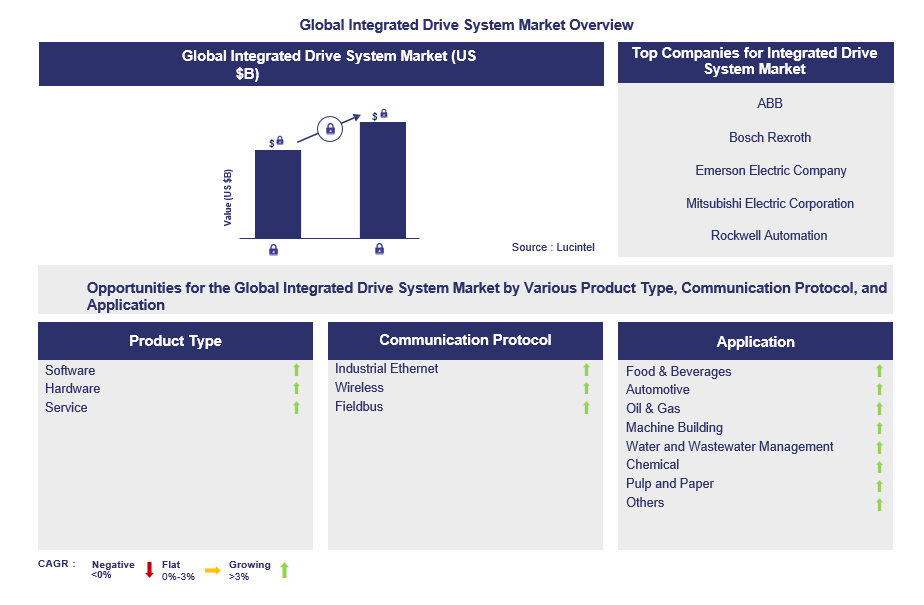
Key data points: The market size in 2030 = $61.9 billion, growth forecast = 6.7% annually for the next 6 years. Scroll below to get more insights. This market report covers trends, opportunities, and forecasts in the global integrated drive system market to 2030 by product type (software, hardware, and services), communication protocol (industrial ethernet, wireless, and fieldbus), application (food & beverages, automotive, oil & gas, machine building, water and wastewater management, chemical, pulp and paper, and others), and region (North America, Europe, Asia Pacific, and the Rest of the World)
We'll send your sample report shortly.
• Lucintel forecasts that, within the product type category, the software segment is expected to witness the highest growth over the forecast period.
• Within the application category, water and wastewater management will remain the largest segment.
• In terms of region, APAC is expected to witness the highest growth over the forecast period. Gain valuable insight for your business decisions with our comprehensive 150+ page report.
• Increased Adoption of Electric Vehicles: Advanced drive systems are being incorporated by manufacturers in response to the growing adoption of electric vehicles (EVs) in the automotive sector. This is due to regulatory pressure on emission reduction policies and changing consumer preferences for sustainable transportation alternatives. Integrated drive systems enable efficient management of electric motors, improving vehicle performance and enhancing energy consumption efficiency. As such, sophisticated IDS solutions will be required for both manufacturing processes and supply chain transformation as automakers transition to EVs.
• Growth of Automation and Industry 4.0: The integrated drive system market is greatly influenced by the demand for automation and Industry 4.0 principles. More companies are adopting smart manufacturing technologies that utilize IoT and data analytics for real-time monitoring and control purposes. These systems enable precise control over machinery and processes, assisting in operational efficiency, reducing downtime, and enabling predictive maintenance. This results in cost savings and increased productivity
• Expansion in Renewable Energy Applications: In managing and optimizing energy production, integrated drive systems play essential roles as the world shifts toward renewable energy sources. The rapid growth of wind turbines and solar power facilities has been accompanied by an increased reliance on highly-engineered drives that ensure maximum efficiency. Trends like these will continue to boost demand for IDSs that can handle fluctuating loads while maintaining a steady energy output. As a result, more opportunities will be created for manufacturers focused on sustainable energy investments.
• Focus on Energy Efficiency and Sustainability: Integrated Drive Systems (IDS) are being designed and adopted in line with the growing focus on energy conservation and sustainability across all industries. There is a strong desire to minimize power usage and lower operational costs. This includes the incorporation of advanced drive technologies such as variable frequency drives (VFDs), which enhance motor performance and energy consumption during operations. These advancements align with global goals to reduce the carbon footprint while complying with environmental regulations, making IDS a critical element in sustainability.
• Rising Demand for Customization and Flexibility: The integrated drive system market is being reshaped by the increasing need for customization and flexibility within manufacturing processes. Industries now require more specific solutions that can be tailored to their operating requirements and production needs. Modular designs offer ease of modification or upgrading, making them suitable for multiple applications. This trend allows manufacturers to quickly respond to changing market demands and consumer preferences, fostering innovation and creating a competitive edge. These emerging trends collectively improve efficiency, sustainability, and adaptability across various sectors, reshaping the integrated drive system market. As industries continue to develop, the incorporation of advanced technologies and increased customization will drive further growth and innovation within the IDS landscape.

• Power Electronics Advancements: The integration of silicon carbide (SiC) and gallium nitride (GaN) wide bandgap semiconductors has led to high power density, reduced energy losses, and improved IDS efficiency.
• Enhanced Integration and Miniaturization: The demand for compact IDS designs has driven the trend toward highly integrated solutions. These designs ensure that power electronics, motor controls, and feedback systems are all incorporated into small, compact modules.
• Intelligent Control Algorithms: Intelligent algorithms, such as machine learning (ML) and artificial intelligence (AI), are among the latest features in IDSs. These algorithms improve functional effectiveness, optimize energy usage, and enable proactive maintenance practices.
• Focus on Energy Efficiency: The rise of sustainable development goals has led to the creation of more energy-efficient IDSs, such as regenerative braking systems combined with effective motor control strategies.
• Increased Connectivity and IoT Integration: With the industrial internet of things (IIoT) becoming more prevalent, industries are increasingly integrating IDSs into their networks. This connectivity allows for remote monitoring, predictive maintenance, and data-driven decision-making. These developments are collectively driving higher operational flexibility, efficiency, and availability in the integrated drive system market. The continued adoption of automation and digitalization across industries is expected to further enhance the demand for integrated drive systems globally, promoting further innovations within this critical technology sector.
• Manufacturing Automation: The adoption of integrated drive systems in manufacturing is boosting productivity and reducing downtime. By enabling seamless communication between devices, these systems enhance precision and operational efficiency, driving the evolution of smart factories and Industry 4.0.
• Energy Sector Optimization: Integrated drive systems are crucial for optimizing energy production and distribution. They improve the performance and reliability of wind turbines, solar power systems, and grid infrastructure, facilitating the transition to renewable energy sources and enhancing sustainability.
• Automotive Industry Evolution: In the automotive sector, integrated drive systems are enabling the development of electric vehicles (EVs) and advanced manufacturing processes. These systems support higher efficiency, reduced emissions, and improved vehicle performance, aligning with the industry's shift toward electrification and automation.
• Food and Beverage Industry Efficiency: The food and beverage industry leverages integrated drive systems to enhance processing and packaging efficiency. These systems ensure precise control over production lines, reduce waste, and maintain product quality, meeting the industry's demand for high-speed, reliable operations.
• Material Handling and Logistics: Integrated drive systems are revolutionizing material handling and logistics by enhancing the automation of conveyors, cranes, and robotics. They enable faster, more accurate movement of goods, improving supply chain efficiency and reducing operational costs. The strategic growth opportunities in manufacturing, energy, automotive, food and beverage, and material handling are driving the widespread adoption of integrated drive systems. These advancements are transforming industries by enhancing efficiency, sustainability, and automation, positioning integrated drive systems as critical enablers of future industrial growth.
• Energy Efficiency: IDS solutions provide significant power savings by optimizing power consumption and reducing losses. This is especially important in applications where energy efficiency is critical, such as in electric vehicles and industrial machinery.
• Developments in Power Electronics: Advances in power electronics technology have made it possible to create smaller, more efficient, and reliable IDS components. This has allowed for the integration of several subsystems into one unit, simplifying the structure and lowering costs.
• Increasing Demand for Electric Vehicles: The global trend toward electric vehicles has increased the demand for IDS solutions. These systems are essential for managing the flow of power between the battery, motor, and other components within an electric vehicle.
• Industrial Automation and Robotics: The growing use of industrial robots is accelerating the adoption of IDS solutions. These systems offer precise control and energy efficiency, making them ideal for applications such as material handling systems and factory automation.
• Government Policies and Incentives: Governments worldwide are implementing measures to encourage the efficient use of energy sources and reduce greenhouse gas emissions. These policies are creating a favorable environment for the expansion of the IDS market. Challenges in the integrated drive system market include:
• High Initial Costs: The substantial upfront investment required for implementing IDS technologies, especially on a large scale, can hinder adoption, particularly among smaller firms or industries with limited budgets.
• Thermal Management: Thermal management is a primary challenge for IDS systems used in high-power applications. Overheating can lower performance and shorten the lifespan of the system, making effective cooling solutions essential.
• Integration and Compatibility: Integrating IDS solutions with existing systems and ensuring compatibility with various standards and protocols can be difficult. This increases the cost of implementation and may lead to delays. The integrated drive system market is expected to grow further, fueled by technological advances, rising demand for energy-efficient solutions, and favorable government policies. However, challenges such as high initial costs, thermal management issues, and integration difficulties must be overcome to fully realize the potential of IDS systems. These obstacles can be addressed, allowing IDS technology to become a key driver of sustainable and efficient operations across various sectors of the economy.
• ABB
• Bosch Rexroth
• Emerson Electric Company
• Mitsubishi Electric Corporation
• Rockwell Automation
• Schneider Electric
• Siemens
• Tq Group
• Yaskawa Electric Corporation
• Software
• Hardware
• Service
• Industrial Ethernet
• Wireless
• Fieldbus
• Food & Beverages
• Automotive
• Oil & Gas
• Machine Building
• Water and Wastewater Management
• Chemical
• Pulp and Paper
• Others
• North America
• Europe
• Asia Pacific
• The Rest of the World
• United States: Digital transformation is a key focus for the United States, with an emphasis on adopting IoT and AI technologies to achieve predictive maintenance and energy efficiency. Major players are investing in smart manufacturing solutions that can easily integrate with existing industry infrastructure, promoting ease of operation and reducing downtime. Additionally, eco-friendly drive systems are gaining traction, aligning with the nation's broader environmental goals.
• China: In China, rapid industrialization and an automation-focused approach are driving the integrated drive system market. As a global leader in output generation, the Chinese government is encouraging the use of advanced drive systems in manufacturing to maintain its competitive edge. Significant progress has been made in the development of smart factories that use integrated drives to maximize productivity. China is also investing heavily in renewable energy initiatives, such as wind and solar power, and facilitating global partnerships to build clean energy infrastructure.
• Germany: Germany, known for its industrial expertise, is leading the development of highly efficient automated integrated drive systems. The country is pushing Industry 4.0 forward, focusing on precision-based integration of digital technologies into its drive systems. This enhances flexibility and control, helping Germany maintain global competitiveness. Furthermore, German automakers are designing smaller, more efficient motors and transmission lines to reduce fuel consumption and lower CO2 emissions.
• India: With the country’s manufacturing industry growing and the government's "Make in India" campaign, India’s integrated drive system market is expanding rapidly. There is a rising demand for affordable, energy-efficient drives capable of supporting large-scale industrial operations. Many indigenous manufacturers are shifting to digital solutions to improve operations and reduce costs. Additionally, industries across India are embracing automation, focusing on scalability and adaptability in their drive systems.
• Japan: Japan is advancing its integrated drive systems market by leveraging robotics and automation, areas in which the country has long been a global leader. Japan is focusing on the development of compact, high-performance drives for various applications, including automobiles and consumer electronics. There is also a strong emphasis on precision engineering techniques, enhancing the effectiveness and reliability of these drives. Additionally, Japan is integrating AI and IoT into its drive systems, improving operational efficiency and predictive maintenance capabilities.


• ABB
• Bosch Rexroth
• Emerson Electric Company
• Mitsubishi Electric Corporation
• Rockwell Automation
• Schneider Electric
• Siemens
• TQ Group
• Yaskawa Electric Corporation Q6. Which integrated drive system market segment will be the largest in the future? Answer: Lucintel forecasts that the software segment is expected to witness the highest growth over the forecast period. Q7. In the integrated drive system market, which region is expected to be the largest in the next 5 years? Answer: APAC is expected to witness the highest growth over the forecast period. Q.8 Do we receive customization in this report? Answer: Yes, Lucintel provides 10% customization without any additional cost.


Choose a license that fits your team. Instant PDF delivery.
Prices exclude taxes. Instant delivery. Custom licensing available on request.
Market Report · May 18, 2026
Market Report · May 18, 2026
Market Report · May 18, 2026
Trusted partner for strategic intelligence and business growth


Receive a complimentary market analysis tailored to your industry. Our analysts will identify key growth opportunities and competitive dynamics specific to your business.

Market size, growth rate, and key trend analysis for your specific sector.

Top competitor positioning and market share analysis.

Strategic recommendations backed by data-driven insights.
Get curated market intelligence and competitive moves straight to your inbox.
By subscribing, you agree to receive our monthly insights. Unsubscribe anytime.
Receive a complimentary market analysis tailored to your industry. Our analysts will identify key growth opportunities and competitive dynamics specific to your business.
Market size, growth rate, and key trend analysis for your specific sector.
Top competitor positioning and market share analysis.
Strategic recommendations backed by data-driven insights.
Get curated market intelligence, emerging trends, and competitive moves straight to your inbox each month.
By subscribing, you agree to receive our monthly insights. Unsubscribe anytime.
We'll send your sample report shortly.