
Report Feature
Integrated Circuit Linear Regulator Market Trends and Forecast
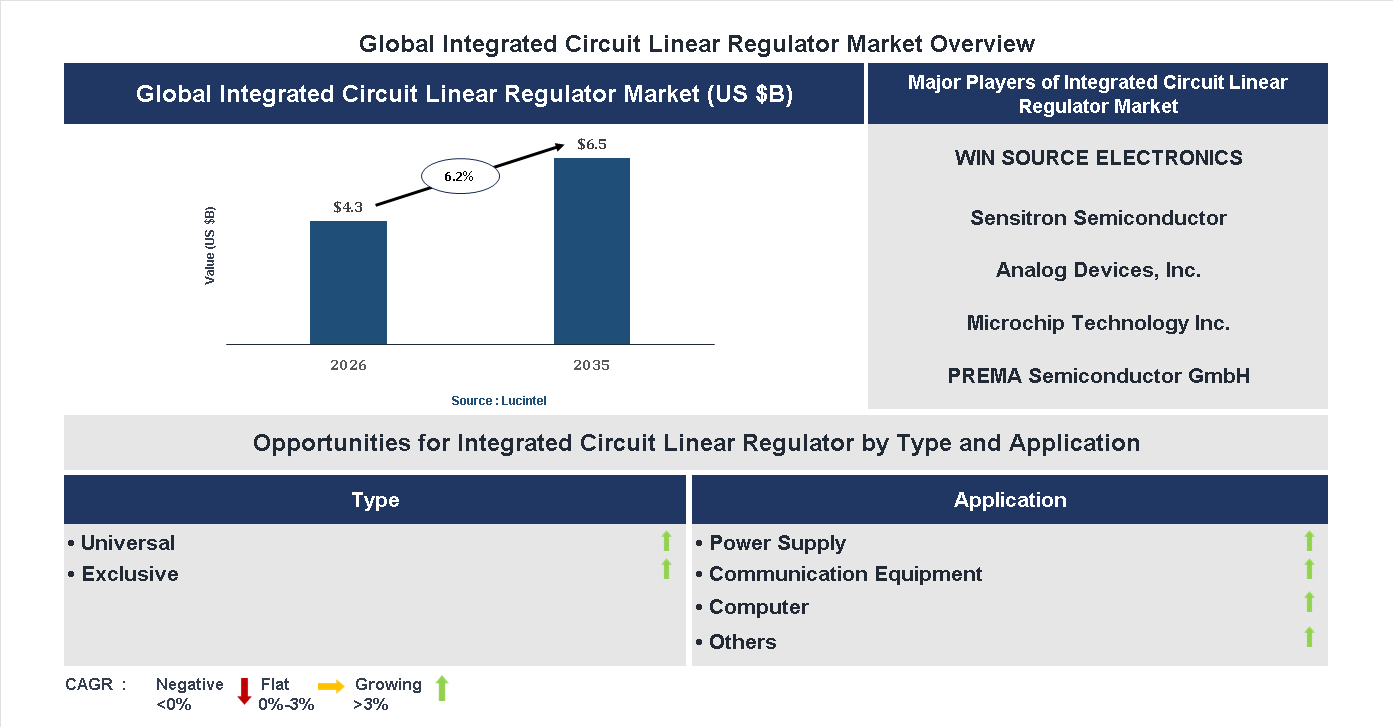
The future of the global integrated circuit linear regulator market looks promising with opportunities in the power supply, communication equipment, and computer markets. The global integrated circuit linear regulator market is expected to reach an estimated $6.5 billion by 2035 with a CAGR of 6.2% from 2026 to 2035. The major drivers for this market are the increasing demand for consumer electronics, the rising need for energy-efficient components, and the growing adoption of automation in industries.• Lucintel forecasts that, within the type category, exclusive is expected to witness higher growth over the forecast period.
• Within the application category, communication equipment is expected to witness the highest growth.
• In terms of region, APAC is expected to witness the highest growth over the forecast period. Gain valuable insights for your business decisions with our comprehensive 150+ page report. Sample figures with some insights are shown below.
Emerging Trends in the Integrated Circuit Linear Regulator Market
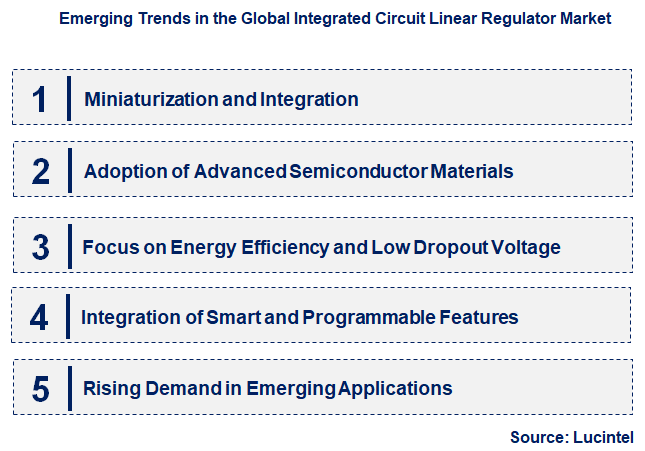
The integrated circuit linear regulator market is experiencing rapid evolution driven by technological advancements, increasing demand for energy-efficient solutions, and the proliferation of electronic devices across various sectors. As industries seek more reliable, compact, and power-efficient components, market players are innovating to meet these needs. Emerging trends are shaping the future landscape, influencing product development, manufacturing processes, and application scopes. These developments are not only expanding market opportunities but also redefining competitive dynamics, pushing companies to adopt new strategies. Understanding these key trends is essential for stakeholders aiming to capitalize on the markets growth potential and navigate the evolving technological environment effectively.• Miniaturization and Integration: The trend toward smaller, more integrated linear regulators is driven by the demand for compact electronic devices. Manufacturers are developing highly integrated ICs that combine multiple functions, reducing overall device size and power consumption. This miniaturization enhances portability and design flexibility, especially in wearable technology, IoT devices, and mobile applications. As space constraints become more critical, integrated solutions are increasingly preferred, leading to innovations in packaging and fabrication techniques that support high-density integration without compromising performance.
• Adoption of Advanced Semiconductor Materials: The use of advanced materials such as gallium nitride (GaN) and silicon carbide (SiC) in linear regulators is gaining traction. These materials offer superior electrical characteristics, including higher efficiency, faster switching speeds, and better thermal management. Their adoption results in reduced energy losses and improved device reliability, especially in high-power applications. This trend is transforming the market by enabling the development of more efficient, durable, and high-performance linear regulators suitable for demanding environments like automotive and industrial sectors.
• Focus on Energy Efficiency and Low Dropout Voltage: Increasing emphasis on energy efficiency is a key driver in the market. Linear regulators with low dropout voltage are in high demand as they allow operation closer to the supply voltage, reducing power wastage. Innovations in circuit design aim to minimize quiescent current and improve load regulation, which is critical for battery-powered devices. This focus on efficiency not only extends battery life but also aligns with global sustainability goals, prompting manufacturers to develop regulators that deliver high performance with minimal energy consumption.
• Integration of Smart and Programmable Features: The market is witnessing a shift toward smart linear regulators equipped with programmable and adaptive features. These regulators can dynamically adjust output voltage, monitor system parameters, and communicate with other components via digital interfaces. Such capabilities enable enhanced system control, improved power management, and increased reliability. The integration of IoT and automation technologies further accelerates this trend, allowing for remote monitoring and predictive maintenance, which are vital for complex and mission-critical applications.
• Rising Demand in Emerging Applications: New application areas such as electric vehicles, renewable energy systems, and 5G infrastructure are fueling demand for linear regulators. These sectors require high efficiency, robust performance, and reliable power regulation under challenging conditions. The growth of electric vehicles, in particular, demands specialized regulators capable of handling high voltages and currents. Similarly, the expansion of 5G networks necessitates compact, high-performance regulators to support advanced communication equipment. This trend is expanding the market scope and encouraging innovation tailored to these emerging needs. In summary, these trends are collectively reshaping the integrated circuit linear regulator market by fostering innovation, improving efficiency, and expanding application horizons. They are driving the development of smarter, more compact, and energy-efficient solutions, which are crucial for meeting the evolving demands of modern electronic systems. As these trends continue to evolve, they will significantly influence market dynamics, competitive strategies, and technological standards, ensuring sustained growth and relevance in the future.
Recent Development in the Integrated Circuit Linear Regulator Market
The integrated circuit linear regulator market is experiencing rapid growth driven by advancements in electronics, increased demand for energy-efficient power management solutions, and expanding applications across consumer electronics, automotive, and industrial sectors. Innovations in semiconductor technology and miniaturization are further fueling market expansion. As industries prioritize reliable and compact power regulation, new opportunities emerge for manufacturers to develop smarter, more efficient linear regulators. These developments are shaping the future landscape of power management, offering significant benefits to various high-tech applications worldwide.• Growing Demand for Energy-Efficient Power Solutions: The increasing need for energy-efficient devices is driving the adoption of advanced linear regulators, reducing power consumption and enhancing device performance across multiple sectors.
• Technological Advancements in Semiconductor Materials: Innovations in materials like GaN and SiC are enabling the development of high-performance linear regulators with improved efficiency, thermal management, and miniaturization, expanding their application scope.
• Expansion in Consumer Electronics Market: The proliferation of smartphones, wearables, and smart home devices is boosting demand for compact, reliable linear regulators, fostering market growth through increased integration.
• Automotive Industry Adoption: The shift toward electric vehicles and advanced driver-assistance systems (ADAS) necessitates robust power management solutions, leading to increased integration of linear regulators in automotive electronics.
• Rising Use in Industrial Automation: The growth of Industry 4.0 and automation systems requires precise and efficient power regulation, prompting increased deployment of integrated linear regulators in industrial applications. These developments are significantly impacting the market by enhancing product efficiency, enabling miniaturization, and expanding application areas. The focus on energy savings and technological innovation is fostering competitive growth, attracting new entrants, and driving overall market expansion. As industries continue to evolve, the integrated circuit linear regulator market is poised for sustained growth and technological advancement.
Strategic Growth Opportunities in the Integrated Circuit Linear Regulator Market
The integrated circuit linear regulator market is experiencing significant growth driven by increasing demand for efficient power management solutions across various industries. Technological advancements, miniaturization, and the need for reliable voltage regulation are fueling market expansion. As electronic devices become more sophisticated, the need for high-performance, low-noise regulators grows, creating numerous opportunities for innovation and market penetration. Companies that leverage these opportunities can gain competitive advantages and meet the evolving needs of consumers and industries.• Growing Demand for Portable Devices and Wearables: The proliferation of portable electronics and wearable devices necessitates compact, energy-efficient power regulation solutions. Linear regulators are favored for their low noise and simplicity, making them ideal for sensitive applications like medical devices, smartphones, and IoT gadgets. This trend drives manufacturers to develop smaller, more efficient regulators, expanding market opportunities and encouraging innovation in power management technology.
• Increasing Adoption in Automotive Electronics: The automotive industry’s shift toward electric and autonomous vehicles is boosting demand for reliable power management systems. Linear regulators are essential for controlling voltage levels in sensors, infotainment systems, and advanced driver-assistance systems (ADAS). The need for high stability, low noise, and compact design in automotive electronics presents significant growth opportunities for integrated circuit linear regulators, especially as vehicles become more electronically complex.
• Rising Use in Consumer Electronics and Home Automation: Consumer electronics such as smart TVs, gaming consoles, and home automation systems require efficient power regulation to ensure optimal performance. Linear regulators provide low ripple and noise, which are critical for high-quality audio and video output. The increasing integration of smart home devices and the demand for energy-efficient solutions are expected to further expand the market, encouraging manufacturers to innovate and improve regulator performance.
• Technological Advancements in Power Management ICs: Continuous innovation in power management integrated circuits (PMICs) is enhancing the capabilities of linear regulators. Developments include improved thermal management, higher efficiency, and integration with other power components. These advancements enable regulators to operate in more demanding environments, reduce size, and improve overall system reliability, opening new avenues for growth in high-performance applications such as aerospace, industrial automation, and telecommunications.
• Rising Focus on Energy Efficiency and Sustainability: Increasing global emphasis on energy conservation and sustainable practices is driving demand for highly efficient power regulation solutions. Linear regulators with low quiescent current and high efficiency help reduce power consumption in electronic devices, supporting green initiatives. This focus encourages the development of eco-friendly, energy-efficient regulators, creating opportunities for market expansion in environmentally conscious markets and industries seeking sustainable power management solutions. The overall market outlook is positively influenced by these growth opportunities, fostering innovation and expanding the application scope of integrated circuit linear regulators. As industries evolve and technological demands increase, the market is poised for sustained growth, driven by the need for efficient, reliable, and compact power management solutions across diverse sectors.
Integrated Circuit Linear Regulator Market Driver and Challenges
The integrated circuit linear regulator market is influenced by a variety of technological, economic, and regulatory factors. Rapid advancements in semiconductor technology and increasing demand for energy-efficient power management solutions are key drivers. Economic growth in emerging markets fuels consumer electronics and automotive sectors, further propelling market expansion. Regulatory standards for energy efficiency and environmental sustainability also shape product development and market strategies. However, the market faces challenges such as technological complexity, supply chain disruptions, and stringent regulatory compliance. Understanding these drivers and challenges is essential for stakeholders to navigate the evolving landscape and capitalize on growth opportunities effectively. The factors responsible for driving the integrated circuit linear regulator market include:-• Technological Innovation: The continuous evolution of semiconductor technology enables the development of more efficient, compact, and reliable linear regulators. Innovations such as low dropout (LDO) regulators and integrated power management solutions improve device performance, reduce power consumption, and support the miniaturization of electronic devices. These advancements meet the increasing demand for energy-efficient and high-performance electronic products across consumer electronics, automotive, and industrial applications. As technology progresses, manufacturers can offer more sophisticated solutions, driving market growth and expanding application scope.
• Growing Consumer Electronics Market: The surge in demand for smartphones, tablets, wearables, and smart home devices significantly boosts the need for efficient power management solutions. Linear regulators are essential for providing stable voltage regulation in these compact devices, ensuring optimal performance and battery life. The proliferation of IoT devices and smart gadgets further amplifies this trend, creating a robust market for integrated linear regulators. As consumer preferences shift towards portable and connected devices, the market is expected to experience sustained growth driven by this expanding sector.
• Automotive Electronics Expansion: The increasing integration of electronic systems in vehicles, including advanced driver-assistance systems (ADAS), infotainment, and electric vehicle (EV) powertrains, drives demand for reliable power regulation solutions. Linear regulators are critical in ensuring a stable voltage supply to sensitive automotive components, enhancing safety and performance. The automotive industry’s shift towards electrification and automation necessitates highly efficient and compact power management ICs, positioning the market for significant growth. Regulatory standards for vehicle safety and emissions further incentivize the adoption of advanced integrated circuits, reinforcing this trend.
• Regulatory and Environmental Standards: Stringent government regulations aimed at reducing energy consumption and minimizing environmental impact influence product development. Manufacturers are compelled to design more energy-efficient and environmentally friendly linear regulators that comply with standards such as RoHS, REACH, and energy efficiency directives. These regulations promote innovation in low-power design and sustainable manufacturing practices, shaping the competitive landscape. Compliance not only ensures market access but also enhances brand reputation, encouraging companies to invest in greener technologies and expand their market share.
• Increasing Adoption of IoT and Smart Devices: The proliferation of Internet of Things (IoT) applications and smart devices necessitates compact, efficient, and reliable power management solutions. Linear regulators are vital in ensuring a stable voltage supply in sensors, actuators, and communication modules within IoT ecosystems. The demand for miniaturized, low-power ICs that can operate in diverse environments is driving innovation and market expansion. As IoT adoption accelerates across industries such as healthcare, manufacturing, and agriculture, the market for integrated linear regulators is poised for substantial growth, supported by the need for scalable and energy-efficient power solutions. The challenges facing the integrated circuit linear regulator market include:-
• Technological Complexity and Design Challenges: Developing highly efficient, low-noise, and compact linear regulators involves complex engineering and design processes. Achieving optimal performance while maintaining cost-effectiveness is challenging, especially as device miniaturization demands tighter integration and thermal management. These complexities can lead to longer development cycles, increased R&D costs, and potential delays in product launches. Additionally, integrating multiple functionalities into a single IC while ensuring reliability and compliance with industry standards adds to the technical hurdles faced by manufacturers.
• Supply Chain Disruptions: The global supply chain for semiconductor components has been significantly impacted by geopolitical tensions, pandemics, and logistical issues. Shortages of raw materials and manufacturing capacity constraints can delay production and lead to increased costs. Such disruptions affect the timely delivery of integrated linear regulators, impacting market growth and customer satisfaction. Companies must navigate these uncertainties by diversifying suppliers and investing in supply chain resilience, which can be resource-intensive and complex.
• Stringent Regulatory Compliance: The evolving landscape of regulatory standards related to environmental safety, energy efficiency, and electronic waste management poses ongoing compliance challenges. Manufacturers must continuously adapt their products to meet new regulations, which can involve redesigning components, increasing testing requirements, and incurring higher certification costs. Non-compliance risks legal penalties, market restrictions, and damage to brand reputation. Staying ahead of regulatory changes requires significant investment in R&D and compliance infrastructure, which can strain resources, especially for smaller players. In summary, the integrated circuit linear regulator market is driven by technological innovation, expanding consumer electronics, automotive electronics growth, regulatory standards, and IoT adoption. However, it faces challenges such as technological complexity, supply chain disruptions, and regulatory compliance. These factors collectively shape the market’s trajectory, demanding strategic agility from industry players. While growth opportunities are substantial, addressing these challenges effectively will be crucial for sustained success. The market’s evolution will depend on technological advancements, supply chain resilience, and adaptive regulatory strategies, ultimately influencing its competitive landscape and prospects.
List of Integrated Circuit Linear Regulator Companies
Companies in the market compete on the basis of product quality offered. Major players in this market focus on expanding their manufacturing facilities, R&D investments, infrastructural development, and leverage integration opportunities across the value chain. With these strategies integrated circuit linear regulator companies cater increasing demand, ensure competitive effectiveness, develop innovative products & technologies, reduce production costs, and expand their customer base. Some of the integrated circuit linear regulator companies profiled in this report include-• WIN SOURCE ELECTRONICS
• Sensitron Semiconductor
• Analog Devices, Inc.
• Microchip Technology Inc.
• PREMA Semiconductor GmbH
• Cissoid
• Toshiba Electronic Devices & Storage Corporation
• Renesas Electronics Corporation
• Monolithic Power Systems
• Trex Semiconductor
Integrated Circuit Linear Regulator Market by Segment
The study includes a forecast for the global integrated circuit linear regulator market by type, application, and region.Integrated Circuit Linear Regulator Market by Type [Value from 2019 to 2035]:
• Universal
• Exclusive
Integrated Circuit Linear Regulator Market by Application [Value from 2019 to 2035]:
• Power Supply
• Communication Equipment
• Computer
• Others
Integrated Circuit Linear Regulator Market by Region [Value from 2019 to 2035]:
• North America
• Europe
• Asia Pacific
• The Rest of the World
Country Wise Outlook for the Integrated Circuit Linear Regulator Market
The integrated circuit linear regulator market has experienced significant advancements driven by technological innovation, increasing demand for energy-efficient solutions, and expanding applications across various industries. As global electronics and semiconductor sectors grow, countries are investing heavily in research, development, and manufacturing capabilities to stay competitive. Recent developments reflect a shift towards more compact, high-performance, and environmentally friendly linear regulators, with a focus on integrating smart features and improving power management efficiency. These trends are shaping the future landscape of the market, influencing product offerings and strategic initiatives worldwide.• United States: The United States leads in innovation, with major players investing in advanced linear regulator designs that emphasize energy efficiency and miniaturization. Recent developments include the integration of smart features such as remote monitoring and adaptive regulation, driven by the growing demand for IoT and 5G applications. U.S. companies are also focusing on sustainable manufacturing practices and expanding R&D efforts to develop next-generation solutions that cater to high-performance computing and automotive sectors.
• China: China has rapidly expanded its integrated circuit manufacturing capabilities, with a focus on domestic production of linear regulators to reduce reliance on imports. Recent developments include the launch of new high-efficiency regulators tailored for consumer electronics and electric vehicles. The government’s support for semiconductor industry growth has facilitated technological advancements, leading to increased adoption of integrated circuit solutions in smart devices, renewable energy systems, and industrial automation.
• Germany: Germany remains a key player in the European semiconductor market, emphasizing high-quality, reliable linear regulators for industrial and automotive applications. Recent advancements involve the development of robust, temperature-resistant regulators suitable for harsh environments and precision control. German firms are also investing in innovative power management solutions that enhance energy efficiency and comply with stringent environmental standards, supporting the country’s push towards sustainable manufacturing and Industry 4.0 initiatives.
• India: India is witnessing rapid growth in the semiconductor sector, with a focus on developing indigenous linear regulator solutions to support its expanding electronics industry. Recent developments include collaborations between government agencies and private firms to establish semiconductor fabrication and design centers. The market is seeing increased adoption of energy-efficient regulators in consumer electronics, renewable energy projects, and telecommunications infrastructure, driven by government initiatives like Make in India and Digital India.
• Japan: Japan continues to innovate in the integrated circuit sector, emphasizing high-performance, low-noise linear regulators for aerospace, automotive, and industrial applications. Recent advancements include the development of ultra-compact regulators with enhanced thermal management and reliability features. Japanese companies are also investing in research to improve power efficiency and integrate smart functionalities, aligning with global trends towards sustainable and intelligent power management solutions.

Features of the Global Integrated Circuit Linear Regulator Market
Market Size Estimates: Integrated circuit linear regulator market size estimation in terms of value ($B). Trend and Forecast Analysis: Market trends (2019 to 2025) and forecast (2026 to 2035) by various segments and regions. Segmentation Analysis: Integrated circuit linear regulator market size by type, application, and region in terms of value ($B). Regional Analysis: Integrated circuit linear regulator market breakdown by North America, Europe, Asia Pacific, and Rest of the World. Growth Opportunities: Analysis of growth opportunities in different types, applications, and regions for the integrated circuit linear regulator market. Strategic Analysis: This includes M&A, new product development, and competitive landscape of the integrated circuit linear regulator market. Analysis of competitive intensity of the industry based on Porter’s Five Forces model.
FAQ
Q1. What is the integrated circuit linear regulator market size? Answer: The global integrated circuit linear regulator market is expected to reach an estimated $6.5 billion by 2035. Q2. What is the growth forecast for integrated circuit linear regulator market? Answer: The global integrated circuit linear regulator market is expected to grow with a CAGR of 6.2% from 2026 to 2035. Q3. What are the major drivers influencing the growth of the integrated circuit linear regulator market? Answer: The major drivers for this market are the increasing demand for consumer electronics, the rising need for energy-efficient components, and the growing adoption of automation in industries. Q4. What are the major segments for integrated circuit linear regulator market? Answer: The future of the integrated circuit linear regulator market looks promising with opportunities in the power supply, communication equipment, and computer markets. Q5. Who are the key integrated circuit linear regulator market companies? Answer: Some of the key integrated circuit linear regulator companies are as follows:• WIN SOURCE ELECTRONICS
• Sensitron Semiconductor
• Analog Devices, Inc.
• Microchip Technology Inc.
• PREMA Semiconductor GmbH
• Cissoid
• Toshiba Electronic Devices & Storage Corporation
• Renesas Electronics Corporation
• Monolithic Power Systems
• Trex Semiconductor Q6. Which integrated circuit linear regulator market segment will be the largest in future? Answer: Lucintel forecasts that, within the type category, exclusive is expected to witness higher growth over the forecast period. Q7. In integrated circuit linear regulator market, which region is expected to be the largest in next 5 years? Answer: In terms of region, APAC is expected to witness the highest growth over the forecast period. Q8. Do we receive customization in this report? Answer: Yes, Lucintel provides 10% customization without any additional cost.
Table of Contents
List of Figures
List of Tables
Methodology
- In-depth interviews of the major players in this market
- Detailed secondary research from competitors’ financial statements and published data
- Extensive searches of published works, market, and database information pertaining to industry news, company press releases, and customer intentions
- A compilation of the experiences, judgments, and insights of Lucintel’s professionals, who have analyzed and tracked this market over the years.


Buy Now
Choose a license that fits your team. Instant PDF delivery.
Prices exclude taxes. Instant delivery. Custom licensing available on request.
Key Questions
- • What are some of the most promising, high-growth opportunities for the integrated circuit linear regulator market by type (universal and exclusive), application (power supply, communication equipment, computer, and others), and region (North America, Europe, Asia Pacific, and the Rest of the World)?
- • Which segments will grow at a faster pace and why?
- • Which region will grow at a faster pace and why?
- • What are the key factors affecting market dynamics? What are the key challenges and business risks in this market?
- • What are the business risks and competitive threats in this market?
- • What are the emerging trends in this market and the reasons behind them?
- • What are some of the changing demands of customers in the market?
- • What are the new developments in the market? Which companies are leading these developments?
- • Who are the major players in this market? What strategic initiatives are key players pursuing for business growth?
- • What are some of the competing products in this market and how big of a threat do they pose for loss of market share by material or product substitution?
- • What M&A activity has occurred in the last 7 years and what has its impact been on the industry? For any questions related to Integrated Circuit Linear Regulator Market, Integrated Circuit Linear Regulator Market Size, Integrated Circuit Linear Regulator Market Growth, Integrated Circuit Linear Regulator Market Analysis, Integrated Circuit Linear Regulator Market Report, Integrated Circuit Linear Regulator Market Share, Integrated Circuit Linear Regulator Market Trends, Integrated Circuit Linear Regulator Market Forecast, Integrated Circuit Linear Regulator Companies, write Lucintel analyst at email: helpdesk@lucintel.com. We will be glad to get back to you soon.


