
'
...

The Impact of COVID-19 is included in Insufflator Market Report. Buy it today to get an advantage.

Request the impact of COVID-19 on your product or industry


Insufflator Market Trends and Forecast

The future of the global insufflator market looks promising with opportunities in the laparoscopy, bariatric surgery, and heart surgery markets. The global insufflator market is expected to reach an estimated $596 million by 2035 with a CAGR of 7.8% from 2026 to 2035. The major drivers for this market are the increasing demand for minimally invasive surgeries, the rising number of laparoscopic procedures, and the growing adoption of advanced insufflation technologies.

• Lucintel forecasts that, within the type category, high flow insufflator is expected to witness the highest growth over the forecast period.
• Within the application category, laparoscopy is expected to witness the highest growth.
• In terms of region, APAC is expected to witness the highest growth over the forecast period.
Gain valuable insights for your business decisions with our comprehensive 150+ page report. Sample figures with some insights are shown below.
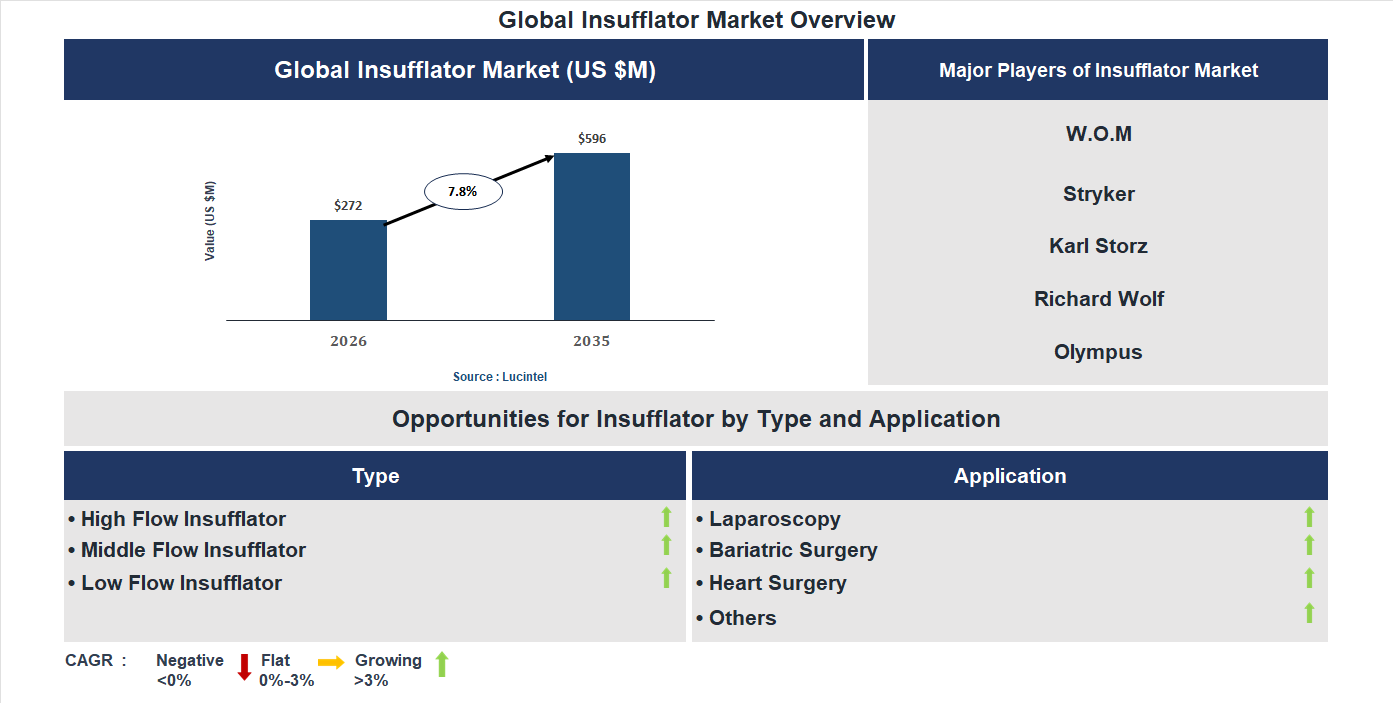
Insufflator Market Trends and Forecast

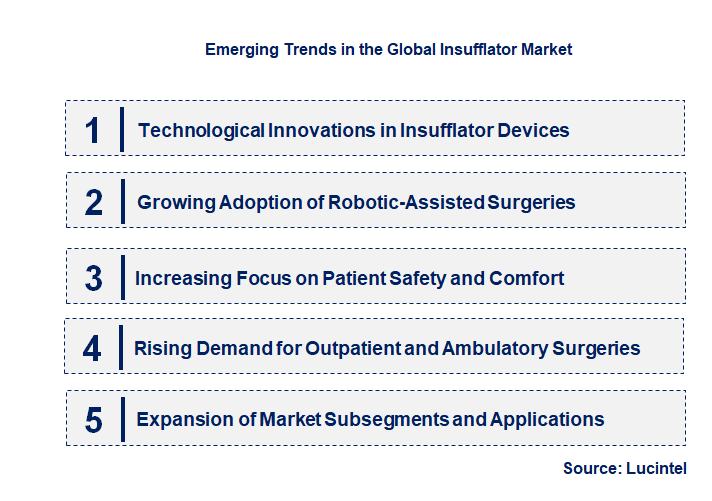
Emerging Trends in the Insufflator Market

The insufflator market is experiencing rapid evolution driven by technological advancements, increasing demand for minimally invasive surgeries, and a focus on improving patient outcomes. As healthcare providers seek more efficient, safer, and cost-effective solutions, the market is witnessing the emergence of innovative products and practices. These developments are not only enhancing surgical precision but also expanding the scope of procedures that can be performed with insufflators. The following key trends highlight the transformative changes shaping this market, reflecting a shift towards smarter, more integrated, and patient-centric surgical tools.

• Technological Innovations in Insufflator Devices: The integration of advanced features such as high-definition imaging, real-time monitoring, and automated pressure control is revolutionizing insufflator devices. These innovations improve surgical accuracy, reduce complications, and enhance user experience. Manufacturers are investing in smart technology that allows for better control and customization during procedures, leading to increased adoption in complex surgeries. The trend toward miniaturization and portability also enables use in diverse clinical settings, including outpatient and remote locations, broadening the market scope.
• Growing Adoption of Robotic-Assisted Surgeries: The rise of robotic-assisted surgical systems is significantly impacting the insufflator market. These systems require specialized insufflators that can seamlessly integrate with robotic platforms, offering enhanced precision and dexterity. The trend is driven by the benefits of minimally invasive approaches, such as reduced recovery time and improved outcomes. As hospitals and surgical centers increasingly adopt robotic technologies, demand for compatible insufflators is surging. This integration is fostering the development of advanced insufflators with features like automated gas flow regulation and compatibility with various robotic systems.
• Increasing Focus on Patient Safety and Comfort: Market players are prioritizing features that enhance patient safety and comfort during procedures. Innovations include improved gas filtration systems to reduce postoperative complications, quieter devices to minimize patient discomfort, and ergonomic designs for easier handling by surgeons. These improvements are crucial in expanding the acceptance of minimally invasive surgeries among patients and healthcare providers. The trend also involves developing insufflators that can better manage intra-abdominal pressure, thereby reducing risks such as tissue damage and postoperative pain, ultimately leading to better patient outcomes.
• Rising Demand for Outpatient and Ambulatory Surgeries: The shift towards outpatient and ambulatory surgical procedures is a significant driver for the insufflator market. These settings demand compact, easy-to-use, and reliable insufflators that can facilitate quick setup and turnaround times. The trend is supported by advancements in device portability and user-friendly interfaces, enabling procedures to be performed efficiently outside traditional operating rooms. This shift not only reduces healthcare costs but also increases patient convenience and satisfaction. As outpatient surgeries grow, manufacturers are innovating to meet the specific needs of these environments, expanding the market reach.
• Expansion of Market Subsegments and Applications: The insufflator market is diversifying beyond traditional laparoscopic surgeries to include applications in thoracoscopy, gynecology, urology, and bariatric procedures. This expansion is driven by technological advancements that allow for specialized devices tailored to different surgical needs. Subsegments such as high-flow insufflators, portable units, and integrated systems are gaining prominence. This diversification broadens the market scope, attracting new healthcare providers and expanding access to minimally invasive options across various medical disciplines. It also encourages innovation in device design, catering to the unique requirements of each surgical specialty.

These emerging trends are reshaping the insufflator market by fostering innovation, expanding application areas, and emphasizing safety and efficiency. The integration of smart technology, the rise of robotic-assisted surgeries, and the focus on outpatient procedures are collectively driving growth and transforming how minimally invasive surgeries are performed. These developments are making procedures safer, more accessible, and more effective, ultimately improving patient outcomes and expanding market opportunities.
Emerging Trends in the Insufflator Market

Recent Development in the Insufflator Market

The insufflator market is experiencing rapid growth driven by technological advancements, increasing demand for minimally invasive surgeries, and expanding healthcare infrastructure worldwide. These developments are transforming surgical procedures, improving patient outcomes, and creating new opportunities for manufacturers and healthcare providers. As the market evolves, stakeholders are focusing on innovation, regulatory compliance, and expanding access to advanced insufflation devices, which collectively are shaping the future landscape of minimally invasive surgery.

• Technological Innovations in Insufflators: Advancements such as high-precision control systems and portable devices are enhancing surgical efficiency and safety. These innovations reduce procedure times, improve visualization, and minimize patient trauma, leading to better clinical outcomes. The integration of smart technology and user-friendly interfaces is also increasing adoption among surgeons. As a result, the market is witnessing a surge in demand for sophisticated insufflators, fostering competitive growth and encouraging further R&D investments.
• Rising Adoption of Minimally Invasive Surgeries: The global shift towards minimally invasive procedures is significantly boosting the insufflator market. Benefits like reduced hospital stays, quicker recovery, and lower complication rates are driving healthcare providers to adopt advanced insufflation devices. This trend is particularly prominent in developed regions but is also expanding into emerging markets. The increased preference for outpatient surgeries and outpatient clinics further accelerates demand, making insufflators a critical component in modern surgical practices.
• Growing Healthcare Infrastructure and Investment: Expanding healthcare facilities and increased government and private sector investments are facilitating access to advanced surgical equipment, including insufflators. Countries are upgrading their medical infrastructure to support minimally invasive surgeries, which require specialized devices. This growth in healthcare capacity is enabling broader adoption of insufflation technology, especially in developing regions, and is expected to sustain market expansion through increased procurement and installation of new equipment.
• Regulatory Approvals and Standardization: The approval of innovative insufflators by regulatory bodies such as the FDA and EMA is fostering market confidence and facilitating global distribution. Standardization of device safety and performance standards ensures quality and reliability, encouraging healthcare providers to adopt new technologies. Regulatory support also accelerates product launches and market entry, boosting competition and innovation. As regulatory frameworks evolve, they will continue to shape the development and commercialization of insufflation devices.
• Impact of COVID-19 Pandemic on Market Dynamics: The pandemic has heightened awareness of minimally invasive procedures due to their reduced hospital stay and lower infection risk. It has also prompted healthcare systems to prioritize efficient surgical solutions, increasing demand for advanced insufflators. Supply chain disruptions initially challenged market growth, but recovery efforts and increased investment in healthcare infrastructure have stabilized the market. Overall, COVID-19 has accelerated the adoption of innovative insufflation technologies, influencing long-term market growth and strategic planning.

The overall impact of these developments is a robust and expanding insufflator market characterized by technological innovation, increased adoption of minimally invasive surgeries, enhanced healthcare infrastructure, supportive regulatory environments, and pandemic-driven shifts. These factors collectively are driving market growth, fostering competition, and improving surgical outcomes worldwide.

Strategic Growth Opportunities in the Insufflator Market

The insufflator market is experiencing significant growth driven by advancements in minimally invasive surgeries, increasing adoption in healthcare facilities, and technological innovations. Rising demand for efficient, safe, and precise surgical tools is fueling market expansion across various regions. Key applications such as laparoscopic procedures, bariatric surgeries, and gynecological interventions are expanding rapidly. Strategic investments, regulatory approvals, and increasing awareness about minimally invasive techniques are creating new opportunities for market players to innovate and capture market share.

• Growing Adoption of Minimally Invasive Surgeries: The increasing preference for minimally invasive procedures worldwide is a major driver for the insufflator market. Surgeons and healthcare providers favor these techniques due to reduced patient recovery time, lower infection risks, and minimal scarring. As awareness and training improve, hospitals are investing more in advanced insufflators to meet demand. This trend is particularly prominent in developed regions but is rapidly expanding into emerging markets, creating substantial growth opportunities for manufacturers.
• Technological Innovations Enhancing Surgical Precision: Advances in insufflator technology, such as integrated smoke evacuation, precise pressure control, and ergonomic designs, are improving surgical outcomes. These innovations enable surgeons to perform complex procedures more efficiently and safely. The development of portable and user-friendly insufflators is also expanding their use in outpatient and emergency settings. Continuous R&D efforts are expected to introduce smarter, more adaptable devices, further boosting market growth and adoption across diverse surgical applications.
• Rising Demand in Bariatric and Obesity-Related Surgeries: The global rise in obesity rates is fueling the demand for bariatric surgeries, which heavily rely on insufflators for laparoscopic procedures. As obesity-related health issues become more prevalent, healthcare providers are increasingly adopting minimally invasive bariatric techniques. This surge presents significant growth opportunities for insufflator manufacturers to develop specialized, high-capacity devices tailored for these complex surgeries, expanding their market footprint in the obesity treatment segment.
• Increasing Use in Gynecological and Urological Procedures: Gynecological surgeries, such as hysterectomies and ovarian cyst removals, along with urological interventions, are increasingly performed using laparoscopic techniques that require insufflators. The demand is driven by the benefits of reduced hospital stays and quicker recovery times. As these procedures become more common, the need for reliable, versatile insufflators grows. Market players are focusing on developing devices optimized for these specialties, opening new avenues for growth and technological differentiation.
• Expansion in Emerging Markets and Healthcare Infrastructure Development: Emerging economies are witnessing rapid healthcare infrastructure development and increased healthcare spending, creating new opportunities for insufflator market expansion. Governments and the private sectors are investing in modern surgical facilities, driving demand for advanced insufflators. Additionally, rising awareness and training programs are facilitating adoption in these regions. This expansion offers manufacturers the chance to tap into high-growth markets, customize products for local needs, and establish a strong presence in developing healthcare landscapes.

The insufflator market is poised for substantial growth driven by technological advancements, expanding surgical applications, and increasing healthcare investments worldwide. These opportunities will enable market players to innovate, diversify their product offerings, and strengthen their global footprint, ultimately enhancing patient outcomes and surgical efficiency across diverse medical disciplines.

Insufflator Market Driver and Challenges

The insufflator market is influenced by a variety of technological, economic, and regulatory factors that shape its growth trajectory. Advances in minimally invasive surgical techniques, increasing healthcare expenditure, and evolving regulatory standards are key drivers. However, the market also faces challenges such as high equipment costs, stringent regulatory approvals, and the need for specialized training. These factors collectively impact market dynamics, influencing innovation, adoption rates, and overall growth potential. Understanding these drivers and challenges is essential for stakeholders aiming to capitalize on emerging opportunities while navigating potential obstacles in this evolving landscape.

The factors responsible for driving the insufflator market include:-
• Technological Advancements: The continuous development of innovative insufflation devices, such as portable and high-precision insufflators, enhances surgical outcomes and broadens the application scope. These advancements improve safety, reduce procedure times, and enable minimally invasive surgeries, which are increasingly preferred by healthcare providers and patients. As technology evolves, the market benefits from increased adoption, driving growth and expanding market size.
• Rising Prevalence of Chronic Diseases: The increasing incidence of chronic conditions like obesity, cardiovascular diseases, and cancers necessitates minimally invasive surgical interventions. Insufflators are essential in laparoscopic and endoscopic procedures, making their demand directly proportional to the rise in such diseases. This trend fuels market expansion as healthcare systems seek efficient surgical solutions to manage complex health issues.
• Growing Preference for Minimally Invasive Surgeries: Patients and healthcare providers are favoring minimally invasive procedures due to benefits like reduced pain, shorter hospital stays, and quicker recovery times. This shift boosts demand for advanced insufflators capable of supporting such surgeries. The trend is further supported by technological innovations and increased awareness, contributing significantly to market growth.
• Increasing Healthcare Expenditure: Rising healthcare budgets across developed and developing countries facilitate the procurement of advanced surgical equipment, including insufflators. Governments and the private sector are investing more in healthcare infrastructure, which promotes the adoption of modern surgical tools. This economic support accelerates market expansion and encourages innovation in inflation technology.

The challenges facing the insufflator market include:-
• High Equipment Costs: The cost of advanced insufflators and related accessories remains a significant barrier, especially for smaller healthcare facilities and in developing regions. These high costs limit widespread adoption and can hinder market growth, as hospitals may be reluctant to invest in expensive equipment without clear cost-benefit advantages.
• Stringent Regulatory Approvals: The approval process for new insufflation devices is complex and time-consuming, involving rigorous safety and efficacy evaluations. Regulatory hurdles can delay product launches, increase development costs, and restrict market entry for innovative solutions, thereby impacting overall market growth.
• Need for Specialized Training: Effective use of insufflators requires specialized training for surgeons and operating room staff. The lack of adequately trained personnel can lead to underutilization of advanced devices and potential safety concerns. This challenge necessitates investment in training programs, which can be resource-intensive and slow down adoption rates.

The insufflator market is driven by technological innovations, increasing disease prevalence, and a shift towards minimally invasive surgeries, supported by rising healthcare expenditure. However, high costs, regulatory complexities, and training requirements pose significant challenges. These factors collectively influence market growth, with opportunities for innovation and expansion tempered by obstacles that require strategic navigation. Overall, the markets future will depend on balancing these drivers and challenges to foster sustainable growth and technological advancement.

List of Insufflator Companies

Companies in the market compete on the basis of product quality offered. Major players in this market focus on expanding their manufacturing facilities, R&D investments, infrastructural development, and leverage integration opportunities across the value chain. With these strategies insufflator companies cater increasing demand, ensure competitive effectiveness, develop innovative products & technologies, reduce production costs, and expand their customer base. Some of the insufflator companies profiled in this report include-
• W.O.M
• Stryker
• Karl Storz
• Richard Wolf
• Olympus
• B.Braun
• Hoya
• STERIS
• Fujifilm
• Smith & Nephew

Insufflator Market by Segment

The study includes a forecast for the global insufflator market by type, application, and region.

Insufflator Market by Type [Value from 2019 to 2035]:


• High Flow Insufflator
• Middle Flow Insufflator
• Low Flow Insufflator

Insufflator Market by Application [Value from 2019 to 2035]:


• Laparoscopy
• Bariatric Surgery
• Heart Surgery
• Others

Insufflator Market by Region [Value from 2019 to 2035]:


• North America
• Europe
• Asia Pacific
• The Rest of the World

Country Wise Outlook for the Insufflator Market

The insufflator market has experienced significant growth driven by advancements in minimally invasive surgical techniques, technological innovations, and increasing healthcare demands worldwide. As hospitals and clinics seek more efficient and safer procedures, key players are investing in new product development and expanding their market presence. Regulatory approvals and rising adoption in emerging markets further fuel this expansion. The United States, China, Germany, India, and Japan are at the forefront of these developments, each contributing uniquely to the global landscape through technological advancements, increased adoption, and strategic initiatives.

• United States: The US market has seen rapid adoption of advanced insufflators with integrated imaging and safety features. Major companies are focusing on product innovation, including portable and high-precision devices, driven by a high prevalence of minimally invasive surgeries and favorable reimbursement policies. The FDAs approval processes have facilitated the launch of new technologies, boosting market growth. Additionally, increasing investments in healthcare infrastructure and rising awareness about minimally invasive procedures have contributed to market expansion.
• China: China’s insufflator market is expanding due to rising healthcare infrastructure and government initiatives promoting minimally invasive surgeries. Local manufacturers are increasingly developing cost-effective devices to meet the growing demand. The adoption of advanced insufflators is accelerating in urban hospitals, supported by technological collaborations with international firms. The government’s focus on healthcare reform and increasing healthcare expenditure are key drivers, alongside a rising number of surgical procedures requiring insufflation.
• Germany: Germany’s market benefits from a well-established healthcare system and high adoption of innovative surgical technologies. Leading medical device companies are introducing sophisticated insufflators with enhanced safety features and user-friendly interfaces. The country’s focus on minimally invasive surgeries, especially in gynecology and urology, has driven demand. Regulatory standards are stringent, ensuring high-quality products, and there is a growing trend toward integrating insufflators with other surgical systems for improved outcomes.
• India: The Indian market is witnessing rapid growth due to increasing awareness of minimally invasive surgeries and expanding healthcare infrastructure. Local and international companies are offering affordable, technologically advanced insufflators to cater to a large patient base. Government initiatives aimed at improving healthcare access and affordability are boosting market penetration. The rising number of laparoscopic surgeries in urban and semi-urban areas is a significant factor, along with a growing preference for outpatient procedures.
• Japan: Japan’s market is characterized by high technological adoption and a focus on precision medicine. Leading companies are launching innovative insufflators with features like automatic pressure control and enhanced safety mechanisms. The aging population has increased demand for minimally invasive procedures, driving market growth. Japan’s strict regulatory environment ensures high product standards, and collaborations between medical device firms and healthcare providers are fostering technological advancements and market expansion.

Lucintel Analytics Dashboard

Features of the Global Insufflator Market

Market Size Estimates: Insufflator market size estimation in terms of value ($M).
Trend and Forecast Analysis: Market trends (2019 to 2025) and forecast (2026 to 2035) by various segments and regions.
Segmentation Analysis: Insufflator market size by type, application, and region in terms of value ($M).
Regional Analysis: Insufflator market breakdown by North America, Europe, Asia Pacific, and Rest of the World.
Growth Opportunities: Analysis of growth opportunities in different types, applications, and regions for the insufflator market.
Strategic Analysis: This includes M&A, new product development, and competitive landscape of the insufflator market.
Analysis of competitive intensity of the industry based on Porter’s Five Forces model.

Lucintel Consulting Services

FAQ

Q1. What is the market size and growth forecast for insufflator market?
Answer: The global insufflator market is expected to reach an estimated $596 million by 2035 and grow with a CAGR of 7.8% from 2026 to 2035.
Q2. What are the major drivers influencing the growth of the insufflator market?
Answer: The major drivers for this market are the increasing demand for minimally invasive surgeries, the rising number of laparoscopic procedures, and the growing adoption of advanced insufflation technologies.
Q3. What are the major segments for insufflator market?
Answer: The future of the insufflator market looks promising with opportunities in the laparoscopy, bariatric surgery, and heart surgery markets.
Q4. Who are the key insufflator market companies?
Answer: Some of the key insufflator companies are as follows:
• W.O.M
• Stryker
• Karl Storz
• Richard Wolf
• Olympus
• B.Braun
• Hoya
• STERIS
• Fujifilm
• Smith & Nephew
Q5. Which insufflator market segment will be the largest in future?
Answer: Lucintel forecasts that, within the type category, high flow insufflator is expected to witness the highest growth over the forecast period.
Q6. In insufflator market, which region is expected to be the largest in next 5 years?
Answer: In terms of region, APAC is expected to witness the highest growth over the forecast period.
Q7. Do we receive customization in this report?
Answer: Yes, Lucintel provides 10% customization without any additional cost.

This report answers following 11 key questions:

Q.1. What are some of the most promising, high-growth opportunities for the insufflator market by type (high flow insufflator, middle flow insufflator, and low flow insufflator), application (laparoscopy, bariatric surgery, heart surgery, and others), and region (North America, Europe, Asia Pacific, and the Rest of the World)?
Q.2. Which segments will grow at a faster pace and why?
Q.3. Which region will grow at a faster pace and why?
Q.4. What are the key factors affecting market dynamics? What are the key challenges and business risks in this market?
Q.5. What are the business risks and competitive threats in this market?
Q.6. What are the emerging trends in this market and the reasons behind them?
Q.7. What are some of the changing demands of customers in the market?
Q.8. What are the new developments in the market? Which companies are leading these developments?
Q.9. Who are the major players in this market? What strategic initiatives are key players pursuing for business growth?
Q.10. What are some of the competing products in this market and how big of a threat do they pose for loss of market share by material or product substitution?
Q.11. What M&A activity has occurred in the last 7 years and what has its impact been on the industry?

For any questions related to Insufflator Market, Insufflator Market Size, Insufflator Market Growth, Insufflator Market Analysis, Insufflator Market Report, Insufflator Market Share, Insufflator Market Trends, Insufflator Market Forecast, Insufflator Companies, write Lucintel analyst at email: helpdesk@lucintel.com. We will be glad to get back to you soon.
                                           Table of Contents

            1. Executive Summary

            2. Market Overview

                        2.1 Background and Classifications
                        2.2 Supply Chain

            3. Market Trends & Forecast Analysis

                        3.1 Macroeconomic Trends and Forecasts
                        3.2 Industry Drivers and Challenges
                        3.3 PESTLE Analysis
                        3.4 Patent Analysis
                        3.5 Regulatory Environment
                        3.6 Global Insufflator Market Trends and Forecast

            4. Global Insufflator Market by Type

                        4.1 Overview
                        4.2 Attractiveness Analysis by Type
                        4.3 High Flow Insufflator : Trends and Forecast 2019 to 2035
                        4.4 Middle Flow Insufflator : Trends and Forecast 2019 to 2035
                        4.5 Low Flow Insufflator : Trends and Forecast 2019 to 2035

            5. Global Insufflator Market by Application

                        5.1 Overview
                        5.2 Attractiveness Analysis by Application
                        5.3 Laparoscopy : Trends and Forecast 2019 to 2035
                        5.4 Bariatric Surgery : Trends and Forecast 2019 to 2035
                        5.5 Heart Surgery : Trends and Forecast 2019 to 2035
                        5.6 Others : Trends and Forecast 2019 to 2035

            6. Regional Analysis

                        6.1 Overview
                        6.2 Global Insufflator Market by Region

            7. North American Insufflator Market

                        7.1 Overview
                        7.2 North American Insufflator Market by Type
                        7.3 North American Insufflator Market by Application
                        7.4 The United States Insufflator Market
                        7.5 Canadian Insufflator Market
                        7.6 Mexican Insufflator Market

            8. European Insufflator Market

                        8.1 Overview
                        8.2 European Insufflator Market by Type
                        8.3 European Insufflator Market by Application
                        8.4 German Insufflator Market
                        8.5 French Insufflator Market
                        8.6 Italian Insufflator Market
                        8.7 Spanish Insufflator Market
                        8.8 The United Kingdom Insufflator Market

            9. APAC Insufflator Market

                        9.1 Overview
                        9.2 APAC Insufflator Market by Type
                        9.3 APAC Insufflator Market by Application
                        9.4 Chinese Insufflator Market
                        9.5 Indian Insufflator Market
                        9.6 Japanese Insufflator Market
                        9.7 South Korean Insufflator Market
                        9.8 Indonesian Insufflator Market

            10. ROW Insufflator Market

                        10.1 Overview
                        10.2 ROW Insufflator Market by Type
                        10.3 ROW Insufflator Market by Application
                        10.4 Middle Eastern Insufflator Market
                        10.5 South American Insufflator Market
                        10.6 African Insufflator Market

            11. Competitor Analysis

                        11.1 Product Portfolio Analysis
                        11.2 Operational Integration
                        11.3 Porter’s Five Forces Analysis
                                    • Competitive Rivalry
                                    • Bargaining Power of Buyers
                                    • Bargaining Power of Suppliers
                                    • Threat of Substitutes
                                    • Threat of New Entrants
                        11.4 Market Share Analysis

            12. Opportunities & Strategic Analysis

                        12.1 Value Chain Analysis
                        12.2 Growth Opportunity Analysis
                                    12.2.1 Growth Opportunity by Type
                                    12.2.2 Growth Opportunity by Application
                        12.3 Emerging Trends in the Global Insufflator Market
                        12.4 Strategic Analysis
                                    12.4.1 New Product Development
                                    12.4.2 Certification and Licensing
                                    12.4.3 Mergers, Acquisitions, Agreements, Collaborations, and Joint Ventures

            13. Company Profiles of the Leading Players Across the Value Chain

                        13.1 Competitive Analysis Overview
                        13.2 W.O.M
                                    • Company Overview
                                    • Insufflator Market Business Overview
                                    • New Product Development
                                    • Merger, Acquisition, and Collaboration
                                    • Certification and Licensing
                        13.3 Stryker
                                    • Company Overview
                                    • Insufflator Market Business Overview
                                    • New Product Development
                                    • Merger, Acquisition, and Collaboration
                                    • Certification and Licensing
                        13.4 Karl Storz
                                    • Company Overview
                                    • Insufflator Market Business Overview
                                    • New Product Development
                                    • Merger, Acquisition, and Collaboration
                                    • Certification and Licensing
                        13.5 Richard Wolf
                                    • Company Overview
                                    • Insufflator Market Business Overview
                                    • New Product Development
                                    • Merger, Acquisition, and Collaboration
                                    • Certification and Licensing
                        13.6 Olympus
                                    • Company Overview
                                    • Insufflator Market Business Overview
                                    • New Product Development
                                    • Merger, Acquisition, and Collaboration
                                    • Certification and Licensing
                        13.7 B.Braun
                                    • Company Overview
                                    • Insufflator Market Business Overview
                                    • New Product Development
                                    • Merger, Acquisition, and Collaboration
                                    • Certification and Licensing
                        13.8 Hoya
                                    • Company Overview
                                    • Insufflator Market Business Overview
                                    • New Product Development
                                    • Merger, Acquisition, and Collaboration
                                    • Certification and Licensing
                        13.9 STERIS
                                    • Company Overview
                                    • Insufflator Market Business Overview
                                    • New Product Development
                                    • Merger, Acquisition, and Collaboration
                                    • Certification and Licensing
                        13.10 Fujifilm
                                    • Company Overview
                                    • Insufflator Market Business Overview
                                    • New Product Development
                                    • Merger, Acquisition, and Collaboration
                                    • Certification and Licensing
                        13.11 Smith & Nephew
                                    • Company Overview
                                    • Insufflator Market Business Overview
                                    • New Product Development
                                    • Merger, Acquisition, and Collaboration
                                    • Certification and Licensing

            14. Appendix

                        14.1 List of Figures
                        14.2 List of Tables
                        14.3 Research Methodology
                        14.4 Disclaimer
                        14.5 Copyright
                        14.6 Abbreviations and Technical Units
                        14.7 About Us
                        14.8 Contact Us

                                               List of Figures


            Chapter 1

                        Figure 1.1: Trends and Forecast for the Global Insufflator Market

            Chapter 2

                        Figure 2.1: Usage of Insufflator Market
                        Figure 2.2: Classification of the Global Insufflator Market
                        Figure 2.3: Supply Chain of the Global Insufflator Market

            Chapter 3

                        Figure 3.1: Trends of the Global GDP Growth Rate
                        Figure 3.2: Trends of the Global Population Growth Rate
                        Figure 3.3: Trends of the Global Inflation Rate
                        Figure 3.4: Trends of the Global Unemployment Rate
                        Figure 3.5: Trends of the Regional GDP Growth Rate
                        Figure 3.6: Trends of the Regional Population Growth Rate
                        Figure 3.7: Trends of the Regional Inflation Rate
                        Figure 3.8: Trends of the Regional Unemployment Rate
                        Figure 3.9: Trends of Regional Per Capita Income
                        Figure 3.10: Forecast for the Global GDP Growth Rate
                        Figure 3.11: Forecast for the Global Population Growth Rate
                        Figure 3.12: Forecast for the Global Inflation Rate
                        Figure 3.13: Forecast for the Global Unemployment Rate
                        Figure 3.14: Forecast for the Regional GDP Growth Rate
                        Figure 3.15: Forecast for the Regional Population Growth Rate
                        Figure 3.16: Forecast for the Regional Inflation Rate
                        Figure 3.17: Forecast for the Regional Unemployment Rate
                        Figure 3.18: Forecast for Regional Per Capita Income
                        Figure 3.19: Driver and Challenges of the Insufflator Market

            Chapter 4

                        Figure 4.1: Global Insufflator Market by Type in 2019, 2025, and 2035
                        Figure 4.2: Trends of the Global Insufflator Market ($M) by Type
                        Figure 4.3: Forecast for the Global Insufflator Market ($M) by Type
                        Figure 4.4: Trends and Forecast for High Flow Insufflator in the Global Insufflator Market (2019-2035)
                        Figure 4.5: Trends and Forecast for Middle Flow Insufflator in the Global Insufflator Market (2019-2035)
                        Figure 4.6: Trends and Forecast for Low Flow Insufflator in the Global Insufflator Market (2019-2035)

            Chapter 5

                        Figure 5.1: Global Insufflator Market by Application in 2019, 2025, and 2035
                        Figure 5.2: Trends of the Global Insufflator Market ($M) by Application
                        Figure 5.3: Forecast for the Global Insufflator Market ($M) by Application
                        Figure 5.4: Trends and Forecast for Laparoscopy in the Global Insufflator Market (2019-2035)
                        Figure 5.5: Trends and Forecast for Bariatric Surgery in the Global Insufflator Market (2019-2035)
                        Figure 5.6: Trends and Forecast for Heart Surgery in the Global Insufflator Market (2019-2035)
                        Figure 5.7: Trends and Forecast for Others in the Global Insufflator Market (2019-2035)

            Chapter 6

                        Figure 6.1: Trends of the Global Insufflator Market ($M) by Region (2019-2025)
                        Figure 6.2: Forecast for the Global Insufflator Market ($M) by Region (2026-2035)

            Chapter 7

                        Figure 7.1: Trends and Forecast for the North American Insufflator Market (2019-2035)
                        Figure 7.2: North American Insufflator Market by Type in 2019, 2025, and 2035
                        Figure 7.3: Trends of the North American Insufflator Market ($M) by Type (2019-2025)
                        Figure 7.4: Forecast for the North American Insufflator Market ($M) by Type (2026-2035)
                        Figure 7.5: North American Insufflator Market by Application in 2019, 2025, and 2035
                        Figure 7.6: Trends of the North American Insufflator Market ($M) by Application (2019-2025)
                        Figure 7.7: Forecast for the North American Insufflator Market ($M) by Application (2026-2035)
                        Figure 7.8: Trends and Forecast for the United States Insufflator Market ($M) (2019-2035)
                        Figure 7.9: Trends and Forecast for the Mexican Insufflator Market ($M) (2019-2035)
                        Figure 7.10: Trends and Forecast for the Canadian Insufflator Market ($M) (2019-2035)

            Chapter 8

                        Figure 8.1: Trends and Forecast for the European Insufflator Market (2019-2035)
                        Figure 8.2: European Insufflator Market by Type in 2019, 2025, and 2035
                        Figure 8.3: Trends of the European Insufflator Market ($M) by Type (2019-2025)
                        Figure 8.4: Forecast for the European Insufflator Market ($M) by Type (2026-2035)
                        Figure 8.5: European Insufflator Market by Application in 2019, 2025, and 2035
                        Figure 8.6: Trends of the European Insufflator Market ($M) by Application (2019-2025)
                        Figure 8.7: Forecast for the European Insufflator Market ($M) by Application (2026-2035)
                        Figure 8.8: Trends and Forecast for the German Insufflator Market ($M) (2019-2035)
                        Figure 8.9: Trends and Forecast for the French Insufflator Market ($M) (2019-2035)
                        Figure 8.10: Trends and Forecast for the Spanish Insufflator Market ($M) (2019-2035)
                        Figure 8.11: Trends and Forecast for the Italian Insufflator Market ($M) (2019-2035)
                        Figure 8.12: Trends and Forecast for the United Kingdom Insufflator Market ($M) (2019-2035)

            Chapter 9

                        Figure 9.1: Trends and Forecast for the APAC Insufflator Market (2019-2035)
                        Figure 9.2: APAC Insufflator Market by Type in 2019, 2025, and 2035
                        Figure 9.3: Trends of the APAC Insufflator Market ($M) by Type (2019-2025)
                        Figure 9.4: Forecast for the APAC Insufflator Market ($M) by Type (2026-2035)
                        Figure 9.5: APAC Insufflator Market by Application in 2019, 2025, and 2035
                        Figure 9.6: Trends of the APAC Insufflator Market ($M) by Application (2019-2025)
                        Figure 9.7: Forecast for the APAC Insufflator Market ($M) by Application (2026-2035)
                        Figure 9.8: Trends and Forecast for the Japanese Insufflator Market ($M) (2019-2035)
                        Figure 9.9: Trends and Forecast for the Indian Insufflator Market ($M) (2019-2035)
                        Figure 9.10: Trends and Forecast for the Chinese Insufflator Market ($M) (2019-2035)
                        Figure 9.11: Trends and Forecast for the South Korean Insufflator Market ($M) (2019-2035)
                        Figure 9.12: Trends and Forecast for the Indonesian Insufflator Market ($M) (2019-2035)

            Chapter 10

                        Figure 10.1: Trends and Forecast for the ROW Insufflator Market (2019-2035)
                        Figure 10.2: ROW Insufflator Market by Type in 2019, 2025, and 2035
                        Figure 10.3: Trends of the ROW Insufflator Market ($M) by Type (2019-2025)
                        Figure 10.4: Forecast for the ROW Insufflator Market ($M) by Type (2026-2035)
                        Figure 10.5: ROW Insufflator Market by Application in 2019, 2025, and 2035
                        Figure 10.6: Trends of the ROW Insufflator Market ($M) by Application (2019-2025)
                        Figure 10.7: Forecast for the ROW Insufflator Market ($M) by Application (2026-2035)
                        Figure 10.8: Trends and Forecast for the Middle Eastern Insufflator Market ($M) (2019-2035)
                        Figure 10.9: Trends and Forecast for the South American Insufflator Market ($M) (2019-2035)
                        Figure 10.10: Trends and Forecast for the African Insufflator Market ($M) (2019-2035)

            Chapter 11

                        Figure 11.1: Porter’s Five Forces Analysis of the Global Insufflator Market
                        Figure 11.2: Market Share (%) of Top Players in the Global Insufflator Market (2025)

            Chapter 12

                        Figure 12.1: Growth Opportunities for the Global Insufflator Market by Type
                        Figure 12.2: Growth Opportunities for the Global Insufflator Market by Application
                        Figure 12.3: Growth Opportunities for the Global Insufflator Market by Region
                        Figure 12.4: Emerging Trends in the Global Insufflator Market

                                               List of Tables


            Chapter 1

                        Table 1.1: Growth Rate (%, 2024-2025) and CAGR (%, 2026-2035) of the Insufflator Market by Type and Application
                        Table 1.2: Attractiveness Analysis for the Insufflator Market by Region
                        Table 1.3: Global Insufflator Market Parameters and Attributes

            Chapter 3

                        Table 3.1: Trends of the Global Insufflator Market (2019-2025)
                        Table 3.2: Forecast for the Global Insufflator Market (2026-2035)

            Chapter 4

                        Table 4.1: Attractiveness Analysis for the Global Insufflator Market by Type
                        Table 4.2: Market Size and CAGR of Various Type in the Global Insufflator Market (2019-2025)
                        Table 4.3: Market Size and CAGR of Various Type in the Global Insufflator Market (2026-2035)
                        Table 4.4: Trends of High Flow Insufflator in the Global Insufflator Market (2019-2025)
                        Table 4.5: Forecast for High Flow Insufflator in the Global Insufflator Market (2026-2035)
                        Table 4.6: Trends of Middle Flow Insufflator in the Global Insufflator Market (2019-2025)
                        Table 4.7: Forecast for Middle Flow Insufflator in the Global Insufflator Market (2026-2035)
                        Table 4.8: Trends of Low Flow Insufflator in the Global Insufflator Market (2019-2025)
                        Table 4.9: Forecast for Low Flow Insufflator in the Global Insufflator Market (2026-2035)

            Chapter 5

                        Table 5.1: Attractiveness Analysis for the Global Insufflator Market by Application
                        Table 5.2: Market Size and CAGR of Various Application in the Global Insufflator Market (2019-2025)
                        Table 5.3: Market Size and CAGR of Various Application in the Global Insufflator Market (2026-2035)
                        Table 5.4: Trends of Laparoscopy in the Global Insufflator Market (2019-2025)
                        Table 5.5: Forecast for Laparoscopy in the Global Insufflator Market (2026-2035)
                        Table 5.6: Trends of Bariatric Surgery in the Global Insufflator Market (2019-2025)
                        Table 5.7: Forecast for Bariatric Surgery in the Global Insufflator Market (2026-2035)
                        Table 5.8: Trends of Heart Surgery in the Global Insufflator Market (2019-2025)
                        Table 5.9: Forecast for Heart Surgery in the Global Insufflator Market (2026-2035)
                        Table 5.10: Trends of Others in the Global Insufflator Market (2019-2025)
                        Table 5.11: Forecast for Others in the Global Insufflator Market (2026-2035)

            Chapter 6

                        Table 6.1: Market Size and CAGR of Various Regions in the Global Insufflator Market (2019-2025)
                        Table 6.2: Market Size and CAGR of Various Regions in the Global Insufflator Market (2026-2035)

            Chapter 7

                        Table 7.1: Trends of the North American Insufflator Market (2019-2025)
                        Table 7.2: Forecast for the North American Insufflator Market (2026-2035)
                        Table 7.3: Market Size and CAGR of Various Type in the North American Insufflator Market (2019-2025)
                        Table 7.4: Market Size and CAGR of Various Type in the North American Insufflator Market (2026-2035)
                        Table 7.5: Market Size and CAGR of Various Application in the North American Insufflator Market (2019-2025)
                        Table 7.6: Market Size and CAGR of Various Application in the North American Insufflator Market (2026-2035)
                        Table 7.7: Trends and Forecast for the United States Insufflator Market (2019-2035)
                        Table 7.8: Trends and Forecast for the Mexican Insufflator Market (2019-2035)
                        Table 7.9: Trends and Forecast for the Canadian Insufflator Market (2019-2035)

            Chapter 8

                        Table 8.1: Trends of the European Insufflator Market (2019-2025)
                        Table 8.2: Forecast for the European Insufflator Market (2026-2035)
                        Table 8.3: Market Size and CAGR of Various Type in the European Insufflator Market (2019-2025)
                        Table 8.4: Market Size and CAGR of Various Type in the European Insufflator Market (2026-2035)
                        Table 8.5: Market Size and CAGR of Various Application in the European Insufflator Market (2019-2025)
                        Table 8.6: Market Size and CAGR of Various Application in the European Insufflator Market (2026-2035)
                        Table 8.7: Trends and Forecast for the German Insufflator Market (2019-2035)
                        Table 8.8: Trends and Forecast for the French Insufflator Market (2019-2035)
                        Table 8.9: Trends and Forecast for the Spanish Insufflator Market (2019-2035)
                        Table 8.10: Trends and Forecast for the Italian Insufflator Market (2019-2035)
                        Table 8.11: Trends and Forecast for the United Kingdom Insufflator Market (2019-2035)

            Chapter 9

                        Table 9.1: Trends of the APAC Insufflator Market (2019-2025)
                        Table 9.2: Forecast for the APAC Insufflator Market (2026-2035)
                        Table 9.3: Market Size and CAGR of Various Type in the APAC Insufflator Market (2019-2025)
                        Table 9.4: Market Size and CAGR of Various Type in the APAC Insufflator Market (2026-2035)
                        Table 9.5: Market Size and CAGR of Various Application in the APAC Insufflator Market (2019-2025)
                        Table 9.6: Market Size and CAGR of Various Application in the APAC Insufflator Market (2026-2035)
                        Table 9.7: Trends and Forecast for the Japanese Insufflator Market (2019-2035)
                        Table 9.8: Trends and Forecast for the Indian Insufflator Market (2019-2035)
                        Table 9.9: Trends and Forecast for the Chinese Insufflator Market (2019-2035)
                        Table 9.10: Trends and Forecast for the South Korean Insufflator Market (2019-2035)
                        Table 9.11: Trends and Forecast for the Indonesian Insufflator Market (2019-2035)

            Chapter 10

                        Table 10.1: Trends of the ROW Insufflator Market (2019-2025)
                        Table 10.2: Forecast for the ROW Insufflator Market (2026-2035)
                        Table 10.3: Market Size and CAGR of Various Type in the ROW Insufflator Market (2019-2025)
                        Table 10.4: Market Size and CAGR of Various Type in the ROW Insufflator Market (2026-2035)
                        Table 10.5: Market Size and CAGR of Various Application in the ROW Insufflator Market (2019-2025)
                        Table 10.6: Market Size and CAGR of Various Application in the ROW Insufflator Market (2026-2035)
                        Table 10.7: Trends and Forecast for the Middle Eastern Insufflator Market (2019-2035)
                        Table 10.8: Trends and Forecast for the South American Insufflator Market (2019-2035)
                        Table 10.9: Trends and Forecast for the African Insufflator Market (2019-2035)

            Chapter 11

                        Table 11.1: Product Mapping of Insufflator Suppliers Based on Segments
                        Table 11.2: Operational Integration of Insufflator Manufacturers
                        Table 11.3: Rankings of Suppliers Based on Insufflator Revenue

            Chapter 12

                        Table 12.1: New Product Launches by Major Insufflator Producers (2019-2025)
                        Table 12.2: Certification Acquired by Major Competitor in the Global Insufflator Market

.

Buy full report or by chapter as follows

Price by License Type:
[-] Hide Chapter Details
[Chapter Number] [Chapter Name] [Chapter Number Of Pages] [Chapter Price]
Title/Chapter Name Pages Price
Full Report: Insufflator Market Report: Trends, Forecast and Competitive Analysis to 2035 Full Report $ 2,990
A 150 Page Report
Lucintel has been in the business of market research and management consulting since 2000 and has published over 1000 market intelligence reports in various markets / applications and served over 1,000 clients worldwide. This study is a culmination of four months of full-time effort performed by Lucintel's analyst team. The analysts used the following sources for the creation and completion of this valuable report:
  • In-depth interviews of the major players in this market
  • Detailed secondary research from competitors’ financial statements and published data 
  • Extensive searches of published works, market, and database information pertaining to industry news, company press releases, and customer intentions
  • A compilation of the experiences, judgments, and insights of Lucintel’s professionals, who have analyzed and tracked this market over the years.
Extensive research and interviews are conducted across the supply chain of this market to estimate market share, market size, trends, drivers, challenges, and forecasts. Below is a brief summary of the primary interviews that were conducted by job function for this report.
 
Thus, Lucintel compiles vast amounts of data from numerous sources, validates the integrity of that data, and performs a comprehensive analysis. Lucintel then organizes the data, its findings, and insights into a concise report designed to support the strategic decision-making process. The figure below is a graphical representation of Lucintel’s research process. 
 

Please sign in below to get report brochure - Insufflator Market Report.

At Lucintel, we respect your privacy and maintain the confidentiality of information / data provided by you
(Please enter your corporate email. * These fields are mandatory )

Follow us on