
Report Feature
Insect Repellent Market Trends and Forecast
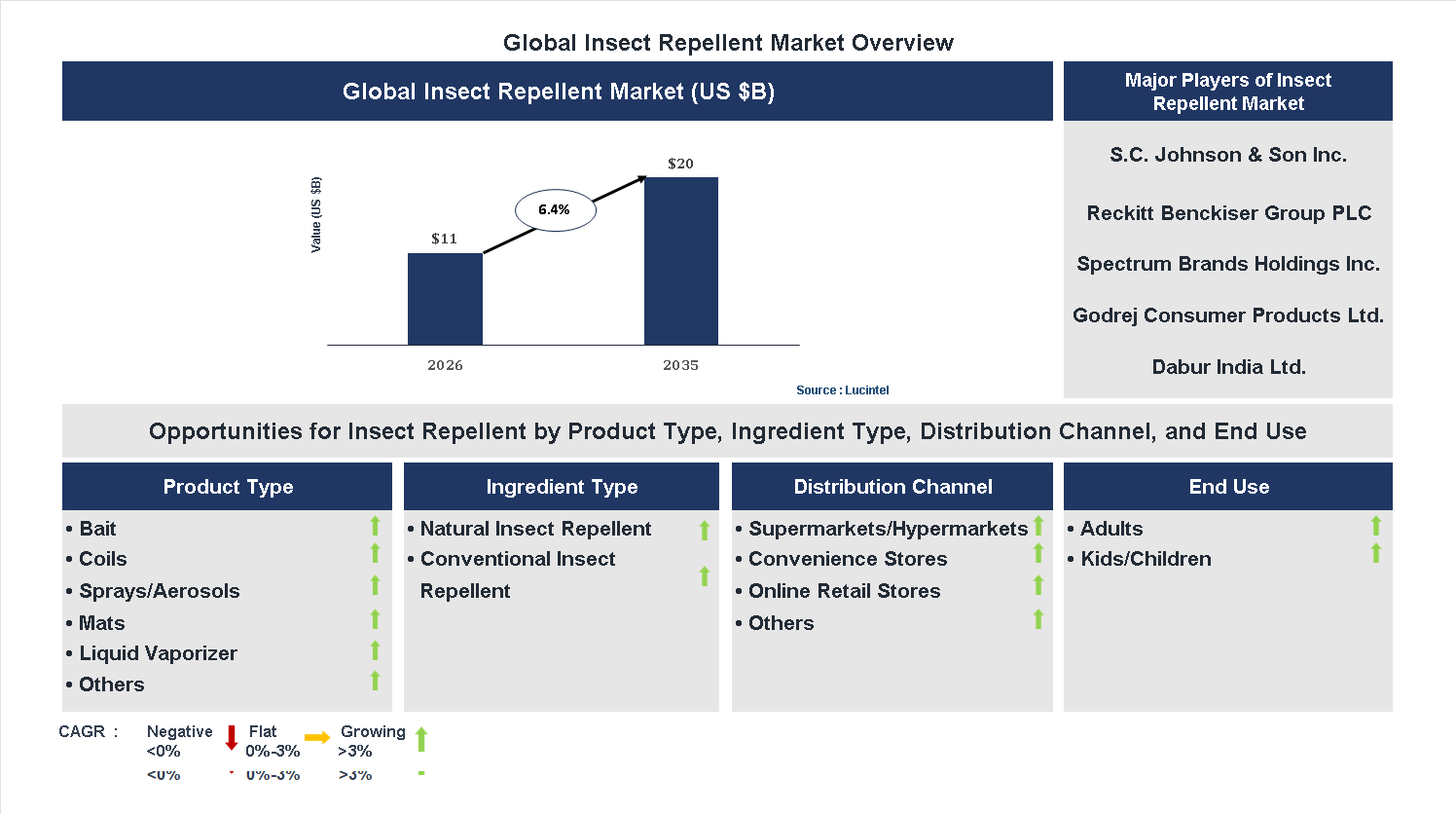
The future of the global insect repellent market looks promising with opportunities in the bait, coil, spray/aerosol, mat, and liquid vaporizer markets. The global insect repellent market is expected to reach an estimated $20 billion by 2035 with a CAGR of 6.4% from 2026 to 2035. The major drivers for this market are the increasing prevalence of mosquito borne diseases, the rising consumer awareness regarding insect protection, and the growing demand for household pest control products.• Lucintel forecasts that, within the distribution channel category, online retail store is expected to witness the highest growth over the forecast period.
• Within the product type category, liquid vaporizer is expected to witness the highest growth.
• In terms of region, APAC is expected to witness the highest growth over the forecast period. Gain valuable insights for your business decisions with our comprehensive 150+ page report. Sample figures with some insights are shown below.
Emerging Trends in the Insect Repellent Market
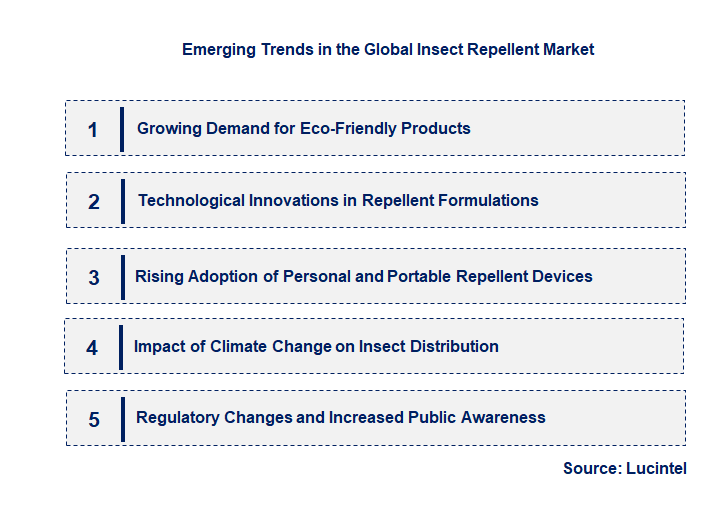
The insect repellent market is experiencing rapid growth driven by increasing awareness of vector-borne diseases, changing climate patterns, and rising outdoor activities. Consumers are seeking more effective, eco-friendly, and long-lasting solutions to protect themselves from insects. Technological advancements and regulatory changes are also shaping product development and marketing strategies. As urbanization continues and global travel expands, the demand for insect repellents is expected to grow across various regions. These developments are transforming the market landscape, creating new opportunities and challenges for manufacturers, retailers, and consumers alike.• Growing Demand for Eco-Friendly Products: Consumers are increasingly prioritizing environmentally safe and natural insect repellents. This trend is driven by rising awareness of chemical-related health risks and environmental concerns. Companies are developing plant-based and organic formulations that appeal to health-conscious consumers. The shift towards eco-friendly products is encouraging innovation in natural ingredients and sustainable packaging, which enhances brand reputation and meets regulatory standards. This trend is expected to expand market share for natural repellents and influence product development strategies.
• Technological Innovations in Repellent Formulations: Advances in formulation technology are leading to more effective and longer-lasting insect repellents. Innovations include microencapsulation, which releases active ingredients gradually, and new active compounds with enhanced efficacy. These developments improve user experience by providing extended protection and reducing the frequency of reapplication. Additionally, smart delivery systems and wearable devices are emerging, offering targeted and convenient protection. Such technological progress is boosting consumer confidence and expanding the market for high-performance repellents.
• Rising Adoption of Personal and Portable Repellent Devices: The demand for portable, personal insect protection solutions is increasing, especially among travelers and outdoor enthusiasts. Devices such as electronic mosquito repellents, wearable patches, and portable sprays are gaining popularity due to their convenience and safety. These devices often use ultrasonic, electromagnetic, or chemical methods to repel insects without the need for sprays or lotions. The trend reflects a preference for discreet, easy-to-use, and chemical-free options, which is driving innovation and diversification in product offerings within the market.
• Impact of Climate Change on Insect Distribution: Changing climate patterns are expanding the habitats of disease-carrying insects like mosquitoes and ticks. Warmer temperatures and increased rainfall create favorable breeding conditions, leading to higher insect populations and extended transmission seasons. This shift is increasing the demand for insect repellents in regions previously less affected, such as temperate zones. It also prompts manufacturers to develop products tailored to new markets and emerging health risks. The climate-driven spread of insects is a significant factor influencing market growth and product innovation.
• Regulatory Changes and Increased Public Awareness: Governments and health organizations are implementing stricter regulations on chemical ingredients and promoting awareness campaigns about insect-borne diseases. These measures influence product formulations, labeling, and marketing strategies. Consumers are becoming more informed about the importance of using effective repellents, which boosts market demand. Companies are investing in research to meet regulatory standards and develop safer, compliant products. This trend underscores the importance of transparency and education in driving market growth and ensuring consumer safety. These trends are collectively reshaping the insect repellent market by fostering innovation, expanding geographic reach, and aligning products with consumer preferences for safety and sustainability. As these developments continue, the market is poised for sustained growth and diversification, meeting the evolving needs of global consumers.
Recent Development in the Insect Repellent Market
The insect repellent market is experiencing rapid growth driven by increasing awareness of vector-borne diseases, rising outdoor activities, and expanding urbanization. Innovations in formulation and eco-friendly products are attracting diverse consumer segments. Governments and health organizations are promoting insect control solutions, further boosting demand. Market players are investing in research to develop long-lasting, safe, and sustainable repellents. These developments are shaping a dynamic landscape, offering significant opportunities for growth and innovation in the insect repellent industry.• Technological Innovations in Repellent Formulations: Advancements in active ingredients and delivery systems are creating more effective, longer-lasting repellents. Nano-technology and bio-based solutions are gaining popularity, reducing environmental impact and health concerns. These innovations improve user experience and efficacy, expanding market reach. Companies investing in R&D are gaining competitive advantages, leading to increased market share and consumer trust. The focus on safety and sustainability is driving product differentiation and market expansion.
• Rising Demand for Eco-Friendly and Natural Repellents: Consumers are increasingly seeking natural, chemical-free options due to health and environmental concerns. Organic ingredients like citronella, neem, and essential oils are being incorporated into products, appealing to eco-conscious buyers. This shift is encouraging manufacturers to develop innovative, sustainable formulations. The demand for natural repellents is particularly strong in North America and Europe, influencing global market trends. This growth supports a broader movement towards environmentally responsible consumer products.
• Expansion in Emerging Markets: Rapid urbanization and increased outdoor activities in developing regions are fueling demand for insect repellents. Countries in Asia-Pacific, Africa, and Latin America are witnessing rising awareness of mosquito-borne diseases, prompting government campaigns and consumer adoption. Local manufacturing and distribution are expanding to meet this demand, creating new market opportunities. Market players are tailoring products to regional preferences and climates, enhancing accessibility and affordability. This expansion is vital for global market growth and diversification.
• Impact of Regulatory Changes and Standards: Governments are implementing stricter regulations on chemical ingredients and labeling to ensure safety. These policies are encouraging innovation in safer, natural alternatives and transparent marketing practices. Compliance costs are influencing product development and market entry strategies. Companies investing in regulatory adherence are gaining consumer trust and avoiding legal issues. The evolving regulatory landscape is shaping product portfolios and fostering industry-wide standards, ultimately promoting safer, more sustainable insect repellent options.
• Integration of Digital and E-commerce Platforms: Online sales channels are becoming crucial for reaching diverse consumer segments. Digital marketing and e-commerce platforms facilitate product education, reviews, and direct purchasing, boosting sales. Companies are leveraging data analytics to understand consumer preferences and personalize offerings. The convenience of online shopping and targeted advertising is accelerating market penetration, especially among younger demographics. This digital shift is enabling brands to expand globally, adapt quickly to market trends, and enhance customer engagement. The overall impact of these developments is a more innovative, sustainable, and accessible insect repellent market. Increased consumer awareness, technological advancements, and regulatory support are driving growth, expanding product options, and improving safety standards. These factors collectively foster a competitive environment that benefits consumers and industry stakeholders, ensuring continued market expansion and evolution.
Strategic Growth Opportunities in the Insect Repellent Market
The insect repellent market is experiencing significant growth driven by increasing awareness of vector-borne diseases, rising outdoor activities, and expanding urbanization. Innovations in formulation and eco-friendly products are attracting diverse consumer segments. Strategic partnerships, regulatory support, and technological advancements are further fueling market expansion. Companies are focusing on product diversification and geographic expansion to capture emerging opportunities. This dynamic environment presents numerous avenues for growth, innovation, and competitive advantage, shaping the future landscape of insect repellents globally.• Growing Demand for Eco-Friendly and Natural Insect Repellents: Consumers are increasingly seeking environmentally safe and natural insect repellent options due to health concerns and environmental impact. This trend encourages companies to develop plant-based, organic, and biodegradable formulations. The shift towards eco-friendly products is driven by regulatory pressures and consumer preferences for sustainable lifestyles. As awareness grows, the market for natural repellents is expected to expand rapidly, creating opportunities for innovation, branding, and market differentiation.
• Expansion of Insect Repellent Use in Emerging Markets: Rapid urbanization, climate change, and rising disease prevalence are boosting insect repellent demand in emerging economies across Asia, Africa, and Latin America. These regions face high mosquito-borne disease burdens, increasing the need for effective protection. Market players are investing in localized manufacturing, distribution channels, and awareness campaigns to penetrate these markets. The expanding middle class and increased outdoor activities further support growth, making emerging markets a key focus for future expansion.
• Technological Innovations in Repellent Formulations: Advances in formulation technology are enabling longer-lasting, more effective, and safer insect repellents. Innovations include microencapsulation, slow-release systems, and bio-based active ingredients. These developments improve product efficacy and user experience, encouraging consumer adoption. Additionally, integration with wearable devices and smart packaging is emerging. Such technological progress offers competitive advantages, opens new product segments, and enhances market appeal through improved safety and convenience.
• Strategic Collaborations and Partnerships for Market Penetration: Companies are forming alliances with research institutions, government agencies, and local distributors to expand reach and develop innovative products. Collaborations facilitate access to new markets, share R&D costs, and enhance credibility. Joint ventures and licensing agreements are common strategies to accelerate product development and distribution. These partnerships help companies adapt to regional preferences, navigate regulatory landscapes, and strengthen their market position, ultimately driving growth and innovation.
• Increasing Adoption of Insect Repellents in the Travel and Outdoor Recreation Sector: The rising popularity of outdoor activities, adventure tourism, and international travel is boosting demand for portable, effective insect repellents. Travelers seek convenient, long-lasting protection against insects, especially in tropical and subtropical regions. Companies are developing travel-sized, easy-to-apply, and multi-purpose products to meet this demand. The outdoor recreation sector’s growth directly correlates with increased insect repellent sales, creating a lucrative niche and expanding the overall market scope. These growth opportunities collectively shape a vibrant and expanding insect repellent market. Emphasizing eco-friendly products, technological innovation, emerging market penetration, strategic collaborations, and outdoor sector adoption will drive future growth. Companies that capitalize on these trends can enhance their market share, meet evolving consumer needs, and sustain competitive advantage. Overall, these opportunities promise a dynamic, innovative, and resilient market landscape in the coming years.
Insect Repellent Market Driver and Challenges
The insect repellent market is influenced by a variety of technological, economic, and regulatory factors that shape its growth and development. Advances in formulation technology, increasing consumer awareness about insect-borne diseases, and expanding urbanization are key drivers. Simultaneously, regulatory restrictions on chemical ingredients and environmental concerns pose significant challenges. Economic factors such as rising disposable incomes and tourism growth further impact market dynamics. Understanding these drivers and challenges is essential for stakeholders to navigate the evolving landscape effectively and capitalize on emerging opportunities while addressing potential risks. The factors responsible for driving the insect repellent market include:-• Technological Innovations: The development of advanced, long-lasting, and eco-friendly formulations has significantly boosted market growth. Innovations such as natural and organic repellents cater to health-conscious consumers, expanding the customer base. Enhanced delivery systems like wearable devices and spatial repellents improve efficacy and convenience, encouraging repeated purchases. Continuous R&D efforts lead to improved product performance, fostering consumer trust and brand loyalty. These technological advancements enable companies to differentiate their offerings, meet regulatory standards, and tap into new market segments, ultimately driving overall market expansion.
• Rising Incidence of Vector-Borne Diseases: Increasing prevalence of diseases like malaria, dengue, Zika, and chikungunya has heightened awareness about the importance of insect repellents. Governments and health organizations are actively promoting preventive measures, including the use of repellents, to curb disease transmission. This heightened awareness translates into higher demand for effective insect repellents across residential, commercial, and travel sectors. The growing burden of vector-borne diseases, especially in tropical and subtropical regions, directly correlates with increased consumer spending on protective products, fueling market growth.
• Growing Tourism and Travel Industry: The expanding global travel industry, including adventure tourism and international travel, has significantly contributed to the demand for insect repellents. Travelers seek protection against insect bites and vector-borne diseases, especially in endemic regions. Hospitality sectors and travel agencies promote insect repellents as essential travel accessories, boosting sales. The rise in outbound tourism from emerging economies further amplifies demand, as consumers prioritize health and safety during travel. This trend creates a steady revenue stream for market players and encourages innovation tailored to travelers’ needs.
• Urbanization and Changing Lifestyle Patterns: Rapid urbanization has led to increased exposure to insect habitats in residential and commercial areas. Modern lifestyles, outdoor recreational activities, and increased awareness about health risks associated with insect bites have driven demand for convenient, portable repellents. Urban dwellers seek effective solutions for outdoor activities, commuting, and home protection. Additionally, the rise of e-commerce platforms facilitates easy access to a wide range of products, expanding market reach. These lifestyle shifts contribute to sustained demand, encouraging companies to develop diverse product lines suited for various consumer needs.
• Environmental and Health Concerns: Growing awareness about the adverse effects of certain chemical repellents, such as DEET, has prompted demand for natural and organic alternatives. Regulatory agencies are imposing restrictions on harmful ingredients, pushing manufacturers to innovate safer formulations. Consumers are increasingly seeking eco-friendly products that are safe for children, pets, and the environment. This shift influences product development, marketing strategies, and regulatory compliance, shaping the competitive landscape. While this presents opportunities for natural product segments, it also challenges companies to balance efficacy with safety, impacting overall market dynamics. The challenges in the insect repellent market are:-
• Regulatory Restrictions and Compliance: Stringent regulations governing the use of certain chemicals in insect repellents, such as DEET and picaridin, pose significant hurdles. Compliance requires extensive testing, certification, and adherence to safety standards, increasing costs and time-to-market for new products. Regulatory bodies frequently update guidelines, necessitating continuous monitoring and reformulation efforts. Non-compliance can lead to legal penalties, product recalls, and damage to brand reputation. Navigating diverse regulations across regions complicates international expansion. These regulatory challenges demand substantial investment in R&D and legal expertise, potentially limiting innovation and market agility.
• Environmental Impact and Sustainability Concerns: The environmental footprint of chemical-based repellents, including their persistence and toxicity, raises sustainability issues. Increasing consumer demand for eco-friendly products pressures manufacturers to develop biodegradable and non-toxic alternatives. However, natural repellents often face challenges related to efficacy, shelf life, and cost. Balancing environmental sustainability with product performance remains a key challenge. Additionally, disposal and manufacturing processes must adhere to environmental standards, adding complexity and cost. Failure to address these concerns can lead to consumer distrust and reduced market share, emphasizing the need for sustainable innovation.
• Market Saturation and Intense Competition: The insect repellent market is highly competitive, with numerous global and local players vying for market share. Product differentiation becomes challenging as many offerings are similar in formulation and branding. Market saturation in developed regions limits growth opportunities, compelling companies to seek new markets or innovate further. Price wars and marketing battles can erode profit margins. Additionally, counterfeit and low-quality products undermine brand integrity and consumer trust. To sustain growth, companies must invest in branding, innovation, and distribution channels, which can be resource-intensive and complex in a crowded marketplace. The insect repellent market is shaped by technological advancements, increasing disease awareness, tourism growth, urbanization, and environmental concerns. While these drivers foster expansion and innovation, regulatory restrictions, environmental issues, and market saturation pose significant challenges. The interplay of these factors influences market dynamics, requiring stakeholders to adapt strategies, invest in R&D, and prioritize sustainability. Successfully navigating these drivers and challenges will determine the market’s future trajectory, offering opportunities for growth amid evolving consumer preferences and regulatory landscapes.
List of Insect Repellent Companies
Companies in the market compete on the basis of product quality offered. Major players in this market focus on expanding their manufacturing facilities, R&D investments, infrastructural development, and leverage integration opportunities across the value chain. With these strategies insect repellent companies cater increasing demand, ensure competitive effectiveness, develop innovative products & technologies, reduce production costs, and expand their customer base. Some of the insect repellent companies profiled in this report include-• S.C. Johnson & Son Inc.
• Reckitt Benckiser Group PLC
• Spectrum Brands Holdings Inc.
• Godrej Consumer Products Ltd.
• Dabur India Ltd.
• Henkel AG & Co. KGaA
• Newell Brands Inc.
• Enesis Group
• Quantum Health
• Jyothy Labs Limited
Insect Repellent Market by Segment
The study includes a forecast for the global insect repellent market by product type, ingredient type, distribution channel, end use, and region.Insect Repellent Market by Product Type [Value from 2019 to 2035]:
• Bait
• Coils
• Sprays/Aerosols
• Mats
• Liquid Vaporizer
• Others
Insect Repellent Market by Ingredient Type [Value from 2019 to 2035]:
• Natural Insect Repellent
• Conventional Insect Repellent
Insect Repellent Market by Distribution Channel [Value from 2019 to 2035]:
• Supermarkets/Hypermarkets
• Convenience Stores
• Online Retail Stores
• Others
Insect Repellent Market by End Use [Value from 2019 to 2035]:
• Adults
• Kids/Children
Insect Repellent Market by Region [Value from 2019 to 2035]:
• North America
• Europe
• Asia Pacific
• The Rest of the World
Country Wise Outlook for the Insect Repellent Market
The insect repellent market has experienced significant growth driven by increasing awareness of vector-borne diseases, rising outdoor activities, and expanding urbanization. Technological innovations and eco-friendly formulations are shaping the competitive landscape. Governments and private sectors are investing in research to develop more effective and sustainable products. The markets evolution reflects changing consumer preferences towards natural and organic options, alongside regulatory developments aimed at safety and environmental impact. These trends are particularly prominent across major economies, influencing product offerings and market strategies globally.• United States: The US insect repellent market has seen a surge in demand for natural and organic products, driven by health-conscious consumers. Innovations include plant-based repellents and long-lasting formulations. Regulatory agencies like the EPA are tightening safety standards, encouraging companies to develop eco-friendly options. The outdoor recreation sector, including camping and hiking, significantly contributes to market growth. E-commerce sales are rising rapidly, providing new distribution channels. Additionally, public health campaigns against mosquito-borne diseases have increased awareness and consumption of repellents.
• China: Chinas insect repellent market is expanding rapidly due to increasing urbanization and rising awareness of vector-borne diseases like dengue and Zika. Local companies are investing in R&D to develop affordable, effective products tailored to regional needs. The demand for natural and herbal repellents is growing, driven by consumer preferences for safer, chemical-free options. E-commerce platforms are playing a crucial role in market penetration, especially in rural areas. Government initiatives to control mosquito populations and promote public health are also boosting market growth. Imports of international brands are increasing, reflecting rising consumer purchasing power.
• Germany: The German insect repellent market is characterized by a strong preference for environmentally friendly and sustainable products. Consumers favor natural ingredients and products with minimal chemical content. The market is influenced by strict EU regulations on chemical safety and environmental impact, prompting companies to innovate with organic formulations. The outdoor and travel segments are significant drivers, especially among urban populations seeking protection during outdoor activities. There is a growing trend towards wearable and innovative delivery systems. E-commerce and specialty stores are primary distribution channels, with increasing demand for premium, eco-conscious brands.
• India: The Indian insect repellent market is witnessing rapid growth due to high prevalence of mosquito-borne diseases and increasing awareness about health. The market is dominated by affordable, chemical-based products, but natural and herbal repellents are gaining popularity among health-conscious consumers. Urban and semi-urban areas are primary markets, with rural regions showing increasing adoption through government campaigns and awareness programs. The rise of e-commerce platforms has expanded access to a variety of products. Seasonal demand peaks during monsoon and summer months. Local manufacturers are expanding their product portfolios to include innovative and long-lasting formulations to meet diverse consumer needs.
• Japan: Japans insect repellent market is evolving with a focus on safety, convenience, and eco-friendliness. Consumers prefer products with natural ingredients and minimal chemical exposure. The market is driven by increasing outdoor activities and travel, especially during summer. Technological innovations include wearable devices and long-lasting sprays. Regulatory standards emphasize safety and environmental sustainability, influencing product development. The rise of e-commerce and specialty stores has facilitated access to premium and innovative products. Public awareness campaigns about insect-borne diseases and the importance of prevention are also contributing to steady market growth.

Features of the Global Insect Repellent Market
Market Size Estimates: Insect repellent market size estimation in terms of value ($B). Trend and Forecast Analysis: Market trends (2019 to 2025) and forecast (2026 to 2035) by various segments and regions. Segmentation Analysis: Insect repellent market size by various segments, such as by product type, ingredient type, distribution channel, end use, and region in terms of value ($B). Regional Analysis: Insect repellent market breakdown by North America, Europe, Asia Pacific, and Rest of the World. Growth Opportunities: Analysis of growth opportunities in different product types, ingredient types, distribution channels, end uses, and regions for the insect repellent market. Strategic Analysis: This includes M&A, new product development, and competitive landscape of the insect repellent market. Analysis of competitive intensity of the industry based on Porter’s Five Forces model.
FAQ
Q1. What is the insect repellent market size? Answer: The global insect repellent market is expected to reach an estimated $20 billion by 2035. Q2. What is the growth forecast for insect repellent market? Answer: The global insect repellent market is expected to grow with a CAGR of 6.4% from 2026 to 2035. Q3. What are the major drivers influencing the growth of the insect repellent market? Answer: The major drivers for this market are the increasing prevalence of mosquito borne diseases, the rising consumer awareness regarding insect protection, and the growing demand for household pest control products. Q4. What are the major segments for insect repellent market? Answer: The future of the insect repellent market looks promising with opportunities in the bait, coil, spray/aerosol, mat, and liquid vaporizer markets. Q5. Who are the key insect repellent market companies? Answer: Some of the key insect repellent companies are as follows:• S.C. Johnson & Son Inc.
• Reckitt Benckiser Group PLC
• Spectrum Brands Holdings Inc.
• Godrej Consumer Products Ltd.
• Dabur India Ltd.
• Henkel AG & Co. KGaA
• Newell Brands Inc.
• Enesis Group
• Quantum Health
• Jyothy Labs Limited Q6. Which insect repellent market segment will be the largest in future? Answer: Lucintel forecasts that, within the distribution channel category, online retail store is expected to witness the highest growth over the forecast period. Q7. In insect repellent market, which region is expected to be the largest in next 5 years? Answer: In terms of region, APAC is expected to witness the highest growth over the forecast period. Q8. Do we receive customization in this report? Answer: Yes, Lucintel provides 10% customization without any additional cost.
Table of Contents
List of Figures
List of Tables
Methodology
- In-depth interviews of the major players in this market
- Detailed secondary research from competitors’ financial statements and published data
- Extensive searches of published works, market, and database information pertaining to industry news, company press releases, and customer intentions
- A compilation of the experiences, judgments, and insights of Lucintel’s professionals, who have analyzed and tracked this market over the years.


Buy Now
Choose a license that fits your team. Instant PDF delivery.
Prices exclude taxes. Instant delivery. Custom licensing available on request.
Key Questions
- • What are some of the most promising, high-growth opportunities for the insect repellent market by product type (bait, coils, sprays/aerosols, mats, liquid vaporizer, and others), ingredient type (natural insect repellent and conventional insect repellent), distribution channel (supermarkets/hypermarkets, convenience stores, online retail stores, and others), end use (adults and kids/children), and region (North America, Europe, Asia Pacific, and the Rest of the World)?
- • Which segments will grow at a faster pace and why?
- • Which region will grow at a faster pace and why?
- • What are the key factors affecting market dynamics? What are the key challenges and business risks in this market?
- • What are the business risks and competitive threats in this market?
- • What are the emerging trends in this market and the reasons behind them?
- • What are some of the changing demands of customers in the market?
- • What are the new developments in the market? Which companies are leading these developments?
- • Who are the major players in this market? What strategic initiatives are key players pursuing for business growth?
- • What are some of the competing products in this market and how big of a threat do they pose for loss of market share by material or product substitution?
- • What M&A activity has occurred in the last 7 years and what has its impact been on the industry? For any questions related to Insect Repellent Market, Insect Repellent Market Size, Insect Repellent Market Growth, Insect Repellent Market Analysis, Insect Repellent Market Report, Insect Repellent Market Share, Insect Repellent Market Trends, Insect Repellent Market Forecast, Insect Repellent Companies, write Lucintel analyst at email: helpdesk@lucintel.com. We will be glad to get back to you soon.


