
Market Report · July 31, 2026

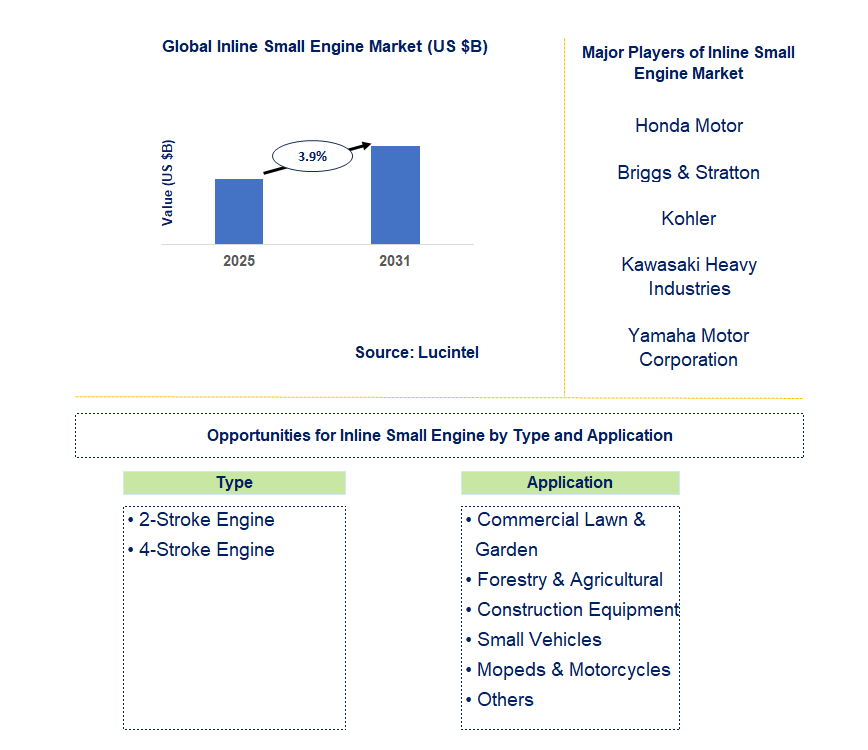
Key data points: The growth forecast = 3.9% annually for the next 7 years. Scroll below to get more insights. This market report covers Trends, opportunities and forecasts in inline small engine market to 2031 by type (2-stroke engine and 4-stroke engine), application (commercial lawn & garden, forestry & agricultural, construction equipment, small vehicles, mopeds & motorcycles, and others), and region (North America, Europe, Asia Pacific, and the Rest of the World)
We'll send your sample report shortly.
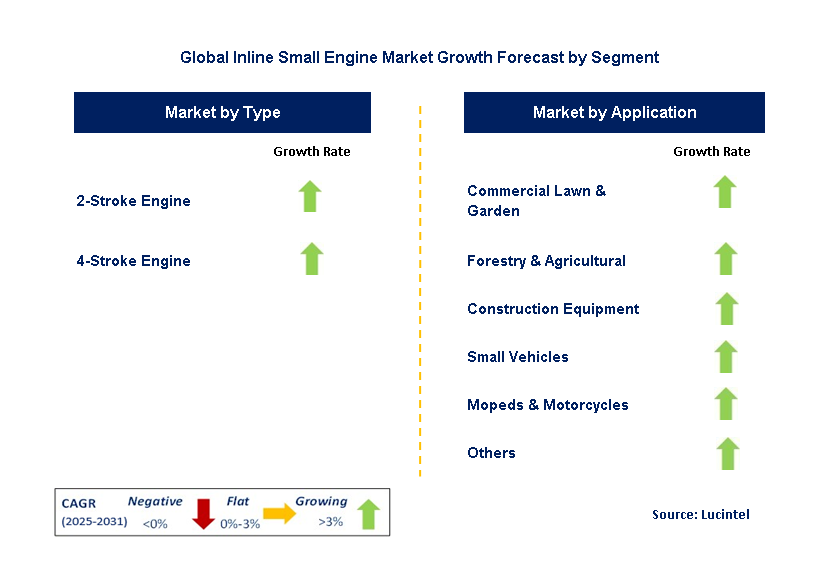
• Lucintel forecasts that, within the type category, 4-stroke engine is expected to witness higher growth over the forecast period.
• Within the application category, commercial lawn & garden is expected to witness the highest growth.
• In terms of region, APAC is expected to witness the highest growth over the forecast period.
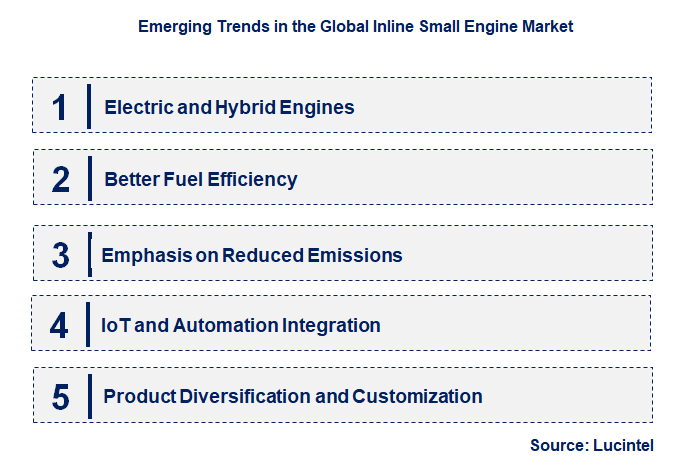
• Electric and Hybrid Engines: One of the most notable trends is the transition to electric and hybrid small engines. Companies are increasingly creating engines that blend the efficiency of electric power with the strength of conventional engines. Hybrid and electric systems provide the benefit of lower emissions, improved fuel economy, and lower operating expenses, which makes them a popular option for environmentally aware consumers and businesses. Demand for such engines is anticipated to increase, particularly in lawn care and power tools markets, in accordance with worldwide sustainability targets.
• Better Fuel Efficiency: Fuel efficiency remains a top priority for inline small engine manufacturers. With fuel costs increasing and concern for the environment on the rise, consumers and companies alike are seeking engines that provide more power while burning less fuel. Advances in engine technology, including improved carburetors, combustion systems, and fuel injection systems, are assisting companies to achieve this requirement. Economical engines with reduced fuel consumption are not only cost-saving but also adhere to the tightening emission standards, and therefore, they are very attractive in both commercial and industrial markets.
• Emphasis on Reduced Emissions: Tighter environmental legislation globally is forcing the design of low-emission small engines. In markets like Europe and the United States, regulation like that of the EPA and EU emissions standards is fueling innovation in cleaner engine technology. Companies are pouring dollars into research and development on engines that are cleaner-burning, with reduced emissions of carbon monoxide, hydrocarbons, and particulate matter. The trend is especially significant for markets like lawn maintenance, power equipment, and small industrial equipment, where emissions are stringently tracked.
• IoT and Automation Integration: Automation and Internet of Things (IoT) integration are gaining traction in the inline small engine industry. Cloud-connected smart engines allow for real-time monitoring, predictive maintenance, and remote troubleshooting. IoT-enabled engines have the ability to automatically modify performance based on workload and ambient conditions, delivering more efficiency and less downtime. This trend works exceptionally well with businesses where a lot of uptime is essential, i.e., the construction and farming industries. Growth in intelligent technologies is redefining how small engines are implemented and managed, providing the consumer with improved ease of use and reliability.
• Product Diversification and Customization: More emphasis is placed on delivering individualized solutions by manufacturers for serving the specialized demands of varied businesses. Inline small engines are being designed with adjustable power output, modular part design, and variable speed in order to match different applications. Diversified product lines enable consumers to purchase engines according to their specific demands, whether domestic lawn maintenance, heavy-duty industry, or mobile power generation. This trend is fueling industry growth by offering specialized engines that attract a wide customer base. Inline small engine manufacturing is being rewritten by a series of key developments, such as the move toward electric and hybrid engines, driving fuel efficiency and emissions reduction, and embedding intelligent technologies. They are moving along with world ecological objectives and clients' demands for more efficient, economical, and eco-friendly motors, providing potential growth opportunities through various industries.
• Technological Advances in Hybrid and Electric Technology: Hybrid and electric small engines are developing rapidly as companies concentrate on bringing more eco-friendly and efficient technologies to market. These engines take the capabilities of conventional internal combustion engines and couple them with the advantages of electric motors in order to produce lower emissions and improved fuel economy. The coupling of electric motors with conventional small engines is a significant development that is helping lower environmental impact, especially in markets like lawn care and power tools, where cleaner solutions are increasingly in demand.
• Greater Attention to Sustainability: Greater attention to sustainability has promoted innovations in engine technologies that help minimize fuel use and emissions. Manufacturers are concentrating on making small engines that not only consume less fuel but also emit less carbon. Technologies like cleaner combustion technologies, green materials, and recyclable engine parts are assisting manufacturers in achieving global sustainability targets. This trend is especially seen in nations with strict emissions regulations, including the United States and Germany.
• Integration of Smart Technologies: The use of smart technologies, such as IoT and automation, is transforming the inline small engine industry. These technologies enable real-time monitoring, predictive maintenance, and automatic engine performance adjustments based on usage patterns. These technologies are being integrated by manufacturers to enhance efficiency, lower maintenance costs, and improve user experience. The blending of smart capabilities is especially useful in industries such as construction and agriculture, where downtime for machinery can be severely consequential.
• Enhanced Engine Reliability and Performance: Small inline engines are becoming stronger and capable of performing heavier tasks. Suppliers are employing high-strength materials, enhanced cooling systems, and more efficient fuel systems to make small engines stronger and more durable. These enhancements are especially crucial for applications that operate continuously under heavy loads, like industrial machinery and construction. Small engine durability is another element of customer satisfaction that fuels the increasing demand for high-performance engines.
• Entering New Markets: With the increasing demand for small engines, manufacturers are venturing into new markets, including developing economies where urbanization and industrialization are rising. In areas like India and Southeast Asia, development of the transportation, construction, and agriculture industries is propelling demand for more efficient and dependable small engines. Producers are emphasizing affordable, long-lasting engines to serve these developing markets, offering new growth opportunities in consumer and industrial segments. Inline small engine markets are experiencing intense transformation, characterized by advancements in electric and hybrid technology, intensified efforts towards sustainability, integration with smart technology, and enhanced performance in engines. The developments contribute towards manufacturers to serve the wants and needs of various and expanded consumer bases, energizing growth within the markets.
• Farm and Agriculture Equipment: The farm sector offers a huge growth prospect for inline small engines based on the rising need for reliable and efficient equipment. Tractor, harvester, and irrigation system engines require durability and efficiency. The market can be exploited by producers with engines that are not just strong but also emission-reducing and fuel-efficient, fitting the sustainability wave in the farm sector.
• Construction and Heavy Equipment: With the growth in the construction sector, the market for small engines employed in equipment, generators, and tools is also increasing. There is great potential for companies to offer small engines that are fuel-efficient, compact, and can perform rigorous tasks. The growing trend towards mechanization and automation of construction projects offers a further area for expansion in this market, with an increasing demand for small engines as part of automated systems.
• Lawn Care and Landscaping Equipment: The increased demand for lawn care and landscaping services creates a healthy market for small engines. Manufacturers can capture the opportunity by creating engines that are energy efficient, low maintenance, and versatile enough for performing different outdoor activities, including mowing, trimming, and landscaping equipment. There is also growing demand for environmental solutions in this market as consumers look more towards environmentally friendly products.
• Power Tools and Home Improvement: The home improvement and do-it-yourself trend has spurred demand for power tools, some of which use small engines. The opportunity for manufacturers is to concentrate on creating small engines for this market that are high-performing, yet compact and maneuverable. With consumers looking for less expensive, efficient, and long-lasting tools, small engine manufacturers can provide these with creative product solutions.
• Electric and Hybrid Engine Solutions: The transition to electric and hybrid engines in consumer and industrial uses poses a major growth opportunity. Companies can make investments in research and development to produce electric and hybrid small engines that provide reduced emissions, higher fuel efficiency, and enhanced performance. Such engines would be ideal for use in lawn maintenance, power equipment, and small industrial equipment. Focusing on prominent applications such as agriculture, construction, landscaping, power tools, and electric engines enables manufacturers to ride the wave of increasing markets and address swelling demand for high-performing, eco-friendly small engines. These developments are propelling innovation and growth in the inline small engine industry.
• Honda Motor
• Briggs & Stratton
• Kohler
• Kawasaki Heavy Industries
• Yamaha Motor Corporation
• Mitsubishi Heavy Industries
• Generac Power Systems
• Kubota Corporation
• Yanmar
• SDF Group
• 2-Stroke Engine
• 4-Stroke Engine
• Commercial Lawn & Garden
• Forestry & Agricultural
• Construction Equipment
• Small Vehicles
• Mopeds & Motorcycles
• Others
• North America
• Europe
• Asia Pacific
• The Rest of the World
• United States: The inline small engine market has increased considerably in the United States, led by demand in industries such as lawn care, landscaping, and construction. Manufacturers are targeting improved engine performance while keeping up with stringent emission standards. The transition towards electric and hybrid technologies is accelerating as part of the nation's wider drive towards sustainability. The improvements in fuel efficiency and lightweight engine designs are also contributing further to the need for inline small engines. Growing interest in do-it-yourself and home repair activities has driven growth in this segment further.
• China: China is the leading inline small engine producer, with its immense manufacturing capacity and the increasing need for small engines in the industrial and agriculture segments. The nation is making efforts to make more fuel-efficient engines while responding to increased environmental concerns by implementing tighter emissions policies. Advances in engine design and efficiency are resulting in the use of more powerful and smaller engines. The growth of online shopping and DIY culture in China is also contributing to the demand for small engines, particularly consumer-oriented markets such as gardening gear and power equipment.
• Germany: The inline small engine market in Germany is fueled mainly by automotive and industrial segments, where quality, efficient engines are highly demanded. The nation is famous for its focus on engineering quality, and German manufacturers are leading the way in the manufacture of small engines that comply with EU emissions regulations. The increasing trend of mechanization and automation of many industries is also driving demand for such engines. Moreover, the increase in environmental awareness is urging new developments in more energy-efficient and environmentally friendly technologies, and hybrid and electric-powered small engines are a result of these developments.
• India: India has witnessed consistent growth in the inline small engine business, especially in the agricultural and construction industries. Demand for robust and fuel-efficient engines for small machinery and farm equipment is propelling the growth. Indian industries are growing more interested in enhancing fuel efficiency and lowering emissions in their small engines. The sector is also seeing increased demand for hybrid and electric small engines in accordance with worldwide trends towards sustainability. Increasing urbanization in India is also driving the demand for power tools and lawn care equipment, thereby fueling the growth of the inline small engine industry.
• Japan: The inline small engine market in Japan is characterized by high demand in the agriculture and technology sectors. Japanese companies are leading the charge in creating next-generation engine technologies with emphasis on performance and sustainability. Lawn mowers, construction equipment, and robots are in increasing demand for more efficient, smaller engines. With Japan's drive towards sustainability and green technologies, companies are also investing in electric and hybrid small engines. Japan's big domestic market for small engines is further aided by emphasis on automation and robotics in many industrial applications.


• Honda Motor
• Briggs & Stratton
• Kohler
• Kawasaki Heavy Industries
• Yamaha Motor Corporation
• Mitsubishi Heavy Industries
• Generac Power Systems
• Kubota Corporation
• Yanmar
• SDF Group Q5. Which inline small engine market segment will be the largest in future? Answer: Lucintel forecasts that, within the type category, 4-stroke engine is expected to witness higher growth over the forecast period. Q6. In inline small engine market, which region is expected to be the largest in next 5 years? Answer: In terms of region, APAC is expected to witness the highest growth over the forecast period. Q7. Do we receive customization in this report? Answer: Yes, Lucintel provides 10% customization without any additional cost.


Choose a license that fits your team. Instant PDF delivery.
Prices exclude taxes. Instant delivery. Custom licensing available on request.
Market Report · July 31, 2026
Market Report · July 22, 2026
Market Report · July 20, 2026
Trusted partner for strategic intelligence and business growth


Receive a complimentary market analysis tailored to your industry. Our analysts will identify key growth opportunities and competitive dynamics specific to your business.

Market size, growth rate, and key trend analysis for your specific sector.

Top competitor positioning and market share analysis.

Strategic recommendations backed by data-driven insights.
Get curated market intelligence and competitive moves straight to your inbox.
By subscribing, you agree to receive our monthly insights. Unsubscribe anytime.
Receive a complimentary market analysis tailored to your industry. Our analysts will identify key growth opportunities and competitive dynamics specific to your business.
Market size, growth rate, and key trend analysis for your specific sector.
Top competitor positioning and market share analysis.
Strategic recommendations backed by data-driven insights.
Get curated market intelligence, emerging trends, and competitive moves straight to your inbox each month.
By subscribing, you agree to receive our monthly insights. Unsubscribe anytime.
We'll send your sample report shortly.