
Report Feature
Infrared Imaging Software Market Trends and Forecast
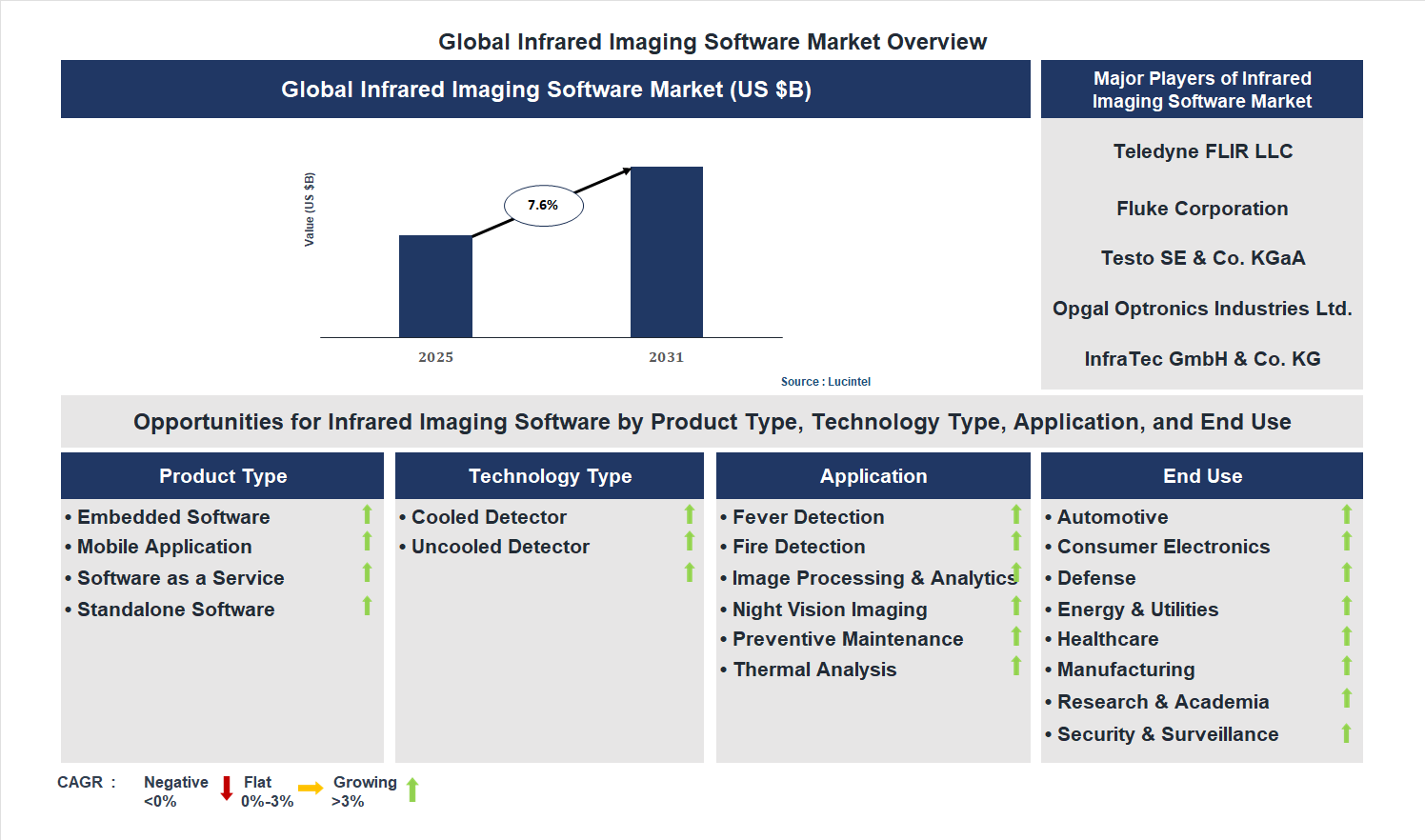
The future of the global infrared imaging software market looks promising with opportunities in the automotive, consumer electronics, defense, energy & utility, healthcare, manufacturing, research & academia, and security & surveillance markets. The global infrared imaging software market is expected to grow with a CAGR of 7.6% from 2025 to 2031. The major drivers for this market are the increasing demand for thermal inspection tools, the rising adoption of infrared monitoring applications, and the growing use of imaging software in industries.• Lucintel forecasts that, within the product type category, software as a service is expected to witness the highest growth over the forecast period.
• Within the end use category, consumer electronics is expected to witness the highest growth.
• In terms of region, APAC is expected to witness the highest growth over the forecast period. Gain valuable insights for your business decisions with our comprehensive 150+ page report. Sample figures with some insights are shown below.
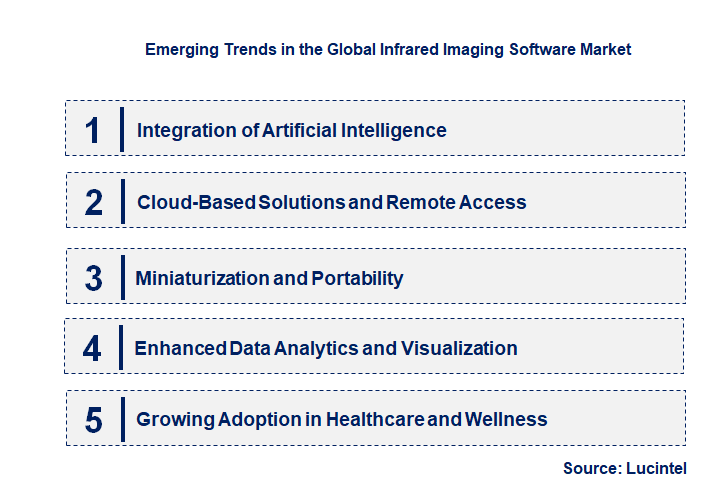
Emerging Trends in the Infrared Imaging Software Market
The infrared imaging software market is experiencing rapid growth driven by technological advancements and increasing applications across various industries. As demand for precise thermal imaging solutions rises, market players are innovating to meet evolving needs. Emerging trends are shaping the future landscape, influencing product development, market strategies, and user adoption. These developments are not only expanding the market scope but also enhancing the capabilities and accessibility of infrared imaging technology. Understanding these key trends is essential for stakeholders aiming to capitalize on new opportunities and stay competitive in this dynamic environment.• Integration of Artificial Intelligence (AI): AI is increasingly integrated into infrared imaging software to enhance image analysis and interpretation. This trend improves accuracy in detecting anomalies, automates processes, and enables real-time decision-making. AI-powered software can identify patterns and anomalies that might be missed by human operators, increasing efficiency and reliability. This integration is particularly impactful in sectors like healthcare, security, and industrial inspection, where precision is critical. As AI continues to evolve, it will further expand the capabilities of infrared imaging systems, making them more intelligent and user-friendly.
• Cloud-Based Solutions and Remote Access: Cloud technology is transforming how infrared imaging data is stored, processed, and accessed. Cloud-based software allows users to analyze thermal images remotely, facilitating real-time monitoring and collaboration across locations. This trend enhances flexibility, reduces hardware costs, and improves data security. Industries such as manufacturing, security, and research benefit from instant access to imaging data, enabling quicker decision-making. As remote work and IoT integration grow, cloud solutions will become a standard feature, broadening the market reach and usability of infrared imaging software.
• Miniaturization and Portability: Advances in hardware and software are leading to smaller, more portable infrared imaging devices. Compact software solutions enable handheld thermal cameras and mobile applications, making thermal imaging accessible outside traditional settings. This trend expands applications in field inspections, emergency response, and personal health monitoring. Portability enhances user convenience and broadens market adoption, especially among non-specialists. As devices become more affordable and user-friendly, the market will see increased penetration in consumer and small business segments, driving overall growth.
• Enhanced Data Analytics and Visualization: Modern infrared imaging software emphasizes sophisticated data analytics and visualization tools. These features help users interpret complex thermal data through intuitive graphs, heat maps, and 3D models. Improved analytics enable better diagnostics, predictive maintenance, and detailed environmental assessments. This trend increases the value of thermal imaging by providing actionable insights, reducing false positives, and improving operational efficiency. As visualization techniques advance, users can make more informed decisions quickly, boosting confidence in thermal imaging applications across industries.
• Growing Adoption in Healthcare and Wellness: Infrared imaging software is increasingly used in healthcare for non-invasive diagnostics, such as detecting inflammation, circulatory issues, and breast cancer screening. The trend toward integrating thermal imaging into wellness and fitness monitoring is also rising, offering consumers insights into their health status. This expansion is driven by technological improvements, regulatory approvals, and rising awareness of non-invasive health assessment methods. The markets growth in healthcare and wellness sectors is expected to significantly boost demand, opening new revenue streams and encouraging further innovation in infrared imaging software. In summary, these emerging trends are fundamentally reshaping the infrared imaging software market by enhancing technological capabilities, expanding application areas, and improving user accessibility. The integration of AI, cloud solutions, portability, advanced analytics, and healthcare applications is driving market expansion and innovation. As these trends continue to evolve, they will create new opportunities for growth, improve operational efficiencies, and broaden the adoption of infrared imaging technology across diverse sectors.
Recent Development in the Infrared Imaging Software Market
The infrared imaging software market has experienced significant growth driven by technological advancements and increasing applications across various industries. As demand for precise thermal imaging solutions rises, developers are innovating to enhance software capabilities, improve integration, and expand usability. These developments are shaping the market landscape, making infrared imaging more accessible and efficient for sectors such as healthcare, defense, automotive, and industrial inspection. The evolving regulatory environment and rising adoption of smart technologies further influence market dynamics. Staying updated on these key developments is essential for stakeholders aiming to leverage new opportunities and maintain competitive advantage in this rapidly expanding market.• Integration of AI and Machine Learning: Enhances image analysis accuracy and speeds up data processing, leading to improved diagnostic and surveillance capabilities.
• Cloud-Based Infrared Imaging Solutions: Offers scalable, remote access to imaging data, facilitating real-time monitoring and collaboration across industries.
• Advanced User Interface Designs: Simplifies operation, making infrared imaging software more accessible to non-expert users and expanding its application scope.
• Increased Focus on Cybersecurity: Ensures data protection and privacy, especially for sensitive applications in defense and healthcare sectors.
• Expansion into New Industry Verticals: Adoption in automotive for driver assistance systems, industrial automation, and smart building management broadens market reach. These developments are significantly impacting the infrared imaging software market by increasing efficiency, expanding application areas, and improving user experience. The integration of AI and cloud solutions is driving innovation, making infrared imaging more versatile and accessible. Enhanced cybersecurity measures are building trust among users, especially in sensitive sectors. Overall, these advancements are propelling market growth, fostering new opportunities, and encouraging further technological innovation.
Strategic Growth Opportunities in the Infrared Imaging Software Market
The infrared imaging software market is experiencing rapid expansion driven by technological advancements and increasing applications across various industries. As demand for precise thermal imaging solutions grows, companies are exploring innovative growth opportunities to capture market share. These developments are shaping the future landscape of infrared imaging software, enabling enhanced performance, integration, and user experience. Key application areas such as healthcare, industrial inspection, security, automotive, and research are witnessing significant growth, driven by the need for accurate thermal analysis and real-time data processing. The following five growth opportunities highlight the most promising avenues for market expansion and technological innovation.• Healthcare: Enhanced Diagnostic Capabilities : Infrared imaging software is increasingly used for non-invasive diagnostics, such as detecting inflammation, circulatory issues, and tumors. Advanced algorithms improve image clarity and analysis accuracy, leading to earlier disease detection and better patient outcomes. This growth opportunity is transforming healthcare by enabling faster, safer, and more cost-effective diagnostic procedures.
• Industrial Inspection: Predictive Maintenance and Quality Control : The integration of infrared imaging software with industrial equipment allows for real-time monitoring of machinery and infrastructure. Predictive analytics help identify potential failures before they occur, reducing downtime and maintenance costs. This application enhances operational efficiency and safety, making it a vital growth area for manufacturing and energy sectors.
• Security and Surveillance: Enhanced Threat Detection : Infrared imaging software is crucial for night vision and covert surveillance. Developments in image processing algorithms improve target identification and tracking in challenging environments. This growth opportunity strengthens security systems, enabling more reliable and accurate threat detection in military, law enforcement, and private security applications.
• Automotive: Advanced Driver Assistance Systems (ADAS) : The adoption of infrared imaging software in vehicles enhances night vision and obstacle detection. Integration with autonomous driving systems improves safety and situational awareness. This growth opportunity is pivotal for the development of smarter, safer vehicles, driving innovation in automotive safety technology.
• Research and Development: High-Precision Thermal Data Analysis : Scientific research benefits from sophisticated infrared imaging software capable of detailed thermal analysis at micro and nano scales. These tools support innovations in material science, electronics, and environmental studies. The growth in R&D applications fosters technological breakthroughs and expands the market’s scope. In summary, these growth opportunities are significantly impacting the infrared imaging software market by driving technological innovation, expanding application areas, and improving performance across industries. As companies capitalize on these opportunities, the market is poised for sustained growth, enhanced competitiveness, and broader adoption of infrared imaging solutions worldwide.
Infrared Imaging Software Market Driver and Challenges
The infrared imaging software market is influenced by a variety of technological, economic, and regulatory factors that shape its growth trajectory. Advances in sensor technology and image processing algorithms are driving innovation, while increasing defense and security budgets worldwide bolster demand. Regulatory standards for safety and data privacy also impact market development. Additionally, economic factors such as rising investments in surveillance infrastructure and the proliferation of smart city initiatives contribute to market expansion. However, the market faces challenges related to high development costs, data security concerns, and regulatory compliance complexities. Understanding these drivers and challenges is essential for stakeholders aiming to capitalize on emerging opportunities and navigate potential risks effectively. The factors responsible for driving the infrared imaging software market include:• Technological Advancements: The continuous evolution of infrared sensor technology and image processing algorithms enhances software capabilities, enabling higher resolution, better accuracy, and real-time analysis. These innovations improve applications in defense, healthcare, and industrial sectors, making infrared imaging more accessible and effective. As technology becomes more sophisticated and affordable, adoption rates increase, fueling market growth. Moreover, integration with AI and machine learning further enhances software functionalities, providing predictive analytics and automation, which are highly valued across various industries.
• Growing Defense and Security Spending: Governments worldwide are increasing their investments in defense and homeland security to combat emerging threats. Infrared imaging software plays a crucial role in surveillance, target detection, and night vision applications. The rising demand for advanced military equipment and border security systems directly boosts the market. Additionally, the need for enhanced situational awareness in military operations encourages the adoption of sophisticated infrared imaging solutions, creating a robust growth environment for software providers.
• Expansion in Healthcare Applications: Infrared imaging software is increasingly used in medical diagnostics, such as detecting vascular issues, breast cancer screening, and inflammation monitoring. The non-invasive nature and real-time imaging capabilities make it attractive for healthcare providers. As medical imaging technology advances and the demand for early diagnosis grows, the market for infrared imaging software expands. Regulatory approvals and technological improvements further facilitate integration into clinical workflows, opening new revenue streams for software developers.
• Rise of Smart City and Industrial Automation Initiatives: Urban infrastructure projects and industrial automation are adopting infrared imaging for surveillance, maintenance, and safety monitoring. Smart city initiatives leverage infrared software for traffic management, public safety, and energy efficiency. Industrial sectors utilize infrared imaging for predictive maintenance and quality control. The increasing deployment of IoT devices and smart sensors enhances data collection and analysis, driving demand for advanced infrared imaging software solutions that can process large datasets efficiently.
• Increasing Adoption in Automotive and Consumer Electronics: The automotive industry is integrating infrared imaging for driver assistance systems, night vision, and autonomous vehicle navigation. Consumer electronics, such as security cameras and wearable devices, also incorporate infrared imaging features. The expanding application scope in these sectors is driven by consumer demand for enhanced safety and convenience, as well as technological feasibility. This diversification broadens the market base and stimulates innovation in software functionalities tailored for these emerging applications. The challenges facing this infrared imaging software market include:
• High Development and Implementation Costs: Developing advanced infrared imaging software requires significant investment in research, specialized hardware, and skilled personnel. The costs associated with integrating infrared sensors, ensuring compatibility across platforms, and maintaining high performance can be prohibitive, especially for smaller companies. These financial barriers may slow down innovation and limit market entry, restricting overall growth. Additionally, ongoing maintenance and updates add to the total cost of ownership, impacting affordability for end-users.
• Data Security and Privacy Concerns: Infrared imaging software often handles sensitive data, especially in defense, healthcare, and surveillance applications. Ensuring data security and compliance with privacy regulations is a major challenge. Breaches or misuse of infrared data can lead to legal repercussions and loss of trust. As cyber threats evolve, safeguarding imaging data requires robust encryption, secure storage, and strict access controls, which increase complexity and costs for developers and users alike.
• Regulatory and Standardization Challenges: The market faces complex regulatory environments across different regions, with varying standards for safety, data privacy, and interoperability. Navigating these regulations can delay product launches and increase compliance costs. Lack of standardized protocols for infrared imaging software hampers seamless integration and scalability. Moreover, evolving regulations require continuous updates and certifications, posing ongoing challenges for manufacturers and software providers to stay compliant and competitive. In summary, the infrared imaging software market is driven by rapid technological innovations, increased defense and healthcare investments, and expanding applications in smart cities and automotive sectors. However, high development costs, data security issues, and regulatory complexities pose significant hurdles. These factors collectively influence market growth, requiring stakeholders to balance innovation with risk management. Successful navigation of these drivers and challenges will determine the market’s future trajectory, with opportunities for substantial expansion amid ongoing technological and infrastructural developments.
List of Infrared Imaging Software Companies
Companies in the market compete on the basis of product quality offered. Major players in this market focus on expanding their manufacturing facilities, R&D investments, infrastructural development, and leverage integration opportunities across the value chain. With these strategies infrared imaging software companies cater increasing demand, ensure competitive effectiveness, develop innovative products & technologies, reduce production costs, and expand their customer base. Some of the infrared imaging software companies profiled in this report include-• Teledyne FLIR LLC
• Fluke Corporation
• Testo SE & Co. KGaA
• Opgal Optronics Industries Ltd.
• InfraTec GmbH & Co. KG
• Seek Thermal Inc.
• Leonardo DRS, Inc.
• ULIS S.A.
• Nippon Avionics Co., Ltd.
• Hamamatsu Photonics K.K.
Infrared Imaging Software Market by Segment
The study includes a forecast for the global infrared imaging software market by product type, technology type, application, end use, and region.Infrared Imaging Software Market by Product Type [Value from 2019 to 2031]:
• Embedded Software
• Mobile Application
• Software as a Service
• Standalone Software
Infrared Imaging Software Market by Technology Type [Value from 2019 to 2031]:
• Cooled Detector
• Uncooled Detector
Infrared Imaging Software Market by Application [Value from 2019 to 2031]:
• Fever Detection
• Fire Detection
• Image Processing & Analytics
• Night Vision Imaging
• Preventive Maintenance
• Thermal Analysis
Infrared Imaging Software Market by End Use [Value from 2019 to 2031]:
• Automotive
• Consumer Electronics
• Defense
• Energy & Utilities
• Healthcare
• Manufacturing
• Research & Academia
• Security & Surveillance
Infrared Imaging Software Market by Region [Value from 2019 to 2031]:
• North America
• Europe
• Asia Pacific
• The Rest of the World
Country Wise Outlook for the Infrared Imaging Software Market
The infrared imaging software market has experienced significant growth driven by technological advancements, increasing demand for security and surveillance, and expanding applications in healthcare, automotive, and industrial sectors. Countries are investing heavily in research and development to enhance software capabilities, improve accuracy, and integrate AI and machine learning features. The markets evolution reflects a shift towards more sophisticated, user-friendly solutions that cater to diverse industry needs. As the adoption of infrared imaging technology accelerates globally, key players are focusing on innovation, strategic partnerships, and expanding their geographic presence to capitalize on emerging opportunities.• United States: The U.S. market has seen rapid adoption of advanced infrared imaging software, driven by increased investments in defense, security, and healthcare sectors. Major tech companies are integrating AI to improve image analysis and predictive capabilities. Government agencies are funding research to develop more precise and real-time imaging solutions, boosting innovation. The rise of autonomous vehicles has also spurred demand for sophisticated infrared software for night vision and obstacle detection. Additionally, startups are emerging with innovative applications in industrial inspection and environmental monitoring, further expanding the market landscape.
• China: China has become a significant player in the infrared imaging software market, with substantial government backing for technological development. The focus is on enhancing software for military, surveillance, and smart city applications. Chinese firms are investing in AI-driven solutions to improve image processing and data analytics. The rapid expansion of urban infrastructure and industrial automation has increased demand for infrared imaging in manufacturing and safety inspections. Moreover, collaborations between domestic companies and international tech firms are fostering innovation. The market is characterized by aggressive growth strategies and a focus on cost-effective, scalable solutions to meet domestic and export needs.
• Germany: Germanys market is characterized by a strong emphasis on industrial applications, including manufacturing, automotive, and aerospace sectors. Companies are developing high-precision infrared imaging software to support quality control, predictive maintenance, and research activities. The country’s focus on Industry 4.0 initiatives has accelerated the integration of infrared imaging with IoT and automation systems. German firms are also investing in R&D to improve software interoperability and user experience. The demand for environmentally friendly and energy-efficient solutions is driving innovation, with a particular emphasis on applications in renewable energy and smart infrastructure.
• India: India is witnessing rapid growth in the infrared imaging software market, fueled by increased defense spending, urban security needs, and industrial automation. The government’s initiatives to modernize defense and border security are boosting demand for advanced imaging solutions. The expanding healthcare sector is adopting infrared software for diagnostic imaging and remote monitoring. Additionally, the rise of smart cities and IoT integration is creating new opportunities for infrared applications in surveillance and traffic management. Local startups and global companies are collaborating to develop affordable, scalable solutions tailored to the Indian market, fostering innovation and market penetration.
• Japan: Japan’s market is driven by advancements in robotics, automotive, and healthcare sectors. Japanese firms are focusing on developing infrared imaging software with enhanced accuracy, speed, and integration capabilities for autonomous vehicles and industrial robots. The country’s emphasis on aging population healthcare solutions has led to innovations in medical infrared imaging software. Japan is also investing in AI-powered analysis tools to improve diagnostic and surveillance systems. The integration of infrared imaging with smart manufacturing processes and disaster management systems is gaining momentum. Overall, Japan’s market is characterized by high-quality, technologically advanced solutions tailored to both domestic and international needs.

Features of the Global Infrared Imaging Software Market
Market Size Estimates: Infrared imaging software market size estimation in terms of value ($B). Trend and Forecast Analysis: Market trends (2019 to 2024) and forecast (2025 to 2031) by various segments and regions. Segmentation Analysis: Infrared imaging software market size by various segments, such as by product type, technology type, application, end use, and region in terms of value ($B). Regional Analysis: Infrared imaging software market breakdown by North America, Europe, Asia Pacific, and Rest of the World. Growth Opportunities: Analysis of growth opportunities in different product types, technology types, applications, end uses, and regions for the infrared imaging software market. Strategic Analysis: This includes M&A, new product development, and competitive landscape of the infrared imaging software market. Analysis of competitive intensity of the industry based on Porter’s Five Forces model.
FAQ
Q1. What is the growth forecast for infrared imaging software market? Answer: The global infrared imaging software market is expected to grow with a CAGR of 7.6% from 2025 to 2031. Q2. What are the major drivers influencing the growth of the infrared imaging software market? Answer: The major drivers for this market are the increasing demand for thermal inspection tools, the rising adoption of infrared monitoring applications, and the growing use of imaging software in industries. Q3. What are the major segments for infrared imaging software market? Answer: The future of the infrared imaging software market looks promising with opportunities in the automotive, consumer electronics, defense, energy & utility, healthcare, manufacturing, research & academia, and security & surveillance markets. Q4. Who are the key infrared imaging software market companies? Answer: Some of the key infrared imaging software companies are as follows:• Teledyne FLIR LLC
• Fluke Corporation
• Testo SE & Co. KGaA
• Opgal Optronics Industries Ltd.
• InfraTec GmbH & Co. KG
• Seek Thermal Inc.
• Leonardo DRS, Inc.
• ULIS S.A.
• Nippon Avionics Co., Ltd.
• Hamamatsu Photonics K.K. Q5. Which infrared imaging software market segment will be the largest in future? Answer: Lucintel forecasts that, within the product type category, software as a service is expected to witness the highest growth over the forecast period. Q6. In infrared imaging software market, which region is expected to be the largest in next 5 years? Answer: In terms of region, APAC is expected to witness the highest growth over the forecast period. Q7. Do we receive customization in this report? Answer: Yes, Lucintel provides 10% customization without any additional cost.
Table of Contents
List of Figures
List of Tables
Methodology
- In-depth interviews of the major players in this market
- Detailed secondary research from competitors’ financial statements and published data
- Extensive searches of published works, market, and database information pertaining to industry news, company press releases, and customer intentions
- A compilation of the experiences, judgments, and insights of Lucintel’s professionals, who have analyzed and tracked this market over the years.


Buy Now
Choose a license that fits your team. Instant PDF delivery.
Prices exclude taxes. Instant delivery. Custom licensing available on request.
Key Questions
- • What are some of the most promising, high-growth opportunities for the infrared imaging software market by product type (embedded software, mobile application, software as a service, and standalone software), technology type (cooled detector and uncooled detector), application (fever detection, fire detection, image processing & analytics, night vision imaging, preventive maintenance, and thermal analysis), end use (automotive, consumer electronics, defense, energy & utilities, healthcare, manufacturing, research & academia, and security & surveillance), and region (North America, Europe, Asia Pacific, and the Rest of the World)?
- • Which segments will grow at a faster pace and why?
- • Which region will grow at a faster pace and why?
- • What are the key factors affecting market dynamics? What are the key challenges and business risks in this market?
- • What are the business risks and competitive threats in this market?
- • What are the emerging trends in this market and the reasons behind them?
- • What are some of the changing demands of customers in the market?
- • What are the new developments in the market? Which companies are leading these developments?
- • Who are the major players in this market? What strategic initiatives are key players pursuing for business growth?
- • What are some of the competing products in this market and how big of a threat do they pose for loss of market share by material or product substitution?
- • What M&A activity has occurred in the last 5 years and what has its impact been on the industry? For any questions related to Infrared Imaging Software Market, Infrared Imaging Software Market Size, Infrared Imaging Software Market Growth, Infrared Imaging Software Market Analysis, Infrared Imaging Software Market Report, Infrared Imaging Software Market Share, Infrared Imaging Software Market Trends, Infrared Imaging Software Market Forecast, Infrared Imaging Software Companies, write Lucintel analyst at email: helpdesk@lucintel.com. We will be glad to get back to you soon.


