
Market Report · July 31, 2026

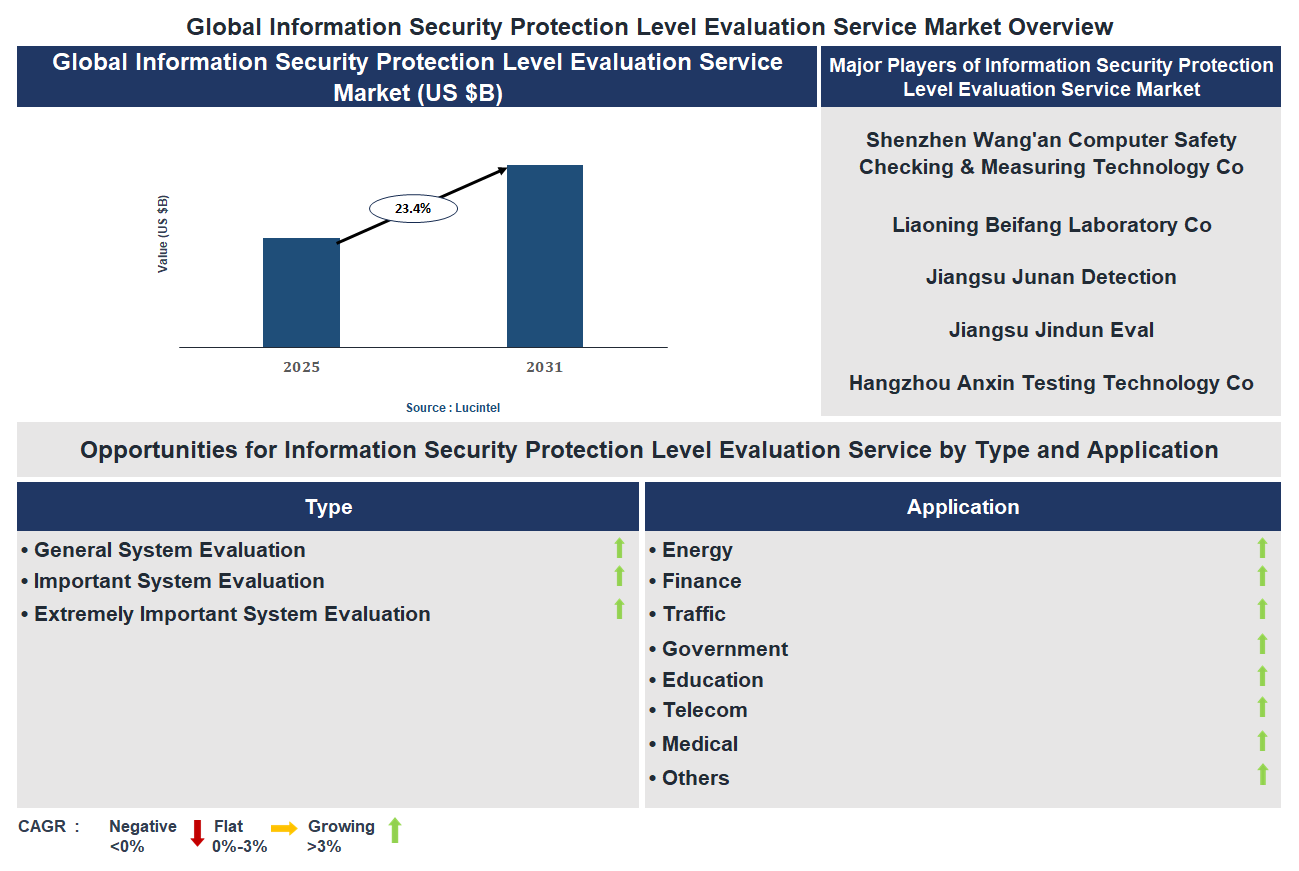
Key data points: The growth forecast = 23.4% annually for the next 7 years. Scroll below to get more insights. This market report covers trends, opportunities and forecasts in information security protection level evaluation service market to 2031 by type (general system evaluation, important system evaluation, and extremely important system evaluation), application (energy, finance, traffic, government, education, telecom, medical, and others), and region (North America, Europe, Asia Pacific, and the Rest of the World)
We'll send your sample report shortly.
• Lucintel forecasts that, within the type category, extremely important system evaluation is expected to witness the highest growth over the forecast period.
• Within the application category, energy is expected to witness the highest growth.
• In terms of region, APAC is expected to witness the highest growth over the forecast period. Gain valuable insights for your business decisions with our comprehensive 150+ page report. Sample figures with some insights are shown below.
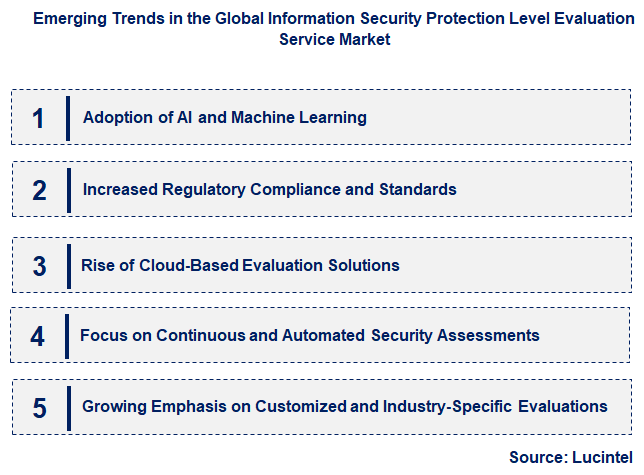
• Adoption of AI and Machine Learning: The integration of AI and machine learning into evaluation services enhances threat detection and risk assessment. These technologies enable real-time analysis of vast data sets, identifying vulnerabilities and anomalies more efficiently than traditional methods. AI-driven tools can predict potential security breaches, allowing organizations to proactively address weaknesses. This trend improves accuracy, speeds up evaluation processes, and reduces human error, making security assessments more dynamic and responsive to evolving threats. As AI becomes more sophisticated, its role in security evaluation will expand significantly.
• Increased Regulatory Compliance and Standards: Governments and industry bodies are establishing stricter cybersecurity regulations and standards, such as GDPR, ISO 27001, and NIST frameworks. Evaluation services are increasingly tailored to ensure compliance with these requirements, helping organizations avoid penalties and reputational damage. This trend drives demand for comprehensive assessments that verify adherence to legal and industry standards. Companies are investing in regular evaluations to maintain certifications and demonstrate security maturity to clients and partners. The evolving regulatory landscape underscores the importance of continuous security evaluation as a core business practice.
• Rise of Cloud-Based Evaluation Solutions: As organizations migrate to cloud environments, evaluation services are shifting towards cloud-based platforms. These solutions offer scalability, flexibility, and remote accessibility, enabling continuous monitoring and assessment of cloud security postures. Cloud-based evaluation tools facilitate faster deployment, easier updates, and integration with existing cloud infrastructure. They also support multi-cloud and hybrid environments, addressing complex security needs. This trend allows organizations to maintain high security standards without significant infrastructure investments, making security evaluation more accessible and efficient in the cloud era.
• Focus on Continuous and Automated Security Assessments: Traditional periodic evaluations are giving way to continuous monitoring and automated assessments. This approach provides real-time insights into security posture, enabling swift responses to emerging threats. Automation reduces manual effort, minimizes human error, and ensures consistent evaluation standards. Organizations adopting this trend can identify vulnerabilities promptly, prioritize remediation efforts, and maintain a proactive security stance. Continuous assessment is becoming a vital component of modern cybersecurity strategies, ensuring that security levels are constantly optimized in a rapidly changing threat landscape.
• Growing Emphasis on Customized and Industry-Specific Evaluations: Recognizing that different sectors face unique security challenges, evaluation services are increasingly tailored to specific industries such as finance, healthcare, and critical infrastructure. Customized assessments consider industry-specific regulations, threat vectors, and operational requirements. This trend enhances the relevance and effectiveness of evaluations, providing organizations with targeted insights and actionable recommendations. Industry-specific evaluations help organizations meet compliance, mitigate sector-specific risks, and strengthen their overall security posture, fostering greater confidence among stakeholders and customers. In summary, these trends are fundamentally transforming the information security protection level evaluation service market by making assessments more intelligent, compliant, scalable, continuous, and tailored. This evolution supports organizations in building resilient security frameworks capable of addressing complex and dynamic cyber threats, ultimately fostering a safer digital environment.
• Adoption of AI and Machine Learning: Integration of AI and ML into evaluation services enhances threat detection and risk assessment accuracy, leading to more proactive security measures and reducing false positives. This technological shift improves efficiency and provides deeper insights, boosting client confidence and market growth.
• Regulatory Framework Enhancements: Governments and industry bodies are updating compliance standards, such as GDPR and ISO 27001, requiring more comprehensive security evaluations. These changes increase demand for specialized evaluation services, encouraging providers to develop tailored solutions that meet evolving legal requirements.
• Expansion of Cloud Security Assessments: As cloud adoption accelerates, evaluation services now focus heavily on cloud security posture assessments. This development helps organizations identify vulnerabilities in cloud environments, ensuring compliance and reducing risks associated with data breaches and service disruptions.
• Strategic Partnerships and Collaborations: Service providers are forming alliances with cybersecurity firms, technology vendors, and consulting agencies to offer integrated evaluation solutions. These collaborations expand service capabilities, improve market reach, and foster innovation in security assessment methodologies.
• Growth of Automated Evaluation Tools: The rise of automation in security evaluations allows for faster, more consistent assessments. Automated tools reduce manual effort, lower costs, and enable continuous monitoring, which is critical for dynamic threat landscapes and real-time security management. In summary, these developments are significantly impacting the information security protection level evaluation service market by enhancing assessment accuracy, expanding service scope, and increasing compliance requirements. They are driving market growth, fostering innovation, and enabling organizations to better protect their digital assets in an increasingly complex cyber environment.
• Enhanced Fraud Detection and Risk Management : As financial institutions face sophisticated cyber threats, evaluation services help identify vulnerabilities, improve fraud detection systems, and ensure compliance with regulations, thereby strengthening customer trust and reducing financial losses.
• Protecting Patient Data and Ensuring Compliance : With increasing data breaches in healthcare, evaluation services assist in assessing security levels of patient information systems, ensuring compliance with regulations like HIPAA, and safeguarding sensitive health data, which is critical for patient safety and institutional reputation.
• Securing Critical Infrastructure and National Security : Governments utilize these services to evaluate security protocols for critical infrastructure, defense systems, and public services, reducing risks of cyber-attacks that could compromise national security and public safety.
• Safeguarding Customer Data and Payment Systems : Retailers leverage evaluation services to assess the security of payment gateways, customer databases, and online platforms, minimizing fraud, enhancing customer confidence, and complying with PCI DSS standards.
• Protecting Intellectual Property and Industrial Control Systems : Manufacturing firms focus on evaluating the security of industrial control systems and intellectual property, preventing cyber espionage, and ensuring operational continuity in a highly competitive environment. These growth opportunities are significantly impacting the market by driving increased adoption of evaluation services, fostering innovation in security solutions, and emphasizing the importance of proactive cybersecurity measures across sectors. As organizations recognize the critical need for robust security evaluations, the market is poised for sustained expansion and technological advancement.
• Technological Advancements: Rapid innovation in cybersecurity tools and evaluation methodologies enhances the ability to identify vulnerabilities effectively. As new threats emerge, continuous technological improvements enable providers to offer more comprehensive and accurate security assessments. This fosters increased adoption among organizations seeking robust protection, thereby expanding the market. The integration of AI and machine learning further automates and refines evaluation processes, making them more efficient and reliable. Consequently, technological progress directly correlates with market growth by enabling more sophisticated security evaluations that meet the dynamic threat landscape.
• Increasing Cyber Threats: The surge in cyberattacks, data breaches, and ransomware incidents has heightened awareness among organizations about the importance of security evaluations. As cyber threats become more complex and frequent, companies recognize the need for regular assessment of their security levels to prevent potential damages. This growing threat landscape drives demand for specialized evaluation services to identify vulnerabilities proactively. The heightened risk environment compels organizations across industries to invest in comprehensive security assessments, fueling market expansion and innovation in evaluation services.
• Regulatory and Compliance Requirements: Governments and industry bodies are implementing stringent data protection and cybersecurity regulations, such as GDPR, HIPAA, and ISO standards. Organizations must demonstrate compliance through regular security evaluations, which increases the demand for specialized assessment services. These regulatory frameworks compel companies to adopt standardized evaluation procedures to avoid penalties and reputational damage. As compliance becomes a critical aspect of business operations, the market for security level evaluation services expands to meet these legal obligations, fostering growth and standardization within the industry.
• Digital Transformation Initiatives: The widespread adoption of cloud computing, IoT, and mobile technologies has transformed organizational infrastructures, creating new security challenges. As companies migrate to digital platforms, they require comprehensive evaluations to ensure these new environments are secure. The complexity of modern digital ecosystems necessitates specialized assessment services to identify vulnerabilities across diverse platforms. This trend accelerates market growth by increasing demand for tailored evaluation solutions that address the unique security needs of digital transformation projects, ensuring organizations can innovate securely.
• Growing Awareness and Adoption of Security Best Practices: Organizations increasingly recognize the importance of proactive security measures and best practices to mitigate risks. This awareness drives demand for regular security evaluations to benchmark security levels and implement improvements. As security culture becomes more ingrained in corporate strategies, the market for evaluation services expands, supported by a rising number of enterprises seeking to enhance their security posture. This trend promotes the adoption of standardized evaluation frameworks, fostering trust and reliability in security assessments across industries. The challenges facing this information security protection level evaluation service market include:
• Complexity of Security Environments: The increasing complexity of IT infrastructures, including hybrid cloud environments, IoT devices, and legacy systems, complicates security evaluations. Assessing vulnerabilities across diverse and interconnected platforms requires sophisticated tools and expertise. This complexity can lead to gaps in security assessments, making it difficult for evaluators to provide comprehensive insights. Organizations may face increased costs and time delays in evaluations, which can hinder market growth. Overcoming this challenge necessitates continuous innovation in evaluation methodologies and skilled professionals capable of navigating complex environments.
• Regulatory Compliance Burdens: While regulations drive demand, they also impose significant compliance burdens on organizations. Keeping up with evolving standards and ensuring assessments meet all legal requirements can be resource-intensive and complex. Non-compliance risks penalties and reputational damage, prompting organizations to seek expert evaluation services. However, the diversity of regulations across regions and industries complicates standardization efforts. This regulatory landscape can slow market growth due to the high costs and operational challenges associated with maintaining compliance, especially for small and medium-sized enterprises.
• Skilled Workforce Shortage: The cybersecurity industry faces a persistent shortage of qualified professionals capable of conducting thorough security evaluations. This talent gap limits the capacity of service providers to meet increasing demand, potentially delaying assessments and reducing service quality. Organizations may struggle to find reliable evaluators, leading to increased costs and reliance on automated tools that may not fully replace expert judgment. Addressing this challenge requires investment in training and education, but the current shortage remains a significant barrier to market expansion and the delivery of high-quality evaluation services. In summary, the information security protection level evaluation service market is driven by technological innovations, rising cyber threats, regulatory pressures, digital transformation, and increased security awareness. However, it faces challenges related to environmental complexity, regulatory compliance burdens, and workforce shortages. These factors collectively influence the markets growth trajectory, requiring stakeholders to innovate continuously and invest in skilled resources. The markets future will depend on how effectively these drivers are leveraged and challenges mitigated, shaping a resilient and adaptive cybersecurity evaluation ecosystem.
• Shenzhen Wangan Computer Safety Checking & Measuring Technology Co
• Liaoning Beifang Laboratory Co
• Jiangsu Junan Detection
• Jiangsu Jindun Eval
• Hangzhou Anxin Testing Technology Co
• Inner Mongolia Xinyuan Network Security Technology Co
• Guangzhou China GDN Security Technology Co
• Changchun Jiacheng Information Technology Co
• Wuhan MingJiaXin Technology Co
• Wuhan Anyu Infomation Security Technology Co
• General System Evaluation
• Important System Evaluation
• Extremely Important System Evaluation
• Energy
• Finance
• Traffic
• Government
• Education
• Telecom
• Medical
• Others
• North America
• Europe
• Asia Pacific
• The Rest of the World
• United States: The US market has seen significant advancements with the adoption of AI-driven evaluation tools and increased government funding for cybersecurity initiatives. Major firms are expanding their service offerings to include comprehensive risk assessments and compliance audits, driven by evolving regulations like CMMC and NIST standards. The private sectors focus on critical infrastructure protection has intensified, leading to innovative evaluation methodologies and increased market competition.
• China: China is rapidly developing its cybersecurity evaluation capabilities, emphasizing national security and technological sovereignty. The government has launched large-scale initiatives to standardize security assessment processes across industries, integrating AI and big data analytics. Domestic firms are expanding their service portfolios, and there is a strong push for self-reliance in cybersecurity evaluation tools to reduce dependence on foreign technology.
• Germany: Germanys market is characterized by a focus on industrial cybersecurity, especially within manufacturing and automotive sectors. The country is adopting stringent EU regulations, such as GDPR and NIS Directive, to enhance data protection and security evaluation standards. German firms are investing in advanced assessment solutions that combine compliance with operational security, emphasizing resilience and risk mitigation.
• India: India is witnessing rapid growth in cybersecurity evaluation services driven by digital expansion and increasing cyberattacks. The government’s initiatives like the National Cyber Security Policy and Digital India are fostering a conducive environment for market development. Local companies are adopting innovative evaluation techniques, including AI and machine learning, to cater to the expanding needs of government and private enterprises.
• Japan: Japan is focusing on strengthening its critical infrastructure security through advanced evaluation services. The government promotes collaboration between public and private sectors to develop comprehensive security standards. Japan is also investing in next-generation evaluation tools that incorporate IoT and AI, aiming to enhance resilience against sophisticated cyber threats and align with international cybersecurity frameworks.


• Shenzhen Wangan Computer Safety Checking & Measuring Technology Co
• Liaoning Beifang Laboratory Co
• Jiangsu Junan Detection
• Jiangsu Jindun Eval
• Hangzhou Anxin Testing Technology Co
• Inner Mongolia Xinyuan Network Security Technology Co
• Guangzhou China GDN Security Technology Co
• Changchun Jiacheng Information Technology Co
• Wuhan MingJiaXin Technology Co
• Wuhan Anyu Infomation Security Technology Co Q5. Which information security protection level evaluation service market segment will be the largest in future? Answer: Lucintel forecasts that, within the type category, extremely important system evaluation is expected to witness the highest growth over the forecast period. Q6. In information security protection level evaluation service market, which region is expected to be the largest in next 5 years? Answer: In terms of region, APAC is expected to witness the highest growth over the forecast period. Q7. Do we receive customization in this report? Answer: Yes, Lucintel provides 10% customization without any additional cost.


Choose a license that fits your team. Instant PDF delivery.
Prices exclude taxes. Instant delivery. Custom licensing available on request.
Market Report · July 31, 2026
Market Report · July 31, 2026
Market Report · July 31, 2026
Trusted partner for strategic intelligence and business growth


Receive a complimentary market analysis tailored to your industry. Our analysts will identify key growth opportunities and competitive dynamics specific to your business.

Market size, growth rate, and key trend analysis for your specific sector.

Top competitor positioning and market share analysis.

Strategic recommendations backed by data-driven insights.
Get curated market intelligence and competitive moves straight to your inbox.
By subscribing, you agree to receive our monthly insights. Unsubscribe anytime.
Receive a complimentary market analysis tailored to your industry. Our analysts will identify key growth opportunities and competitive dynamics specific to your business.
Market size, growth rate, and key trend analysis for your specific sector.
Top competitor positioning and market share analysis.
Strategic recommendations backed by data-driven insights.
Get curated market intelligence, emerging trends, and competitive moves straight to your inbox each month.
By subscribing, you agree to receive our monthly insights. Unsubscribe anytime.
We'll send your sample report shortly.