
Report Feature
Infertility Service Market Trends and Forecast
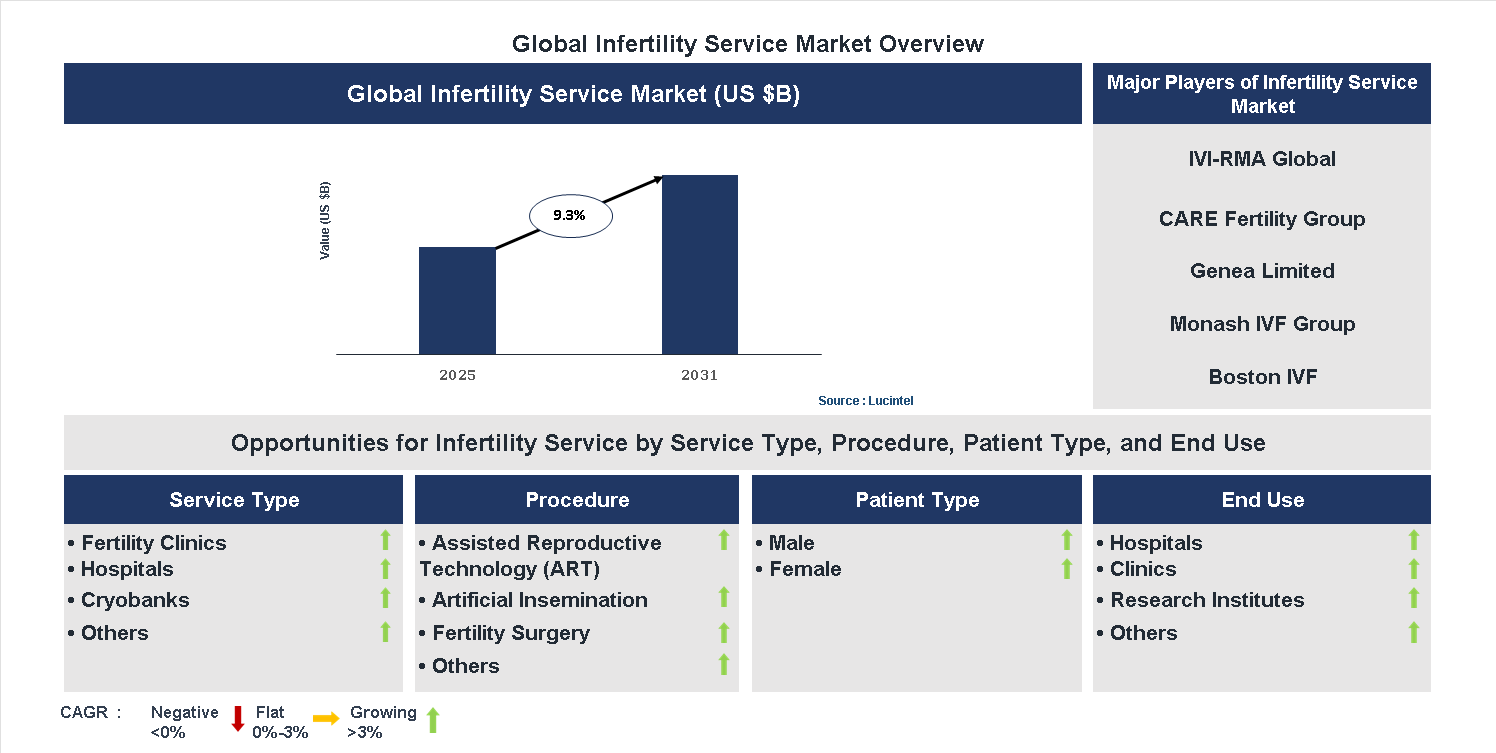
The future of the global infertility service market looks promising with opportunities in the hospital, clinic, and research institute markets. The global infertility service market is expected to grow with a CAGR of 9.3% from 2025 to 2031. The major drivers for this market are the growing integration of digital & telehealth technology, the increase in availability & accessibility of fertility clinic, and the rising awareness & acceptance of fertility services.• Lucintel forecasts that, within the service type category, fertility clinic is expected to witness the highest growth over the forecast period.
• Within the end use category, hospital is expected to witness the highest growth.
• In terms of region, APAC is expected to witness the highest growth over the forecast period. Gain valuable insights for your business decisions with our comprehensive 150+ page report. Sample figures with some insights are shown below.
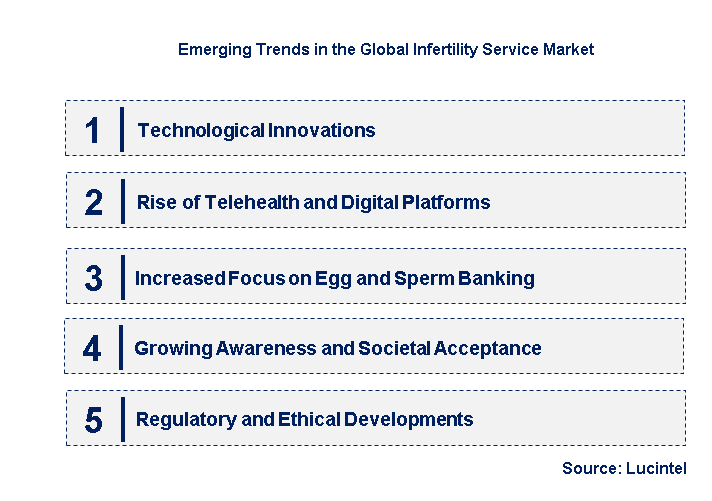
Emerging Trends in the Infertility Service Market
The infertility service market is experiencing rapid transformation driven by technological advancements, changing societal attitudes, and increasing awareness about reproductive health. As more individuals and couples seek fertility solutions, the industry is adapting to meet these demands through innovative treatments, digital integration, and expanded service offerings. These developments are not only improving success rates but also making fertility services more accessible and personalized. The markets evolution reflects broader shifts towards reproductive autonomy and health equity, creating new opportunities and challenges for providers, policymakers, and consumers alike. Understanding these emerging trends is essential for stakeholders aiming to navigate and capitalize on this dynamic landscape.• Technological Innovations: The integration of advanced technologies such as AI, machine learning, and genetic testing is revolutionizing fertility treatments. These tools enhance diagnostic accuracy, personalize treatment plans, and improve success rates. For example, AI-driven embryo selection increases the likelihood of successful pregnancies, while genetic screening helps identify potential hereditary issues. This trend leads to more effective, less invasive procedures, reducing emotional and financial burdens on patients. As technology continues to evolve, the market will see increased adoption of digital health solutions, making fertility services more precise and accessible.
• Rise of Telehealth and Digital Platforms: The adoption of telehealth services is expanding access to fertility consultations, counseling, and follow-up care. Digital platforms enable remote monitoring, virtual consultations, and online support communities, breaking geographical barriers. This trend is particularly impactful in underserved or rural areas where specialized clinics are scarce. It also offers convenience and privacy for patients, encouraging more individuals to seek help. The growth of telehealth is reshaping the patient experience, reducing costs, and streamlining service delivery, thus broadening the market reach and improving overall patient engagement.
• Increased Focus on Egg and Sperm Banking: The demand for fertility preservation options like egg and sperm banking is rising, driven by delayed childbearing and career considerations. These services provide individuals with reproductive flexibility and security, especially in the context of cancer treatments or other health risks. The market is witnessing technological improvements in cryopreservation techniques, leading to higher survival rates and better outcomes. This trend supports reproductive autonomy and offers a safety net for future family planning, expanding the scope of fertility services beyond immediate conception needs and creating new revenue streams for providers.
• Growing Awareness and Societal Acceptance: Societal attitudes towards infertility and assisted reproductive technologies are becoming more open and accepting. Increased awareness campaigns, celebrity endorsements, and supportive policies are reducing stigma and encouraging more people to seek treatment. This shift is broadening the demographic profile of patients and fostering inclusivity for LGBTQ+ individuals and single parents. As societal acceptance grows, demand for diverse fertility options and services is expected to rise, driving market growth and prompting providers to diversify their offerings to meet evolving consumer needs.
• Regulatory and Ethical Developments: Evolving regulations and ethical considerations are shaping the market landscape. Governments and industry bodies are establishing guidelines for embryo research, genetic editing, and surrogacy practices to ensure safety and ethical compliance. These regulations influence market entry, innovation, and international collaborations. While they may pose challenges, they also promote responsible practices and consumer trust. As the regulatory environment stabilizes, it will facilitate investment, innovation, and cross-border services, ultimately fostering a more sustainable and ethically grounded fertility services market. In summary, these emerging trends are collectively transforming the infertility service market by enhancing technological capabilities, expanding access, promoting societal acceptance, and ensuring ethical standards. This evolution is making fertility treatments more effective, inclusive, and accessible, thereby reshaping the industry landscape and opening new avenues for growth and innovation.
Recent Development in the Infertility Service Market
The infertility service market has experienced significant growth and transformation driven by technological advancements, increasing awareness, and changing societal attitudes towards reproductive health. As more individuals and couples seek fertility solutions, the market is evolving rapidly, with innovations improving success rates and accessibility. Additionally, regulatory changes and expanding insurance coverage are shaping the landscape, making treatments more affordable and available. The global focus on reproductive health and rising infertility rates are further fueling market expansion. These developments collectively influence market dynamics, creating new opportunities and challenges for providers, patients, and stakeholders involved in infertility services.• Technological Innovations: The introduction of advanced reproductive technologies such as genetic testing, embryo freezing, and AI-driven diagnostics has improved success rates and personalized treatment plans, leading to higher patient satisfaction and increased demand for sophisticated services.
• Rising Adoption of IVF and ART: The increasing acceptance and utilization of in-vitro fertilization (IVF) and assisted reproductive technologies (ART) have expanded market size, driven by greater awareness, reduced stigma, and improved success rates, making these options more accessible to a broader population.
• Regulatory and Insurance Changes: Governments and insurance providers are implementing policies to cover fertility treatments, reducing financial barriers for patients. This shift enhances affordability and encourages more individuals to seek infertility services, thereby expanding the market.
• Growing Awareness and Societal Acceptance: Campaigns and educational initiatives are reducing stigma associated with infertility, encouraging more individuals to pursue treatment. This societal shift is boosting demand and fostering a more inclusive environment for reproductive health services.
• Market Consolidation and Strategic Partnerships: Major players are engaging in mergers, acquisitions, and collaborations to expand their service offerings and geographic reach. This consolidation enhances innovation, improves service quality, and increases market competitiveness. In summary, these developments are significantly impacting the infertility service market by increasing accessibility, improving treatment outcomes, and fostering innovation. The market is becoming more competitive and patient-centric, with technological advancements and supportive policies driving sustained growth and expanding opportunities for stakeholders.
Strategic Growth Opportunities in the Infertility Service Market
The infertility service market is experiencing rapid growth driven by technological advancements, increasing awareness, and changing societal attitudes towards family planning. As global populations seek accessible and effective fertility solutions, key applications are emerging as significant growth drivers. These opportunities are transforming the landscape, offering innovative treatments and expanding market reach. Stakeholders are focusing on diversifying service offerings, improving success rates, and addressing unmet needs across various demographic segments. This dynamic environment presents substantial potential for market expansion, driven by both technological progress and evolving consumer preferences. The following are five key growth opportunities across different applications within this market.• Assisted Reproductive Technologies (ART): The adoption of ART, including IVF and ICSI, is expanding rapidly due to technological improvements and higher success rates. This growth enhances patient options and attracts a broader demographic, including older women and those with complex infertility issues. Increased accessibility and affordability are further fueling demand, making ART a cornerstone of market expansion.
• Fertility Preservation Services: Rising awareness about fertility preservation, especially among cancer patients and young women, is creating a significant demand. Advances in cryopreservation techniques, such as egg and embryo freezing, are improving success rates and safety. This application offers hope for individuals delaying parenthood, thereby broadening the market scope and creating new revenue streams.
• Donor Sperm and Egg Services: The increasing acceptance of donor gametes to overcome infertility challenges is a key growth driver. Enhanced screening processes and donor availability are improving outcomes and patient confidence. This segment caters to diverse needs, including single parents and same-sex couples, expanding the market reach and inclusivity.
• Surrogacy Services: Surrogacy is gaining popularity, especially in regions with restrictive local laws on other ART procedures. Technological and legal advancements are making surrogacy more accessible and affordable. This application addresses complex infertility cases and expands options for intended parents, significantly contributing to market growth.
• Diagnostic and Testing Services: Early and accurate diagnosis of infertility causes is crucial for effective treatment planning. Innovations in genetic testing, hormone analysis, and imaging are improving diagnostic precision. Enhanced testing capabilities lead to personalized treatments, increasing success rates and patient satisfaction, thereby driving market growth. In summary, these growth opportunities are collectively transforming the infertility service market by broadening treatment options, improving success rates, and making services more accessible. They are attracting diverse patient segments and fostering innovation, which accelerates market expansion and enhances overall industry competitiveness.
Infertility Service Market Driver and Challenges
The infertility service market is influenced by a complex interplay of technological advancements, economic factors, and regulatory frameworks. Rapid innovations in reproductive technologies, increasing awareness, and rising infertility rates are key drivers propelling market growth. Conversely, challenges such as high treatment costs, regulatory hurdles, and ethical concerns pose significant barriers. Understanding these drivers and challenges is essential for stakeholders to navigate the evolving landscape effectively. The markets trajectory depends on how well these factors are managed and leveraged to improve access, affordability, and ethical standards in infertility treatments. The factors responsible for driving the infertility service market include:-• Technological Innovations: The development of advanced reproductive technologies such as IVF, ICSI, and egg/embryo freezing has revolutionized infertility treatment. These innovations increase success rates, making treatments more effective and accessible. As technology continues to evolve, costs are gradually decreasing, and procedures are becoming less invasive, which broadens patient acceptance. Additionally, innovations like genetic screening and cryopreservation expand treatment options, attracting more patients and healthcare providers to invest in these services. This technological progress directly correlates with increased market demand and growth potential.
• Rising Infertility Prevalence: Factors such as delayed childbearing, lifestyle changes, and increasing environmental pollutants contribute to higher infertility rates worldwide. The growing prevalence of infertility cases drives demand for specialized services, including IVF clinics, fertility testing, and counseling. As awareness about infertility increases, more individuals seek treatment, fueling market expansion. Governments and healthcare organizations are also emphasizing reproductive health, further promoting access to infertility services. This rising prevalence ensures a steady increase in market size and investment opportunities.
• Increasing Awareness and Acceptance: Societal shifts towards accepting infertility as a treatable medical condition have led to greater awareness and reduced stigma. Educational campaigns, media coverage, and advocacy by healthcare providers have empowered individuals to seek treatment. This increased acceptance encourages more patients to pursue fertility services, thereby expanding the market. Additionally, the availability of information online and support groups helps destigmatize infertility, making treatment options more approachable. As awareness continues to grow, market penetration is expected to deepen, fostering sustained growth.
• Economic Growth and Healthcare Spending: Rising disposable incomes and increased healthcare expenditure in emerging economies are facilitating access to infertility services. As economies grow, more individuals can afford advanced reproductive treatments, which were previously inaccessible due to high costs. Insurance coverage and government subsidies in some regions further reduce financial barriers. This economic development encourages clinics to expand their services and invest in new technologies, boosting market growth. The overall increase in healthcare spending underscores the importance of infertility services as a vital component of reproductive health, attracting investments and fostering innovation.
• Regulatory and Policy Support: Favorable regulatory environments and supportive policies promote the growth of infertility services. Governments and health authorities are implementing guidelines to ensure safety, efficacy, and ethical standards, which build patient trust. Reimbursement policies and subsidies in certain regions make treatments more affordable, increasing patient access. Additionally, regulatory approval for new technologies accelerates market entry and innovation. Such supportive frameworks create a conducive environment for market players to expand their offerings, attract investments, and improve service quality, ultimately driving market growth. The challenges facing this Market include:-
• High Treatment Costs: Infertility treatments, especially advanced procedures like IVF, are expensive, often limiting access for many individuals. The costs include medications, laboratory procedures, and multiple clinic visits, which can be prohibitive without insurance coverage. This financial barrier restricts treatment to higher-income groups, creating disparities in access. Moreover, the high costs can lead to emotional stress and treatment discontinuation, impacting overall market growth. Efforts to reduce costs through technological innovation and insurance coverage are ongoing but remain a significant challenge for widespread adoption.
• Regulatory and Ethical Concerns: The infertility services industry faces complex regulatory landscapes that vary across regions. Stringent regulations can delay the approval of new technologies and limit innovation. Ethical issues surrounding embryo selection, genetic modification, and surrogacy also pose challenges, leading to legal restrictions and public debate. These concerns can hinder market expansion and create uncertainty for investors and providers. Balancing innovation with ethical standards and regulatory compliance remains a critical challenge that influences market dynamics and growth prospects.
• Limited Reimbursement and Insurance Coverage: In many regions, infertility treatments are not adequately covered by insurance or government programs, making them financially inaccessible for many patients. The lack of reimbursement policies discourages clinics from expanding services and limits patient uptake. This financial gap hampers market growth, especially in developing countries where out-of-pocket expenses are a significant barrier. Advocacy for better coverage and reimbursement policies is essential to improve access and ensure sustainable market development. In summary, the infertility service market is driven by technological advancements, increasing prevalence, rising awareness, economic growth, and supportive policies. However, high costs, regulatory hurdles, and limited insurance coverage pose significant challenges. These factors collectively influence market growth, with technological innovation and policy support likely to mitigate some barriers. Addressing cost and ethical concerns will be crucial for expanding access and ensuring sustainable growth. Overall, the markets future depends on balancing innovation with affordability and ethical standards to meet the growing demand for infertility treatments worldwide.
List of Infertility Service Companies
Companies in the market compete on the basis of product quality offered. Major players in this market focus on expanding their manufacturing facilities, R&D investments, infrastructural development, and leverage integration opportunities across the value chain. With these strategies infertility service companies cater increasing demand, ensure competitive effectiveness, develop innovative products & technologies, reduce production costs, and expand their customer base. Some of the infertility service companies profiled in this report include-• IVI-RMA Global
• CARE Fertility Group
• Genea Limited
• Monash IVF Group
• Boston IVF
• The Cooper Companies Inc.
• Virtus Health
• Progyny Inc.
• OvaScience Inc.
• Fertility Focus Limited
Infertility Service Market by Segment
The study includes a forecast for the global infertility service market by service type, procedure, patient type, end use, and region.Infertility Service Market by Service Type [Value from 2019 to 2031]:
• Fertility Clinics
• Hospitals
• Cryobanks
• Others
Infertility Service Market by Procedure [Value from 2019 to 2031]:
• Assisted Reproductive Technology (ART)
• Artificial Insemination
• Fertility Surgery
• Others
Infertility Service Market by Patient Type [Value from 2019 to 2031]:
• Male
• Female
Infertility Service Market by End Use [Value from 2019 to 2031]:
• Hospitals
• Clinics
• Research Institutes
• Others
Infertility Service Market by Region [Value from 2019 to 2031]:
• North America
• Europe
• Asia Pacific
• The Rest of the World
Country Wise Outlook for the Infertility Service Market
The infertility service market has experienced significant growth and innovation driven by technological advancements, increasing awareness, and changing societal attitudes towards family planning. Countries are investing in new treatments, expanding access, and adopting digital health solutions to meet rising demand. Regulatory changes and increased funding are also shaping the landscape, making infertility care more accessible and effective. The markets evolution reflects broader demographic trends, healthcare priorities, and cultural shifts across different regions. As a result, key players are focusing on research, affordability, and personalized treatments to stay competitive and address diverse patient needs worldwide. United States: The US market has seen rapid growth with advancements in assisted reproductive technologies such as IVF and egg freezing. Telehealth services have expanded access, especially during the pandemic, and new regulations aim to improve insurance coverage. Innovative treatments like genetic testing and embryo freezing are becoming more common, increasing success rates. The government and private sector are investing heavily in research, and there is a rising trend of fertility clinics partnering with biotech firms to develop personalized medicine options. Public awareness campaigns are also reducing stigma around infertility. China: China’s infertility market is expanding due to increasing awareness and changing societal norms. The government has relaxed some regulations around assisted reproductive services, encouraging private sector growth. Technological innovations, including advanced IVF techniques and genetic screening, are being adopted rapidly. There is a rising demand for fertility preservation and donor services, driven by urban middle-class populations. The country is also witnessing a surge in fertility clinics, supported by government initiatives to address declining birth rates. Digital platforms are increasingly used for consultation and treatment management, improving accessibility. Germany: Germany’s market is characterized by a focus on high-quality, regulated infertility treatments. The country has strict legal frameworks governing reproductive services, ensuring safety and ethical standards. Innovations include minimally invasive procedures and improved embryo cryopreservation techniques. There is a growing emphasis on personalized medicine and genetic diagnostics. Public and private insurance coverage is expanding, making treatments more affordable. Germany is also investing in research on new fertility preservation methods and addressing age-related infertility. Patient-centered care and technological integration are key trends shaping the market. India: India’s infertility service market is rapidly growing, driven by increasing awareness and affordability. The country offers a wide range of treatments, including IVF, ICSI, and surrogacy, with many clinics adopting advanced technologies. Government initiatives aim to improve access and regulate practices, though challenges remain around ethical standards. The market is witnessing a rise in fertility tourism, with patients from neighboring countries seeking affordable care. Digital health platforms are facilitating consultations and treatment management. The focus on research and innovation is increasing, with some clinics pioneering low-cost, high-quality fertility solutions. Japan: Japan’s infertility market is evolving with a focus on technological innovation and patient-centered care. The country has seen increased adoption of advanced reproductive technologies, including genetic testing and embryo freezing. Regulatory reforms are making treatments more accessible and affordable. There is a growing emphasis on minimally invasive procedures and personalized treatment plans. Japan is also investing in research on age-related infertility and fertility preservation. Public awareness campaigns are reducing stigma, and collaborations between clinics and biotech firms are fostering innovation. The market is poised for steady growth driven by demographic shifts and technological advancements.
Features of the Global Infertility Service Market
Market Size Estimates: Infertility service market size estimation in terms of value ($B). Trend and Forecast Analysis: Market trends (2019 to 2024) and forecast (2025 to 2031) by various segments and regions. Segmentation Analysis: Infertility service market size by various segments, such as by service type, procedure, patient type, end use, and region in terms of value ($B). Regional Analysis: Infertility service market breakdown by North America, Europe, Asia Pacific, and Rest of the World. Growth Opportunities: Analysis of growth opportunities in different service types, procedures, patient types, end uses, and regions for the infertility service market. Strategic Analysis: This includes M&A, new product development, and competitive landscape of the infertility service market. Analysis of competitive intensity of the industry based on Porter’s Five Forces model.
FAQ
Q1. What is the growth forecast for infertility service market? Answer: The global infertility service market is expected to grow with a CAGR of 9.3% from 2025 to 2031. Q2. What are the major drivers influencing the growth of the infertility service market? Answer: The major drivers for this market are the growing integration of digital & telehealth technology, the increase in availability & accessibility of fertility clinic, and the rising awareness & acceptance of fertility services. Q3. What are the major segments for infertility service market? Answer: The future of the infertility service market looks promising with opportunities in the hospital, clinic, and research institute markets. Q4. Who are the key infertility service market companies? Answer: Some of the key infertility service companies are as follows:• IVI-RMA Global
• CARE Fertility Group
• Genea Limited
• Monash IVF Group
• Boston IVF
• The Cooper Companies Inc.
• Virtus Health
• Progyny Inc.
• OvaScience Inc.
• Fertility Focus Limited Q5. Which infertility service market segment will be the largest in future? Answer: Lucintel forecasts that, within the service type category, fertility clinic is expected to witness the highest growth over the forecast period. Q6. In infertility service market, which region is expected to be the largest in next 5 years? Answer: In terms of region, APAC is expected to witness the highest growth over the forecast period. Q7. Do we receive customization in this report? Answer: Yes, Lucintel provides 10% customization without any additional cost.
Table of Contents
List of Figures
List of Tables
Methodology
- In-depth interviews of the major players in this market
- Detailed secondary research from competitors’ financial statements and published data
- Extensive searches of published works, market, and database information pertaining to industry news, company press releases, and customer intentions
- A compilation of the experiences, judgments, and insights of Lucintel’s professionals, who have analyzed and tracked this market over the years.


Buy Now
Choose a license that fits your team. Instant PDF delivery.
Prices exclude taxes. Instant delivery. Custom licensing available on request.
Key Questions
- • What are some of the most promising, high-growth opportunities for the infertility service market by service type (fertility clinics, hospitals, cryobanks, and others), procedure (assisted reproductive technology (ART), artificial insemination, fertility surgery, and others), patient type (male and female), end use (hospitals, clinics, research institutes, and others), and region (North America, Europe, Asia Pacific, and the Rest of the World)?
- • Which segments will grow at a faster pace and why?
- • Which region will grow at a faster pace and why?
- • What are the key factors affecting market dynamics? What are the key challenges and business risks in this market?
- • What are the business risks and competitive threats in this market?
- • What are the emerging trends in this market and the reasons behind them?
- • What are some of the changing demands of customers in the market?
- • What are the new developments in the market? Which companies are leading these developments?
- • Who are the major players in this market? What strategic initiatives are key players pursuing for business growth?
- • What are some of the competing products in this market and how big of a threat do they pose for loss of market share by material or product substitution?
- • What M&A activity has occurred in the last 5 years and what has its impact been on the industry? For any questions related to Infertility Service Market, Infertility Service Market Size, Infertility Service Market Growth, Infertility Service Market Analysis, Infertility Service Market Report, Infertility Service Market Share, Infertility Service Market Trends, Infertility Service Market Forecast, Infertility Service Companies, write Lucintel analyst at email: helpdesk@lucintel.com. We will be glad to get back to you soon.


