
Market Report · July 22, 2026

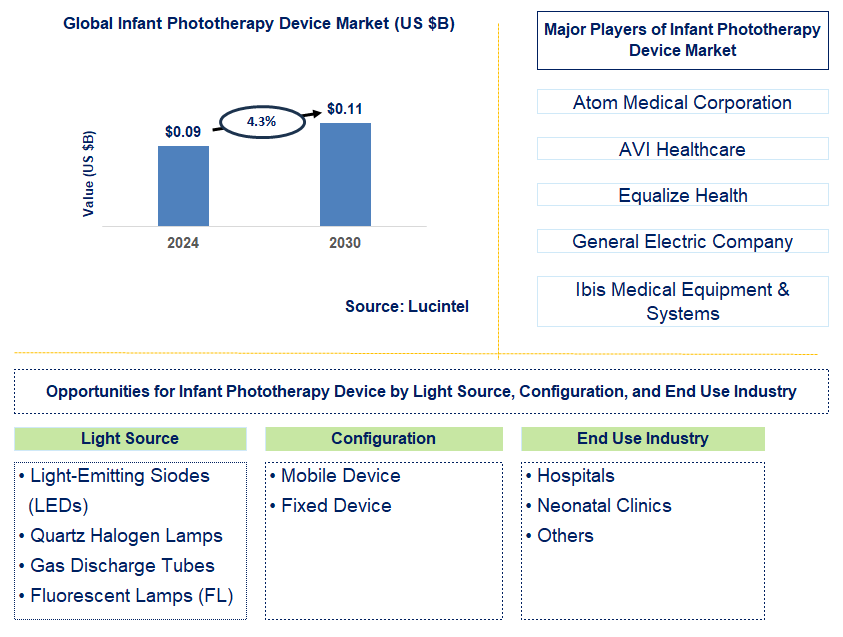
Key data points: The market size in 2030 = $0.11 billion, growth forecast = 4.3% annually for the next 6 years. Scroll below to get more insights. This market report covers trends, opportunities, and forecasts in the global infant phototherapy device market to 2030 by light source (light-emitting diodes (LEDs), quartz halogen lamps, gas discharge tubes, and fluorescent lamps (FL)), configuration (mobile device and fixed device), end use industry (hospitals, neonatal clinics, and others), and region (North America, Europe, Asia Pacific, and the Rest of the World)
We'll send your sample report shortly.
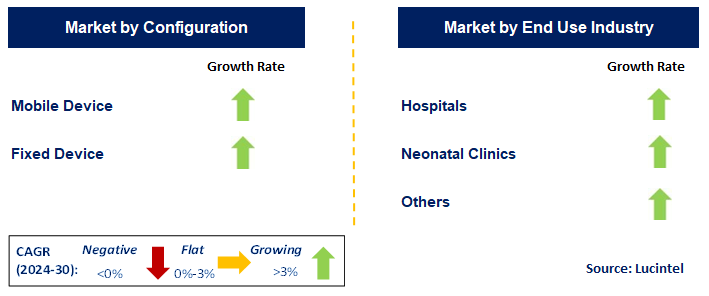
• Lucintel forecasts that, within the configuration category, mobile device is expected to witness higher growth over the forecast period because they help in providing accurate estimates of total serum bilirubin (TSB) values, thus depicting an inexpensive technology that uses commodity smartphones to effectively screen newborns for jaundice.
• Within the end use industry category, hospitals will remain the largest segment due to the growing number of jaundice treatments performed at hospitals and the increasing implementation of government initiatives to improve the healthcare infrastructure across the globe.
• In terms of regions, North America will remain the largest region over the forecast period due to the presence of strong infrastructure for developmental research, growing funding for research, and an increasing number of government programs to promote the market for infant phototherapy devices in the region. Gain valuable insights for your business decisions with our 150+ page report.
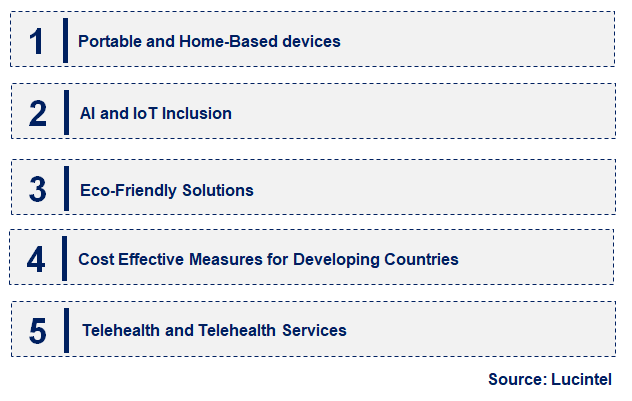
• Portable and home-based devices: The portable and home-based phototherapy devices market is expected to grow due to the rising trend of shortening the length of stay in hospitals and the desire for more individualized services. These devices are designed to be user-friendly so that caregivers, primarily parents, can take care of infants in the comfort of their homes.
• AI and IoT inclusion: Even with all the aforementioned attempts to administer treatment, the process is made easier by the interplay of AI and IoT with phototherapy devices, allowing patients to receive remote treatment and monitoring. This trend seems to be more pronounced in advanced countries like Japan.
• Eco-friendly solutions: Some recent trends have been predominant in emerging phototherapy devices, whereby manufacturers are incorporating designs that support the use of less energy. This is especially prominent in Germany, where manufacturers' efforts are leading to progress in greening the industry.
• Cost-effective measures for developing countries: Phototherapy devices for the treatment of jaundice have also begun receiving attention in markets such as India, where cost-effective devices targeting limited resources are used. Public-private partnerships are also enabling this trend.
• Telehealth services: Manufacturers have responded to the use of telemedicine alongside the development of phototherapy devices, where treatment can be attended to by healthcare professionals remotely through the device, reducing the number of visits to the hospital while improving care. People have seen much better development in accessibility, effectiveness, and environmentally friendly adaptations in the infant phototherapy device market. As these trends advance, they are expected to bring about further transformation to the market.
• Development of AI devices for users: Real-time AI-enabled phototherapy systems have improved the management and efficiency of neonatal therapy, with the ability to monitor patients in real-time and customize treatment for individual patients.
• Expansion of telemedicine: A few changes have been seen in telemedicine modules. However, the capabilities of telemedicine have expanded to allow remote phototherapy treatment assessment and consultation, which in turn decreases the number of clinic visits.
• Growth in portable devices: As treatment gains demand, the accessibility of portable phototherapy devices in the market has also increased, making home care more comfortable, especially in the US and Japan.
• Regulatory enhancements: Particularly in Europe, new policies on energy conservation and safety have led to the introduction of safer and more environmentally friendly phototherapy systems.
• Affordable innovations for emerging markets: There is an increasing affordability in new technologies, prompting manufacturers to prepare affordable devices for India, where there is a high need for neonatal devices. Decisive changes within the infant phototherapy apparatus market are taking place, improving the efficiency, effectiveness, and sustainability of neonatal care practices in different regions.
• Neonatal jaundice: The most common use of infant phototherapy devices is for treating an abnormality called neonatal jaundice. Cultural and political changes leading to increased incidence of neonatal jaundice, particularly in developing countries, along with better healthcare systems, can create an attractive level of sales for companies.
• Premature infants: Phototherapy is often required for an extended period in cases of premature babies, who are at an increased risk of developing jaundice. The number of premature babies tends to rise worldwide, accompanied by improved neonatal care; therefore, there is significant demand for infant phototherapy devices.
• Home phototherapy: The realization of home care has called for the manufacture of portable and easy-to-use infant phototherapy devices, which can be utilized in homes. This provides comfort to parents or caregivers without overloading the healthcare system.
• Bilirubin measurement devices: Treatment decisions regarding phototherapy largely depend on bilirubin levels, which need to be measured accurately to determine the appropriate treatment. This capability can be added to the product line of this class of devices to widen their market and increase sales volume.
• Specialty phototherapy devices: Addressing specific issues like jaundice or working under peculiar circumstances, particularly by developing specialty phototherapy systems that offer unique benefits to cover niche markets, is important for doing business. These growth opportunities are collectively driving the expansion of the infant phototherapy device market. This growth includes the rising need for quality care in managing jaundice, growing technology, and the trend of preferring treatment at home. Manufacturers are innovating and creating differentiated products at low costs to tap into these opportunities.
• Technological advancements: Continuous improvements in LED technology, power supply, and device design are contributing to the production of more efficient, compact, and user-friendly infant phototherapy devices.
• Rising healthcare expenditure: Rising healthcare costs, especially in developing nations, are propelling growth in the use of medical equipment, including phototherapy devices for treating jaundice in children.
• Increased understanding of jaundice: Enhanced understanding of the risk factors, etiology, and management of jaundice among both parents and clinicians is causing an increase in the phototherapy market.
• Government policies: Appropriate government-supported policies and measures encouraging maternal and child healthcare and the prevention and treatment of jaundice are driving market expansion.
• Rising incidence of prematurity: Increasing global cases of preterm births mean that more babies will seek phototherapy treatment. Challenges in the infant phototherapy device market include:
• Need to meet regulatory requirements: These hurdles can be particularly challenging in emerging economies for manufacturers looking to enter the market.
• Affordability issues: Geographical disparities and limitations in healthcare systems have also contributed to the high cost of devices for use in infant phototherapy.
• Negative policies regarding reimbursement: Low remuneration policies for phototherapy treatment in various healthcare systems may divert marketing initiatives and hinder economic growth. According to earlier estimations, the revenue of the infant phototherapy device market is expected to grow due to technological factors, increasing healthcare investments, and growing awareness of jaundice. Nevertheless, factors such as regulatory restrictions, cost limitations, and lack of coverage can be detrimental to market growth. Thus, the manner in which these challenges are addressed, as well as the opportunities within the market, will define manufacturers’ long-term achievements.
• Atom Medical Corporation
• AVI Healthcare
• Equalize Health
• General Electric Company
• Ibis Medical Equipment & Systems
• Natus Medical Incorporated
• Ningbo David Medical Device
• Novos Medical Devices
• Weyer
• Zhengzhou Dison Instrument & Meter
• Light-Emitting Siodes (LEDs)
• Quartz Halogen Lamps
• Gas Discharge Tubes
• Fluorescent Lamps (FL)
• Mobile Device
• Fixed Device
• Hospitals
• Neonatal Clinics
• Others
• North America
• Europe
• Asia Pacific
• The Rest of the World
• United States: Recent changes include the emergence of portable and home-based phototherapy devices that allow patients to stay at home and limit the time spent in hospitals by patients' caregivers.
• China: The government has encouraged the population to improve the welfare of newborns, and the advancement of the healthcare system has resulted in the use of more advanced phototherapy equipment, particularly in remote areas.
• Germany: In the market for phototherapy devices in Germany, there has been an increased tendency to consume devices with reduced energy consumption and environmentally friendly materials, driven by the growth of the regulatory framework and ambitions related to sustainable development.
• India: The market in India has been characterized by the development of phototherapy devices for neonates suffering from jaundice in low-resource settings, funded through public and private sectors.
• Japan: In Japan, the focus is on using AI and IoT in phototherapy devices to facilitate tailoring and management of treatment from distant locations, enhancing neonatal care provided to infants and allowing for more effective care of newborns.


• Atom Medical Corporation
• AVI Healthcare
• Equalize Health
• General Electric Company
• Ibis Medical Equipment & Systems
• Natus Medical Incorporated
• Ningbo David Medical Device
• Novos Medical Devices
• Weyer
• Zhengzhou Dison Instrument & Meter Q6. Which infant phototherapy device market segment will be the largest in future? Answer: Lucintel forecasts that mobile device is expected to witness higher growth over the forecast period because they help in providing accurate estimates of total serum bilirubin (TSB) values, thus depicting an inexpensive technology that uses commodity smartphones to effectively screen newborns for jaundice. Q7. In infant phototherapy device market, which region is expected to be the largest in next 5 years? Answer: North America will remain the largest region over the forecast period due to the presence of strong infrastructure for developmental research, growing funding for research, and an increasing number of government programs to promote the market for infant phototherapy devices in the region. Q.8 Do we receive customization in this report? Answer: Yes, Lucintel provides 10% customization without any additional cost.


Choose a license that fits your team. Instant PDF delivery.
Prices exclude taxes. Instant delivery. Custom licensing available on request.
Market Report · July 22, 2026
Market Report · July 22, 2026
Market Report · July 22, 2026
Trusted partner for strategic intelligence and business growth


Receive a complimentary market analysis tailored to your industry. Our analysts will identify key growth opportunities and competitive dynamics specific to your business.

Market size, growth rate, and key trend analysis for your specific sector.

Top competitor positioning and market share analysis.

Strategic recommendations backed by data-driven insights.
Get curated market intelligence and competitive moves straight to your inbox.
By subscribing, you agree to receive our monthly insights. Unsubscribe anytime.
Receive a complimentary market analysis tailored to your industry. Our analysts will identify key growth opportunities and competitive dynamics specific to your business.
Market size, growth rate, and key trend analysis for your specific sector.
Top competitor positioning and market share analysis.
Strategic recommendations backed by data-driven insights.
Get curated market intelligence, emerging trends, and competitive moves straight to your inbox each month.
By subscribing, you agree to receive our monthly insights. Unsubscribe anytime.
We'll send your sample report shortly.