
Market Report · May 18, 2026

This market report covers trends, opportunities, and forecasts in the global inertial navigation system market to 2031 by technology (mechanical gyro technology, ring laser gyro technology, fiber optics gyro technology, mems technology, and others), application (aerospace, maritime, military and defense, automotive, robotics, and others), and region (North America, Europe, Asia Pacific, and the Rest of the World)
We'll send your sample report shortly.
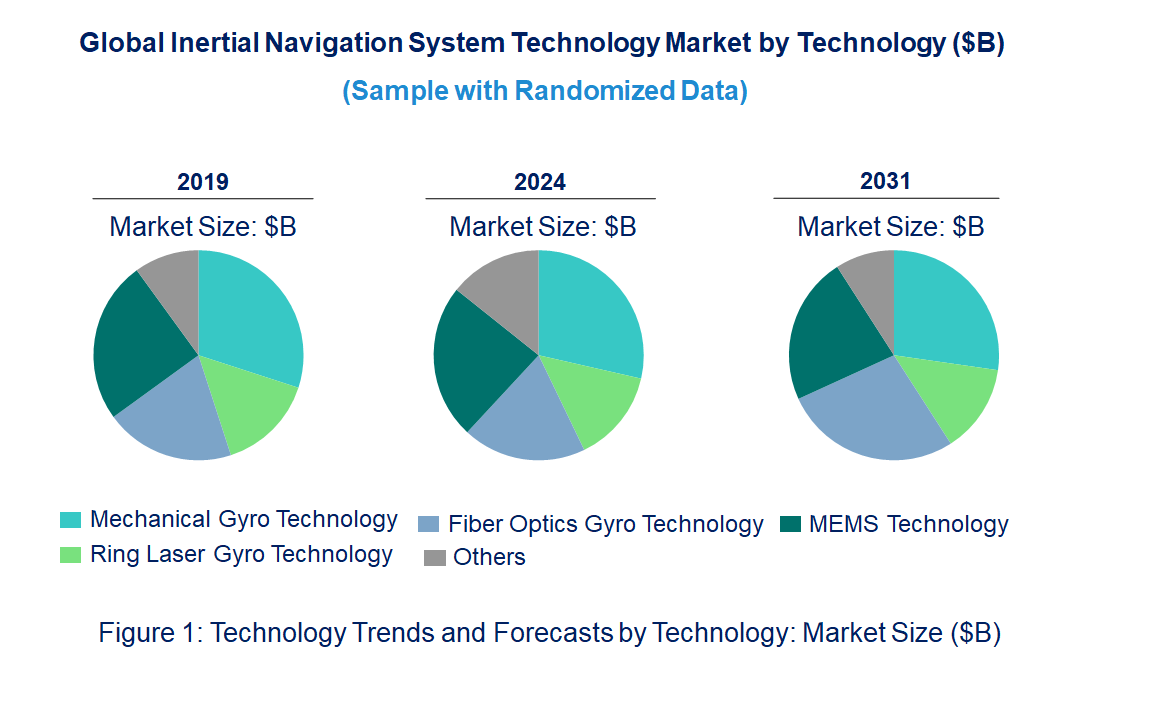
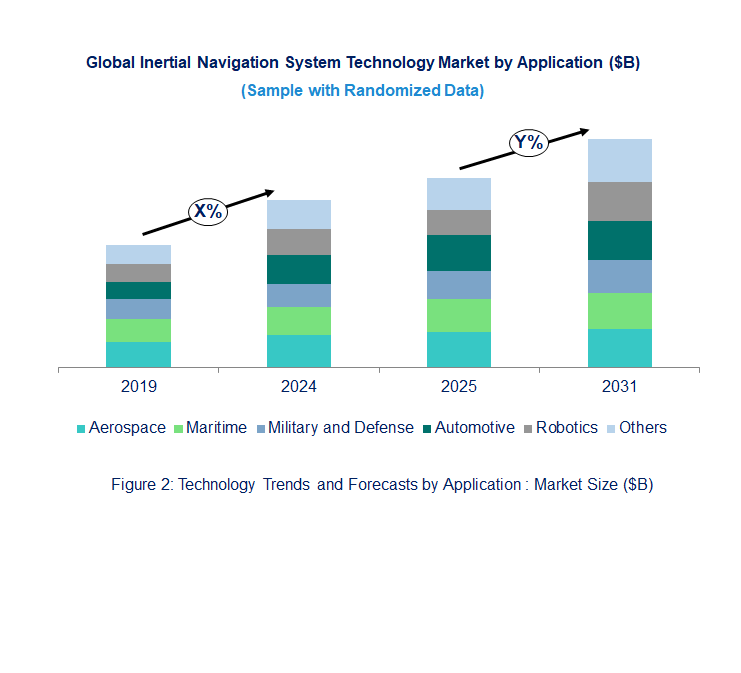
• Miniaturization of Sensors: The trend of reducing the size of inertial sensors is growing, with MEMS technology leading the way. This development allows for smaller, lightweight INS systems suitable for applications in drones, automotive systems, and robotics.
• Integration with GPS: INS systems are increasingly being integrated with GPS and other satellite-based navigation systems to improve accuracy and reliability. This trend enhances the performance of autonomous vehicles and military navigation systems.
• Growth in Automotive Applications: As autonomous driving technology advances, INS is playing a critical role in enabling precise vehicle navigation and enhancing the safety and functionality of self-driving cars.
• Advanced Fiber Optic Gyros (FOG): The adoption of FOG technology is increasing due to its high precision and reliability in aerospace and defense applications. FOGs are ideal for systems requiring high accuracy over extended periods.
• Artificial Intelligence (AI) in Navigation Systems: AI algorithms are being integrated into INS to enhance navigation accuracy and decision-making in complex environments, improving applications like robotics and military defense systems. These trends are reshaping the inertial navigation system market by enabling more efficient, accurate, and flexible systems that are critical for modern navigation, safety, and autonomy.
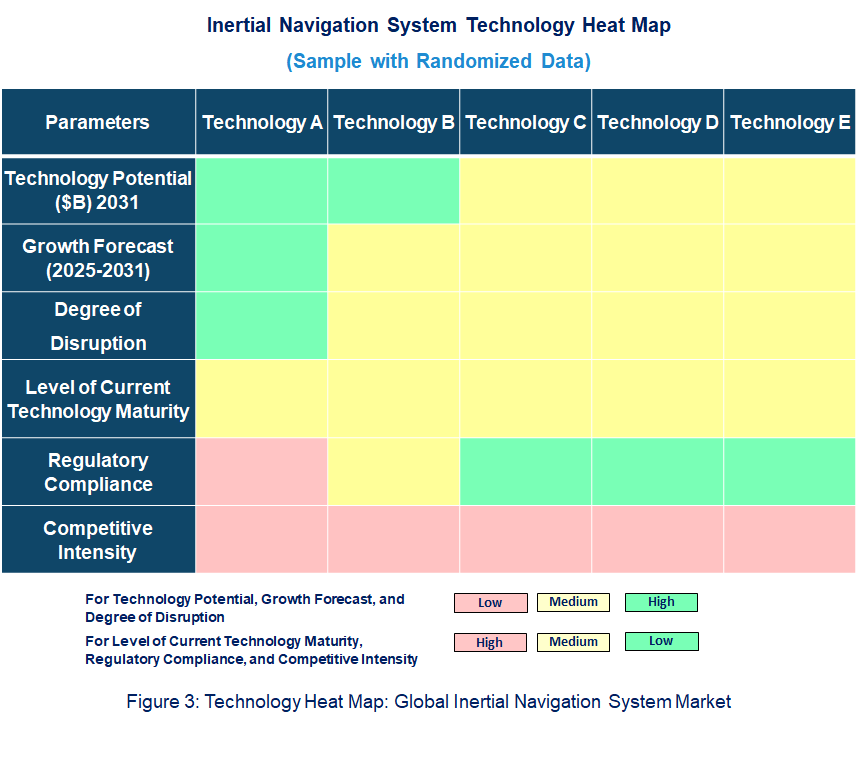
• Technology Potential: The potential of INS technology is enormous, especially with the growth of autonomous systems, aerospace, and defense applications. Improvements in MEMS and sensor fusion technologies improve the accuracy, size, and cost-effectiveness of INS, opening new possibilities in commercial applications such as drones, robotics, and autonomous vehicles.
• Degree of Disruption: The INS market is being gradually disrupted through GPS-denied navigation technologies and advanced sensor fusion techniques, which combine INS with other technologies such as LiDAR and computer vision. Despite that, traditional INS continues to play a major role in high-precision, mission-critical applications, thereby restricting total disruption.
• Current Technology Maturity: INS technology is very mature in the aerospace and defense sectors, but is still under development for consumer applications. MEMS-based inertial sensors have moved significantly in terms of miniaturization and affordability, opening more commercial markets to their wider adoption.
• Regulatory Compliance: INS technologies must meet high regulatory standards, including MIL-STD for defense applications and aerospace certifications, such as FAA standards for aviation. For systems that include location-based services, data privacy regulations also need to be met.
• Honeywell: Honeywell has developed next-generation MEMS-based INS systems that have a major accuracy and performance improvement. These systems are widely used in commercial aviation and military applications where high reliability and precision are needed. Honeywell’s developments are making it easier for industries to adopt INS technologies in smaller, more affordable packages.
• Northrop Grumman: Northrop Grumman has developed an advanced fiber optic gyroscope (FOG) INS that provides ultra-high precision and is designed for aerospace, defense, and maritime applications. The systems are known for their robustness in extreme conditions, and Northrop Grumman further expands its focus on autonomous navigation solutions, especially for unmanned aerial vehicles (UAVs).
• Safran: Safran has done significant work in integrating gyroscopes with MEMS and laser gyro technologies. The company’s latest developments are concentrated on performance improvement and accuracy of INS for automotive and aerospace industries with an emphasis on low power consumption and compactness. The systems are suitable for a wide range of applications, including drones and autonomous vehicles.
• Thales: Thales is at the forefront of combining INS with multi-sensor fusion technology to ensure highly accurate navigation, even in GPS-denied environments. The company’s advanced INS is being implemented into military and civilian aircraft and also autonomous vehicle systems that can significantly reduce the operational risks associated with those systems and make the systems more reliable.
• EMCORE: EMCORE has recently introduced a new range of fiber optic gyro (FOG) INS developed specifically for the aerospace and defense market. FOGs from this company have excellent long-term accuracy and stability, making them excellent options for applications in very accurate navigation such as satellite and missile guidance systems.
• Kearftt: Kearftt has designed its latest INS systems, especially for the automotive industry in the context of autonomous driving. Combining MEMS technology with GPS and vision-based systems, Kearftt provides highly accurate, real-time navigation systems capable of supporting full autonomy in challenging environments.
• Inertial Labs: Inertial Labs has designed low-cost MEMS-based INS systems for commercial and industrial use. Its products are more focused on applications in robotics and unmanned systems, where the need for precision at a cost enables scaling up operations. These trends depict the general movement of higher integration, miniaturization, and accuracy in inertial navigation systems. As automation demand is rising and advanced applications are growing, these key players drive INS technology adoption across the different sectors in defense, aerospace, and automotive.
• Autonomous Systems: The growing demand for autonomous vehicles, drones, and robots is one of the main drivers of the INS market. These systems require high-precision, real-time navigation capabilities offered by INS to work effectively in GPS-denied environments.
• Increasing Demand for High Precision in Defense and Aerospace: The defense and aerospace sectors require high-accuracy navigation systems for critical applications like missile guidance, UAVs, and satellite positioning. INS is used in these systems, and its increasing demand is due to advanced, reliable, and high-performance units.
• Commercial Drone Market: The fast growth of drone usage for business and recreational activities has demanded affordable, compact, precise INS solutions. This trend increases the use of INSs in consumer electronics and industries like mapping, surveillance, and delivery services.
• Technological Developments in MEMS and Gyro Technologies: Advances in MEMS, FOGs, and RLGs have led to less expensive, smaller, and more accurate INS systems. The technological development has thus opened up new markets like automotive and consumer electronics, which were earlier out of the cost range for traditional INS systems. Challenges in the inertial navigation system (INS) market are:
• High Price of Advanced INS Technologies. Though MEMS and other technologies have helped bring costs down, high-performance INS systems, especially those with fiber optic or ring laser gyros, are still pricey. This is challenging for industries such as automotive and consumer electronics, in which price sensitivity is rather high.
• Complexity in Multi-Sensor Integration: The integration of different sensors such as GPS, vision systems, and magnetometers with INS can be complex and costly. Design challenges associated with multi-sensor fusion require advanced algorithms and calibration methods to ensure accuracy and reliability, thereby increasing the overall system cost and development time.
• Environmental and Physical Constraints: INS systems, particularly those used in aerospace, defense, and automotive applications, have to survive with reliable performance in extremely high levels of vibration, temperature variation, and electromagnetic interference. These environmental demands form one of the biggest challenges against which performance and reliability need to be maintained. The inertial navigation system (INS) market is experiencing tremendous growth based on the increasing adoption of autonomous systems, the MEMS and gyro technology advancements, and increasing demand from various end-users such as aerospace, defense, and automotive sectors. However, factors that challenge the market, including cost, integration complexity, and environmental factors, will have to be resolved if the market is to sustain further growth. Still, industries are being transformed through ongoing evolution in INS technologies toward more autonomy, precision, and reliability across diverse applications.
• Honeywell
• Northrop Grumman
• Safran
• Thales
• EMCORE
• Kearftt
• Technology Readiness by Technology Type in Inertial Navigation System Market: Mechanical gyros have matured and are being superseded by MEMS, which are widely employed in consumer and automotive segments. RLGs and FOGs are highly accurate and therefore suitable for use in Aerospace and Defense segments, however, they are bulky and expensive. MEMS technology is fast-moving towards accuracy and reliability, making it suitable for commercial applications in drones, smartphones, and automotive systems. MEMS technology provides strong competition due to its small size and cost, whereas RLGs and FOGs are dominant in high-performance fields. MEMS is easier to certify, whereas RLGs and FOGs are strictly regulated for military and aerospace applications.
• Competitive Intensity and Regulatory Compliance of Different Technologies in Inertial Navigation System Market: The intensity is high with key market leaders offering MEMS, ring laser, and fiber optic gyroscopes. MEMS technology is rapidly growing due to its low cost and compact size, competing with the expensive RLGs and FOGs. RLGs and FOGs are good for high-precision sectors such as aerospace, but MEMS is gaining popularity in commercial applications. Compliance with regulations is a critical issue in industries like defense and aerospace, where safety and performance standards are strict. MEMS are less regulated; RLGs and FOGs require strict military and aerospace standardization, primarily for the accuracy and stability requirements.
• Disruption Potential of Different Technologies in Inertial Navigation System Market: Mechanical gyros are being replaced by advanced technologies like MEMS, which offer smaller, lighter, and cheaper solutions. Ring lasers and fiber optic gyros provide high precision but are costly and bulky, limiting their adoption outside military and aerospace. MEMS technology has significant disruption potential due to its affordability and improving performance, especially in the consumer electronics and automotive industries. While fiber optic and ring laser gyros continue to lead in high-performance areas, MEMS is giving competition through similar performance at a much-reduced price, thus being most suited for mass-market applications. Other technologies, such as those based on quartz, have niche applications but are overall not as competitive.
• Mechanical Gyro Technology
• Ring Laser Gyro Technology
• Fiber Optics Gyro Technology
• MEMS Technology
• Others
• Aerospace
• Maritime
• Military and Defense
• Automotive
• Robotics
• Others
• North America
• Europe
• Asia Pacific
• The Rest of the World
• Latest Developments and Innovations in the Inertial Navigation System Technologies
• Companies / Ecosystems
• Strategic Opportunities by Technology Type


Choose a license that fits your team. Instant PDF delivery.
Prices exclude taxes. Instant delivery. Custom licensing available on request.
Market Report · May 18, 2026
Market Report · May 18, 2026
Market Report · May 18, 2026
Trusted partner for strategic intelligence and business growth


Receive a complimentary market analysis tailored to your industry. Our analysts will identify key growth opportunities and competitive dynamics specific to your business.

Market size, growth rate, and key trend analysis for your specific sector.

Top competitor positioning and market share analysis.

Strategic recommendations backed by data-driven insights.
Get curated market intelligence and competitive moves straight to your inbox.
By subscribing, you agree to receive our monthly insights. Unsubscribe anytime.
Receive a complimentary market analysis tailored to your industry. Our analysts will identify key growth opportunities and competitive dynamics specific to your business.
Market size, growth rate, and key trend analysis for your specific sector.
Top competitor positioning and market share analysis.
Strategic recommendations backed by data-driven insights.
Get curated market intelligence, emerging trends, and competitive moves straight to your inbox each month.
By subscribing, you agree to receive our monthly insights. Unsubscribe anytime.
We'll send your sample report shortly.