
Market Report · July 15, 2026

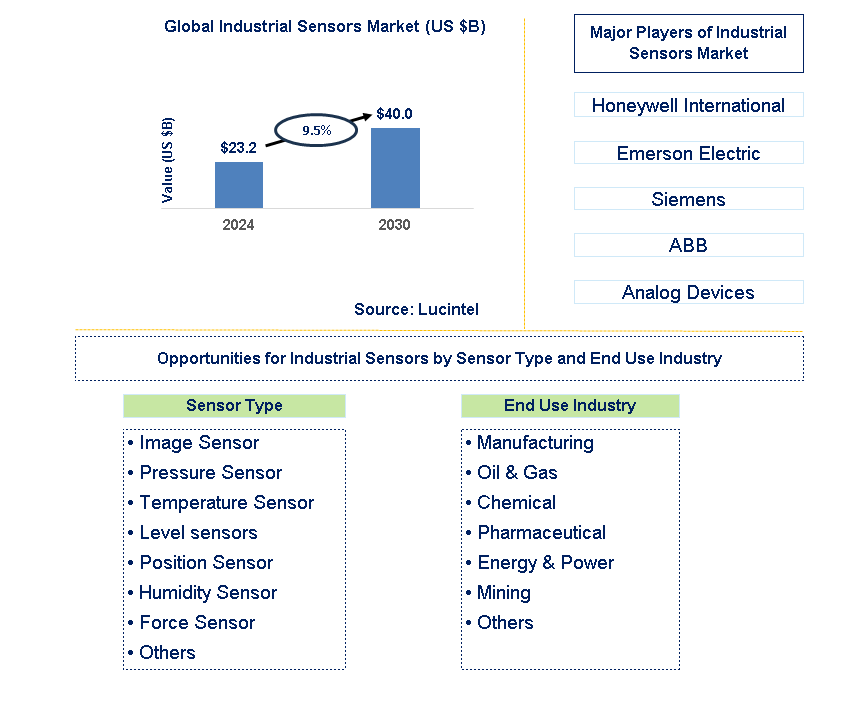
Key data points: The market size in 2030 = $40.0 billion, growth forecast = 9.5% annually for the next 6 years. Scroll below to get more insights. This market report covers trends, opportunities, and forecasts in the global industrial sensors market to 2030 by sensor type (image sensor, pressure sensor, temperature sensor,level sensors, position sensor, humidity sensor, force sensor, and others), end use (manufacturing, oil & gas, chemical, pharmaceutical, energy & power, mining, and others), and region (North America, Europe, Asia Pacific, and the Rest of the World)
We'll send your sample report shortly.
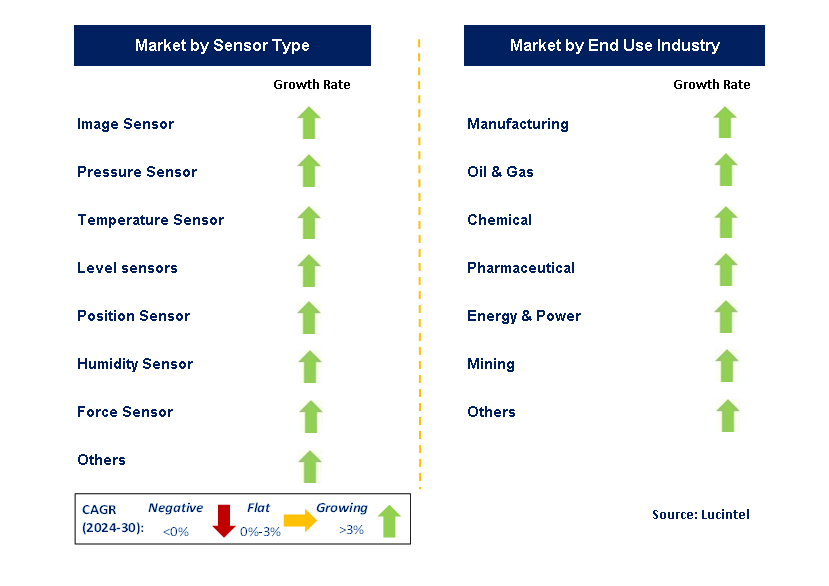
• Lucintel forecast that within the sensor type category, image sensor is expected to witness highest growth over the forecast period.
• Within the end use category, manufacturing will remain the largest segment.
• In terms of regions, APAC is expected to witness highest growth over the forecast period. Gain valuable insights for your business decisions with our 150+ page report.
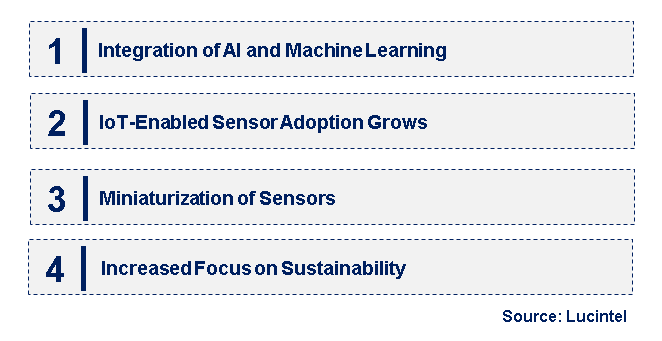
• Integration of AI and Machine Learning: The use of AI and machine learning integrated with industrial sensors is a significant trend that allows in-flight analysis for real-time intelligence and predictive maintenance. The AI-enabled sensors can analyze data directly at the edge for instant insights that improve operational efficiency while reducing downtime. Machine learning algorithms find patterns and anomalies within sensor data to drive proactive maintenance and limit unexpected failures. This becomes particularly important in industries where equipment uptime is essential. For this reason, AI-powered sensors, which learn from data and adapt to changing conditions, are increasingly deployed across various industrial sectors.
• IoT-Enabled Sensor Adoption Grows: IoT-enabled sensors are being deployed across industries to enhance connectivity and data sharing. Such sensors can be interconnected with other devices and systems, creating a network of machines whose performance can be monitored and regulated from different locations. The application of IoT in the industrial environment stimulates the growth of smart factories that rely on sensors for automation and efficiency. IoT-enabled sensors provide real-time data related to several parameters, such as temperature, pressure, and humidity, thereby enabling better decision-making and process optimization. This trend is transforming traditional manufacturing into a connected and intelligent activity.
• Miniaturization of Sensors: Another development in the industrial sensors market is the miniaturization of sensors. Smaller sensors are easier to integrate with equipment and machinery, enabling the same or even extended functionality within a smaller form factor. This is particularly important for healthcare, aerospace, and robotics, where space limitations and accuracy are crucial. Miniaturized sensors also consume less power and are therefore the best solution for battery-powered devices. As sensor technology continues to evolve, this trend ensures that sensors will become smaller and more efficient for innovation across a broader range of industries.
• Increased Focus on Sustainability: Sustainability is gaining prominence in the industrial sensors market, with sensors being developed to monitor and reduce environmental impact. Moreover, the sensing of energy consumption, emissions, and resource utilization enables industries to track their energy and resource usage for more ecologically viable operations. Additionally, growing regulatory pressure on companies to meet environmental standards remains a key trend in the growth of the sensor market. Sensors that provide real-time data about environmental parameters hold tremendous potential for enabling industries to optimize their processes, reduce waste, and lower operational costs. The emphasis on sustainability has led to the development of sensors that are not only efficient but also eco-friendly, thus forming part of the larger picture of sustainable industrial practices. The emerging trends in the industrial sensors market are reshaping the operational framework to make the industry more efficient, connected, and sustainable. The integration of AI, growth in IoT, miniaturization of sensors, focus on sustainability, and advances in wireless technology power this transformation. While these trends continue to extend the capabilities of industrial sensors, they also expand the areas in which sensors will be applied across various sectors.
• AI-Driven Sensors: Artificial intelligence integrated into industrial sensors has revolutionized the market. It can analyze data in real time, predict maintenance, and make autonomous decisions. Such sensors improve operational efficiency by reducing the likelihood of downtime and enhancing process optimization. AI-driven sensors are finding rapid applications in manufacturing, energy, and automotive industries in the quest for higher productivity and cost savings. This development further catalyzes innovation in sensor design, enabling the creation of more intelligent and adaptive sensors that can respond to complex industrial environments and continually changing operational needs.
• IoT-Enabled Smart Sensors: One of the major developments noted in the industrial sensors market is the proliferation of IoT-enabled smart sensors. These sensors are connected to networks and allow for the monitoring and controlling of industrial processes in real time. Data collection and sharing across systems facilitate decision-making and operational efficiency. Smart sensors are an essential part of smart factories in construction, where they play a critical role in automation and process optimization. As connectivity and data-driven insights demand grow stronger in industries ranging from manufacturing and logistics to energy, so does the requirement for IoT-enabled smart sensors, making them a cornerstone of modern industrial operations.
• Wireless Sensor Technology: Advancements in wireless sensor technology are transforming the outlook of the industrial sensors market. Wireless sensors enable flexibility in installation, reduce cabling costs, and allow remote monitoring in harsh environments. These sensors are gaining acceptance in industries related to oil and gas, mining, and agriculture due to their feasibility in areas where traditional wired sensors are not practical. Low-power wireless communication protocols have been developed to improve the viability of wireless sensors, making them more reliable and efficient. The technology is also extending the use of sensors in areas where their application was previously not viable, causing the market scope to expand further and encouraging innovation.
• Sensor Miniaturization: Sensor miniaturization is a major trend in the industrial sensors market. Smaller-sized sensors offer more opportunities for integration into machinery and equipment, providing added functionalities in compact forms. This is most significant in industries such as healthcare, aerospace, and robotics, where space limitations become critical. Miniaturized sensors also consume less power, making them particularly suited for portable and battery-operated devices. While this technology is continuously improving, the need for even tinier and more capable sensors has driven further innovation, prolonging their application in industrial contexts and contributing to market growth. New territories are being defined by the latest developments in the industrial sensors market, transforming industries into more efficient, better-connected, and environmentally sustainable entities. The integration of AI, rise of IoT-enabled sensors, advancements in wireless technology, miniaturization of sensors, and sustainability have emerged as key drivers for recent changes. These developments are extending the application of industrial sensors, driving innovation, and creating new avenues for growth. In this continually evolving market, these factors will be crucial in determining the future of industrial automation and fostering the next wave of technological innovation.
• Smart Manufacturing: Smart manufacturing is a major growth opportunity in the industrial sensors market. The adoption of Industry 4.0 technologies is driving the demand for advanced sensors that enable real-time monitoring, process automation, and data-driven decision-making. These sensors are crucial in smart factories, where they aid in optimizing the production process and quality control, while reducing occurrences of downtime. The use of IoT and AI in manufacturing further expands the capabilities of sensors, making them essential for operational efficiency and competitiveness. Greater adoption of smart technologies by manufacturers is forecasted to translate into rapid growth in demand for industrial sensors within this sector.
• Energy Management: Energy management has become a significant growth area for the industrial sensors market. Sustainability concerns among industries and governments drive the demand for sensors that monitor and optimize energy consumption. Additionally, sensors for tracking energy consumption, leak detection, and power distribution management find applications in industrial settings. The demand for sensors has also been driven by the growth of renewable energy sources like solar and wind, which require monitoring and control in energy production and storage. This is opening more opportunities for sensor manufacturers to develop solutions supporting energy efficiency and participate in the global transition to sustainable energy systems.
• Healthcare Automation: Healthcare automation is rapidly becoming a primary growth sector in the industrial sensors market. Sensors are gaining widespread use in medical devices, diagnostic equipment, and patient monitoring systems to achieve higher levels of accuracy and efficiency, while also improving patient safety. Demand from healthcare for sensors stems from the need for accurate data acquisition and real-time monitoring related to surgery, imaging, and patient care. The integration of IoT in healthcare—known as the Internet of Medical Things (IoMT)—is further expanding the role of sensors in this sector. As healthcare providers aim to enhance patient outcomes while reducing costs, the use of advanced sensors is expected to grow in this field.
• Automotive Sensors: The automotive industry represents a significant growth opportunity for the industrial sensors market. The demand for sensors that improve safety, efficiency, and performance is largely driven by the increasing trend of electric vehicles, autonomous driving, and connected car technologies. Sensors are applied in various automotive applications, such as collision detection, adaptive cruise control, and battery management of electric vehicles. A movement toward greener and smarter transportation systems is also boosting the demand for advanced sensors in the automotive segment. As more innovations and new technologies are adopted by automotive companies, the demand for industrial sensors is expected to increase significantly within automotive applications. The increasing adoption of advanced technologies across key applications involving manufacturing, energy, healthcare, automotive, and environmental monitoring propels strategic growth opportunities within the industrial sensors market. This is reshaping the market toward the development of more sophisticated, efficient, and versatile sensors. With the growing industrial focus on efficiency, sustainability, and innovation, the demand for industrial sensors will continue to rise. These emerging avenues for growth underscore how sensors will be at the heart of future industrial operations and the ongoing digital transformation in each sector.
• Growing Adoption of IoT: The increasing adoption of IoT technologies in industrial environments has emerged as a significant driver for the industrial sensors market. IoT-enabled sensors facilitate seamless connectivity and communication between devices and systems, enabling real-time monitoring, analysis, and decision-making. As industries embrace the need for smarter operations and data-driven insights, the demand for industrial sensors that support IoT solutions is expected to grow exponentially. This technology advancement allows businesses to track performance metrics, optimize processes, and enhance efficiency across a wide range of applications.
• Demand for Automation: The growing emphasis on automation across industries is a critical driver in the industrial sensors market. As manufacturers and industrial operators seek to enhance productivity and minimize human error, sensors play an essential role in automating processes. Sensors enable real-time monitoring, predictive maintenance, and quality control, ensuring efficient operations and increased throughput. The rising need for operational efficiency across manufacturing, energy, and other sectors is expected to boost the demand for industrial sensors significantly, as businesses strive to optimize their workflows.
• Sustainability Initiatives: Sustainability initiatives are gaining traction across industries, acting as a strong driver for the industrial sensors market. As organizations become more aware of their environmental impact, the demand for sensors that facilitate energy efficiency, emissions monitoring, and resource management is increasing. Sensors provide crucial data for tracking energy consumption and carbon emissions, empowering industries to implement eco-friendly practices and meet regulatory requirements. With sustainability becoming a key priority for businesses and governments alike, the industrial sensors market is poised for significant growth as organizations implement strategies to minimize their environmental footprint. Challenges:
• Integration Complexity: Despite the growing demand for advanced sensors, integration complexity remains a significant challenge in the industrial sensors market. Companies face difficulties in integrating new sensor technologies into existing systems and workflows, leading to operational inefficiencies and potential downtimes. Additionally, many industries utilize legacy systems that may not be compatible with modern sensor technologies, complicating the integration process. Organizations need to invest in research, training, and support to ensure a smooth transition toward adopting advanced sensors and IoT solutions. The complexity involved in integration may slow the pace of sensor adoption, posing challenges for manufacturers and industry stakeholders.
• Data Security Concerns: With the rise of IoT and interconnected devices, data security concerns pose a major challenge to the industrial sensors market. Sensors collect and transmit vast amounts of data, which may expose organizations to cybersecurity threats and data breaches. Protecting sensitive information from unauthorized access and ensuring data integrity is crucial, as any breach can lead to financial losses, regulatory penalties, and reputational damage. The focus on cybersecurity is vital for sensor manufacturers and industries, as they must develop robust security measures to safeguard data collected and transmitted by sensors in order to promote confidence in their solutions.
• Regulatory Compliance: The industrial sensors market is subject to various regulations and standards, which can pose challenges for manufacturers and users. Compliance with these regulations requires continuous monitoring and adaptation to changes in legal requirements, which can be resource-intensive. Industries operating in highly regulated sectors, such as healthcare and energy, must ensure that their sensors meet strict performance, quality, and safety standards. Navigating the complexities of regulatory compliance can impact the pace of technology adoption and hinder market growth as companies strive to keep up with evolving standards while balancing cost and efficiency. These drivers and challenges put together shape the curve of growth and evolution of the industrial sensors market. Some of the key drivers for this market are technological advancements, demand for automation on the rise, focus on sustainability, growth of IoT, and government initiatives, while some of the major challenges that need to be overcome include high cost, data security, and integration complexity. The interaction between these drivers and challenges will determine the direction in which the future of the industrial sensors market will take, including the pace at which innovation and adoption will occur to eventually result in the overall market growth.
• Honeywell International
• Emerson Electric
• Siemens
• ABB
• Analog Devices
• Infineon Technologies
• Texas Instruments
• STMicroelectronics
• Robert Bosch
• Image Sensor
• Pressure Sensor
• Temperature Sensor
• Level sensors
• Position Sensor
• Humidity Sensor
• Force Sensor
• Others
• Manufacturing
• Oil & Gas
• Chemical
• Pharmaceutical
• Energy & Power
• Mining
• Others
• North America
• Europe
• Asia Pacific
• The Rest of the World
• United States: In the United States, the industrial sensors market is driven by increasing adoption of IoT and Industry 4.0 technologies among manufacturing, automotive, and energy sectors. In addition, there is a growing demand for smart sensors that provide real-time data and predictive maintenance. The U.S. government's focus on advanced manufacturing and intelligent infrastructure is also accelerating the deployment of industrial sensors. Furthermore, the presence of large technology companies and significant R&D investments drive the market. Digitalization and automation in industries will continue in the U.S., which in turn will drive the market for industrial sensors.
• China: The Chinese industrial sensor market is growing rapidly, powered by the country's strong manufacturing base and government initiatives focused on intelligent manufacturing and industrial automation. The Made in China 2025 initiative is one of the significant factors driving advanced sensor adoption in smart factories. The major utilization of AI and IoT technologies has also initiated heavy investment by China in these areas since both are integral to the development of next-generation industrial sensors. Domestic players offer low-cost and creative sensor solutions for various products in competition with global players. In conjunction with Chinese industries, which are increasingly modernizing and automating, this market is generally expected to grow even more.
• Germany: With one of the most developed manufacturing sectors in the world, Germany leads in the industrial sensors market. Industry 4.0 and smart manufacturing are significant focuses in the country, thus encouraging the incorporation of advanced sensors capable of real-time data analysis and process optimization. German firms have always been leaders in developing high-precision sensors used in automotive, aerospace, and industrial automation. Support from the government in digitalization and innovation in manufacturing boosts the market even further. Germany's focus on sustainability and energy efficiency also influences the demand for sensors that monitor environmental impact and resource utilization.
• India: The industrial sensors market is one of the fastest-growing markets in India, driven by growing demand from manufacturing industries and the government's Make in India initiative. Demand for sensors is present across various sectors, such as automotive, pharmaceuticals, and electronics. This is also where the adoption of IoT and Industry 4.0 technologies is increasing, leading to a higher demand for smart sensors in automation and real-time monitoring. Indian startups have begun to play important roles by offering innovative and cost-effective sensor solutions. The government's push for digitalization and infrastructure development is likely to accelerate further in the coming years.
• Japan: Japan has one of the largest markets for industrial sensors, with high demand for advanced sensors, especially in automotive and robotics. Japan is also a leading country in automation technology, where precision manufacturing requires the best sensors. Japanese companies are highly innovative in sensor technology, particularly in areas such as MEMS and optical sensors. This is further driven by an aging population and labor shortages, among other factors, contributing to increased automation. Japan's commitment to innovation and quality keeps the country as a significant contributor to the world market for industrial sensors.


• Honeywell International
• Emerson Electric
• Siemens
• ABB
• Analog Devices
• Infineon Technologies
• Texas Instruments
• STMicroelectronics
• Robert Bosch Q6. Which industrial sensors market segment will be the largest in future? Answer: Lucintel forecast that image sensor is expected to witness highest growth over the forecast period . Q7. In industrial sensors market, which region is expected to be the largest in next 5 years? Answer: APAC is expected to witness highest growth over the forecast period. Q.8 Do we receive customization in this report? Answer: Yes, Lucintel provides 10% customization without any additional cost.


Choose a license that fits your team. Instant PDF delivery.
Prices exclude taxes. Instant delivery. Custom licensing available on request.
Market Report · July 15, 2026
Market Report · July 13, 2026
Market Report · July 13, 2026
Trusted partner for strategic intelligence and business growth


Receive a complimentary market analysis tailored to your industry. Our analysts will identify key growth opportunities and competitive dynamics specific to your business.

Market size, growth rate, and key trend analysis for your specific sector.

Top competitor positioning and market share analysis.

Strategic recommendations backed by data-driven insights.
Get curated market intelligence and competitive moves straight to your inbox.
By subscribing, you agree to receive our monthly insights. Unsubscribe anytime.
Receive a complimentary market analysis tailored to your industry. Our analysts will identify key growth opportunities and competitive dynamics specific to your business.
Market size, growth rate, and key trend analysis for your specific sector.
Top competitor positioning and market share analysis.
Strategic recommendations backed by data-driven insights.
Get curated market intelligence, emerging trends, and competitive moves straight to your inbox each month.
By subscribing, you agree to receive our monthly insights. Unsubscribe anytime.
We'll send your sample report shortly.