
Market Report · July 22, 2026

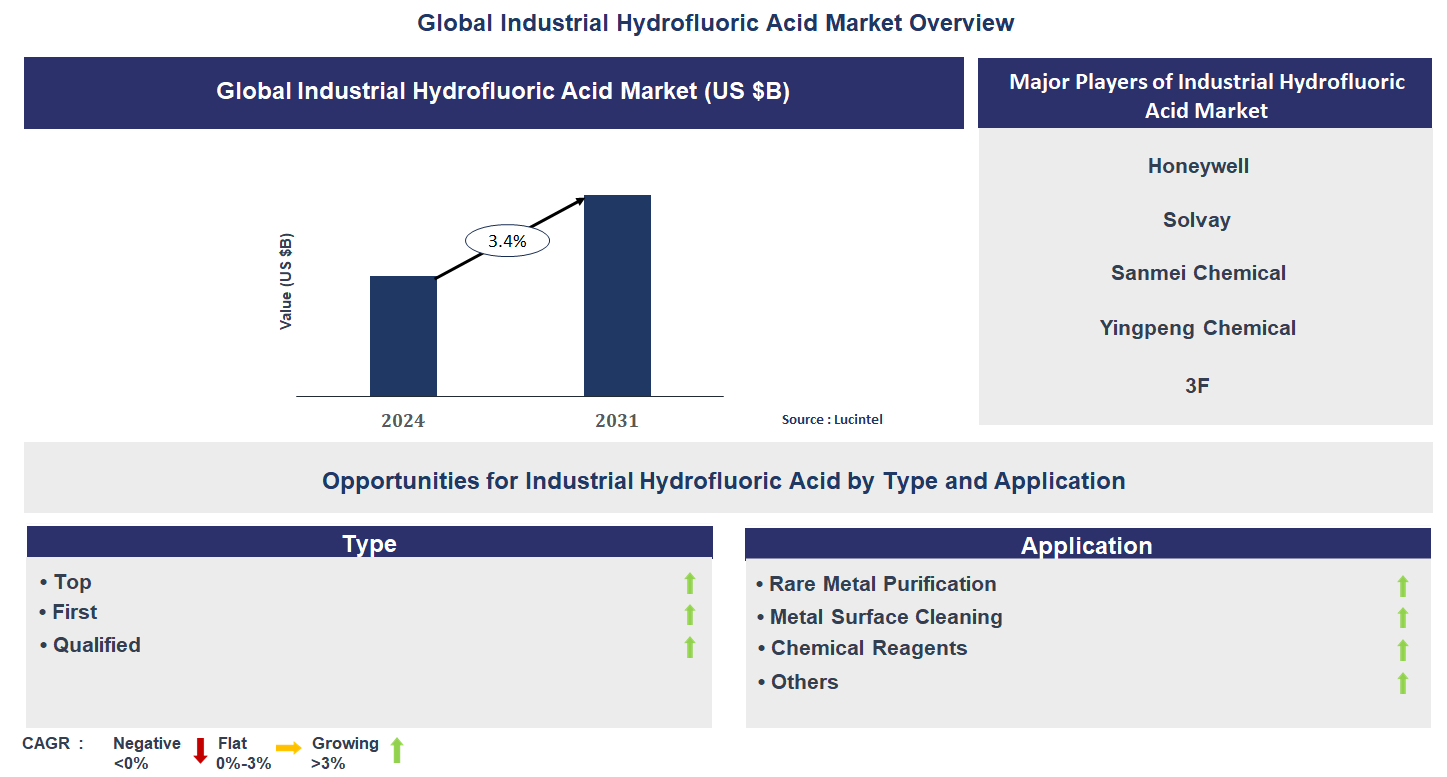
Key data points: The growth forecast = 3.4% annually for the next 7 years. Scroll below to get more insights. This market report covers trends, opportunities and forecasts in industrial hydrofluoric acid market to 2031 by type (top, first, and qualified), application (rare metal purification, metal surface cleaning, chemical reagents, and others), and region (North America, Europe, Asia Pacific, and the Rest of the World)
We'll send your sample report shortly.
• Lucintel forecasts that, within the type category, first is expected to witness the highest growth over the forecast period.
• Within the application category, rare metal purification is expected to witness the highest growth.
• In terms of region, APAC is expected to witness the highest growth over the forecast period. Gain valuable insights for your business decisions with our comprehensive 150+ page report. Sample figures with some insights are shown below.
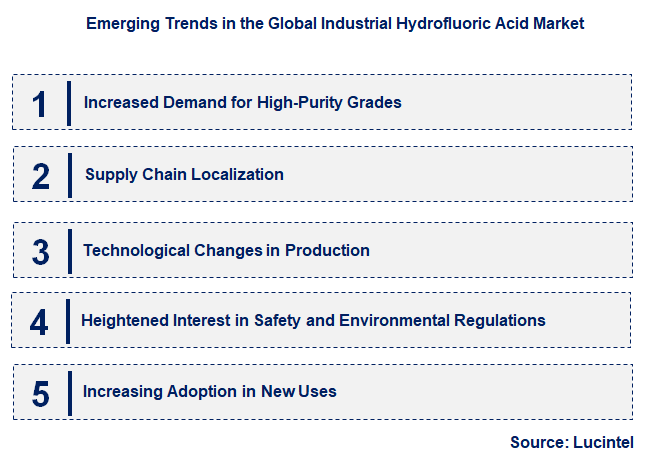
• Increased Demand for High-Purity Grades: The semiconductor industry’s unwavering pursuit of smaller process nodes (below 10 nm) is fueling an unparalleled demand for electronic-grade hydrofluoric acid (EG-HF). This ultra-pure grade is essential for the fine etching and cleaning of silicon wafers. The electronics and semiconductor industries are currently the largest users of high-purity HF, and this trend is only increasing.
• Supply Chain Localization: The market is experiencing a shift towards localized supply chains and production, fueled by geopolitical tensions and the need for increased security. Nations such as the United States are spending a lot of money to lessen their dependence on imports, especially Asian imports. The goal of this trend is to lessen the threat of supply disruption and provide a secured source of this critical chemical for key industries.
• Technological Changes in Production: Manufacturers are making investments in cutting-edge technologies to enhance the safety and efficiency of HF production. This involves improvements in the purification process to attain greater levels of purity and the use of closed-loop systems for spent acid recycling. These technological advancements not only contribute to better product quality but also reduce the environmental footprint of HF production.
• Heightened Interest in Safety and Environmental Regulations: Owing to HF’s extremely corrosive and toxic characteristics, there’s an increasing worldwide interest in strong safety procedures and environmental regulations. The trend is driving new safety gear, real-time monitoring equipment, and safer transportation. The demand for safer handling and disposal is impacting production processes and boosting the cost of compliance.
• Increasing Adoption in New Uses: Besides its conventional applications, industrial HF is being applied in new and emerging uses. It is used in the manufacture of photovoltaic cells in the renewable energy sector, and in the pharmaceutical industry, it is used in the synthesis of fluorinated compounds. These emerging uses are broadening the market and offering new growth opportunities. These trends are redefining the industrial HF market fundamentally from the classic chemical commodity market to a specialist, technology-intensive one. The emphasis is moving away from mass production towards high-purity, value-added goods. This change is creating a more diversified but durable market environment in which supply chain security and technological innovation are emerging as essential competitive strengths.
• CHIPS and Science Act Impact: The United States passage of the CHIPS and Science Act had a historic impact, channeling more than $50 billion in funding into domestic semiconductor production. This has brought about an increased demand for high-purity electronic-grade hydrofluoric acid (EG-HF) to facilitate new wafer manufacturing facilities. This policy-driven growth is one of the key market drivers in North America.
• Chinese Fluorspar Supply Constraints: China’s tightening environmental policy and phasing out of less-efficient, older fluorspar mines have imposed severe supply constraints on the major raw material. This has reduced production capacity and raised costs, which is generating a bullish influence on global HF prices. The development puts into perspective the exposure of the global supply chain to the variation in output in a single major producer.
• More Recycling and Circular Economy Efforts: Firms are increasingly putting money into recycling and spent hydrofluoric acid reclamation technologies. This is a direct response to environmental regulations as well as a need to lower dependence on volatile raw materials markets. This trend helps advance a more circular economy and sustainable approach, lowering waste and raw material usage.
• Strategic Partnerships and Joint Ventures: Major chemical firms are establishing strategic partnerships and joint ventures to secure a safe and localized supply. For instance, joint ventures are being created to construct new manufacturing plants in North America and Europe, frequently with supply chains integrated that use raw materials produced locally. The move is meant to enhance regional self-containment and hedge against geopolitical risks.
• Technological Advance in Purification: With increasing demand for ultra-high-purity HF, there has been a great advancement in purification technologies. There are processes being developed by companies to eliminate impurities to an extent never imagined before, which is critical to the production of sub-10-nanometer semiconductors. This development is increasing the technical cost of entry and establishing a niche market for specialty producers. These changes cumulatively are moving the center of gravity of the market in the direction of high-value uses and increased supply chain stability. They point to a departure from a globalized, commodity-driven market to one that is driven by regional self-containment, technological differentiation, and environmental responsibility. Consequently, the market is increasingly resilient but even more intricate to navigate, demanding advanced strategic planning from all stakeholders.
• Semiconductor Grade High-Purity Acid: The largest opportunity for growth comes from providing electronic-grade hydrofluoric acid (EG-HF) to the semiconductor sector. With wafer fabrication facilities migrating toward lower, more sophisticated geometries (e.g., 3nm, 5nm), they increasingly demand ever-purer chemicals for cleaning and etching applications. Firms that can reliably make and ship EG-HF with strict purity requirements will be able to command a increasing, high-margin business.
• Growth in Renewable Energy: The renewable energy industry, especially the production of photovoltaic (PV) solar cells and lithium-ion batteries, is a fast-growing user of industrial HF. The acid serves in the etching of silicon wafers used in solar cells and in the manufacturing of battery electrolytes. With governments and industries driving decarbonization, demand from this segment is expected to increase substantially, opening a steady growth opportunity.
• Pharmaceuticals and Agrochemicals: Hydrofluoric acid is an important precursor to the production of various fluorinated molecules employed in the manufacture of pharmaceuticals and agrochemicals. The judicious use of fluorine atoms increases the stability, activity, and bioavailability of numerous drugs and pesticides. An ongoing process of new fluorinated molecule development in these sectors provides a stable and high-value growth opportunity for HF manufacturers.
• Next-Generation Refrigerants: As the world phases out older refrigerants such as hydrochlorofluorocarbons (HCFCs), demand is increasing for fresh, more sustainable alternatives such as hydrofluoric-olefins (HFOs). Hydrofluoric acid is a major raw material used in manufacturing these next-generation refrigerants, providing a long-term growth driver due to global environmental policy and regulatory initiatives.
• Metal Refining and Pickling: Although a classic use, the metal refining and pickling market is still one of the dominant growth areas, particularly in industries such as aerospace and automotive where excellent metal surface finish is paramount. Industrial HF is utilized to strip away impurities and oxides on metal surfaces. As these industries push forward with new alloys and processing methods, the need for accurate and efficient metal treatment will continue unabated. These growth opportunities are guiding the industrial HF market away from its traditional dependence on high-volume, low-margin applications and toward a future of high-value, specialty products. This will benefit companies that possess leading research and development strengths, solid quality control, and an intimate knowledge of their end-use industries. The market will become increasingly segmented and competitive, and success will depend on the ability to serve these high-growth segments.
• Honeywell
• Solvay
• Sanmei Chemical
• Yingpeng Chemical
• 3F
• Dongyue Group
• Sanmei Chemical
• Sinochem Lantian
• Fujian Shaowu Yongfei Chemical
• Shaowu Huaxin Chemical
• Top
• First
• Qualified
• Rare Metal Purification
• Metal Surface Cleaning
• Chemical Reagents
• Others
• North America
• Europe
• Asia Pacific
• The Rest of the World
• United States: The American industrial HF market is growing very fast as a result of massive investments in indigenous semiconductor production, a development that has been fueled by the CHIPS and Science Act of 2022. This has created a huge demand for pure electronic-grade HF, which plays a critical role in etching silicon wafers. Demand has outgrown local production in the country, and hence, it has depended on imports. Also, the expanding solar PV industry is becoming another significant customer, continuing to drive demand for this chemical.
• China: China is still the biggest consumer and producer of industrial HF, especially for its fast-growing semiconductor and solar cell industries. The market, though, has special challenges. Stricter environmental regulations are resulting in closures of older, less efficient fluorspar mines, putting upward pressure on raw material prices. Even with these supply-side limitations, demand is still strong as the nation continues to explode in terms of technology. This has seen a stable but slightly firmer trend in prices as manufacturers deal with increasing cost pressures.
• Germany: In Germany, the industrial HF market is characterized by a sound supply-demand equilibrium. The nation, as well as other European countries, is a large consumer and applies the acid for its technologically sophisticated electronics and chemical sectors. Contrary to the US, the German market has witnessed less volatility, as prices have been quite stable. This stability is upheld by stable domestic production levels and combined effects of feedstock prices, which have assisted in retaining market equilibrium.
• India: The industrial HF market in India is witnessing strong growth, with the aid of fast-paced industrialization and policies such as "Make in India." The chemical and aluminum industries are witnessing growing demand for HF, which is utilized in producing fluorocarbons and as a flux. Its growing chemical industry, with fast-increasing demand for fluorinated derivatives, is one major market driver for the country. Investments in new manufacturing plants and efforts to minimize import dependence are also influencing the direction of the market.
• Japan: Japan is an mature industrial HF market, with consumption highly dependent on its established electronics and semiconductor industries. Domestic production and imports from China, among others, are the primary sources of high-purity HF for Japan. Although the market is steady, there is a strategic move to diminish reliance on international suppliers for key materials. There is innovation on the part of companies to create new technologies, such as Daikin’s process employing less-pure Mexican fluorspar, to make supply chains more resilient.


• Honeywell
• Solvay
• Sanmei Chemical
• Yingpeng Chemical
• 3F
• Dongyue Group
• Sanmei Chemical
• Sinochem Lantian
• Fujian Shaowu Yongfei Chemical
• Shaowu Huaxin Chemical Q5. Which industrial hydrofluoric acid market segment will be the largest in future? Answer: Lucintel forecasts that, within the type category, first is expected to witness the highest growth over the forecast period. Q6. In industrial hydrofluoric acid market, which region is expected to be the largest in next 5 years? Answer: In terms of region, APAC is expected to witness the highest growth over the forecast period. Q7. Do we receive customization in this report? Answer: Yes, Lucintel provides 10% customization without any additional cost.


Choose a license that fits your team. Instant PDF delivery.
Prices exclude taxes. Instant delivery. Custom licensing available on request.
Market Report · July 22, 2026
Market Report · July 22, 2026
Market Report · July 22, 2026
Trusted partner for strategic intelligence and business growth


Receive a complimentary market analysis tailored to your industry. Our analysts will identify key growth opportunities and competitive dynamics specific to your business.

Market size, growth rate, and key trend analysis for your specific sector.

Top competitor positioning and market share analysis.

Strategic recommendations backed by data-driven insights.
Get curated market intelligence and competitive moves straight to your inbox.
By subscribing, you agree to receive our monthly insights. Unsubscribe anytime.
Receive a complimentary market analysis tailored to your industry. Our analysts will identify key growth opportunities and competitive dynamics specific to your business.
Market size, growth rate, and key trend analysis for your specific sector.
Top competitor positioning and market share analysis.
Strategic recommendations backed by data-driven insights.
Get curated market intelligence, emerging trends, and competitive moves straight to your inbox each month.
By subscribing, you agree to receive our monthly insights. Unsubscribe anytime.
We'll send your sample report shortly.