
Close Lucintel Chat
Didn't Find What You're Looking for?
Call us at +1972 636 5056 or write at helpdesk@Lucintel.com
Ask an Expert Provide Custom Requirements Download Sample Report Search Available Reports
  • helpdesk@Lucintel.com
  • |
  • Call Lucintel +1 972 636 5056
  • |
  • Login
  • |
  • Register
  • |
  • Search
  • |
'
...

The Impact of COVID-19 is included in Industrial Ethanol Market Report. Buy it today to get an advantage.

Request the impact of COVID-19 on your product or industry


Industrial Ethanol Market Trends and Forecast

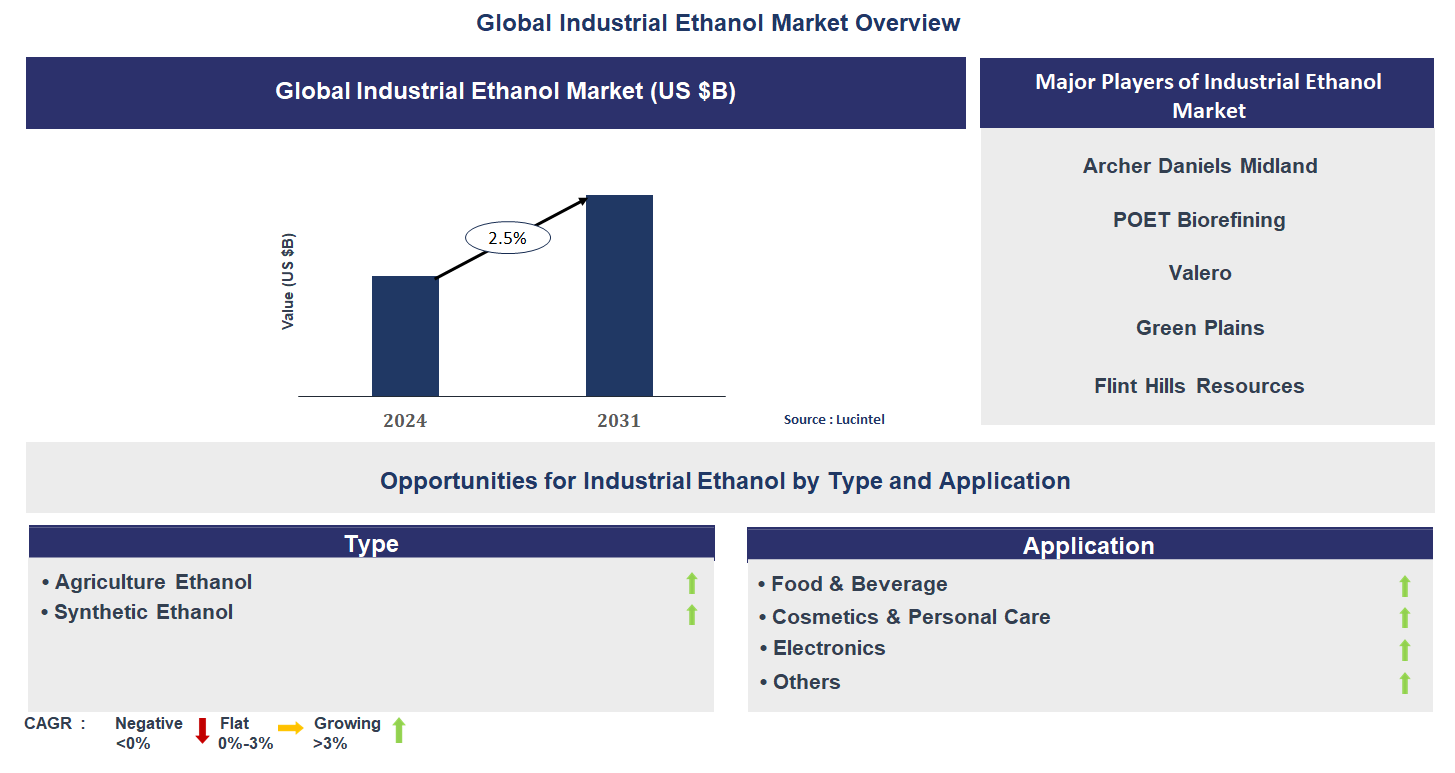
The future of the global industrial ethanol market looks promising with opportunities in the food & beverage, cosmetic & personal care, and electronic markets. The global industrial ethanol market is expected to grow with a CAGR of 2.5% from 2025 to 2031. The major drivers for this market are the increasing demand for biofuels production, the rising consumption in chemical manufacturing, and the growing adoption in personal care products.

• Lucintel forecasts that, within the type category, agriculture ethanol is expected to witness higher growth over the forecast period.
• Within the application category, food & beverage is expected to witness the highest growth.
• In terms of region, APAC is expected to witness the highest growth over the forecast period.
Gain valuable insights for your business decisions with our comprehensive 150+ page report. Sample figures with some insights are shown below.
Industrial Ethanol Market Trends and Forecast

Emerging Trends in the Industrial Ethanol Market

The industrial ethanol industry is undergoing a revolutionary phase, propelled by a convergence of technological innovation, changing lifestyles, and tightened environmental legislation. These new trends are not just incremental but are irreversibly altering the industry’s topography. The industry is tending towards greener production technologies, purer products, and diversification of usage, particularly in high-growth industries. These changes are making manufacturers innovate and adjust, opening up new opportunities while also raising serious challenges.
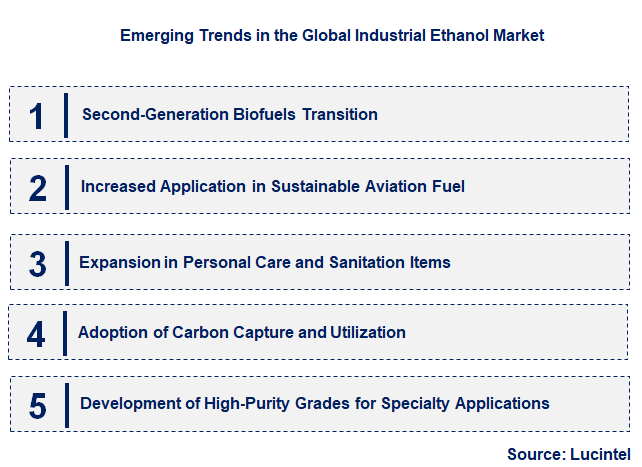
• Second-Generation Biofuels Transition: One of the key trends is the transition towards the production of ethanol from non-food feedstocks, including agricultural residues, cellulosic biomass, and forest residues. This "second-generation" ethanol counters the long-standing "food versus fuel" controversy by using waste materials. This is promoted by green issues and a need to make a more sustainable supply chain. The emergence of more sophisticated fermentation and conversion technologies is making the production of 2G ethanol economically more feasible.
• Increased Application in Sustainable Aviation Fuel: The decarbonization of the aviation sector is under pressure, and one of the important trends is developing and implementing Sustainable Aviation Fuel (SAF), and ethanol is a potential route for its manufacture. Ethanol can be turned into jet fuel with the help of different technologies. This trend is enforced by international climate goals and growing involvement of airlines and governments. It is a huge strategic opportunity because the aviation industry represents a big, new market for ethanol.
• Expansion in Personal Care and Sanitation Items: The world’s emphasis on sanitation and health, spurred by recent public health emergencies, has prompted a boom in the usage of industrial ethanol for personal care items, disinfectants, and hand sanitizers. Ethanol’s antimicrobial traits make it a critical ingredient in these products. This is spurred by increased consciousness among consumers and a focus on public sanitation.
• Adoption of Carbon Capture and Utilization: One of the important trends is the adoption of carbon capture technologies at ethanol plants. The fermentation process naturally generates a huge quantity of carbon dioxide as a byproduct. Firms are now sequestering or using this CO2 in various industries, including food and beverages (for carbonation) or for injection into oil reservoirs to recover more oil. The motivation is to minimize the carbon footprint of making ethanol and establish new earnings streams.
• Development of High-Purity Grades for Specialty Applications: There is an increased trend towards the production of high-purity, specialty-grade industrial ethanol for certain high-value applications. These include application in the electronics industry to clean sensitive components and the pharmaceutical industry for high-purity solvents. This is prompted by the high standards of quality demanded in these industries. The effect is that it develops a premium segment of the market where producers can break away from commodity pricing, concentrate on product differentiation, and earn higher profit margins.
These trends collectively are reshaping the industrial ethanol industry to take it towards a more sustainable, high-value, and technology-driven future. The focus on second-generation production, novel applications in aviation and personal care, and carbon capture integration is redefining the business from being a bulk commodity to a specialized, high-performance solutions business. The industry is getting more diversified and resilient with new opportunities opening up in innovation, product differentiation, and strategic alliances.
Emerging Trends in the Industrial Ethanol Market

Recent Development in the Industrial Ethanol Market

The industrial ethanol industry is experiencing dynamic changes, triggered by a mix of global economic changes, technological advances, and changing regulatory schemes. These recent trends are impacting production, supply chains, and end-user markets. The industry is experiencing pressure to expand capacity to respond to increased demand, while at the same time coping with volatility in raw materials and stiff competition. The sector is reacting with an emphasis on efficiency, product diversification, and a strategic shift toward sustainable and high-value uses.
• Expansion of Biofuel Blending Mandates: One of the key developments is the consolidation and expansion of biofuel blending mandates in nations such as India, Brazil, and the US. Governments are enunciating more ambitious blending targets for ethanol in gasoline (e.g., India’s target for E20), to decrease dependence on imported crude and mitigate carbon emissions. This policy-led demand gives a long-term, stable platform to the market, promoting gigantic investments in infrastructure and production capacity.
• Emergence of Bio-refinery Complexes: A major trend is away from the standalone ethanol plants to integrated biorefinery complexes. The new plants not only make ethanol but also recover and utilize co-products such as distillers’ grains (animal feed), corn oil, and recovered CO2. This integrated process increases profitability, optimizes resource utilization, and minimizes waste.
• Technological Innovations in Feedstock Processing: Some of the recent innovations are the use of novel and advanced technologies for feedstock processing, including novel enzymes and fermentation strains. These technologies can produce higher levels of ethanol from current feedstocks and enable the utilization of more types of feedstocks, such as less conventional ones like cassava or sorghum.
• Emphasize Decentralized and Smaller-scale Production: There is a trend toward more decentralized and smaller-scale ethanol production plants, particularly those based on local agricultural residues, in certain regions. This system minimizes transport costs and resolves the "food versus fuel" issue through the utilization of localized, non-food resources. This is especially relevant in the context of emerging economies where small-scale agriculture is common.
• Higher Market Volatility from Geopolitical Reasons: Recent geopolitics and trade tensions have had a considerable influence on the ethanol market. Fluctuations in trade policies, tariffs, and international energy prices have the potential to create price volatility and supply chain disruption. For example, disruptions in crude markets have the potential to make ethanol more or less viable as a fuel. This evolution is affecting the market by bringing in a greater level of risk and uncertainty, necessitating businesses to be more adaptable with their pricing and supply chain management.
These fundamental developments are collectively influencing the industrial ethanol market by fueling a shift toward a more diversified, competitive, and sustainable industry. The growth of biofuel mandates and the emergence of integrated biorefineries are opening up new opportunities for growth, while geopolitical volatility is forcing companies to become more resilient. The adoption of technological innovation and decentralized production models is fundamentally transforming the market, leading to a more environmentally friendly and efficient future.

Strategic Growth Opportunities in the Industrial Ethanol Market

The industrial ethanol industry, although mature across most applications, offers substantial strategic growth opportunities fueled by changing consumer behavior, technology, and an international drive towards sustainability. These opportunities lie outside of conventional uses and exist in high-value, niche applications in industries. In order to take advantage of these opportunities, players within the industry need to emphasis innovation, product differentiation, as well as strategic alliances.
• Pursuing the Solvent Market for Bio-based Chemicals: One of the main opportunities is to establish ethanol as a leading solvent for the expanding bio-based chemicals industry. While businesses aim to substitute petrochemical-based inputs with more sustainable alternatives, industrial ethanol, being a renewable feedstock, becomes the ideal candidate for producing bio-based adhesives, paints, and plastics. It is an opportunity that affects the market as it introduces a high-value application riding on the trend of sustainability, transitioning ethanol from a commodity fuel additive to a central ingredient in high-tech, environmentally friendly chemical production.
• Piercing the High-Purity Electronics Market: The electronics manufacturing process, especially for fabricating semiconductors and printed circuit boards, necessitates very high-purity solvents for degreasing and cleaning. This is a strategic niche opportunity to manufacture and sell high-purity, electronic-grade ethanol. That involves major investment in current-edge purification technologies and rigorous quality control, but it also generates a premium, high-margin market niche.
• Harvesting the Disinfectant and Personal Care Market: Growing global attention to health and hygiene, particularly after recent pandemics, creates an important growth opportunity for industrial ethanol in disinfectants, sanitizers, and personal care products. Ethanol is a prominent active ingredient in such formulations. The strategic imperative is to secure supply agreements with large consumer goods and pharmaceutical companies.
• Building Partnerships for Cellulosic Ethanol Production: To meet the "food versus fuel" problem and provide a more sustainable supply of feedstock, an important opportunity exists in building strategic partnerships with agricultural firms to manufacture cellulosic ethanol from agricultural residues. By partnering, the collaboration can establish a stable supply of non-food feedstock and enable producers to become eligible for new government incentives as well as a lower carbon intensity score for their product.
• Investing in Small-scale, Decentralized Biorefineries: A strategic investment is to invest in small-scale, decentralized biorefineries, especially in developing areas. These plants may be placed at agricultural centers, keeping the cost of feedstock and finished product transportation lower. This type can prove highly suitable for manufacturing ethanol from locally available waste material. This opportunity has an effect on the market by generating a more distributed and robust production base, which lessens dependency on large centralized facilities and promotes local economic growth.
These strategic growth opportunities are transforming the industrial ethanol market by promoting a transition from a bulk commodity company to one with specialized, high-value products. Tapping high-growth applications and riding the wave toward sustainability enables companies to unleash new revenue streams, differentiate themselves, and establish a more durable market position in the future.

Industrial Ethanol Market Driver and Challenges

Industrial ethanol market is influenced by a multifaceted interplay of prominent drivers and hurdles, comprising several technological, economic, and regulatory elements. The growth of the market is fueled by increasing demand from prominent industries and shifting towards sustainable practices, which stimulate innovation. Nevertheless, growth is moderated by prominent challenges allied with fluctuations in raw material prices, tough competition, and strict environmental rules. The dynamics between these forces need to be understood in order to understand the market’s situation today and project its future.
The factors responsible for driving the industrial ethanol market include:
1. Government Blending Mandates and Policies: One of the key drivers is the enforcement and tightening of government mandates and policies for ethanol blending in gasoline. Nations such as the United States, Brazil, and India have made ethanol a requirement to lower their dependence on fossil fuels and curtail greenhouse gas emissions. Such measures create a stable and large source of demand for industrial ethanol, spurring large-scale production as well as investment in infrastructure.
2. Increasing Demand from End-user Sectors: The demand for industrial ethanol is fueled by steady demand from a host of end-user sectors. Apart from application as a fuel additive, industrial ethanol also finds application as a solvent in paints, coatings, adhesives, and cleaning agents. The development of the world’s construction, automotive, and consumer goods industries directly influences the demand for the said products, hence driving demand for industrial ethanol.
3. New Focus on Public Health and Sanitation: The global focus on hygiene and health, especially in the post-pandemic era, has been a primary driver. Industrial ethanol is a major component in disinfectants, hand sanitizers, and other personal care items. This has opened up a new, high-demanding market for ethanol. The increasing consumer concern with hygiene and ongoing emphasis on public health within institutional environments will continue to propel this use, providing a stable and robust market for manufacturers.
4. Technological Innovation: The impetus is a major improvement in production technology. Fermentation process innovations, enzyme technology, and genetic manipulation of microbes are all raising ethanol output from a range of feedstocks, including non-food feedstocks. These advances raise the efficiency of production but also add new opportunities for feedstocks to use, lessening the market’s sensitivity to change in the price of one commodity, such as corn or sugarcane.
5. Transition to Sustainable Bio-based Chemicals: The worldwide shift towards sustainability and circular economy concepts is compelling demand for bio-based chemicals. Bio-based industrial ethanol, which is made from renewable feedstocks, presents a preferred option to petrochemicals for the production of chemicals such as ethyl acetate and other solvents. This driver aligns the market for ethanol with wider environmental objectives, establishing new high-value applications and transposing the market beyond its historical function as a mere fuel.
Challenges in the industrial ethanol market are:
1. Price Volatility of Raw Materials: The major problem is the price volatility of farm feedstocks such as corn, sugarcane, and molasses. The prices of these are determined by climatic conditions, yields, and international commodity markets. This volatility has a direct effect on the cost of production and will compress profit margins for ethanol manufacturers. The uncertainty of feedstock prices complicates long-term planning and imposes a high level of financial risk on the market.
2. Competition with Food Crops: The argument over the use of food crops for fuel production is still a significant challenge. In countries where food security is an issue, the use of corn or sugarcane for ethanol production has been a controversial topic. This challenge is lessened by the advent of second-generation (2G) ethanol, but the public and political demand to favor food production can still influence policies and public opinion about the industry.
3. Infrastructure and Distribution Constraints: A major challenge, especially in new markets, is the absence of proper infrastructure for blending, storing, and distributing ethanol. The use of higher ethanol blends, such as E20 or E85, involves huge investment in fuel pumps compatible with higher ethanol contents, storage facilities, and transportation networks. The exorbitant cost of this infrastructure can impede the growth and general use of ethanol as a fuel.
Finally, the industrial ethanol industry is standing at the crossroads, with strong drivers on the horizon driving the industry ahead and strong challenges forcing strategic adjustments. The growing demand from conventional and new industries, together with increasing emphasis on sustainability and technological advancements, is opening up new horizons for profitability and growth. Yet the market has to deal with the volatility of raw material prices, the ever-present threat of competition from other solvents, and the rising cost of environmental compliance.

List of Industrial Ethanol Companies

Companies in the market compete on the basis of product quality offered. Major players in this market focus on expanding their manufacturing facilities, R&D investments, infrastructural development, and leverage integration opportunities across the value chain. With these strategies industrial ethanol companies cater increasing demand, ensure competitive effectiveness, develop innovative products & technologies, reduce production costs, and expand their customer base. Some of the industrial ethanol companies profiled in this report include-
• Archer Daniels Midland
• POET Biorefining
• Valero
• Green Plains
• Flint Hills Resources
• Pacific Ethanol
• Big River Resources
• Cargill
• The Andersons Ethanol Group
• White Energy

Industrial Ethanol Market by Segment

The study includes a forecast for the global industrial ethanol market by type, application, and region.

Industrial Ethanol Market by Type [Value from 2019 to 2031]:


• Agriculture Ethanol
• Synthetic Ethanol

Industrial Ethanol Market by Application [Value from 2019 to 2031]:


• Food & Beverage
• Cosmetics & Personal Care
• Electronics
• Others

Industrial Ethanol Market by Region [Value from 2019 to 2031]:


• North America
• Europe
• Asia Pacific
• The Rest of the World

Country Wise Outlook for the Industrial Ethanol Market

Current trends in the international industrial ethanol market are marked by a complex interaction of forces, such as high pressure towards sustainability, changing government policies, and altering demand in major sectors. Although the market continues to be dominated by its conventional usage as a biofuel, increased focus is being placed on its industrial uses in the pharmaceutical, personal care, and chemicals sectors. The sector is seeing huge investments in new production processes, especially those based on non-food feedstocks, to meet the "food versus fuel" dilemma and respond to increasing demand for sustainable alternatives.
• United States: The US industrial ethanol business is dominated by biofuel production, which is fueled by national policies such as the Renewable Fuel Standard (RFS). One of the emerging trends is the growing use of higher ethanol blends, including E15. There is also large-scale investment in carbon capture and storage (CCS) technology at ethanol facilities to decrease their carbon footprint. This not only supports decarbonization but also adds to the environmental attractiveness of US-made ethanol.
• China: China’s industrial ethanol market is also facing a supply-demand gap, with recent additions to output capacity putting downward pressure on prices. Although the nation is working towards nationwide implementation of its E10 biofuel mandate, development has been slow, and industrial and chemical use remain the biggest demand drivers. One of the significant developments is the emphasis on advanced biofuels, with China investing in industrial waste gas and coal conversion to synthetic ethanol.
• Germany: Germany’s industrial ethanol sector forms a major component of Europe’s biofuel policy under the Renewable Energy Directive (RED). One key development is the imposition of tougher greenhouse gas (GHG) reduction targets, which are propelling demand for ethanol in fuel blending. Market is also witnessing a strong focus on bio-based ethanol from agricultural residues, aligning with the European Union’s sustainable development aims.
• India: The industrial ethanol industry of India is in a phase of high growth spurred by the ambitious Ethanol Blending Programmed (EBP) of the government with a goal of 20% ethanol blended gasoline (E20). The policy has triggered a huge increase in capacity expansion, targeting sugarcane as well as grain feedstocks. Incentives and a guaranteed procurement price at a fixed level are offered by the government to maintain a consistent supply. This firm political and financial backing gives India a leader status in the international ethanol industry, with most of the production focused on fuel.
• Japan: Japan’s industrial ethanol industry experienced a recent bearish attitude with falling prices and soft local demand. The market is highly dependent on ethanol derivatives such as ethyl acetate, whose fortunes are tied to those of the chemicals and electronics industries. Although Japan has biofuel goals for greenhouse gas emissions reduction, its market size is smaller than in the US and India. Its developments center on enhancing production efficiency and environmental impact and keeping up with international sustainability standards to continue as a high-standard producer and consumer of ethanol derivatives.

Lucintel Analytics Dashboard

Features of the Global Industrial Ethanol Market

Market Size Estimates: Industrial ethanol market size estimation in terms of value ($B).
Trend and Forecast Analysis: Market trends (2019 to 2024) and forecast (2025 to 2031) by various segments and regions.
Segmentation Analysis: Industrial ethanol market size by type, application, and region in terms of value ($B).
Regional Analysis: Industrial ethanol market breakdown by North America, Europe, Asia Pacific, and Rest of the World.
Growth Opportunities: Analysis of growth opportunities in different types, applications, and regions for the industrial ethanol market.
Strategic Analysis: This includes M&A, new product development, and competitive landscape of the industrial ethanol market.
Analysis of competitive intensity of the industry based on Porter’s Five Forces model.

Lucintel Consulting Services

FAQ

Q1. What is the growth forecast for industrial ethanol market?
Answer: The global industrial ethanol market is expected to grow with a CAGR of 2.5% from 2025 to 2031.
Q2. What are the major drivers influencing the growth of the industrial ethanol market?
Answer: The major drivers for this market are the increasing demand for biofuels production, the rising consumption in chemical manufacturing, and the growing adoption in personal care products.
Q3. What are the major segments for industrial ethanol market?
Answer: The future of the industrial ethanol market looks promising with opportunities in the food & beverage, cosmetic & personal care, and electronic markets.
Q4. Who are the key industrial ethanol market companies?
Answer: Some of the key industrial ethanol companies are as follows:
• Archer Daniels Midland
• POET Biorefining
• Valero
• Green Plains
• Flint Hills Resources
• Pacific Ethanol
• Big River Resources
• Cargill
• The Andersons Ethanol Group
• White Energy
Q5. Which industrial ethanol market segment will be the largest in future?
Answer: Lucintel forecasts that, within the type category, agriculture ethanol is expected to witness higher growth over the forecast period.
Q6. In industrial ethanol market, which region is expected to be the largest in next 5 years?
Answer: In terms of region, APAC is expected to witness the highest growth over the forecast period.
Q7. Do we receive customization in this report?
Answer: Yes, Lucintel provides 10% customization without any additional cost.

This report answers following 11 key questions:

Q.1. What are some of the most promising, high-growth opportunities for the industrial ethanol market by type (agriculture ethanol and synthetic ethanol), application (food & beverage, cosmetics & personal care, electronics, and others), and region (North America, Europe, Asia Pacific, and the Rest of the World)?
Q.2. Which segments will grow at a faster pace and why?
Q.3. Which region will grow at a faster pace and why?
Q.4. What are the key factors affecting market dynamics? What are the key challenges and business risks in this market?
Q.5. What are the business risks and competitive threats in this market?
Q.6. What are the emerging trends in this market and the reasons behind them?
Q.7. What are some of the changing demands of customers in the market?
Q.8. What are the new developments in the market? Which companies are leading these developments?
Q.9. Who are the major players in this market? What strategic initiatives are key players pursuing for business growth?
Q.10. What are some of the competing products in this market and how big of a threat do they pose for loss of market share by material or product substitution?
Q.11. What M&A activity has occurred in the last 5 years and what has its impact been on the industry?

For any questions related to Industrial Ethanol Market, Industrial Ethanol Market Size, Industrial Ethanol Market Growth, Industrial Ethanol Market Analysis, Industrial Ethanol Market Report, Industrial Ethanol Market Share, Industrial Ethanol Market Trends, Industrial Ethanol Market Forecast, Industrial Ethanol Companies, write Lucintel analyst at email: helpdesk@lucintel.com. We will be glad to get back to you soon.
                                           Table of Contents

            1. Executive Summary

            2. Market Overview

                        2.1 Background and Classifications
                        2.2 Supply Chain

            3. Market Trends & Forecast Analysis

                        3.1 Macroeconomic Trends and Forecasts
                        3.2 Industry Drivers and Challenges
                        3.3 PESTLE Analysis
                        3.4 Patent Analysis
                        3.5 Regulatory Environment
                        3.6 Global Industrial Ethanol Market Trends and Forecast

            4. Global Industrial Ethanol Market by Type

                        4.1 Overview
                        4.2 Attractiveness Analysis by Type
                        4.3 Agriculture Ethanol : Trends and Forecast 2025 to 2031
                        4.4 Synthetic Ethanol : Trends and Forecast 2025 to 2031

            5. Global Industrial Ethanol Market by Application

                        5.1 Overview
                        5.2 Attractiveness Analysis by Application
                        5.3 Food & Beverage : Trends and Forecast 2025 to 2031
                        5.4 Cosmetics & Personal Care : Trends and Forecast 2025 to 2031
                        5.5 Electronics : Trends and Forecast 2025 to 2031
                        5.6 Others : Trends and Forecast 2025 to 2031

            6. Regional Analysis

                        6.1 Overview
                        6.2 Global Industrial Ethanol Market by Region

            7. North American Industrial Ethanol Market

                        7.1 Overview
                        7.2 North American Industrial Ethanol Market by Type
                        7.3 North American Industrial Ethanol Market by Application
                        7.4 The United States Industrial Ethanol Market
                        7.5 Canadian Industrial Ethanol Market
                        7.6 Mexican Industrial Ethanol Market

            8. European Industrial Ethanol Market

                        8.1 Overview
                        8.2 European Industrial Ethanol Market by Type
                        8.3 European Industrial Ethanol Market by Application
                        8.4 German Industrial Ethanol Market
                        8.5 French Industrial Ethanol Market
                        8.6 Italian Industrial Ethanol Market
                        8.7 Spanish Industrial Ethanol Market
                        8.8 The United Kingdom Industrial Ethanol Market

            9. APAC Industrial Ethanol Market

                        9.1 Overview
                        9.2 APAC Industrial Ethanol Market by Type
                        9.3 APAC Industrial Ethanol Market by Application
                        9.4 Chinese Industrial Ethanol Market
                        9.5 Indian Industrial Ethanol Market
                        9.6 Japanese Industrial Ethanol Market
                        9.7 South Korean Industrial Ethanol Market
                        9.8 Indonesian Industrial Ethanol Market

            10. ROW Industrial Ethanol Market

                        10.1 Overview
                        10.2 ROW Industrial Ethanol Market by Type
                        10.3 ROW Industrial Ethanol Market by Application
                        10.4 Middle Eastern Industrial Ethanol Market
                        10.5 South American Industrial Ethanol Market
                        10.6 African Industrial Ethanol Market

            11. Competitor Analysis

                        11.1 Product Portfolio Analysis
                        11.2 Operational Integration
                        11.3 Porter’s Five Forces Analysis
                                    • Competitive Rivalry
                                    • Bargaining Power of Buyers
                                    • Bargaining Power of Suppliers
                                    • Threat of Substitutes
                                    • Threat of New Entrants
                        11.4 Market Share Analysis

            12. Opportunities & Strategic Analysis

                        12.1 Value Chain Analysis
                        12.2 Growth Opportunity Analysis
                                    12.2.1 Growth Opportunity by Type
                                    12.2.2 Growth Opportunity by Application
                        12.3 Emerging Trends in the Global Industrial Ethanol Market
                        12.4 Strategic Analysis
                                    12.4.1 New Product Development
                                    12.4.2 Certification and Licensing
                                    12.4.3 Mergers, Acquisitions, Agreements, Collaborations, and Joint Ventures

            13. Company Profiles of the Leading Players Across the Value Chain

                        13.1 Competitive Analysis
                        13.2 Archer Daniels Midland
                                    • Company Overview
                                    • Industrial Ethanol Market Business Overview
                                    • New Product Development
                                    • Merger, Acquisition, and Collaboration
                                    • Certification and Licensing
                        13.3 POET Biorefining
                                    • Company Overview
                                    • Industrial Ethanol Market Business Overview
                                    • New Product Development
                                    • Merger, Acquisition, and Collaboration
                                    • Certification and Licensing
                        13.4 Valero
                                    • Company Overview
                                    • Industrial Ethanol Market Business Overview
                                    • New Product Development
                                    • Merger, Acquisition, and Collaboration
                                    • Certification and Licensing
                        13.5 Green Plains
                                    • Company Overview
                                    • Industrial Ethanol Market Business Overview
                                    • New Product Development
                                    • Merger, Acquisition, and Collaboration
                                    • Certification and Licensing
                        13.6 Flint Hills Resources
                                    • Company Overview
                                    • Industrial Ethanol Market Business Overview
                                    • New Product Development
                                    • Merger, Acquisition, and Collaboration
                                    • Certification and Licensing
                        13.7 Pacific Ethanol
                                    • Company Overview
                                    • Industrial Ethanol Market Business Overview
                                    • New Product Development
                                    • Merger, Acquisition, and Collaboration
                                    • Certification and Licensing
                        13.8 Big River Resources
                                    • Company Overview
                                    • Industrial Ethanol Market Business Overview
                                    • New Product Development
                                    • Merger, Acquisition, and Collaboration
                                    • Certification and Licensing
                        13.9 Cargill
                                    • Company Overview
                                    • Industrial Ethanol Market Business Overview
                                    • New Product Development
                                    • Merger, Acquisition, and Collaboration
                                    • Certification and Licensing
                        13.10 The Andersons Ethanol Group
                                    • Company Overview
                                    • Industrial Ethanol Market Business Overview
                                    • New Product Development
                                    • Merger, Acquisition, and Collaboration
                                    • Certification and Licensing
                        13.11 White Energy
                                    • Company Overview
                                    • Industrial Ethanol Market Business Overview
                                    • New Product Development
                                    • Merger, Acquisition, and Collaboration
                                    • Certification and Licensing

            14. Appendix

                        14.1 List of Figures
                        14.2 List of Tables
                        14.3 Research Methodology
                        14.4 Disclaimer
                        14.5 Copyright
                        14.6 Abbreviations and Technical Units
                        14.7 About Us
                        14.8 Contact Us

                                               List of Figures


            Chapter 1

                        Figure 1.1: Trends and Forecast for the Global Industrial Ethanol Market

            Chapter 2

                        Figure 2.1: Usage of Industrial Ethanol Market
                        Figure 2.2: Classification of the Global Industrial Ethanol Market
                        Figure 2.3: Supply Chain of the Global Industrial Ethanol Market

            Chapter 3

                        Figure 3.1: Trends of the Global GDP Growth Rate
                        Figure 3.2: Trends of the Global Population Growth Rate
                        Figure 3.3: Trends of the Global Inflation Rate
                        Figure 3.4: Trends of the Global Unemployment Rate
                        Figure 3.5: Trends of the Regional GDP Growth Rate
                        Figure 3.6: Trends of the Regional Population Growth Rate
                        Figure 3.7: Trends of the Regional Inflation Rate
                        Figure 3.8: Trends of the Regional Unemployment Rate
                        Figure 3.9: Trends of Regional Per Capita Income
                        Figure 3.10: Forecast for the Global GDP Growth Rate
                        Figure 3.11: Forecast for the Global Population Growth Rate
                        Figure 3.12: Forecast for the Global Inflation Rate
                        Figure 3.13: Forecast for the Global Unemployment Rate
                        Figure 3.14: Forecast for the Regional GDP Growth Rate
                        Figure 3.15: Forecast for the Regional Population Growth Rate
                        Figure 3.16: Forecast for the Regional Inflation Rate
                        Figure 3.17: Forecast for the Regional Unemployment Rate
                        Figure 3.18: Forecast for Regional Per Capita Income
                        Figure 3.19: Driver and Challenges of the Industrial Ethanol Market

            Chapter 4

                        Figure 4.1: Global Industrial Ethanol Market by Type in 2019, 2024, and 2031
                        Figure 4.2: Trends of the Global Industrial Ethanol Market ($B) by Type
                        Figure 4.3: Forecast for the Global Industrial Ethanol Market ($B) by Type
                        Figure 4.4: Trends and Forecast for Agriculture Ethanol in the Global Industrial Ethanol Market (2019-2031)
                        Figure 4.5: Trends and Forecast for Synthetic Ethanol in the Global Industrial Ethanol Market (2019-2031)

            Chapter 5

                        Figure 5.1: Global Industrial Ethanol Market by Application in 2019, 2024, and 2031
                        Figure 5.2: Trends of the Global Industrial Ethanol Market ($B) by Application
                        Figure 5.3: Forecast for the Global Industrial Ethanol Market ($B) by Application
                        Figure 5.4: Trends and Forecast for Food & Beverage in the Global Industrial Ethanol Market (2019-2031)
                        Figure 5.5: Trends and Forecast for Cosmetics & Personal Care in the Global Industrial Ethanol Market (2019-2031)
                        Figure 5.6: Trends and Forecast for Electronics in the Global Industrial Ethanol Market (2019-2031)
                        Figure 5.7: Trends and Forecast for Others in the Global Industrial Ethanol Market (2019-2031)

            Chapter 6

                        Figure 6.1: Trends of the Global Industrial Ethanol Market ($B) by Region (2019-2024)
                        Figure 6.2: Forecast for the Global Industrial Ethanol Market ($B) by Region (2025-2031)

            Chapter 7

                        Figure 7.1: Trends and Forecast for the North American Industrial Ethanol Market (2019-2031)
                        Figure 7.2: North American Industrial Ethanol Market by Type in 2019, 2024, and 2031
                        Figure 7.3: Trends of the North American Industrial Ethanol Market ($B) by Type (2019-2024)
                        Figure 7.4: Forecast for the North American Industrial Ethanol Market ($B) by Type (2025-2031)
                        Figure 7.5: North American Industrial Ethanol Market by Application in 2019, 2024, and 2031
                        Figure 7.6: Trends of the North American Industrial Ethanol Market ($B) by Application (2019-2024)
                        Figure 7.7: Forecast for the North American Industrial Ethanol Market ($B) by Application (2025-2031)
                        Figure 7.8: Trends and Forecast for the United States Industrial Ethanol Market ($B) (2019-2031)
                        Figure 7.9: Trends and Forecast for the Mexican Industrial Ethanol Market ($B) (2019-2031)
                        Figure 7.10: Trends and Forecast for the Canadian Industrial Ethanol Market ($B) (2019-2031)

            Chapter 8

                        Figure 8.1: Trends and Forecast for the European Industrial Ethanol Market (2019-2031)
                        Figure 8.2: European Industrial Ethanol Market by Type in 2019, 2024, and 2031
                        Figure 8.3: Trends of the European Industrial Ethanol Market ($B) by Type (2019-2024)
                        Figure 8.4: Forecast for the European Industrial Ethanol Market ($B) by Type (2025-2031)
                        Figure 8.5: European Industrial Ethanol Market by Application in 2019, 2024, and 2031
                        Figure 8.6: Trends of the European Industrial Ethanol Market ($B) by Application (2019-2024)
                        Figure 8.7: Forecast for the European Industrial Ethanol Market ($B) by Application (2025-2031)
                        Figure 8.8: Trends and Forecast for the German Industrial Ethanol Market ($B) (2019-2031)
                        Figure 8.9: Trends and Forecast for the French Industrial Ethanol Market ($B) (2019-2031)
                        Figure 8.10: Trends and Forecast for the Spanish Industrial Ethanol Market ($B) (2019-2031)
                        Figure 8.11: Trends and Forecast for the Italian Industrial Ethanol Market ($B) (2019-2031)
                        Figure 8.12: Trends and Forecast for the United Kingdom Industrial Ethanol Market ($B) (2019-2031)

            Chapter 9

                        Figure 9.1: Trends and Forecast for the APAC Industrial Ethanol Market (2019-2031)
                        Figure 9.2: APAC Industrial Ethanol Market by Type in 2019, 2024, and 2031
                        Figure 9.3: Trends of the APAC Industrial Ethanol Market ($B) by Type (2019-2024)
                        Figure 9.4: Forecast for the APAC Industrial Ethanol Market ($B) by Type (2025-2031)
                        Figure 9.5: APAC Industrial Ethanol Market by Application in 2019, 2024, and 2031
                        Figure 9.6: Trends of the APAC Industrial Ethanol Market ($B) by Application (2019-2024)
                        Figure 9.7: Forecast for the APAC Industrial Ethanol Market ($B) by Application (2025-2031)
                        Figure 9.8: Trends and Forecast for the Japanese Industrial Ethanol Market ($B) (2019-2031)
                        Figure 9.9: Trends and Forecast for the Indian Industrial Ethanol Market ($B) (2019-2031)
                        Figure 9.10: Trends and Forecast for the Chinese Industrial Ethanol Market ($B) (2019-2031)
                        Figure 9.11: Trends and Forecast for the South Korean Industrial Ethanol Market ($B) (2019-2031)
                        Figure 9.12: Trends and Forecast for the Indonesian Industrial Ethanol Market ($B) (2019-2031)

            Chapter 10

                        Figure 10.1: Trends and Forecast for the ROW Industrial Ethanol Market (2019-2031)
                        Figure 10.2: ROW Industrial Ethanol Market by Type in 2019, 2024, and 2031
                        Figure 10.3: Trends of the ROW Industrial Ethanol Market ($B) by Type (2019-2024)
                        Figure 10.4: Forecast for the ROW Industrial Ethanol Market ($B) by Type (2025-2031)
                        Figure 10.5: ROW Industrial Ethanol Market by Application in 2019, 2024, and 2031
                        Figure 10.6: Trends of the ROW Industrial Ethanol Market ($B) by Application (2019-2024)
                        Figure 10.7: Forecast for the ROW Industrial Ethanol Market ($B) by Application (2025-2031)
                        Figure 10.8: Trends and Forecast for the Middle Eastern Industrial Ethanol Market ($B) (2019-2031)
                        Figure 10.9: Trends and Forecast for the South American Industrial Ethanol Market ($B) (2019-2031)
                        Figure 10.10: Trends and Forecast for the African Industrial Ethanol Market ($B) (2019-2031)

            Chapter 11

                        Figure 11.1: Porter’s Five Forces Analysis of the Global Industrial Ethanol Market
                        Figure 11.2: Market Share (%) of Top Players in the Global Industrial Ethanol Market (2024)

            Chapter 12

                        Figure 12.1: Growth Opportunities for the Global Industrial Ethanol Market by Type
                        Figure 12.2: Growth Opportunities for the Global Industrial Ethanol Market by Application
                        Figure 12.3: Growth Opportunities for the Global Industrial Ethanol Market by Region
                        Figure 12.4: Emerging Trends in the Global Industrial Ethanol Market

                                               List of Tables


            Chapter 1

                        Table 1.1: Growth Rate (%, 2023-2024) and CAGR (%, 2025-2031) of the Industrial Ethanol Market by Type and Application
                        Table 1.2: Attractiveness Analysis for the Industrial Ethanol Market by Region
                        Table 1.3: Global Industrial Ethanol Market Parameters and Attributes

            Chapter 3

                        Table 3.1: Trends of the Global Industrial Ethanol Market (2019-2024)
                        Table 3.2: Forecast for the Global Industrial Ethanol Market (2025-2031)

            Chapter 4

                        Table 4.1: Attractiveness Analysis for the Global Industrial Ethanol Market by Type
                        Table 4.2: Market Size and CAGR of Various Type in the Global Industrial Ethanol Market (2019-2024)
                        Table 4.3: Market Size and CAGR of Various Type in the Global Industrial Ethanol Market (2025-2031)
                        Table 4.4: Trends of Agriculture Ethanol in the Global Industrial Ethanol Market (2019-2024)
                        Table 4.5: Forecast for Agriculture Ethanol in the Global Industrial Ethanol Market (2025-2031)
                        Table 4.6: Trends of Synthetic Ethanol in the Global Industrial Ethanol Market (2019-2024)
                        Table 4.7: Forecast for Synthetic Ethanol in the Global Industrial Ethanol Market (2025-2031)

            Chapter 5

                        Table 5.1: Attractiveness Analysis for the Global Industrial Ethanol Market by Application
                        Table 5.2: Market Size and CAGR of Various Application in the Global Industrial Ethanol Market (2019-2024)
                        Table 5.3: Market Size and CAGR of Various Application in the Global Industrial Ethanol Market (2025-2031)
                        Table 5.4: Trends of Food & Beverage in the Global Industrial Ethanol Market (2019-2024)
                        Table 5.5: Forecast for Food & Beverage in the Global Industrial Ethanol Market (2025-2031)
                        Table 5.6: Trends of Cosmetics & Personal Care in the Global Industrial Ethanol Market (2019-2024)
                        Table 5.7: Forecast for Cosmetics & Personal Care in the Global Industrial Ethanol Market (2025-2031)
                        Table 5.8: Trends of Electronics in the Global Industrial Ethanol Market (2019-2024)
                        Table 5.9: Forecast for Electronics in the Global Industrial Ethanol Market (2025-2031)
                        Table 5.10: Trends of Others in the Global Industrial Ethanol Market (2019-2024)
                        Table 5.11: Forecast for Others in the Global Industrial Ethanol Market (2025-2031)

            Chapter 6

                        Table 6.1: Market Size and CAGR of Various Regions in the Global Industrial Ethanol Market (2019-2024)
                        Table 6.2: Market Size and CAGR of Various Regions in the Global Industrial Ethanol Market (2025-2031)

            Chapter 7

                        Table 7.1: Trends of the North American Industrial Ethanol Market (2019-2024)
                        Table 7.2: Forecast for the North American Industrial Ethanol Market (2025-2031)
                        Table 7.3: Market Size and CAGR of Various Type in the North American Industrial Ethanol Market (2019-2024)
                        Table 7.4: Market Size and CAGR of Various Type in the North American Industrial Ethanol Market (2025-2031)
                        Table 7.5: Market Size and CAGR of Various Application in the North American Industrial Ethanol Market (2019-2024)
                        Table 7.6: Market Size and CAGR of Various Application in the North American Industrial Ethanol Market (2025-2031)
                        Table 7.7: Trends and Forecast for the United States Industrial Ethanol Market (2019-2031)
                        Table 7.8: Trends and Forecast for the Mexican Industrial Ethanol Market (2019-2031)
                        Table 7.9: Trends and Forecast for the Canadian Industrial Ethanol Market (2019-2031)

            Chapter 8

                        Table 8.1: Trends of the European Industrial Ethanol Market (2019-2024)
                        Table 8.2: Forecast for the European Industrial Ethanol Market (2025-2031)
                        Table 8.3: Market Size and CAGR of Various Type in the European Industrial Ethanol Market (2019-2024)
                        Table 8.4: Market Size and CAGR of Various Type in the European Industrial Ethanol Market (2025-2031)
                        Table 8.5: Market Size and CAGR of Various Application in the European Industrial Ethanol Market (2019-2024)
                        Table 8.6: Market Size and CAGR of Various Application in the European Industrial Ethanol Market (2025-2031)
                        Table 8.7: Trends and Forecast for the German Industrial Ethanol Market (2019-2031)
                        Table 8.8: Trends and Forecast for the French Industrial Ethanol Market (2019-2031)
                        Table 8.9: Trends and Forecast for the Spanish Industrial Ethanol Market (2019-2031)
                        Table 8.10: Trends and Forecast for the Italian Industrial Ethanol Market (2019-2031)
                        Table 8.11: Trends and Forecast for the United Kingdom Industrial Ethanol Market (2019-2031)

            Chapter 9

                        Table 9.1: Trends of the APAC Industrial Ethanol Market (2019-2024)
                        Table 9.2: Forecast for the APAC Industrial Ethanol Market (2025-2031)
                        Table 9.3: Market Size and CAGR of Various Type in the APAC Industrial Ethanol Market (2019-2024)
                        Table 9.4: Market Size and CAGR of Various Type in the APAC Industrial Ethanol Market (2025-2031)
                        Table 9.5: Market Size and CAGR of Various Application in the APAC Industrial Ethanol Market (2019-2024)
                        Table 9.6: Market Size and CAGR of Various Application in the APAC Industrial Ethanol Market (2025-2031)
                        Table 9.7: Trends and Forecast for the Japanese Industrial Ethanol Market (2019-2031)
                        Table 9.8: Trends and Forecast for the Indian Industrial Ethanol Market (2019-2031)
                        Table 9.9: Trends and Forecast for the Chinese Industrial Ethanol Market (2019-2031)
                        Table 9.10: Trends and Forecast for the South Korean Industrial Ethanol Market (2019-2031)
                        Table 9.11: Trends and Forecast for the Indonesian Industrial Ethanol Market (2019-2031)

            Chapter 10

                        Table 10.1: Trends of the ROW Industrial Ethanol Market (2019-2024)
                        Table 10.2: Forecast for the ROW Industrial Ethanol Market (2025-2031)
                        Table 10.3: Market Size and CAGR of Various Type in the ROW Industrial Ethanol Market (2019-2024)
                        Table 10.4: Market Size and CAGR of Various Type in the ROW Industrial Ethanol Market (2025-2031)
                        Table 10.5: Market Size and CAGR of Various Application in the ROW Industrial Ethanol Market (2019-2024)
                        Table 10.6: Market Size and CAGR of Various Application in the ROW Industrial Ethanol Market (2025-2031)
                        Table 10.7: Trends and Forecast for the Middle Eastern Industrial Ethanol Market (2019-2031)
                        Table 10.8: Trends and Forecast for the South American Industrial Ethanol Market (2019-2031)
                        Table 10.9: Trends and Forecast for the African Industrial Ethanol Market (2019-2031)

            Chapter 11

                        Table 11.1: Product Mapping of Industrial Ethanol Suppliers Based on Segments
                        Table 11.2: Operational Integration of Industrial Ethanol Manufacturers
                        Table 11.3: Rankings of Suppliers Based on Industrial Ethanol Revenue

            Chapter 12

                        Table 12.1: New Product Launches by Major Industrial Ethanol Producers (2019-2024)
                        Table 12.2: Certification Acquired by Major Competitor in the Global Industrial Ethanol Market

.

Buy full report or by chapter as follows

Limited Time Offer

Price by License Type:
[-] Hide Chapter Details
[Chapter Number] [Chapter Name] [Chapter Number Of Pages] [Chapter Price]
Title/Chapter Name Pages Price
Full Report: Industrial Ethanol Market Report: Trends, Forecast and Competitive Analysis to 2031 Full Report $ 2,990
A 150 Page Report
Lucintel has been in the business of market research and management consulting since 2000 and has published over 1000 market intelligence reports in various markets / applications and served over 1,000 clients worldwide. This study is a culmination of four months of full-time effort performed by Lucintel's analyst team. The analysts used the following sources for the creation and completion of this valuable report:
  • In-depth interviews of the major players in this market
  • Detailed secondary research from competitors’ financial statements and published data 
  • Extensive searches of published works, market, and database information pertaining to industry news, company press releases, and customer intentions
  • A compilation of the experiences, judgments, and insights of Lucintel’s professionals, who have analyzed and tracked this market over the years.
Extensive research and interviews are conducted across the supply chain of this market to estimate market share, market size, trends, drivers, challenges, and forecasts. Below is a brief summary of the primary interviews that were conducted by job function for this report.
 
Thus, Lucintel compiles vast amounts of data from numerous sources, validates the integrity of that data, and performs a comprehensive analysis. Lucintel then organizes the data, its findings, and insights into a concise report designed to support the strategic decision-making process. The figure below is a graphical representation of Lucintel’s research process. 
 

Please sign in below to get report brochure - Industrial Ethanol Market Report.

At Lucintel, we respect your privacy and maintain the confidentiality of information / data provided by you
(Please enter your corporate email. * These fields are mandatory )

Follow us on