
Market Report · July 31, 2026

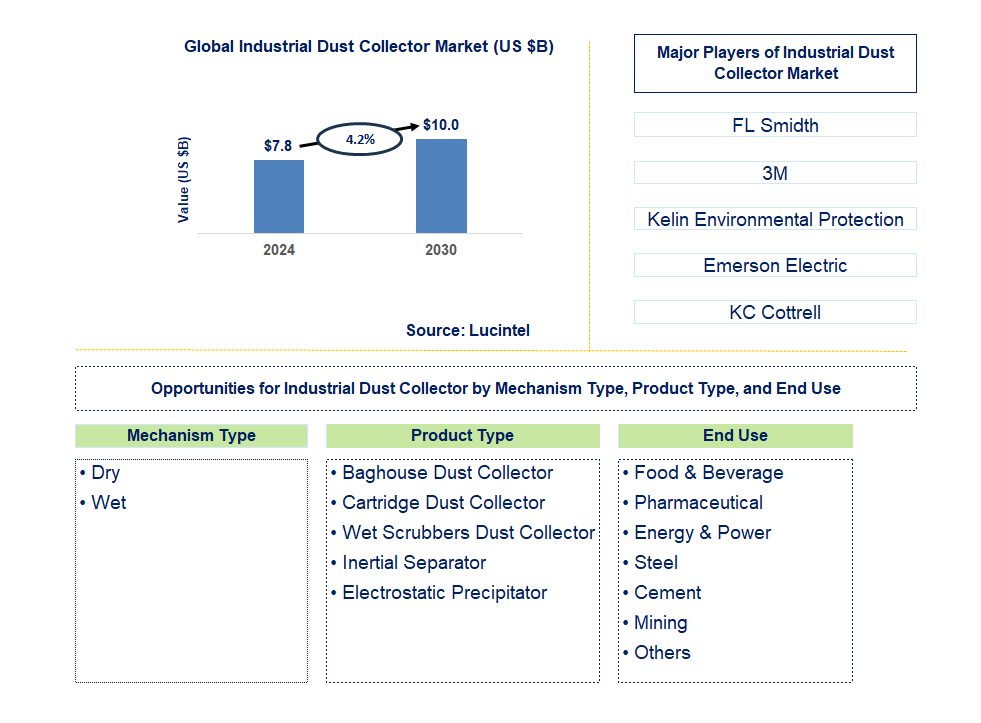
Key data points: The market size in 2030 = $10.0 billion, growth forecast = 4.2% annually for the next 6 years. Scroll below to get more insights. This market report covers trends, opportunities, and forecasts in the global industrial dust collector market to 2030 by mechanism type (dry and wet), product type (baghouse dust collector, cartridge dust collector, wet scrubbers dust collector, inertial separator, and electrostatic precipitator), end use (food & beverage, pharmaceutical, energy & power, steel, cement, mining, and others), and region (North America, Europe, Asia Pacific, and the Rest of the World)
We'll send your sample report shortly.
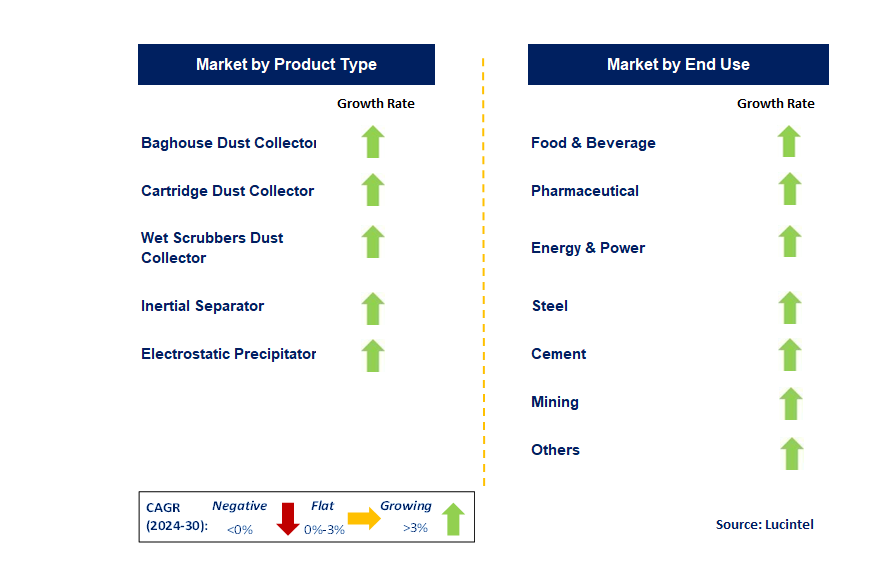
• Lucintel forecasts that, within the product type category, baghouse dust collector will remain the largest segment over the forecast period due to it's cost-effectiveness & superior performance.
• Within the end use category, cement will remain the largest segment due to significant usage of dust control measures in this sector to control the dust generation while cement production processes.
• In terms of regions, APAC will remain the largest region over the forecast period due to growing economic activity and quick industrialization in this region. Gain valuable insight for your business decisions with our comprehensive 150+ page report
• Smart Dust Collectors: These allow real-time monitoring and predictive maintenance through the increasing integration of the Internet of Things (IoT) and smart sensors into dust collectors. These intelligent systems improve operational efficiency, reduce downtime, and optimize filtration performance. Dust load variation insights are obtained through data analytics, which assist in the dynamic control of operations and help increase the longevity of filters.
• Energy Efficiency: A trend toward more energy-efficient designs is emerging in the dust collector segment. Manufacturers are adopting technologies that consume less power while still maintaining high filtration efficiency. Innovations like energy recovery systems or better airflow dynamics can reduce operational costs and ecological footprints.
• Advanced Filter Materials: The development of advanced filter materials, such as nanofiber filters and high-efficiency particulate air (HEPA) filters, has improved dust collection efficiency. These filters offer better performance in terms of filtering, longer lifespans, and lower pressure drops than traditional filters, thus enhancing air quality and reducing maintenance requirements.
• Modular and Compact Designs: The market is shifting toward modular and compact designs for dust collectors. These systems are versatile and fit well in small spaces within various industries. They also have modular features that simplify installation and maintenance, making them suitable for different applications, including smaller and more complex facilities.

• Technological Innovations: The market is dramatically changing due to the evolution of smart dust collectors with IoT capabilities. These machines provide real-time monitoring and predictive maintenance, which increases operational efficiency and reduces outages.
• Energy-Efficient Models: The growing operating costs are addressed through the introduction of energy-efficient dust collectors. Power consumption reduction and decreased environmental impact are some of the gains seen in innovations like energy recovery systems and optimized airflow dynamics.
• Advanced Filtration Technologies: Dust collection efficiency has improved with new filter materials such as nanofibers and HEPA filters. These materials improve air quality, offer better performance, durability, and lower pressure drops, while also reducing maintenance requirements.
• Regulatory Compliance Push: The need to comply with increasingly stringent environmental regulations has driven the development and uptake of advanced dust collectors. Companies are investing in technologies that strictly meet emission standards for fine particulate matter control. These advances enhance the efficiency of dust collectors, making them both cost-effective and compliant with regulatory environments. The combination of technology orientation and energy-saving capabilities is taking over the market.
• Entry into Emerging Markets: Emerging markets, especially developing ones, present great potential for dust collector manufacturers. Rapid industrialization and growing awareness of air quality standards create a demand for efficient dust collection systems. Creating products that comply with local regulations and industrial requirements can help companies penetrate new markets.
• Smart Dust Collector Development: Investment in smart dust collectors presents opportunities for differentiation within the marketplace and provides increased value to customers. Advanced functionalities such as real-time monitoring, predictive maintenance, and data analytics offer significant advantages in terms of operational efficiency and performance. Companies at the forefront of smart technology adoption can attract industries seeking advanced solutions, gaining a competitive edge.
• Energy Efficiency Focus: Developing energy-efficient dust collectors aligns with the rising demand for sustainable alternatives. By emphasizing cost savings, reduced power consumption, and environmental benefits, organizations can appeal to industries targeting sustainability goals or seeking to reduce operating costs. Energy-efficient models support greener initiatives, driving market growth through more affordable dust collection technologies.
• Innovations in Filter Technologies: Advances in filter materials and designs offer opportunities for product line differentiation and entry into new markets. High-performance filters that offer higher filtration efficiency, longer service lives, and reduced maintenance requirements are useful for industries with heavy-duty operations in dusty environments. Investment in cutting-edge filter technologies, capable of meeting various industrial needs, can lead to market share gains and adoption by different sectors. These strategic growth opportunities highlight key areas where companies can focus their efforts to drive market expansion and capitalize on evolving industry needs.
• Technological Advancements: This technology has been amplified by rapid evolution in dust collection. Among these advancements are IoT-integrated smart dust collectors, which can monitor in real time and predict maintenance, improving operational efficiency and reducing downtime. They have also introduced advanced materials like HEPA filters and nanofibers, enhancing performance and extending filter life. These developments improve air quality control and reduce operational costs via improved dust collection.
• Stringent Environmental Regulations: The increase in strict environmental standards is driving global demand for industrial dust collectors. This means that industries worldwide must invest in modern dust collector systems to comply with regulations regarding air quality and pollution control. Non-compliance can be costly in terms of penalties and the need for licenses to continue operations. The need to meet legal requirements on particulate emissions is also pushing for more efficient and compliant dust collection solutions.
• Growing Industrial Demand: The expanding industrial sector, fueled by global industrialization and urbanization, demands highly efficient solutions for managing polluted air from factories, especially those dealing with high levels of pollutants. Industries such as manufacturing, mining, and construction generate large quantities of air pollutants, requiring robust dust collection systems that protect workers' health. As industrial activities increase, so does the variety and quantity of waste, expanding the market for advanced dust collection systems with a broader range of applications. Challenges in the industrial dust collector market include:
• Economic Constraints: The initial cost of purchasing advanced dust collectors can be high due to economic factors like budget constraints. Smaller enterprises may find high-performance equipment unaffordable, as it requires significant capital investment. Other businesses may face financial limitations and cannot afford such sophisticated systems. These businesses must weigh upfront expenses against long-term savings and benefits, making growth difficult.
• Regulatory Compliance Complexity: Compliance with constantly changing regulations creates a significant challenge for the dust collector market. These changes require continuous updates in technology to ensure companies remain aligned with legal requirements. Firms must manage resource-intensive upgrades in their plants to comply with evolving laws, including those related to control panels used throughout manufacturing facilities globally. A number of drivers and challenges impact the industrial dust collector market. Factors such as technological advancements, strict regulations, rising industrialization, green initiatives, and demand for customization are expected to drive the industry. However, financial constraints, difficulties in regulatory compliance, and technological integration issues may limit its growth. Market players should efficiently address these issues to tap into available opportunities while ensuring continued progress in dust collection solutions.
• FL Smidth
• 3M
• Kelin Environmental Protection Technology
• Emerson Electric
• KC Cottrell
• Nederman Holding
• Sumitomo Heavy Industries
• Donaldson
• Badcock & Wilcox Enterprise
• RoboVent
• Dry
• Wet
• Baghouse Dust Collector
• Cartridge Dust Collector
• Wet Scrubbers Dust Collector
• Inertial Separator
• Electrostatic Precipitator
• Food & Beverage
• Pharmaceutical
• Energy & Power
• Steel
• Cement
• Mining
• North America
• Europe
• Asia Pacific
• The Rest of the World
• United States: The U.S. market is characterized by the integration of smart sensors and IoT for real-time monitoring and maintenance of dust collection systems. Additionally, there is increasing emphasis on energy-efficient models that comply with strict EPA regulations. Innovations like nanofiber filters have improved performance and durability. Increased awareness of occupational health hazards has also led to more orders from manufacturing and pharmaceutical firms.
• China: The Chinese industrial dust collector market is expanding rapidly due to intense industrialization and stricter environmental legislation. To avoid penalties related to environmental pollution, competitive firms are investing in advanced dust collection technologies that comply with stringent emission standards set by the Chinese government. Local producers are developing low-cost pollution control equipment to handle heavy particulate loads in heavy industries, ensuring compliance with new regulatory demands. Baghouse systems and electrostatic precipitator systems are increasingly being employed.
• Germany: German manufacturers have always been environmentally conscious, employing advanced technology at all times. The country leads in high-efficiency dust collectors using the latest filter technology developed by industry leaders. These systems incorporate modern technologies such as automation. Strict environmental policies have led to improvements in reducing power usage during operation and other operational efficiencies. There has also been an increase in the adoption of small, modular, and lightweight systems for various industries.
• India: Rapid industrialization and a growing awareness of air quality standards have boosted demand for industrial dust collectors in India. Recent developments have led to the introduction of affordable and scalable dust collection solutions that fit small and medium-sized businesses. Indian manufacturers are investing in technology to improve dust capture efficiency and reduce maintenance costs. The market is also influenced by government initiatives aimed at improving industrial pollution control.
• Japan: Japan’s approach to dust collection systems includes advanced technologies such as real-time analytics and automation. Japanese producers are developing high-performance dust collectors that are cost-effective both operationally and in terms of filtration efficiency. There is also a focus on eco-friendly innovations to reduce the environmental impact of dust extractors. This market is driven by compliance with strict regulations and increased demand from automotive industries and electronics manufacturers. The content has been checked and corrected for errors related to grammar, redundancy, sentence structure, subject-verb agreement, preposition usage, and punctuation as per your requirements.


• FL Smidth
• 3M
• Kelin Environmental Protection Technology
• Emerson Electric
• KC Cottrell
• Nederman Holding
• Sumitomo Heavy Industries
• Donaldson
• Badcock & Wilcox Enterprise
• RoboVent Q6. Which industrial dust collector market segment will be the largest in future? Answer: Lucintel forecasts that baghouse dust collector will remain the largest segment over the forecast period due to it's cost-effectiveness & superior performance. Q7. In industrial dust collector market, which region is expected to be the largest in next 5 years? Answer:
• In terms of regions, APAC will remain the largest region over the forecast period due to growing economic activity and quick industrialization in this region. Q.8 Do we receive customization in this report? Answer: Yes, Lucintel provides 10% customization without any additional cost.


Choose a license that fits your team. Instant PDF delivery.
Prices exclude taxes. Instant delivery. Custom licensing available on request.
Market Report · July 31, 2026
Market Report · July 22, 2026
Market Report · July 20, 2026
Trusted partner for strategic intelligence and business growth


Receive a complimentary market analysis tailored to your industry. Our analysts will identify key growth opportunities and competitive dynamics specific to your business.

Market size, growth rate, and key trend analysis for your specific sector.

Top competitor positioning and market share analysis.

Strategic recommendations backed by data-driven insights.
Get curated market intelligence and competitive moves straight to your inbox.
By subscribing, you agree to receive our monthly insights. Unsubscribe anytime.
Receive a complimentary market analysis tailored to your industry. Our analysts will identify key growth opportunities and competitive dynamics specific to your business.
Market size, growth rate, and key trend analysis for your specific sector.
Top competitor positioning and market share analysis.
Strategic recommendations backed by data-driven insights.
Get curated market intelligence, emerging trends, and competitive moves straight to your inbox each month.
By subscribing, you agree to receive our monthly insights. Unsubscribe anytime.
We'll send your sample report shortly.