
Market Report · July 31, 2026

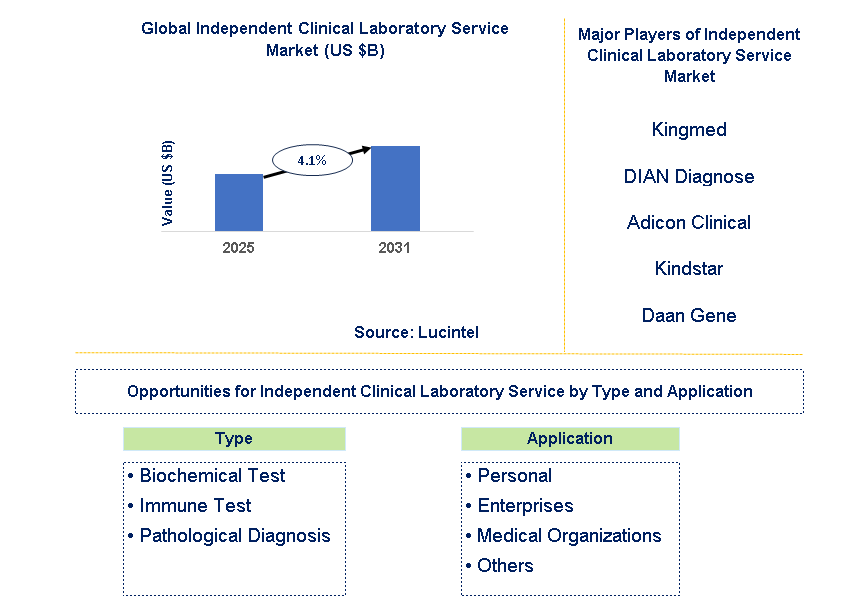
Key data points: The growth forecast = 4.1% annually for the next 7 years. Scroll below to get more insights. This market report covers Trends, opportunities and forecasts in independent clinical laboratory service market to 2031 by type (biochemical test, immune test, and pathological diagnosis), application (personal, enterprises, medical organizations, and others), and region (North America, Europe, Asia Pacific, and the Rest of the World)
We'll send your sample report shortly.
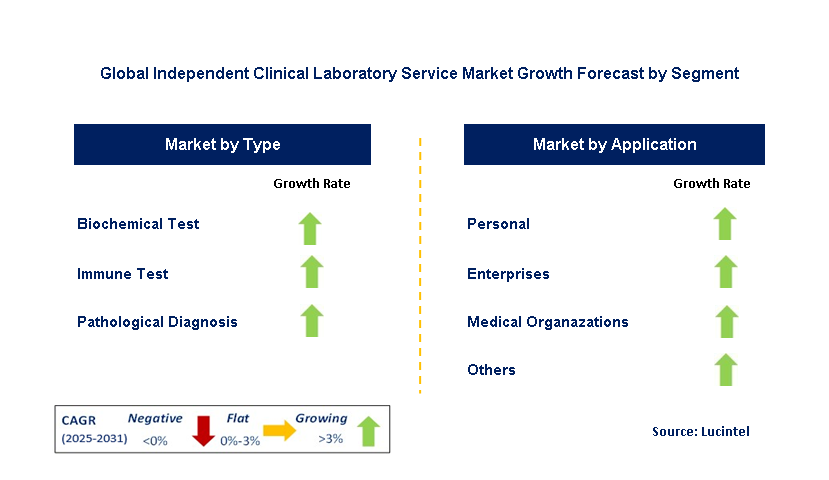
• Lucintel forecasts that, within the type category, pathological diagnosis is expected to witness the highest growth over the forecast period.
• Within the application category, medical organization is expected to witness the highest growth due to the growing demand for diagnostic tests within healthcare settings.
• In terms of region, North America is expected to witness the highest growth over the forecast period due to its advanced healthcare systems and substantial healthcare investments.
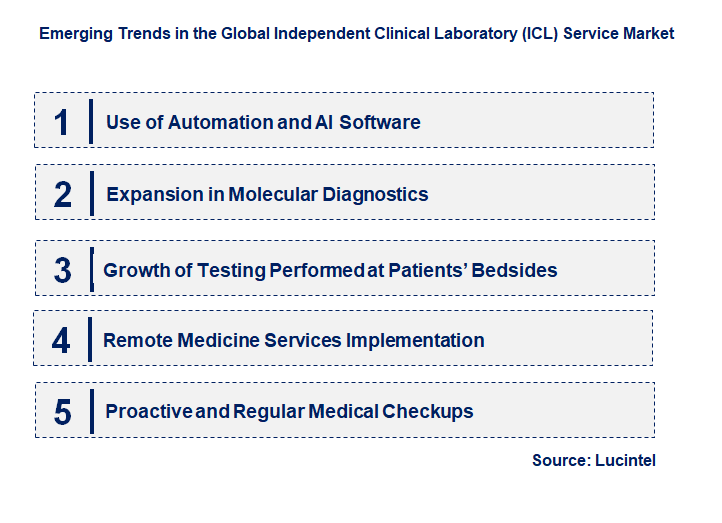
• Use of Automation and AI Software: This is one of the most impactful developments in clinical laboratories; the use of automation and artificial intelligence. The technology being adopted improves the complex diagnostic data in order to increase the speed and accuracy of the tests. In addition, automated systems in clinical laboratories improve workflows, thus minimizing human errors and costs. This phenomenon promotes efficiency and allows greater productivity, meaning that the expense is less and more tests can be taken.
• Expansion in Molecular Diagnostics: The adoption of molecular diagnostics is expeditiously growing in independent clinical labs. There is a greater use of early disease detection and customized treatment programs because of advancements in next generation sequencing (NGS) and PCR labs. The increasing healthcare demand fuel these trends, which are emerging from advancements in genetics. Compared with traditional methods, molecular diagnostics are more effective and provide better patient results, bolstering the healthcare system.
• Growth of Testing Performed at Patients’ Bedsides: Testing done at the patient's bedside is on the rise mainly because it helps provide immediate diagnostic results at the patient's location, thus reducing the waiting time as well as healthcare expenses. Increasingly, portable diagnostic devices are being integrated into independent clinical laboratories that enable clinicians to perform more rapid On-the-spot testing at the clinics, rural regions, and even at home. This trend is particularly significant for the diagnosis and treatment of chronic diseases and infectious diseases where results need to be obtained very urgently to provide further treatment.
• Remote Medicine Services Implementation: The collaboration between independent clinical laboratory services and remote medicine is developing further, especially after the pandemic and in the post COVID period. Healthcare professionals can now remotely consult with patients, and patients can have tests conducted through remote orders. Laboratories are integrating their systems with telemedicine for the smooth transmission of test results and consultations afterwards. This trend makes life easier for patients, increases laboratory outreach, and improves the overall quality of service delivery.
• Proactive and Regular Medical Checkups: With a shift toward preventive medicine, the need for routine diagnostic tests is increasing. Many private clinical laboratories are paying more attention to offering standard tests like blood tests, advancement screening, and genetic tests that can be performed before actual illness develops. This can be attributed to the increased focus on personal consumer health as well as proactive management within the healthcare system which aims to make diagnostic testing a standard procedure in primary care. These trends are changing the dynamics of the independent clinical laboratory service market by improving efficiency of diagnostics and the availability of care tailored to individual patients. To meet the urgent and growing need for more efficient, precise, and inexpensive tests, laboratories are changing and, in turn, the whole world of healthcare is changing as well.
• New AI and machine learning based Diagnostics: The increasing utilization of artificial intelligence and machine learning tools in clinical laboratories is changing how tests are performed. Algorithms enable the processing of intricate and complex diagnostic information. These systems are very accurate and make fewer mistakes. Nearly all laboratories are adopting these technologies to improve processes such as image acquisition and analysis, interpretation of pathology, and even diagnostic forecasting. These technologies lead to faster results, greater accuracy in patient tests, and improved treatment overall.
• Growth in the Demand for Genetic and Personalized Testing: With the strides made towards personalized medicine, the need for genetic testing is on the rise. Independent clinical laboratories are increasing the sophistication of the genetic tests that they offer, such as whole genome sequencing in order to provided proactive treatment for patients. This is largely due to the emerging necessity for more precision medicine approaches, particularly in cancer and other uncommon diseases that require specific treatment protocols for favorable results to be achieved and sustained.
• Focus on Development of Point-of-Care Tests: With the enhancement in the patients' expectations regarding diagnostic turnaround time, point-of-care testing has grown significantly. More laboratories are making available portable diagnostic equipment and testing fluids that may be done outside of the laboratory work place. This enables faster results which is especially beneficial in case of providing better healthcare services in the field or for patients in critical condition or in secluded locations. The ease of use and the rapid response time potential of point-of-care testing is driving its demand and use in many areas of healthcare delivery.
• Evolution in the Cloud Based Laboratory Management: The cloud is emerging across clinical laboratories for data storage, analysis, and reporting. Now, laboratories can securely store large amounts of data, work with other health providers, and make patient information readily available in real-time. This transition boosts workflow productivity, enables remote diagnosis, and increases data security, all of which makes laboratories more responsive to service demands. Workflows in the laboratories have already started benefiting in form of enhanced efficiency.
• Focus Towards Increased Regulations and Accreditations: As healthcare systems adopt greater levels of laboratory testing, there is a consequent institutional focus from regulatory bodies on the standardization and the accreditation process. Independent clinical laboratories have come under greater scrutiny and have to meet strict criteria on precision, safety, and quality control. These regulations will help ensure that claims regarding the service offered by laboratories are valid and professional standards are adhered to, thus improving the confidence patients have in laboratory results. In short, everything that has been discussed reflects the changes taking place in the independent clinical labs ICL market with the technological innovations, regulations, and the increasing emphasis on patient care. Independent clinical laboratories are becoming part of the greater healthcare environment, more efficient, and more available.
• Expansion of Molecular Diagnostics: The usage of precision medicine has allowed the growth of molecular diagnostics to expand substantially. The increasing demand for genetic testing and molecular analysis, laboratories that focus on these areas of specialty will have a prospective market. The development of expanded molecular NC analyses, such as next generation sequencing (NGS), will enable laboratories to offer more effective treatment options for complicated conditions, such as cancer and genetic disorders, within a more personalized manner.
• Adoption of Point-of-Care Testing: The expansion of independent clinical laboratory service has spearheaded point-of-care testing. Developing countries or regions that are medically underserved now have the option of mobile testing units, home test kits, and portable diagnostic units that would deliver medical services to people who require these services. Such innovations are growing to meet the demand of ease and speed of testing, especially for chronic illnesses and infectious diseases.
• Incorporation of Telemedicine Components: Telemedicine is changing the landscape of healthcare delivery in an unprecedented manner and its association with independent clinical laboratory services presents a number of growing opportunities. Patients, especially those in remote or less accessible regions, can be serviced better via virtual consultations and lab testing. This model has gained traction during and after the COVID-19 pandemic, allowing independent clinical laboratory operators to increase their customer base and provide more convenient and timely testing services.
• Advancement of Artificial Intelligence and Automation System: Persistent growth in AI and automation technologies in use and its acceptance in clinical laboratories presents an astounding growth vector. AI powered diagnostic devices and laboratory robotic systems are making operations faster, more accurate, and more efficient. These labs can automate more procedures and do more work with less mistakes and cost. It represents a great opportunity for independent clinical laboratory market growth through competitiveness.
• Moving Into New Markets: New markets, especially in Southeast Asia, Africa and Latin America, offer independent clinical laboratory service providers considerable opportunities for growth. Increased access to diagnostic services is currently available in these regions and is growing at an accelerated rate. Expanding into these regions allows laboratories to focus on a large, underserved population that is in need of affordable, high quality diagnostic testing. It offers independent clinical laboratory service providers various routes and options for expansion and diversifying their services. This report strongly highlights the emerging approaches to sustainable growth throughout the healthcare system focusing on technology, patient and market new segmentation.
• Kingmed
• DIAN Diagnose
• Adicon Clinical Laboratories
• Kindstar
• DaAn Gene
• Berry Genomics
• Frontage Holdings
• Biochemical Test
• Immune Test
• Pathological Diagnosis
• Personal
• Enterprises
• Medical Organizations
• Others
• North America
• Europe
• Asia Pacific
• The Rest of the World
• United States: In the US, the shift in independent clinical laboratory market growth is linked to the increase in healthcare expenditure and the consumption of diagnostic services. Emerging technologies such as AI-enabled diagnostic tools and digital pathology are influencing the way labs are done. In addition, the rise in demand for personalized medicines and genetic tests is forcing the labs to become more advanced. Moreover, the gradual increase in coverage of healthcare services, particularly after the Affordable Care Act, has been continuously increasing the demand for independent clinical laboratory services.
• China: Due to increasing demand in healthcare and government encouragement for innovations in diagnostics, China’s independent clinical laboratory market is progressing at a rapid pace. The country is aggressively pouring funds in biotechnology and laboratory building. The expanding population coupled with lifestyle-related diseases has increased the demand for diagnostic services. Furthermore, China’s healthcare system is shifting towards precision medicine, with laboratories adopting the use of next-generation sequencing (NGS) and other molecular diagnostic techniques. The greater emphasis on healthcare reform also drives the need for modern independent clinical laboratory services.
• Germany: Germany continues to be one of the most important countries in the independent clinical laboratory market in Europe due to its healthcare system and its developed diagnostic services. Laboratories in Germany are increasingly investing in modern automation and artificial intelligence in order to enhance test accuracy and efficiency. The increased attention on preventive medicine and a growing elderly population is increasing the need for routine diagnostic checkup. In addition, Germany is at the forefront in molecular diagnostics, and this is likely to persist as more and more laboratories offer needed personalized testing.
• India: India’s population is becoming more aware of health issues and this is driving the growth of self-testing kits, which, alongside diabetes and cardiac conditions, is resulting in the swift expansion of the independent clinical laboratory market. The steady demand for diagnostic services from both urban and rural areas is significantly amplifying the independent clinical laboratory market. The country’s healthcare infrastructure is developing rapidly, with laboratories adopting new technologies like telemedicine and diagnostics, as well as digital uploads. The increased burden of chronic diseases like diabetes and cardiovascular diseases is further increasing the demand for various diagnostic tests.
• Japan: Japan’s advanced technology integration into independent clinical laboratory services brings efficiency into the market, which, together with the aging population, increases the demand for diabetes and other chronic diseases testing, thus enlarging the spectrum of services and enabling market growth. The use of robotics and molecular diagnostics in Japan has become imperative for achieving higher accuracy and lower costs, along with AI powered robotic automation. Strong health policies from the government enable more funding for medical research and enhances the industry, which allows Japan to excel in independent clinical laboratory services.


• Kingmed
• DIAN Diagnose
• Adicon Clinical Laboratories
• Kindstar
• DaAn Gene
• Berry Genomics
• Frontage Holdings Q5. Which independent clinical laboratory service market segment will be the largest in future? Answer: Lucintel forecasts that, within the type category, pathological diagnosis is expected to witness the highest growth over the forecast period. Q6. In independent clinical laboratory service market, which region is expected to be the largest in next 5 years? Answer: In terms of region, North America is expected to witness the highest growth over the forecast period due to its advanced healthcare systems and substantial healthcare investments. Q7. Do we receive customization in this report? Answer: Yes, Lucintel provides 10% customization without any additional cost.


Choose a license that fits your team. Instant PDF delivery.
Prices exclude taxes. Instant delivery. Custom licensing available on request.
Market Report · July 31, 2026
Market Report · July 31, 2026
Market Report · July 31, 2026
Trusted partner for strategic intelligence and business growth


Receive a complimentary market analysis tailored to your industry. Our analysts will identify key growth opportunities and competitive dynamics specific to your business.

Market size, growth rate, and key trend analysis for your specific sector.

Top competitor positioning and market share analysis.

Strategic recommendations backed by data-driven insights.
Get curated market intelligence and competitive moves straight to your inbox.
By subscribing, you agree to receive our monthly insights. Unsubscribe anytime.
Receive a complimentary market analysis tailored to your industry. Our analysts will identify key growth opportunities and competitive dynamics specific to your business.
Market size, growth rate, and key trend analysis for your specific sector.
Top competitor positioning and market share analysis.
Strategic recommendations backed by data-driven insights.
Get curated market intelligence, emerging trends, and competitive moves straight to your inbox each month.
By subscribing, you agree to receive our monthly insights. Unsubscribe anytime.
We'll send your sample report shortly.