
Market Report · July 29, 2026

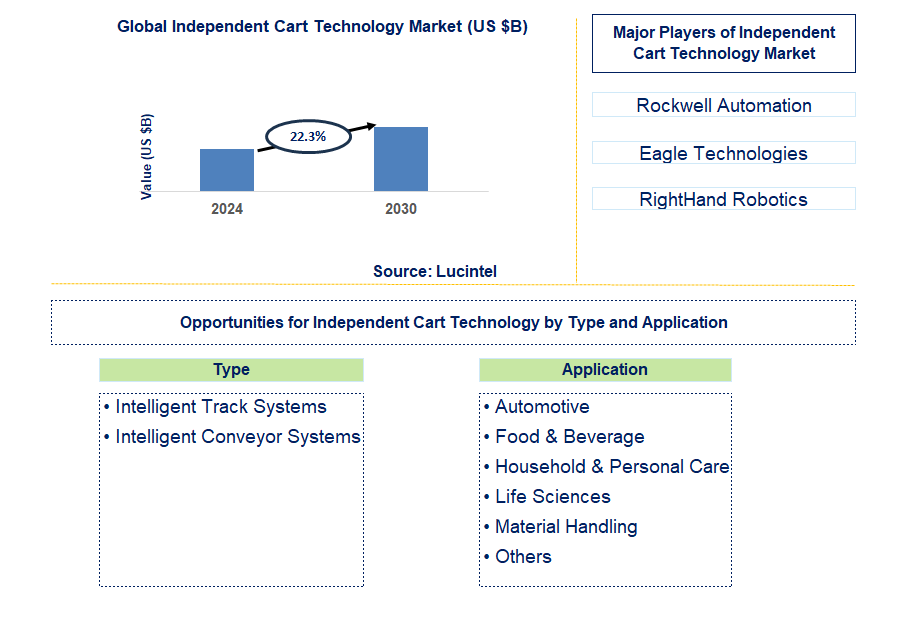
Key data points: The growth forecast = 22.3% annually for the next 6 years. Scroll below to get more insights. This market report covers trends, opportunities, and forecasts in the global independent cart technology market to 2030 by type (intelligent track systems and intelligent conveyor systems), application (automotive, food & beverage, household & personal care, life sciences, material handling, and others), and region (North America, Europe, Asia Pacific, and the Rest of the World)
We'll send your sample report shortly.
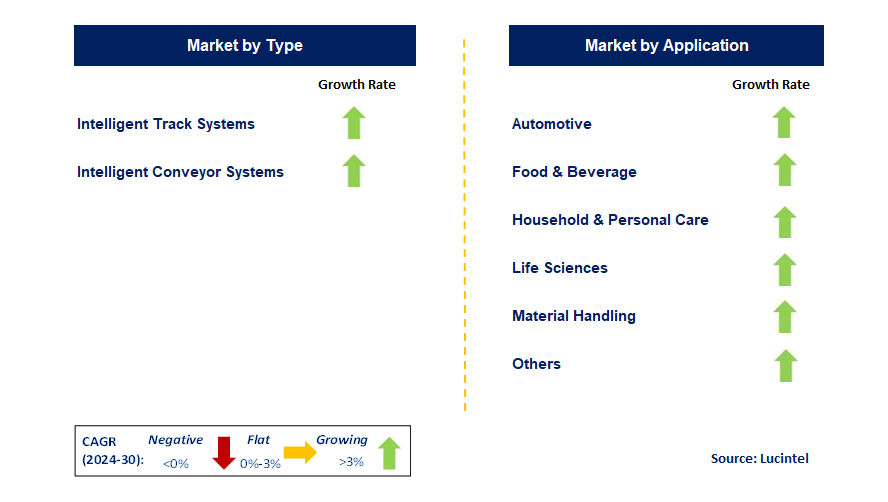
• Lucintel forecasts that, within the type category, intelligent track system is expected to witness higher growth over the forecast period due to its wide application in various end -use industries.
• Within the application category, material handling segment will remain the largest segment due to rising need foe efficient and streamlined warehouse operations.
• In terms of regions, North America is expected to witness the highest growth over the forecast period due to significantly growing e-commerce industry and presence of manufactures in the region.
• AI Integration: The integration of artificial intelligence (AI) is changing the design of stand-alone self-contained carts in a positive direction. AI helps autonomous carts make inferences and solve problems in real-time as well as perform tasks such as navigation, assignment of tasks, and making decisions effectively. It makes such works easier and thus limiting the intervention by human labor thereby making great savings and improvement on operations.
• Enhanced Sensor Technology: Progress made in sensor technology is making self-immediate carts safer and better. The latest models of the carts have state-of-the-art sensors designed for the prevention of collision, navigation accuracy and tracking in current time. This trend enhances reliability as well as improving safety to ensure that the carts can work in very complicated and mobile scenes.
• IoT Connectivity: Independence of sea vessels has structural marvels that have been made possible by the Internet of things (IoT) due to its ability to stream and receive information in real-time. Management of a fleet, upkeep of the machinery, and the connection of the work tools with the warehouses systems smoothly suits the connections of the vehicles in a modern day business. This common practice makes the work performed more efficiently and more effective.
• Increased Automation: There is a visible trend of focusing on the automation of all inclusive e- carts. Autonomous driving technology along with task accomplishment without human intervention is fast becoming a norm. Such a trend minimizes hands-on work, maximizes production, and improves the allocation of resources in logistics and manufacturing industries.
• Customization and Modularization: The movement towards customization and modularization in independent carts is also on the rise. Suppliers provide readily available and easily modifiable offer that fits to address certain specific operations and milieu. This flexibility gives the firms an opportunity to modify the carts according to their demands, enhancing proper usability and effectiveness of the carts used.
Hence it is these trends which are enabling the development of the independent cart technologies that perform better and safer, are more efficient, and are adaptable to broader changes in the environment. Therefore as the sector matures, such improvements in independent cart design and technology will become the new norm in logistics and subsequent cost effective processes.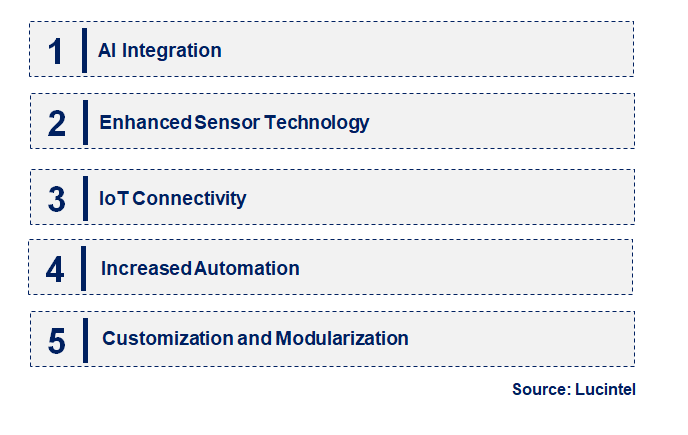
• Progressive Automation: New developments in automation have made independent carts more autonomous and efficient. Some of the innovations being made are advanced navigation systems and the use of real time decision making capabilities. Such enhancement allows the carts to accomplish complicated activities without the need of human assistance to a greater extent, hence making the working process more effective and the costs of labor lower.
• AI-enabled Navigation: The use of independent carts encounters increased adoption of AI-based navigation systems. These systems employ machine learning techniques to improve the aspects of route finding, obstacle avoidance and crash avoidance. Due to the presence of AI, the performance of the carts is dynamic as they are able to adjust their operations to fit different situations in real time.
• Integration with IoT: The incorporation of internet uplink technology is making independent carts more functional. Connectivity via the IoT can enable operations such as tracking in real-time, monitoring of assets offsite and data between devices. This leads to effective coordination and distribution of fleet resources, proper maintenance and scheduling of fleets and increase operational effectiveness.
• Enhanced Safety Features: Emphasis on safety in the independent cart technology is still high. New technologies provide additional elements of safety including better collision sensors and emergency stops or better stability controls. These features help to avoid accidents and safe operation in many different spaces.
• Modular Designs: Thanks to the growing popularity of modular design strategies, the independent carts may also be more adaptable. The availability of modular parts gives the chance for modification of the size of operational rakes hence enabling businesses to alter operational rakes to fit their needs.
These positive deviations predominantly supplement the capacity of independent cart operations making them enhancing their efficiencies and increasing adaptability as well as safety features. Hence there is constant change in technology or design that progresses material management and logistic activities.• E-Commerce Order Fulfillment: The fact that e-commerce is growing rapidly presents a huge market opportunity for independent cart technology. Most order fulfillment processes necessitate compression and technology integration, and independent carts can optimize processes such as sorting and packing. The expansion of this sector creates a market for high quality and advanced performance cart solutions.
• Manufacturing: Application of independent carts for order picking is becoming common as these carts are moving in production facilities to aid in the materials handling and the production line. Development opportunities of carts with remarkable sunk costs targeting higher productivity and safer operations by integrating with the automated production systems.
• Healthcare: The demand for independent horizontally configured carts for use in hospitals and laboratories presents growth opportunities in the health care industry. Specially designed carts for the movement of medical supplies, equipment as well as pharmaceutical preparations will enhance hassle-free operations and reduce contamination risks. Solutions from this sector can target certain requirements such as, sterilizing, and tracking.
• Warehouses: Warehousing work processes are aided by independent carts which help improve inventory control and order picking. Future industries will be employed with new cart systems aimed at the integration of technology with Morrison systems where developers will incorporate Instrumented Indoor navigation systems into the carts’ systems for enhanced safety and speed precise order picking.
• Smart Cities: The notion of smart cities also opens up prospects in the provision of standalone carts outfitted with IoT and AI technologies. On urban logistics, these carts can assist in waste collection, delivery services, maintenance of infrastructure, etc. With the growth of cities in the technological aspect, it is predicted there will be growth in the use of smart autonomous carts in urban spaces.
These strategic growth opportunities underscore the ability of independent cart technology to be effectively deployed across diverse industries. Companies can extract the benefits of emerging growth opportunities in ecommerce, manufacturing, healthcare, warehousing and smart cities to foster more innovation in material handling and logistics.• Rockwell Automation
• Eagle Technologies
• RightHand Robotics
• Intelligent Track Systems
• Intelligent Conveyor Systems
• Automotive
• Food & Beverage
• Household & Personal Care
• Life Sciences
• Material Handling
• Others
• North America
• Europe
• Asia Pacific
• The Rest of the World
• United States: As it is the case in the U.S., new cart developments are driven by the internet of things (IoT) and artificial intelligence (AI) solutions for workers’ independent carts. It is possible to anticipate and direct cart routes and tasks so that they are performed efficiently. There are also developments of more autonomous capabilities like route planning that is more intelligent, and navigational disregard for obstacles that has proven critical in this endeavor.
• China: China chose to direct significant finances towards the robotics and automation of independent carts. Other technologies that have recently been researched include new kinds of sensors and computer vision systems with navigational and anti-collision abilities. Such innovations are more of collective change which aims to upgrade the logistics system and correspond with the booming e-commerce and industrialization trends.
• Germany: In Germany, independent cart technologies are regarded as being centered on mechanical engineering and conforming to industrial 4.0 readiness. Emphasis is laid on developing high-accuracy autonomous carts with sophisticated safety and intelligence capabilities. These types of vehicles are intended to offer higher operational safety without compromising on the manufacturing and logistics quality accepted in Germany.
• India: The independent cart technology in India has its sights set on cheap and versatile technology. New features include lower cost automation applications that serve the business requirements of both the mama mboga and hypermarket. It is also targeted at bringing technologies to lesser developed markets and enhancing the supply chain in the booming industrial sector.
• Japan: Independent cart technology in Japan is under development with stress on reduction in size and use with the existing systems. New features include small-sized, relatively soft-wheeled carts that are suitable for uneven working environments. In this regard, there is a strong potential of combining robotics and ichnology to enhance the advanced manufacturing and logistics practices in Japan.


• Rockwell Automation
• Eagle Technologies
• RightHand Robotics
Q5. Which independent cart technology market segment will be the largest in future?

Choose a license that fits your team. Instant PDF delivery.
Prices exclude taxes. Instant delivery. Custom licensing available on request.
Market Report · July 29, 2026
Market Report · July 20, 2026
Market Report · July 20, 2026
Trusted partner for strategic intelligence and business growth


Receive a complimentary market analysis tailored to your industry. Our analysts will identify key growth opportunities and competitive dynamics specific to your business.

Market size, growth rate, and key trend analysis for your specific sector.

Top competitor positioning and market share analysis.

Strategic recommendations backed by data-driven insights.
Get curated market intelligence and competitive moves straight to your inbox.
By subscribing, you agree to receive our monthly insights. Unsubscribe anytime.
Receive a complimentary market analysis tailored to your industry. Our analysts will identify key growth opportunities and competitive dynamics specific to your business.
Market size, growth rate, and key trend analysis for your specific sector.
Top competitor positioning and market share analysis.
Strategic recommendations backed by data-driven insights.
Get curated market intelligence, emerging trends, and competitive moves straight to your inbox each month.
By subscribing, you agree to receive our monthly insights. Unsubscribe anytime.
We'll send your sample report shortly.