
Market Report · May 18, 2026

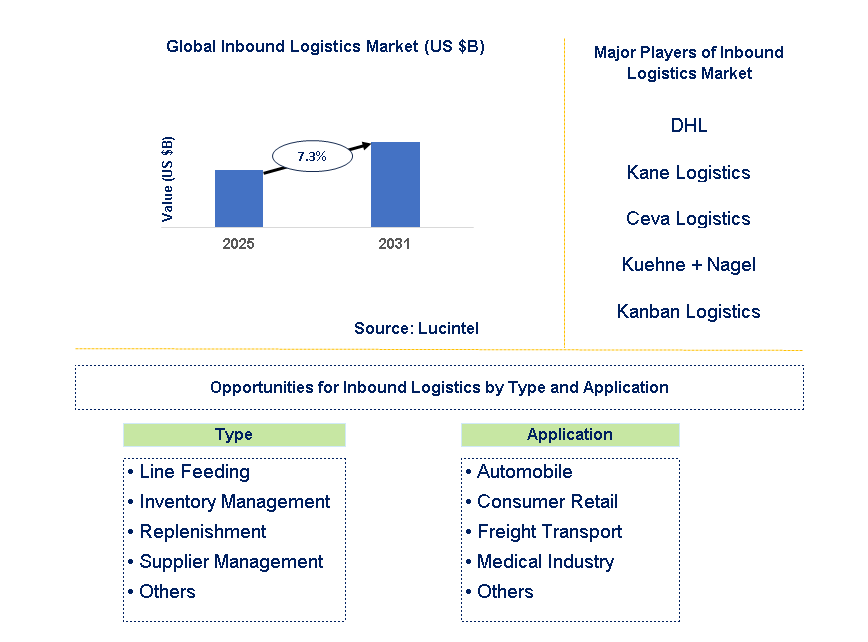
Key data points: The growth forecast = 0.073 annually for the next 7 years. Scroll below to get more insights. This market report covers Trends, opportunities and forecasts in inbound logistics market to 2031 by type (line feeding, inventory management, replenishment, supplier management, and others), application (automobile, consumer retail, freight transport, medical industry, and others), and region (North America, Europe, Asia Pacific, and the Rest of the World)
We'll send your sample report shortly.
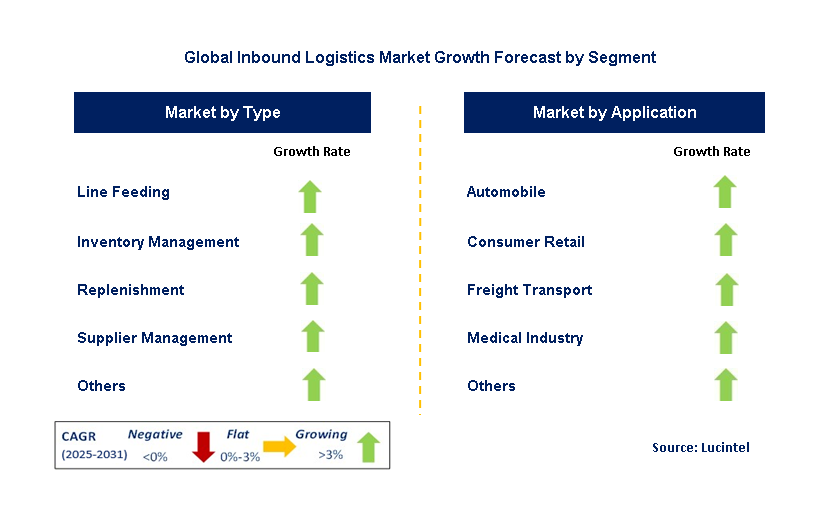
• Lucintel forecasts that, within the type category, inventory management is expected to witness the highest growth over the forecast period.
• Within the application category, freight transport is expected to witness the highest growth.
• In terms of region, APAC is expected to witness the highest growth over the forecast period.
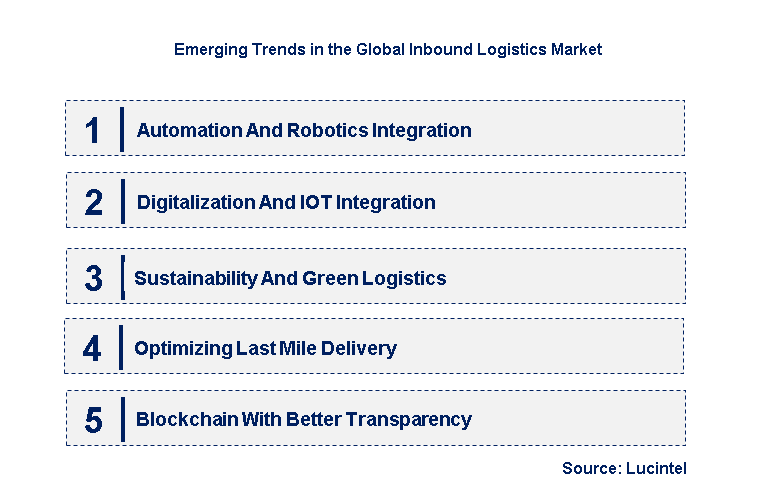
• Automation And Robotics Integration: The use of automation and robotics in inbound logistics is changing the way supply chain management is done. Automated guided vehicles, robotic arms, and AI-driven systems are now being used for the handling of goods to improve efficiency and minimize human labor in warehouses. The technologies improve speed and accuracy in material handling, optimize storage, and reduce the cost of operation. Businesses are witnessing faster turnaround times and more reliable supply chain operations with the help of automation of tasks like inventory management, order fulfillment, and sorting, thus enhancing customer satisfaction and reducing supply chain disruptions.
• Digitalization And IOT Integration: Digitalization and the integration of the Internet of Things (IoT) enhance the visibility and traceability of goods within supply chains. It has real-time inventory monitoring with attached sensors and RFID tags to track and monitor products when being transported with their current condition, hence foreseeing probable breakdowns in the transportation before such incidents. A data-driven methodology improves decisions through enhanced transparency as well as streamlines operational flow. More on cloud-based platform utilization supports proper communication with parties involved and is likely to have the inbound logistics process smooth out in more perfect manners.
• Sustainability And Green Logistics: Sustainability in the inbound logistics market is now one of the most important issues in the industry, where firms adapt themselves towards low carbon footprint and environmental friendly practices. This involves using electric vehicles, optimized routes of delivery with low emissions, and sustainable packaging. The governments are also forcing green logistics through increasing regulations for getting incentives in eco-friendly practice. The emergence of green logistics supports both environmental as well as cost-efficient reduction with lower energy and waste generation. With growing concerns for the environment, sustainability would remain a primary catalyst for innovations in logistics in the near future.
• Optimizing Last Mile Delivery: This is an increasingly popular trend that is driven forward by the tremendous growth of e-commerce. The final leg of delivery, that is, the distance from the distribution center to the customer's doorstep, constitutes the largest part of logistics costs. Companies are innovating new solutions to make this process efficient. For example, companies have been using drones, electric vehicles, and crowdsourced delivery platforms to improve this final leg. Moreover, companies have also utilized smart lockers and automated pickup stations to facilitate delivery and minimize costs. Hence, with effective last-mile delivery, businesses can ensure faster and cheaper supply to consumers with more reliable service.
• Blockchain With Better Transparency: Blockchain technology has been gradually integrated into inbound logistics for its power of providing transparency and security to the chains of supply. Blockchain enables business systems with real-time tracking from origin to destination by producing an unalterable record of transactions, thus reducing fraud, errors, as well as delayed transmissions. Blockchain also allows different supply chain partners to be more collaborative due to a shared, tamper-proof record of all activities. As trust and transparency become an increasingly important business aspect, this adoption is anticipated to increase over time, improving operations and allowing for better connections with customers and suppliers. The trends of automation, digitalization, sustainability, last-mile delivery optimization, and blockchain are drastically changing the inbound logistics market. These trends enhance the efficiency, transparency, and sustainability of logistics operations while fulfilling the increasing need for faster and more reliable supply chain solutions. As these trends continue to develop, the inbound logistics market will see further improvements in cost-effectiveness, speed, and customer satisfaction.
• Automation and Robotics Adoption: This is perhaps the greatest development which sees the far-flung use of automation in inbound logistics. Organizations use robotic systems in warehouses and other distribution centers for sorting, packaging, and transporting goods. Automatic processes help minimize manual errors, increase throughput, and reduce labor-related costs. Companies are investing in autonomous vehicles to move goods around the warehouse and between facilities to enhance efficiency and lower the operational cost. All these innovations are making supply chains faster and more resilient for the markets that operate today.
• Expansion of digital platforms and cloud-based solutions : The digital platform and cloud-based solutions are altering the inbound logistics market by raising the visibility level of goods flowing within the supply chain. By integrating order management, inventory control, and tracking shipment, several functions are done at real time and better decisions can be taken. With centralization of logistics data, a company can ensure improved communication, delay reduction, and coordination among different stages of the supply chain. Digital transformation is helping the logistics operation be more agile and flexible to cope with changing market conditions and expectations from customers.
• Green Logistics and Sustainable Practices: Increasing concern over environmental sustainability has been a significant factor in developing green logistics solutions. Companies are adopting electric vehicles for transportation, optimizing delivery routes to reduce fuel consumption, and using sustainable packaging materials. Governments also support green logistics initiatives through regulatory measures and incentives for adopting environmentally friendly practices. The push for sustainability is not only helping companies reduce their carbon footprints but also providing cost savings in the long term. As concerns for the environment grow, green logistics will remain a major innovation driver in inbound logistics.
• Big Data and AI Integration for Optimization: The integration of big data and AI into inbound logistics is improving the operational efficiency and decision-making process. Big data allows companies to collect and analyze vast amounts of information from various sources, while AI algorithms help optimize routes, predict demand, and manage inventory. By leveraging these technologies, businesses can anticipate disruptions, minimize delays, and improve resource allocation. This enables more precise and responsive supply chain management, leading to better customer satisfaction and reduced operational costs.
• Emphasis on last-mile delivery innovation: As the growth of e-commerce continues to accelerate, last-mile delivery becomes an important concern for companies so that service becomes faster and less expensive. With drones, electric delivery vehicles, and autonomous delivery systems increasingly gaining prominence in cities, alternative models such as crowd shipping are increasingly becoming popular with independent contractors taking the goods across. These innovations are delivered to reduce both delivery time and cost while increasing service levels to a high mark. As competition in the sector of logistics would increasingly be the last-mile delivery, further inventions in technology along with operational tactics will continue coming up. Several developments in the inbound logistics market have been developed, such as automation, digital platforms, green logistics, big data, and last-mile delivery innovations. The efficiency and sustainability of supply chains are being increased through these changes. The increasing demand for fast, reliable, and cost-effective solutions is thus being met with these changes. Companies that understand and adapt to these changes are better positioned to meet the shifting demands of the consumer and streamline their operations.
• Automation and Robotics in Warehousing: There is a growing adoption of automation and robotics in the operations of warehouses; this opens a big play in the market for the growth of inbound logistics. Introducing robot systems for material handling, sorting, and packaging in warehouses would help streamline operations of warehousing, thus reduce labor cost, improve accuracy, and be more efficient with less scale. The increase in demand for faster delivery and efficient logistics will keep the investment in automation high, which would open long-term growth opportunities in the industry.
• Green Logistics Solutions: Green logistics is another significant growth opportunity since companies are being compelled to reduce their environmental footprint. This includes electric vehicles for transportation, energy-efficient warehouse operations, and sustainable packaging materials. Governments around the world are also offering incentives to help practice green logistics better. As environmental regulations get increasingly stringent, consumers demand more sustainable products; businesses will find themselves more competitive if they have invested in green logistics solutions.
• Digitalization and Supply Chain Visibility: With the use of cloud-based platforms, IoT sensors, and big data analytics for digitalizing inbound logistics, new opportunities are coming up for the businesses to have better supply chain visibility and operation optimization. Using these digital solutions, companies are able to keep track of real-time inventory and shipments and can optimize routes as well. Digital solutions make it possible to meet this ever-growing demand, and the ability to adopt an early lead allows businesses to leapfrog others as they can take advantage of these efficiencies to produce better customer experiences.
• Artificial Intelligence and Machine Learning in Inbound Logistics: Demand Forecasting: Artificial intelligence and machine learning are fast-becoming staple tools in both demand forecasting and inventory management practices in inbound logistics. Optimizing their supply chain with AI and ML algorithms on the basis of analysis of past history to predict the future demands so that no kind of stockout or overstock situations happen and the result comes out as the efficient usage of resources, a decrease in inventory costs, and efficient operational results. So, this can drive growth for inbound logistics on account of rising adoption of AI and ML-based demand forecasting in companies.
• Last Mile Delivery Innovation: Last mile delivery innovations include using drones, electric vehicles, and autonomous delivery systems. All of these technologies create a major opportunity for the market of inbound logistics. Companies will invest in this technology due to the growing needs of e-commerce and higher customer expectations regarding fast delivery. In the near future, the technology is going to reduce the costs, speed up the delivery process, and bring more customer satisfaction. As the demand for fast and reliable last-mile delivery grows, significant growth potential can be seen by companies embracing such innovations. The key drivers for strategic growth opportunities in the inbound logistics market include automation, sustainability, digitalization, AI, and last-mile delivery innovations. Such trends are poised to influence the future of logistics and empower companies to better themselves in efficiency, cost-effectiveness, and customer satisfaction. Thus, businesses will be positioned at the top if they make a proper play with these growth opportunities in an ever-increasing competitive global supply chain landscape.
• DHL
• Kane Logistics
• Ceva Logistics
• Kuehne + Nagel
• Kanban Logistics
• Vantec Corporation
• Holman Logistics
• Nwcc Group
• Dsv
• Reliance Logistics Group
• Line Feeding
• Inventory Management
• Replenishment
• Supplier Management
• Others
• Automobile
• Consumer Retail
• Freight Transport
• Medical Industry
• Others
• North America
• Europe
• Asia Pacific
• The Rest of the World
• United States: In the United States, Inbound logistics is evolving with a strong focus on automation and digitalization. Companies are adopting AI-driven solutions for supply chain management to improve efficiency and better demand forecasting. The use of autonomous vehicles and robotic systems is on the rise in logistics hubs to enhance the efficiency of material handling and storage. There is also a greater emphasis on sustainability, with businesses using eco-friendly transportation options and reducing carbon footprints. The US government has also motivated innovation in logistics through incentives for green transportation and integration of technology into a transportation framework.
• China: China remains a global leader with rapid progress in infrastructure and technology in its inbound logistics. The country is investing in smart logistics network under big data, Internet of Things, and AI for the better optimization of supply chain efficiency. China has a vast transportation network, including high-speed rail and advanced port facilities, which can move goods faster and at lower costs. Additionally, the growth of e-commerce in China is forcing companies to adopt just-in-time delivery systems and improve last-mile logistics. The government is also investing in green logistics initiatives, promoting sustainability in the logistics sector.
• Germany: Long a leader in supply chain innovation, inbound logistics in Germany continues to evolve and emphasize aspects of sustainability and digital transformation. Advanced technologies such as AI, machine learning, and blockchain are increasingly being used to enhance the transparency, traceability, and efficiency of their operations. Germany is also witnessing an increase in the adoption of electric and hybrid vehicles for freight transportation, which is in line with the overall green energy goals of the country. Additionally, the growing demand for customized and fast delivery solutions is driving the development of smart logistics platforms and automated warehouses.
• India: In India, the inbound logistics market is growing rapidly due to the country's expanding manufacturing sector and growing demand for e-commerce. Easy movement of goods with the push for infrastructure improvements. The movement of freight can also be made efficient with the development of logistics parks and dedicated freight corridors. India is also embracing digitalization in logistics by involving AI, blockchain, and data analytics for route optimization, inventory management, and supply chain tracking. In addition, sustainability is increasingly being a factor of consideration, and it focuses on the reduction of emissions in transportation and eco-friendly practices in logistics.
• Japan: The inbound logistics market in Japan is characterized by highly efficient systems with a strong focus on automation and robotics. The use of automated guided vehicles (AGVs) in warehouses and factories is expanding, enhancing the speed and accuracy of material handling. Japan is at the forefront in embracing autonomous delivery vehicles and drones in last-mile logistics to help shorten delivery time and enhance the operation. There is also growing utilization of electric vehicles and clean energy solutions for logistics operations to further support Japan's green initiative.


• DHL
• Kane Logistics
• Ceva Logistics
• Kuehne + Nagel
• Kanban Logistics
• Vantec Corporation
• Holman Logistics
• Nwcc Group
• Dsv
• Reliance Logistics Group Q5. Which inbound logistics market segment will be the largest in future? Answer: Lucintel forecasts that, within the type category, inventory management is expected to witness the highest growth over the forecast period. Q6. In inbound logistics market, which region is expected to be the largest in next 5 years? Answer: In terms of region, APAC is expected to witness the highest growth over the forecast period. Q7. Do we receive customization in this report? Answer: Yes, Lucintel provides 10% customization without any additional cost.


Choose a license that fits your team. Instant PDF delivery.
Prices exclude taxes. Instant delivery. Custom licensing available on request.
Market Report · May 18, 2026
Market Report · May 18, 2026
Market Report · May 18, 2026
Trusted partner for strategic intelligence and business growth


Receive a complimentary market analysis tailored to your industry. Our analysts will identify key growth opportunities and competitive dynamics specific to your business.

Market size, growth rate, and key trend analysis for your specific sector.

Top competitor positioning and market share analysis.

Strategic recommendations backed by data-driven insights.
Get curated market intelligence and competitive moves straight to your inbox.
By subscribing, you agree to receive our monthly insights. Unsubscribe anytime.
Receive a complimentary market analysis tailored to your industry. Our analysts will identify key growth opportunities and competitive dynamics specific to your business.
Market size, growth rate, and key trend analysis for your specific sector.
Top competitor positioning and market share analysis.
Strategic recommendations backed by data-driven insights.
Get curated market intelligence, emerging trends, and competitive moves straight to your inbox each month.
By subscribing, you agree to receive our monthly insights. Unsubscribe anytime.
We'll send your sample report shortly.