
Market Report · July 15, 2026

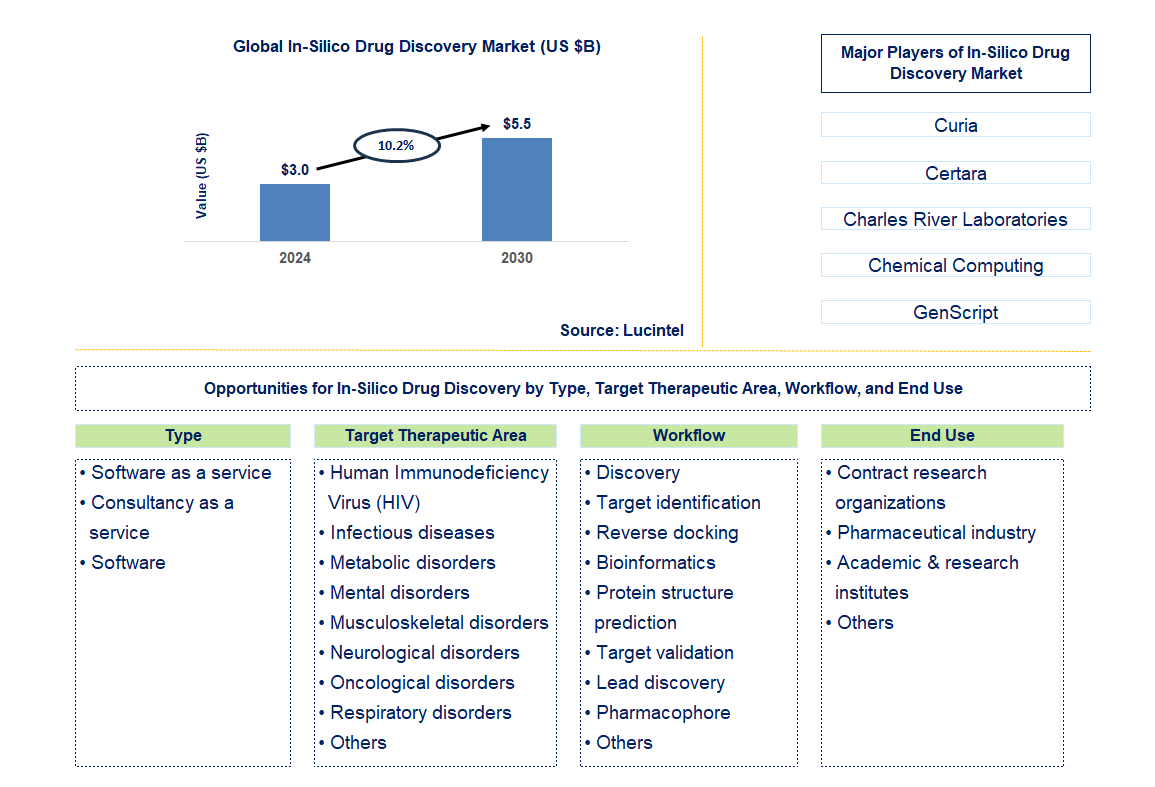
Key data points: The market size in 2031 = $6.1 billion, growth forecast = 10.2% annually for the next 7 years. Scroll below to get more insights. This market report covers trends, opportunities, and forecasts in the global in-silico drug discovery market to 2031 by type (software as a service, consultancy as a service, and software), target therapeutic area (human immunodeficiency virus (HIV), infectious diseases, metabolic disorders, mental disorders, musculoskeletal disorders, neurological disorders, oncological disorders, respiratory disorders, and others), workflow (discovery, target identification, reverse docking, lead discovery, pharmacophore, and others), end use (contract research organizations, pharmaceutical industry, academic & research institutes, and others), and region
We'll send your sample report shortly.
• Lucintel forecasts that, within the type category, software as a service is expected to witness the highest growth over the forecast period due to its increasing adoption for virtual screening and target fising in the drug discovery procedure.
• Within the end use category, pharmaceutical industry will remain the largest segment due as in-silico drug discovery helps the pharmaceutical companies to reduce the time and cost of developing new drugs.
• In terms of regions, North America will remain the largest region over the forecast period due to increasing R&D expenditure by biopharma company, strong presence of marlet players, and large patient population suffering from various chronic and infectious diseases in the region.
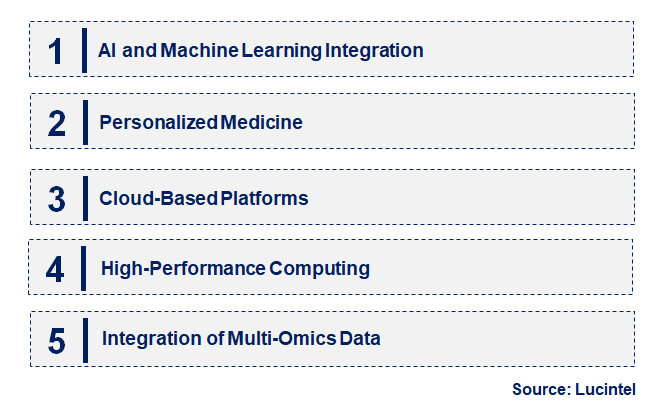
• AI and Machine Learning Integration: Artificial intelligence and machine learning are increasingly integrated into drug development processes, enhancing predictive accuracy and optimizing drug design. These technologies analyze large datasets to predict drug interactions with greater precision.
• Personalized Medicine: Advances in genomics and bioinformatics drive interest in personalized medicine. In-silico models tailored to individual genetic profiles improve efficacy and reduce adverse effects.
• Cloud-Based Platforms: Cloud-based platforms are gaining popularity due to their scalable delivery of in-silico drug discovery solutions. These platforms facilitate collaboration, data sharing, and computational analysis, streamlining drug discovery.
• High-Performance Computing: The use of high-performance computing is expanding, allowing complex simulations and large-scale data analysis. This enables more detailed in-silico modeling, accelerating drug discovery.
• Multi-Omics Data Integration: The integration of multi-omics data, including genomics, proteomics, and metabolomics, is advancing in in-silico drug discovery. This approach provides a deeper understanding of biological systems and aids in identifying potential drug targets.
• AI Algorithm Development: New machine learning algorithms improve predictive modeling and virtual screening, accelerating the identification of drug candidates and the overall drug discovery process.
• Genomic Data Integration: Incorporating genomic data enhances the precision of in-silico models for drug target identification and personalized medicine, aiding in the development of therapies based on genetic information.
• Growth of Cloud-Based Solutions: Cloud-based solutions are now common, providing scalable and flexible platforms for in-silico drug discovery. These solutions support collaboration through data sharing among researchers and pharmaceutical companies.
• High-Performance Computing Improvements: Advances in high-performance computing enable complex simulations and data analysis, supporting detailed in-silico modeling and expediting drug development.
• Multi-Omics Integration Tools: Tools for integrating multi-omics data are rapidly improving, offering comprehensive insights into biological systems. This development enhances drug target identification and supports effective therapy development.
• AI-Driven Drug Discovery: Developing AI-driven platforms enhances predictive modeling and virtual screening, making drug discovery more efficient and reducing development costs.
• Personalized Medicine Solutions: There is growth in developing in-silico models for personalized medicine. Companies can improve treatment efficacy by tailoring drug discovery to individual genetic profiles.
• Cloud-Based Drug Discovery Platforms: The growth of cloud-based platforms provides scalable and accessible drug discovery solutions, supporting global collaboration and data sharing among research teams.
• High-Performance Computing Services: High-performance computing addresses the need for complex simulations and large-scale data analysis in drug discovery, supporting extensive in-silico modeling and expediting drug development.
• Multi-Omics Integration Technologies: Investment in multi-omics integration technologies enhances drug target identification and development by providing a more comprehensive understanding of biological systems.
• Technological advancements: Innovations in AI, machine learning, and high-performance computing strongly drive growth in in-silico drug discovery. These technologies improve predictive accuracy and streamline drug discovery processes.
• Increasing R&D investment: Growing investment in research and development supports the development of new tools and technologies, thereby enhancing efficiency in drug discovery.
• Demand for personalized medicine: Personalized medicine encourages the use of in-silico models that tailor drug discovery to an individual’s genetic makeup, offering better treatment with fewer side effects.
• Cloud adoption: Expanding cloud computing enables access to scalable and flexible platforms for drug discovery. Cloud-based solutions support collaboration, data sharing, and computational analysis.
• Integration of multi-omics data: Integrating multi-omics data allows in-silico drug discovery to achieve a holistic understanding of biological systems, improving the accuracy of drug target identification and development.
• Data privacy and security: Ensuring the privacy and security of sensitive data is a key challenge. Protecting intellectual property and patient data is essential for building trust and ensuring compliance.
• Complexity of integration: Integrating various data sources and technologies into cohesive in-silico models presents a complex challenge. Compatibility issues must be addressed to create a seamless flow of data.
• High costs of advanced technologies: The substantial costs of advanced technologies and computational resources can be a significant obstacle for organizations, impacting the cost-benefit balance in in-silico drug discovery.
• Curia
• Certara
• Charles River Laboratories
• Chemical Computing
• GenScript
• Sygnature Discovery
• Abzena
• Software as a service
• Consultancy as a service
• Software
• Human Immunodeficiency Virus (HIV)
• Infectious diseases
• Metabolic disorders
• Mental disorders
• Musculoskeletal disorders
• Neurological disorders
• Oncological disorders
• Respiratory disorders
• Others
• Discovery
• Target identification
• Reverse docking
• Bioinformatics
• Protein structure prediction
• Target validation
• Lead discovery
• Pharmacophore
• Others
• Contract research organizations
• Pharmaceutical industry
• Academic & research institutes
• Others
• North America
• Europe
• Asia Pacific
• The Rest of the World
• United States: In the US, advancements in AI and machine learning have significantly improved predictive modeling and virtual screening in drug discovery. Firms are increasingly using advanced algorithms and big data on disease biology to identify potential drug candidates more accurately and quickly, promoting faster and more affordable drug development.
• China: China is focusing on integrating AI with bioinformatics to accelerate drug discovery. Sophisticated computational tools for predicting drug interactions and efficacy have been developed, advancing China’s goal of becoming a global leader in pharmaceutical innovation.
• Germany: Germany is applying high-performance computing to drug discovery, supported by a strong R&D infrastructure. This helps in developing in-silico models that enhance drug target identification and optimization in drug design.
• India: India is working toward democratizing access to in-silico drug discovery tools through cloud-based platforms and partnerships with global firms, aiming to strengthen its drug development and research capabilities.
• Japan: Japan is advancing its in-silico drug discovery platform by integrating genomics and AI. The country is focused on using these technologies to support precision medicine and accelerate targeted therapy development.


• Curia
• Certara
• Charles River Laboratories
• Chemical Computing
• GenScript
• Sygnature Discovery
• Abzena
Q6. Which in-silico drug discovery market segment will be the largest in future?

Choose a license that fits your team. Instant PDF delivery.
Prices exclude taxes. Instant delivery. Custom licensing available on request.
Market Report · July 15, 2026
Market Report · June 26, 2026
Market Report · May 18, 2026
Trusted partner for strategic intelligence and business growth


Receive a complimentary market analysis tailored to your industry. Our analysts will identify key growth opportunities and competitive dynamics specific to your business.

Market size, growth rate, and key trend analysis for your specific sector.

Top competitor positioning and market share analysis.

Strategic recommendations backed by data-driven insights.
Get curated market intelligence and competitive moves straight to your inbox.
By subscribing, you agree to receive our monthly insights. Unsubscribe anytime.
Receive a complimentary market analysis tailored to your industry. Our analysts will identify key growth opportunities and competitive dynamics specific to your business.
Market size, growth rate, and key trend analysis for your specific sector.
Top competitor positioning and market share analysis.
Strategic recommendations backed by data-driven insights.
Get curated market intelligence, emerging trends, and competitive moves straight to your inbox each month.
By subscribing, you agree to receive our monthly insights. Unsubscribe anytime.
We'll send your sample report shortly.