
Report Feature
Ileostomy Market Trends and Forecast
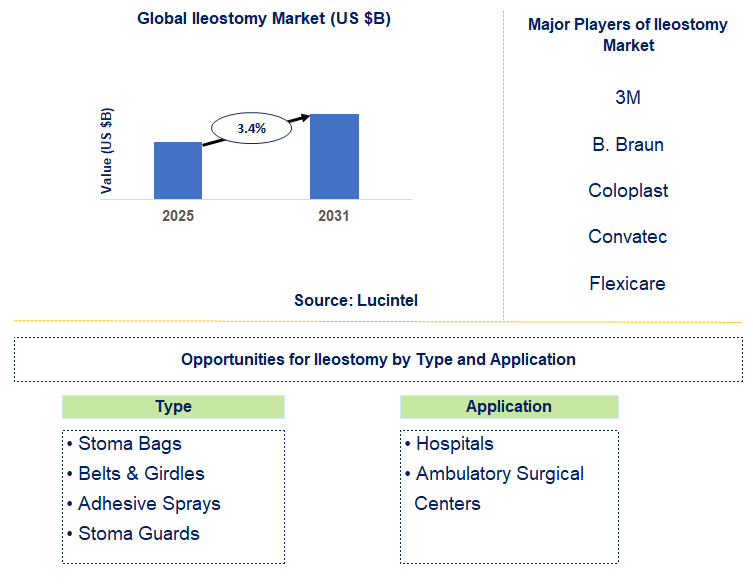
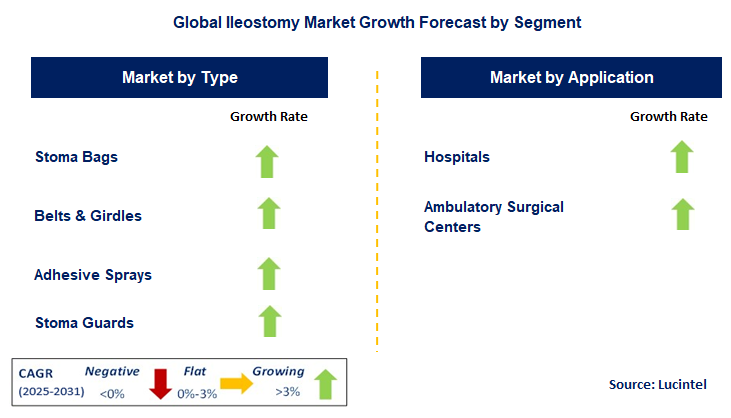
The future of the global ileostomy market looks promising with opportunities in the hospital and ambulatory surgical center markets. The global ileostomy market is expected to grow with a CAGR of 3.4% from 2025 to 2031. The major drivers for this market are the increasing prevalence of gastrointestinal diseases, the rising demand for advanced surgical options, and the growing awareness of ostomy care.• Lucintel forecasts that, within the type category, stoma bag is expected to witness the highest growth over the forecast period.
• Within the application category, hospital is expected to witness higher growth.
• In terms of region, APAC is expected to witness the highest growth over the forecast period. Gain valuable insights for your business decisions with our comprehensive 150+ page report. Sample figures with some insights are shown below.
Emerging Trends in the Ileostomy Market
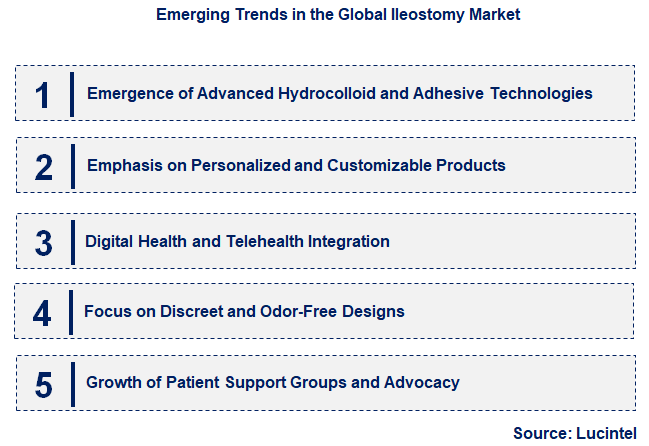
The ileostomy market is being redefined by some fundamental emerging trends that are revolutionizing product design, patient care, and market dynamics. These trends are the result of further knowledge of the patient's needs and the desire to enhance their quality of life. The market is evolving from simplistic functionality to a more holistic solution that combines sophisticated technology, tailor-made solutions, and broad support systems. These developments are not only improving product performance but are also enabling patients to live more active and confident lives.• Emergence of Advanced Hydrocolloid and Adhesive Technologies: One of the emerging trends is the emergence of advanced hydrocolloid and adhesive technologies. These innovations aim to form a tighter seal around the stoma, minimize leakage risk, and defend peristomal skin against irritation and dampness. The result is greatly improved patient comfort and self-esteem since they no longer need to concern themselves with leaks or skin issues. This translates to increased product use and improved quality of life.
• Emphasis on Personalized and Customizable Products: The market is witnessing an increasing trend toward personalized and customizable products. There is an expansion in the range of sizes, shapes, and materials of skin barriers and pouches to suit the individual anatomy of every patient. There is also an increase in products that can be trimmed or molded to form a seal. The effect is a more secure and comfortable fit, which is essential in avoiding leaks and skin injury, enhancing patient satisfaction and lowering healthcare costs in terms of complications.
• Digital Health and Telehealth Integration: One major trend is incorporation of digital health and telehealth services into ileostomy care. This encompasses mobile apps for monitoring pouch changes and output, stoma nurse consultations via telehealth, and patient support groups online. The result is a more engaged and empowered patient population. Health technology enhances patient education, compliance with care regimens, and instant support, potentially decreasing hospital visits and emergency room utilization, resulting in improved long-term health.
• Focus on Discreet and Odor-Free Designs: There is a powerful trend towards developing ileostomy products that are discreet, light in weight, and totally odor-free. This is a direct reaction to a top priority for most patients regarding the social embarrassment and stigma of having an ostomy. The result is a substantial boost in the psychological and social health of patients. These devices enable people to engage in social activities and work with confidence, making life with an ileostomy seem like normal life.
• Growth of Patient Support Groups and Advocacy: One of the emerging trends is the rising influence of patient advocacy and support groups in defining the market. These groups offer essential education, emotional support, and a forum for patients to give feedback to manufacturers. The effect is a more patient-focused industry that is extremely responsive to user needs and issues. This partnership results in the creation of products that are truly useful and straightforward to use, stimulating innovation that is directly focused on enhancing patient lives. In summary, these new trends are essentially transforming the ileostomy market. The emphasis on innovative adhesive technologies and personalized solutions is enhancing product performance and patient comfort. The coupling of digital health and subtle designs is empowering patients as well as treating psychosocial issues. The emergence of patient advocacy is developing a more collaborative and responsible industry. These trends as a whole are creating a more innovative, patient-focused, and effective market that helps individuals with an ileostomy live productive lives.
Recent Development in the Ileostomy Market
Current innovations in the ileostomy market are generally concentrated on improving patient comfort, security, and quality of life. These innovations are fueled by a better appreciation of the issues of people living with an ileostomy and a dedication to more integrated care solutions. The market is evolving beyond the simple process of waste collection to a more advanced solution that responds to the physical and emotional needs of patients, in turn optimizing their post-surgery experience.• Introduction of Next-Generation Skin Barriers and Pouching Systems: One of the most important developments is the introduction of next-generation skin barriers and pouching systems with enhanced material science. They incorporate better adhesives that mold around the body and are ceramide-infused to support skin health and avoid irritation. The effect is a considerable decrease in peristomal skin complications, a frequent and uncomfortable condition in ileostomy patients. This technology offers a more comfortable and secure fit, consequently enhancing patient confidence and product compliance.
• Custom-Fit and 3D Printed Stoma Product Development: There has been great advancements in the application of custom-fit and 3D printed stoma products. Through the use of sophisticated imaging and computer software, the products can be accurately customized to a patient's individual anatomy of stoma and abdomen. The effect is a very safe and comfortable fit, particularly useful for patients with unusual stoma shapes, hernias, or irregularly surfaced skin. The innovation reduces the risk of leakage and gives a degree of personalization previously impossible.
• Launching Smart Ostomy Pouches and Wearables: One of the latest developments is launching smart ostomy pouches and wearables. These sensors come with sensors that are able to track the level of output, check for leaks, and even test the content for evidence of infection. The information is passed through to the smartphone application, warning the user and healthcare provider. The effect is an active response to ostomy care, one which is able to avoid emergencies, enhance patient education, and improve the management of high-output ileostomies.
• Growth of Pouch Accessories and Support Products: One of the major developments is the sheer growth of the accessory business for ileostomy products. This has grown to include a vast array of products including barrier rings, adhesive removers, deodorizing sprays, and support belts. The effect is a holistic solution for the patient, where the patient can combine and interchange products to produce an optimal system for themselves. These items play a vital role in addressing frequent issues such as leaks and odors, thus improving overall patient satisfaction and product performance.
• Telehealth and Remote Patient Monitoring Implementation: Integration of telehealth and remote patient monitoring service is an essential development. Virtual consultations can now be conducted, and on-going support provided to patients at home by stoma nurses and other medical practitioners. The effect is enhanced access to specialist treatment, particularly for rural dwellers. The remote care assists in treating urgent issues, offering education regarding product utilization, and assuring patients are effectively managing their ileostomy, limiting the number of expensive in-person visits. In conclusion, all these innovations are jointly affecting the ileostomy market by making it more advanced, customized, and patient-focused. The rollout of next-generation products and tailored-fit solutions is enhancing body comfort and security. The emergence of intelligent technologies and enhanced accessories is giving rise to a more holistic and reactive care environment. Such advancements are putting the market in a position to serve better a swelling patient populace, retooling their lives from one of struggle to one of self-assurance and autonomy.
Strategic Growth Opportunities in the Ileostomy Market
The ileostomy market presents a number of strategic growth opportunities in main applications, prompted by an upswing in global cases of chronic diseases and the drive towards enhancing patient quality of life. Opportunities are focused around the extension of ileostomy products beyond simple care to meet the specific needs of patients and into more integrated healthcare systems. By addressing these application-specific segments, firms can differentiate their products, establish brand loyalty, and leverage new business opportunities. The industry is transforming from a commodity-based industry to one that focuses on innovation and specialized solutions.• Expansion in Inflammatory Bowel Disease Treatment: One key strategic growth opportunity is in the use of ileostomy products for patients with inflammatory bowel disease (IBD), e.g., Crohn's disease and ulcerative colitis. These conditions usually necessitate temporary or permanent ileostomies. The potential is to create and sell products specifically for high-output stomas, prevalent in IBD patients. The effect is the ability to meet a large and expanding patient group with special requirements, offering specialty products that provide greater security and skin protection.
• Growth into Post-Surgical Recovery: A second significant opportunity for growth is the use of ileostomy products in the post-surgical recovery process. Most ileostomies are temporary, and the patient needs high-quality products for a limited time. The opportunity is to offer an end-to-end care solution comprising not just the pouches but also a variety of accessories and instructional materials to support the patient throughout this crucial period. The contribution is the capacity to form long-term relationships with surgeons and hospitals, establishing a brand as a reliable partner in total patient care.
• Meeting the Pediatric and Geriatric Markets: The market offers great opportunities for growth by providing the distinct needs of the geriatric and pediatric markets. Pediatric patients demand smaller, more adaptive products, whereas geriatric patients may need easier-to-use products with less dexterity required for application. The potential is to create and sell niche product lines to these segments. The impact is to reach two underserved but expanding market segments, delivering differentiated solutions that enhance care and grow share.
• Utilizing E-commerce and Direct-to-Consumer Channels: One of the strategic opportunities is to use e-commerce and direct-to-consumer (D2C) channels. Ostomy patients often prefer the convenience and anonymity of buying their supplies over the internet. The advantage is to design friendly online interfaces that provide a complete assortment of products, learning materials, and customer assistance. The effect is a more immediate connection with the end-consumer, which can translate into beneficial input, brand loyalty, and a decrease in distribution expenses, thus influencing market growth and profitability.
• Integration with Healthcare Provider Networks: There is a strategic potential to link more deeply with healthcare provider networks, such as stoma nurses, hospitals, and clinics. The potential is to provide training courses, educational resources, and product support to medical professionals. The effect is a higher recommendation from trusted medical professionals, which is key to patient uptake and product success. This partnership allows for patients to be treated with the utmost quality care and matched with the most appropriate products. Overall, these strategic growth opportunities are transforming the ileostomy market with a focus on application-specific requirements. Targeting the patient with IBD, post-op management, pediatric and geriatric patients, and using digital channels, companies are trending toward a more specialized and patient-focused model. Integration with healthcare networks is also building credibility and fueling adoption. These opportunities are all driving the market towards a more advanced and segmented strategy, in which focused solutions and a deep patient insight are essential to success.
Ileostomy Market Driver and Challenges
The market for ileostomy is characterized by a complex interaction of major drivers that drive its growth and major challenges that moderate its growth. The growth in the markets is largely driven by the increasing global prevalence of chronic gastrointestinal illness and mounting patient-focused care. But it is also limited by such obstacles as unaffordability of products in certain areas, stigma, and the necessity of far-reaching patient education. The equilibrium among these forces determines the course and speed of market development. It is crucial for market players to comprehend this duality. The factors responsible for driving the ileostomy market include: 1. Growing Incidence of Chronic Gastrointestinal Illnesses: One of the main drivers is the growing worldwide incidence of chronic gastrointestinal illnesses, including inflammatory bowel disease (IBD), colorectal carcinoma, and diverticulitis. All of these conditions frequently require ileostomy procedures. With rising incidence due to changes in lifestyle, aging populations, and enhanced diagnostics, demand for both short-term and long-term ileostomy products also rises, providing a strong and consistent driver for the market. 2. Product Technology and Materials Advances: One of the major drivers is the ongoing improvement in ileostomy product technology and materials. Improved skin barrier adhesives, odor-proof pouching materials, and adaptable designs have greatly enhanced product performance and patient comfort. These technological advances overcome the most frequent patient issues, including leaks and skin irritation, and are helping to make life with an ileostomy easier and less limiting, which drives market growth. 3. Increased Patient Awareness and Support Programs: Another key contributor is the rise in patient awareness and the emergence of patient advocacy and support programs. Healthcare professionals, patient groups, and organizations are collaborating to demystify ileostomy and offer support for patients. Such support enables new ostomates to approach their care with assurance and motivates more people to pursue more advanced and superior products. This expanding base of consumers and educational support is a strong influence on market growth. 4. Increased Geriatric Population: The increased geriatric population around the world is a major driver. Older people are more prone to gastrointestinal disorders that might necessitate an ileostomy. In addition, they usually need products that are simple to use and can be managed with limited dexterity. This population trend builds up and sustained demand for ileostomy products, especially those with ease of use and long-term care management features, which manufacturers are tending to focus on. 5. Advances in Surgical Techniques: The ongoing advancements in surgical procedures, especially the increase in minimally invasive surgeries, are a major influence. These advances have made ileostomy procedures safer and more prevalent, and thus a larger patient population. Improved outcomes from surgery and quicker recovery times prompt more patients to have these surgeries when required, which consequently raises demand for post-surgery care products and regular ileostomy supplies. Challenges in the ileostomy market are: 1. Prohibitively High Cost and Reimbursement Disruptions: One of the key issues is prohibitively high ileostomy product cost, particularly in emerging economies, and the variability in reimbursement policies. Most patients, especially those in nations with weak health insurance cover, cannot afford quality ostomy products, which creates a tendency towards using inferior products and exacerbates health complications. The financial constraint is a major limitation on market growth and utilization of care. 2. Insufficient Skilled Healthcare Professionals: The market is challenged by a shortage of qualified healthcare professionals with specialty skills, including certified wound, ostomy, and continence (WOC) nurses in most regions worldwide. These nurses play an essential role in ensuring adequate patient education, choosing the right products, and preventing complications. Without their skills, the outcome for patients will be suboptimal, their satisfaction with products will decrease, and penetration of the market will be lower in certain markets. 3. Psychological and Social Stigma: The social and psychological stigma of having an ileostomy is one of the biggest challenges. Individuals often feel embarrassed, isolated, or apprehensive about their situation. The stigma hinders their acceptance of treatment and adherence to care regimes. Though patient advocacy is assisting, eliminating entrenched social attitudes is a barrier that impacts patient health and market development. The ileostomy market is at the growth phase with strong growth driven by the rise in chronic disease incidence, technological advancements, and a fast-growing movement towards patient empowerment. These drivers are developing a rich soil for market growth and product innovation. Nevertheless, the market faces some serious challenges such as the high price of products, unavailability of qualified professionals, and the lasting social stigma. The net result is a rapidly changing market that needs to tactically overcome these impediments so that innovative, life-enhancing products are made available to everyone in need, no matter where they live or what their socioeconomic conditions may be.List of Ileostomy Companies
Companies in the market compete on the basis of product quality offered. Major players in this market focus on expanding their manufacturing facilities, R&D investments, infrastructural development, and leverage integration opportunities across the value chain. With these strategies ileostomy companies cater increasing demand, ensure competitive effectiveness, develop innovative products & technologies, reduce production costs, and expand their customer base. Some of the ileostomy companies profiled in this report include-• 3M
• B. Braun
• Coloplast
• Convatec
• Flexicare
• Hollister Incorporated
• Marlen Manufacturing
• Pelican Healthcare
• Salts Healthcare
• Smith & Nephew
Ileostomy Market by Segment
The study includes a forecast for the global ileostomy market by type, application, and region.Ileostomy Market by Type [Value from 2019 to 2031]:
• Stoma Bags
• Belts & Girdles
• Adhesive Sprays
• Stoma Guards
Ileostomy Market by Application [Value from 2019 to 2031]:
• Hospitals
• Ambulatory Surgical Centers
Ileostomy Market by Region [Value from 2019 to 2031]:
• North America
• Europe
• Asia Pacific
• The Rest of the World
Country Wise Outlook for the Ileostomy Market
The ileostomy market is also experiencing rapid change, fueled by increased rates of chronic gastrointestinal disorders globally and a shift towards enhancing the quality of life for ostomy patients. New developments have concentrated on developing more concealed, comfortable, and effective products that take a focus on the most important patient issues such as leakage, skin irritation, and odor. This has been complemented by technical advancements in material science, increased demand for individualized care solutions, and the incorporation of health technologies in the digital space. These technologies are revolutionizing the ileostomy market from being a simple medical supply industry to a patient-centered business targeting overall well-being.• United States: The United States market for ileostomy is dominated by key medical device firms and bears emphasis on sophisticated, patient-oriented products. Emerging trends include the launch of next-generation pouching systems with improved adhesive technologies, offering greater security and skin health. Personalized care is also a key push, with suppliers providing custom-fit barriers as well as extensive accessory options. The market is underpinned by a highly developed reimbursement system and an increasing number of patient support programs driving awareness and better patient outcomes.
• China: China's ileostomy market is growing at a fast rate, driven by growing incidence of inflammatory bowel disease and colorectal cancer, and expanding healthcare expenditures. The latest trends feature a strong emphasis on digital and e-commerce platforms to target a broad and geographically dispersed patient base. Local players are also surfacing, with lower-priced products that are customized to the local market requirements. The market is also enjoying the support of government policies and programs to enhance the access to and the standards of healthcare throughout the country.
• Germany: The ileostomy market in Germany is mature and highly regulated, with great focus on product quality, safety, and extensive healthcare. New trends are built around a push towards innovative, high-quality products that enhance patient comfort and minimize complications. There is also a strong trend towards incorporating advanced hydrocolloid technologies into skin barriers to effectively protect peristomal skin. The market is underpinned by a strong reimbursement system and established network of specialist stoma care nurses who are key to patient education and product choice.
• India: The Indian market for ileostomies is an emerging market with strong growth prospects, led by growing middle-class populations and higher healthcare awareness. The latest trends are focused on making products more affordable and accessible. Domestic players are increasing in the market, providing low-cost solutions. Direct-to-consumer and e-commerce models are contributing significantly to increasing market reach, particularly in rural and semi-urban regions. Initiatives by the government towards enhancing healthcare facilities and public health consciousness are also fueling the market.
• Japan: Japan's ileostomy market is an advanced market with strong emphasis on product design and user convenience. Advanced developments have been toward an increased trend of creating ultra-thin, unobtrusive, and light pouching systems that are attractive and easily concealed. The market is also trending toward products with sophisticated odor control to improve the quality of life in patients. The Japanese market is reinforced by a product culture of care and a robust healthcare system built on patient comfort and social integration.

Features of the Global Ileostomy Market
Market Size Estimates: Ileostomy market size estimation in terms of value ($B). Trend and Forecast Analysis: Market trends (2019 to 2024) and forecast (2025 to 2031) by various segments and regions. Segmentation Analysis: Ileostomy market size by type, application, and region in terms of value ($B). Regional Analysis: Ileostomy market breakdown by North America, Europe, Asia Pacific, and Rest of the World. Growth Opportunities: Analysis of growth opportunities in different type, application, and regions for the ileostomy market. Strategic Analysis: This includes M&A, new product development, and competitive landscape of the ileostomy market. Analysis of competitive intensity of the industry based on Porter’s Five Forces model.
FAQ
Q1. What is the growth forecast for ileostomy market? Answer: The global ileostomy market is expected to grow with a CAGR of 3.4% from 2025 to 2031. Q2. What are the major drivers influencing the growth of the ileostomy market? Answer: The major drivers for this market are the increasing prevalence of gastrointestinal diseases, the rising demand for advanced surgical options, and the growing awareness of ostomy care. Q3. What are the major segments for ileostomy market? Answer: The future of the ileostomy market looks promising with opportunities in the hospital and ambulatory surgical center markets. Q4. Who are the key ileostomy market companies? Answer: Some of the key ileostomy companies are as follows:• 3M
• B. Braun
• Coloplast
• Convatec
• Flexicare
• Hollister Incorporated
• Marlen Manufacturing
• Pelican Healthcare
• Salts Healthcare
• Smith & Nephew Q5. Which ileostomy market segment will be the largest in future? Answer: Lucintel forecasts that, within the type category, stoma bag is expected to witness the highest growth over the forecast period. Q6. In ileostomy market, which region is expected to be the largest in next 5 years? Answer: In terms of region, APAC is expected to witness the highest growth over the forecast period. Q7. Do we receive customization in this report? Answer: Yes, Lucintel provides 10% customization without any additional cost.
Table of Contents
Methodology
- In-depth interviews of the major players in this market
- Detailed secondary research from competitors’ financial statements and published data
- Extensive searches of published works, market, and database information pertaining to industry news, company press releases, and customer intentions
- A compilation of the experiences, judgments, and insights of Lucintel’s professionals, who have analyzed and tracked this market over the years.


Buy Now
Choose a license that fits your team. Instant PDF delivery.
Prices exclude taxes. Instant delivery. Custom licensing available on request.
Key Questions
- • What are some of the most promising, high-growth opportunities for the ileostomy market by type (stoma bags, belts & girdles, adhesive sprays, and stoma guards), application (hospitals and ambulatory surgical centers), and region (North America, Europe, Asia Pacific, and the Rest of the World)?
- • Which segments will grow at a faster pace and why?
- • Which region will grow at a faster pace and why?
- • What are the key factors affecting market dynamics? What are the key challenges and business risks in this market?
- • What are the business risks and competitive threats in this market?
- • What are the emerging trends in this market and the reasons behind them?
- • What are some of the changing demands of customers in the market?
- • What are the new developments in the market? Which companies are leading these developments?
- • Who are the major players in this market? What strategic initiatives are key players pursuing for business growth?
- • What are some of the competing products in this market and how big of a threat do they pose for loss of market share by material or product substitution?
- • What M&A activity has occurred in the last 5 years and what has its impact been on the industry? For any questions related to Ileostomy Market, Ileostomy Market Size, Ileostomy Market Growth, Ileostomy Market Analysis, Ileostomy Market Report, Ileostomy Market Share, Ileostomy Market Trends, Ileostomy Market Forecast, Ileostomy Companies, write Lucintel analyst at email: helpdesk@lucintel.com. We will be glad to get back to you soon.


