
Report Feature
Hydrogen Electrolyser Market Trends and Forecast
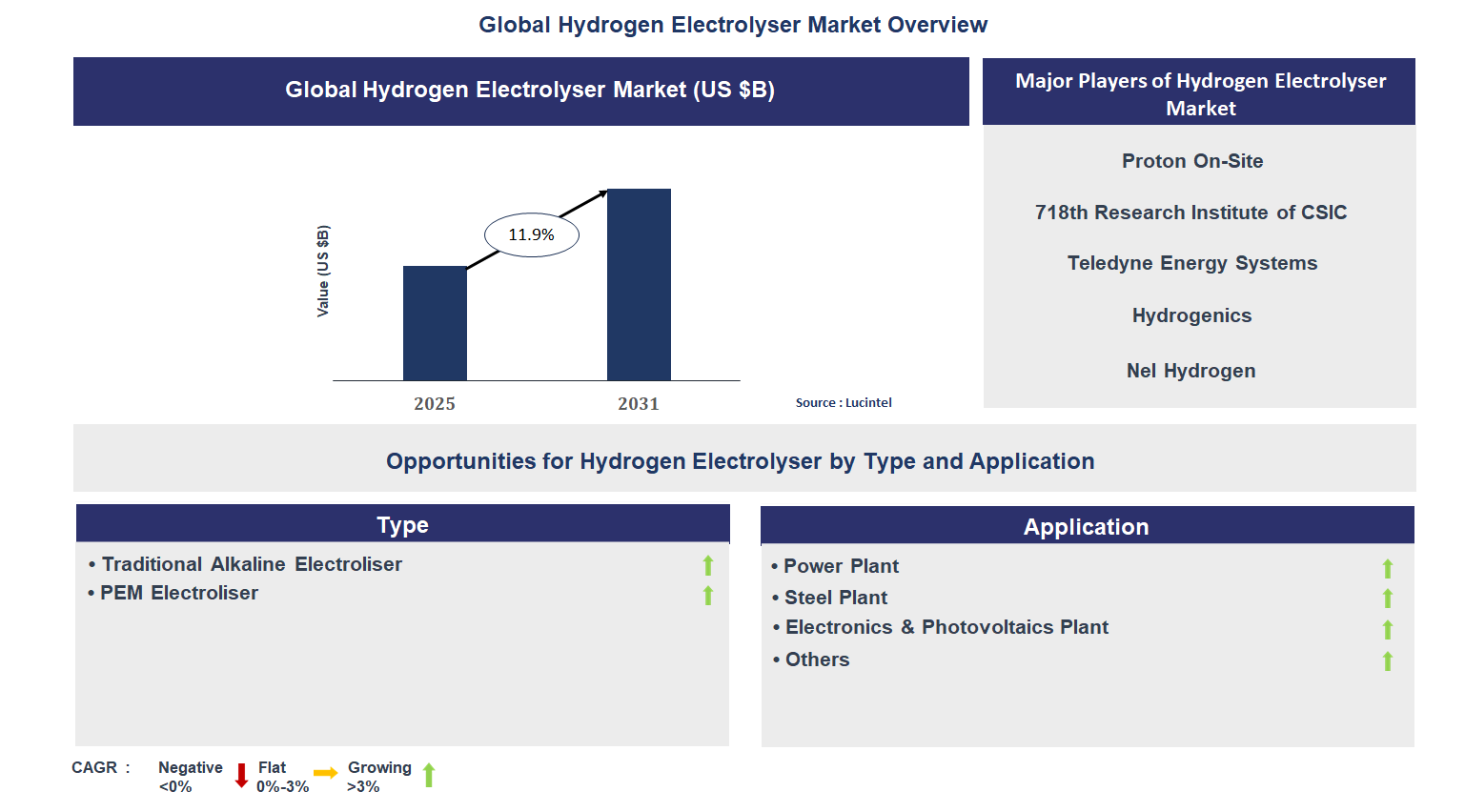
The future of the global hydrogen electrolyser market looks promising with opportunities in the power plant, steel plant, and electronics & photovoltaics plant markets. The global hydrogen electrolyser market is expected to grow with a CAGR of 11.9% from 2025 to 2031. The major drivers for this market are the increasing demand for clean hydrogen production, the rising government investments in renewable energy, and the growing focus on decarbonization & sustainability.• Lucintel forecasts that, within the type category, PEM electroliser is expected to witness higher growth over the forecast period.
• Within the application category, power plant is expected to witness the highest growth.
• In terms of region, APAC is expected to witness the highest growth over the forecast period. Gain valuable insights for your business decisions with our comprehensive 150+ page report. Sample figures with some insights are shown below.
Emerging Trends in the Hydrogen Electrolyser Market
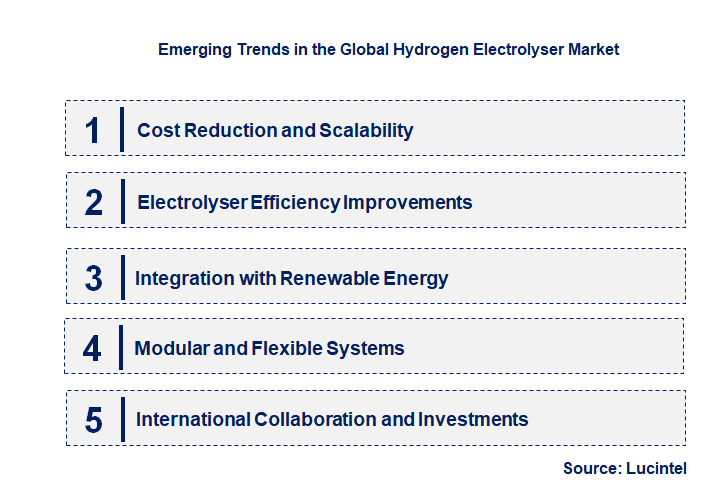
The hydrogen electrolyser market is undergoing transformative changes with the rise of new technologies, evolving production methods, and increasing demand for green hydrogen. Emerging trends in the market reflect a shift toward cost-effective, scalable solutions, integration with renewable energy sources, and greater international collaboration in hydrogen production and infrastructure development.• Cost Reduction and Scalability: One of the key trends in the hydrogen electrolyser market is the development of cost-effective electrolyser systems. Manufacturers are working to reduce costs through economies of scale, more efficient designs, and innovative materials, which is making green hydrogen production more commercially viable and accelerating the adoption of electrolysers worldwide.
• Electrolyser Efficiency Improvements: Another trend is the continuous improvement in electrolyser efficiency. Both PEM and alkaline electrolysers are being optimized to enhance their efficiency in converting electricity into hydrogen, reducing energy losses, and making hydrogen production more cost-effective. This trend is crucial in ensuring the competitiveness of green hydrogen in the broader energy market.
• Integration with Renewable Energy: Electrolysers are increasingly being integrated with renewable energy sources like wind and solar power. This integration is crucial for the production of green hydrogen, as it uses clean, renewable electricity to produce hydrogen without generating carbon emissions. This trend is supported by various government incentives and corporate sustainability goals.
• Modular and Flexible Systems: The development of modular electrolyser systems is gaining traction, enabling more flexible deployment across various industries. These systems allow for easier scaling, improved transportability, and quicker installation, making it easier to meet regional and sector-specific hydrogen production needs while reducing infrastructure costs.
• International Collaboration and Investments: With the global push for a hydrogen economy, international collaboration is intensifying in the electrolyser market. Governments and private companies are increasing investments and forming partnerships to scale up electrolyser production, exchange knowledge, and build a global hydrogen infrastructure that supports the international trade of green hydrogen. These emerging trends are shaping the hydrogen electrolyser market by making production more cost-effective, efficient, and scalable. Integration with renewable energy sources and international collaboration are essential for expanding the global hydrogen economy, paving the way for widespread adoption of green hydrogen in diverse industries.
Recent Development in the Hydrogen Electrolyser Market
Recent advancements in the hydrogen electrolyser market reflect the industrys shift toward more efficient, scalable, and cost-effective hydrogen production systems. Key developments in technology, government policy, and market demand are pushing the market toward greater adoption and commercialization.• Increased Government Investments: Governments, especially in Europe and North America, have significantly increased investments in hydrogen electrolyser research and development. These investments are designed to reduce costs, improve efficiency, and help hydrogen become a competitive fuel source in the energy mix.
• Technological Advancements in Electrolysers: Advancements in PEM and alkaline electrolyser technologies are driving efficiency improvements and reducing costs. New materials, such as advanced catalysts, are being developed to enhance performance, while innovations in electrolyser design are improving scalability.
• Public-Private Partnerships: Strong collaborations between governments and private companies are accelerating the development and deployment of hydrogen electrolysers. These partnerships support large-scale demonstration projects and bring commercial solutions to market faster, helping to drive the adoption of green hydrogen technologies.
• Global Expansion of Hydrogen Infrastructure: The global expansion of hydrogen infrastructure is fostering demand for electrolysers. In regions such as Europe, Asia, and North America, investments in hydrogen storage, transportation, and distribution systems are creating a supportive environment for electrolyser deployment, increasing market growth potential.
• Increased Focus on Sustainable Materials: Electrolyser manufacturers are focusing on using more sustainable materials in the production of electrolysers, including reducing the use of precious metals like platinum and iridium. This focus is helping to reduce the cost of electrolysers and increase their long-term sustainability. These developments are pushing the hydrogen electrolyser market toward more efficient, cost-effective, and scalable solutions. As governments and industries focus on green hydrogen, the market is witnessing accelerated growth and innovation, leading to more widespread adoption of hydrogen as a clean energy source.
Strategic Growth Opportunities in the Hydrogen Electrolyser Market
The hydrogen electrolyser market is brimming with growth opportunities as demand for green hydrogen accelerates across industries. These opportunities are largely driven by innovations in electrolyser technology, regulatory support, and the integration of renewable energy sources.• Green Hydrogen for Industry Decarbonization: One of the major growth opportunities lies in the decarbonization of hard-to-abate industrial sectors, including steel, cement, and chemicals. Electrolysers offer a viable solution for producing green hydrogen to replace fossil fuels in these industries, driving significant demand for electrolyser technology.
• Hydrogen for Transportation: The transportation sector, particularly heavy-duty trucks, shipping, and aviation, offers another promising growth area. Green hydrogen, produced by electrolysers, can be used as a clean fuel, supporting the transition to zero-emission transportation and creating demand for hydrogen production infrastructure.
• Renewable Energy Integration: The integration of electrolysers with renewable energy systems, such as solar and wind farms, offers a huge growth opportunity. Excess renewable energy can be used to produce hydrogen, which can be stored and used when needed, making electrolyser technology a key enabler of energy system decarbonization.
• International Hydrogen Trade: As countries move towards hydrogen economies, international hydrogen trade is set to grow. Electrolysers will play a critical role in producing hydrogen for export, particularly from regions with abundant renewable energy resources to areas with high demand for clean fuel, such as Europe and Asia.
• Energy Storage and Grid Balancing: Electrolyser technology also presents opportunities for energy storage and grid balancing. By using surplus renewable energy to produce hydrogen, electrolysers can help stabilize power grids, providing a reliable and flexible energy storage solution for utilities. These applications offer promising growth opportunities for the hydrogen electrolyser market, with industries looking to decarbonize and integrate renewable energy into their operations. As demand for green hydrogen rises, electrolyser technology will play a key role in supporting the global transition to clean energy.
Hydrogen Electrolyser Market Driver and Challenges
The hydrogen electrolyser market is shaped by several key drivers and challenges. Technological advancements, environmental regulations, and government incentives are driving growth, while challenges such as high initial costs and scalability issues remain hurdles to widespread adoption. The factors responsible for driving the hydrogen electrolyser market include: 1. Government Policies and Incentives: Supportive government policies and incentives for green hydrogen production are driving market growth. Subsidies, tax credits, and carbon pricing mechanisms encourage investments in hydrogen electrolyser technology. 2. Technological Advancements: Breakthroughs in electrolyser technology, including improved efficiency and cost reduction, are key drivers. Advances in PEM and alkaline electrolysis are making green hydrogen more competitive in the energy market. 3. Renewable Energy Integration: Electrolyser systems are increasingly integrated with renewable energy sources like solar and wind, supporting the production of green hydrogen and driving demand for these technologies. 4. Decarbonization Goals: Global decarbonization targets and the need for clean fuel alternatives drive the adoption of green hydrogen in various sectors, creating a strong market for electrolysers. 5. Energy Security Concerns: Hydrogen offers a pathway to energy security, and electrolysers provide a solution to produce domestically sourced hydrogen, reducing dependence on fossil fuels. Challenges in the hydrogen electrolyser market are: 1. High Capital Costs: The high upfront costs of electrolysers, driven by advanced materials and technology, remain a significant challenge to widespread adoption, especially in price-sensitive markets. 2. Scalability and Infrastructure: Building a scalable hydrogen infrastructure, including production, storage, and transportation, requires significant investment and coordination, hindering faster market penetration. 3. Technological Maturity: While significant advancements are being made, electrolyser technology is still maturing, and achieving large-scale commercialization at competitive prices remains a challenge. Strong government support, technological advancements, and the need for clean hydrogen are propelling the market forward, while high costs, scalability issues, and technological maturity must be addressed to unlock the full potential of hydrogen electrolysers.List of Hydrogen Electrolyser Companies
Companies in the market compete on the basis of product quality offered. Major players in this market focus on expanding their manufacturing facilities, R&D investments, infrastructural development, and leverage integration opportunities across the value chain. With these strategies hydrogen electrolyser companies cater increasing demand, ensure competitive effectiveness, develop innovative products & technologies, reduce production costs, and expand their customer base. Some of the hydrogen electrolyser companies profiled in this report include-• Proton On-Site
• 718th Research Institute of CSIC
• Teledyne Energy Systems
• Hydrogenics
• Nel Hydrogen
• Suzhou Jingli
• Beijing Zhongdian
• McPhy
• Siemens
• TianJin Mainland
Hydrogen Electrolyser Market by Segment
The study includes a forecast for the global hydrogen electrolyser market by type, application, and region.Hydrogen Electrolyser Market by Type [Value from 2019 to 2031]:
• Traditional Alkaline Electroliser
• PEM Electroliser
Hydrogen Electrolyser Market by Application [Value from 2019 to 2031]:
• Power Plant
• Steel Plant
• Electronics & Photovoltaics Plant
• Others
Hydrogen Electrolyser Market by Region [Value from 2019 to 2031]:
• North America
• Europe
• Asia Pacific
• The Rest of the World
Country Wise Outlook for the Hydrogen Electrolyser Market
The hydrogen electrolyser market is rapidly expanding as governments and industries strive for sustainable hydrogen production solutions to meet clean energy goals. Key markets such as the United States, China, Germany, India, and Japan are seeing advancements in electrolyser technologies, supported by policy initiatives, rising renewable energy integration, and increasing investment in green hydrogen production.• United States: In the US, the hydrogen electrolyser market has gained momentum with substantial federal investments, including the Hydrogen Hub program. Companies are focusing on scaling up alkaline and PEM (Proton Exchange Membrane) electrolysers to meet rising demand for green hydrogen. Government incentives and partnerships with the private sector are accelerating R&D and production capabilities.
• China: China’s hydrogen electrolyser market is growing rapidly, with a focus on scaling up production and improving efficiency. China is integrating electrolysers into its broader green hydrogen strategy, which is aimed at decarbonizing industrial sectors and achieving carbon neutrality by 2060. The government’s emphasis on renewable energy is boosting electrolyser demand in multiple sectors, including transportation.
• Germany: Germany is a global leader in hydrogen electrolyser technologies, with strong support from both the government and private sector. The country has invested heavily in hydrogen infrastructure and is advancing the commercialization of PEM and alkaline electrolysers. Germany’s National Hydrogen Strategy aims to position the country as a key player in the global hydrogen economy.
• India: India is ramping up its hydrogen electrolyser capabilities as part of its National Hydrogen Mission to support its renewable energy transition. The government is investing in electrolyser technology to produce green hydrogen for sectors such as industry and transportation, and collaborations with international players are helping India build its domestic manufacturing base.
• Japan: Japan’s hydrogen electrolyser market is growing with a focus on developing efficient electrolysis technologies for energy storage and industrial use. The government is investing in R&D for high-efficiency electrolysers, and Japan’s hydrogen strategy emphasizes the production of clean hydrogen for both domestic use and export, bolstering the market.

Features of the Global Hydrogen Electrolyser Market
Market Size Estimates: Hydrogen electrolyser market size estimation in terms of value ($B). Trend and Forecast Analysis: Market trends (2019 to 2024) and forecast (2025 to 2031) by various segments and regions. Segmentation Analysis: Hydrogen electrolyser market size by type, application, and region in terms of value ($B). Regional Analysis: Hydrogen electrolyser market breakdown by North America, Europe, Asia Pacific, and Rest of the World. Growth Opportunities: Analysis of growth opportunities in different types, applications, and regions for the hydrogen electrolyser market. Strategic Analysis: This includes M&A, new product development, and competitive landscape of the hydrogen electrolyser market. Analysis of competitive intensity of the industry based on Porter’s Five Forces model.
FAQ
Q1. What is the growth forecast for hydrogen electrolyser market? Answer: The global hydrogen electrolyser market is expected to grow with a CAGR of 11.9% from 2025 to 2031. Q2. What are the major drivers influencing the growth of the hydrogen electrolyser market? Answer: The major drivers for this market are the increasing demand for clean hydrogen production, the rising government investments in renewable energy, and the growing focus on decarbonization & sustainability. Q3. What are the major segments for hydrogen electrolyser market? Answer: The future of the hydrogen electrolyser market looks promising with opportunities in the power plant, steel plant, and electronics & photovoltaics plant markets. Q4. Who are the key hydrogen electrolyser market companies? Answer: Some of the key hydrogen electrolyser companies are as follows:• Proton On-Site
• 718th Research Institute of CSIC
• Teledyne Energy Systems
• Hydrogenics
• Nel Hydrogen
• Suzhou Jingli
• Beijing Zhongdian
• McPhy
• Siemens
• TianJin Mainland Q5. Which hydrogen electrolyser market segment will be the largest in future? Answer: Lucintel forecasts that, within the type category, PEM electroliser is expected to witness higher growth over the forecast period. Q6. In hydrogen electrolyser market, which region is expected to be the largest in next 5 years? Answer: In terms of region, APAC is expected to witness the highest growth over the forecast period. Q7. Do we receive customization in this report? Answer: Yes, Lucintel provides 10% customization without any additional cost.
Table of Contents
List of Figures
List of Tables
Methodology
- In-depth interviews of the major players in this market
- Detailed secondary research from competitors’ financial statements and published data
- Extensive searches of published works, market, and database information pertaining to industry news, company press releases, and customer intentions
- A compilation of the experiences, judgments, and insights of Lucintel’s professionals, who have analyzed and tracked this market over the years.


Buy Now
Choose a license that fits your team. Instant PDF delivery.
Prices exclude taxes. Instant delivery. Custom licensing available on request.
Key Questions
- • What are some of the most promising, high-growth opportunities for the hydrogen electrolyser market by type (traditional alkaline electroliser and PEM electroliser), application (power plant, steel plant, electronics & photovoltaics plant, and others), and region (North America, Europe, Asia Pacific, and the Rest of the World)?
- • Which segments will grow at a faster pace and why?
- • Which region will grow at a faster pace and why?
- • What are the key factors affecting market dynamics? What are the key challenges and business risks in this market?
- • What are the business risks and competitive threats in this market?
- • What are the emerging trends in this market and the reasons behind them?
- • What are some of the changing demands of customers in the market?
- • What are the new developments in the market? Which companies are leading these developments?
- • Who are the major players in this market? What strategic initiatives are key players pursuing for business growth?
- • What are some of the competing products in this market and how big of a threat do they pose for loss of market share by material or product substitution?
- • What M&A activity has occurred in the last 5 years and what has its impact been on the industry? For any questions related to Hydrogen Electrolyser Market, Hydrogen Electrolyser Market Size, Hydrogen Electrolyser Market Growth, Hydrogen Electrolyser Market Analysis, Hydrogen Electrolyser Market Report, Hydrogen Electrolyser Market Share, Hydrogen Electrolyser Market Trends, Hydrogen Electrolyser Market Forecast, Hydrogen Electrolyser Companies, write Lucintel analyst at email: helpdesk@lucintel.com. We will be glad to get back to you soon.


