
Report Feature
Hydraulic Door Closer Market Trends and Forecast
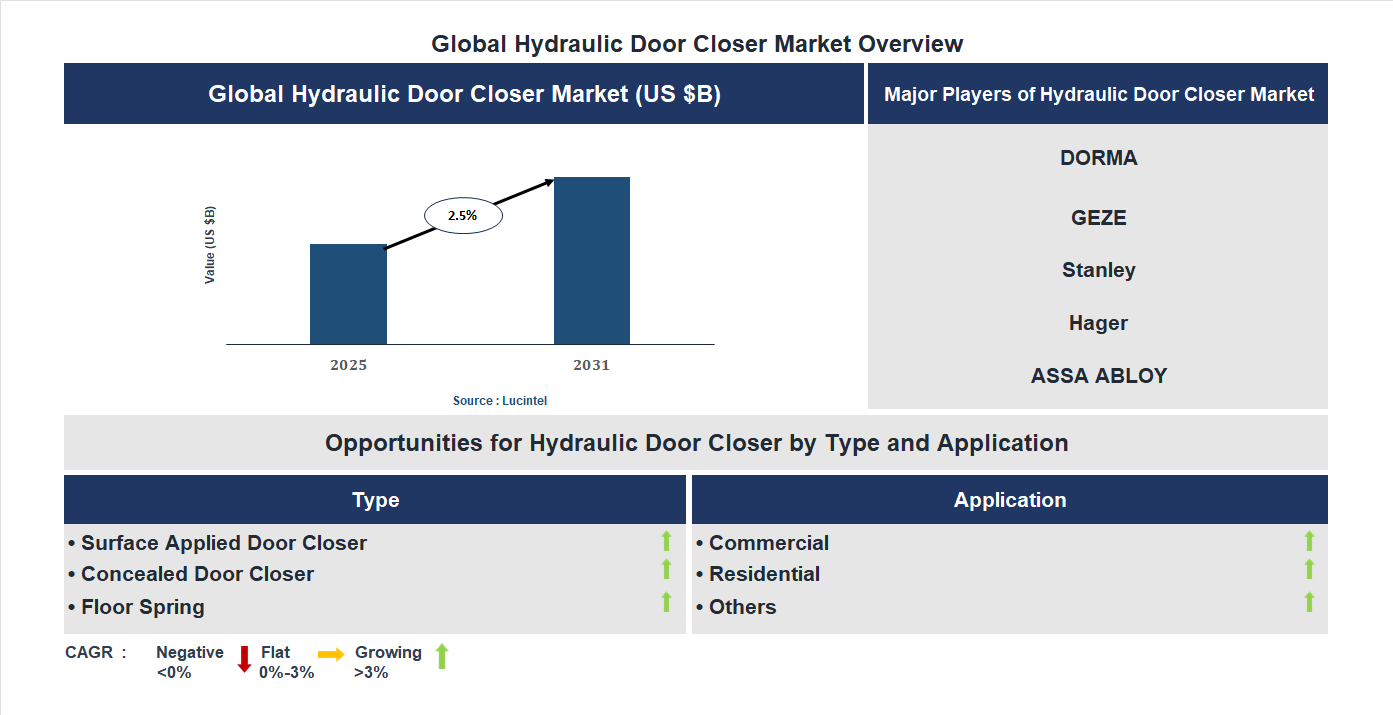
The future of the global hydraulic door closer market looks promising with opportunities in the commercial and residential markets. The global hydraulic door closer market is expected to grow with a CAGR of 2.5% from 2025 to 2031. The major drivers for this market are the increasing demand for controlled door closing systems, the rising installation in commercial & residential buildings, and the growing focus on safety & accessibility compliance.• Lucintel forecasts that, within the type category, concealed door closer is expected to witness the highest growth over the forecast period.
• Within the application category, commercial is expected to witness higher growth.
• In terms of region, APAC is expected to witness the highest growth over the forecast period. Gain valuable insights for your business decisions with our comprehensive 150+ page report. Sample figures with some insights are shown below.
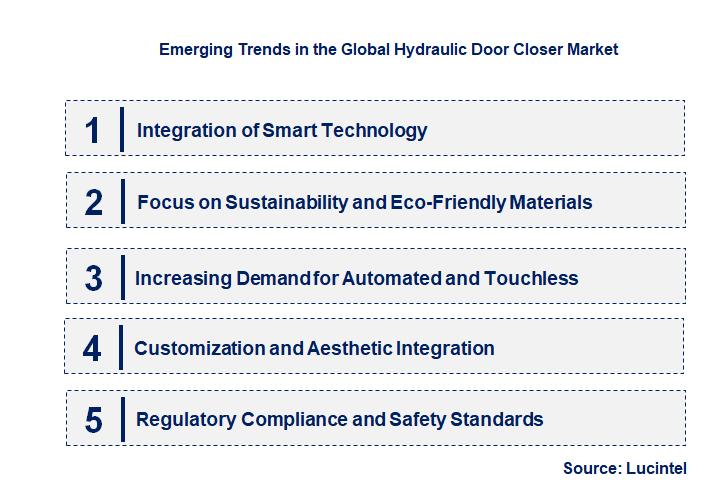
Emerging Trends in the Hydraulic Door Closer Market
The hydraulic door closer market is experiencing significant transformation driven by technological advancements, changing consumer preferences, and increasing safety regulations. As buildings become smarter and more energy-efficient, the demand for innovative door closing solutions is rising. Market players are focusing on sustainability, automation, and enhanced user experience to stay competitive. These developments are not only improving the functionality and safety of door closers but also influencing architectural designs and construction standards worldwide. The following key trends highlight the major shifts shaping this market, reflecting its evolution towards smarter, more efficient, and environmentally friendly solutions.• Integration of Smart Technology: The adoption of IoT-enabled hydraulic door closers is increasing, allowing for remote monitoring, automatic adjustments, and predictive maintenance. This trend enhances user convenience, reduces downtime, and improves safety by providing real-time data on door performance. Smart features also enable integration with building management systems, contributing to energy efficiency and security. As buildings become more connected, the demand for intelligent door closing solutions is expected to grow, driving innovation and offering competitive advantages to manufacturers.
• Focus on Sustainability and Eco-Friendly Materials: Environmental concerns are prompting manufacturers to develop hydraulic door closers using sustainable materials and energy-efficient designs. These products aim to reduce energy consumption and minimize environmental impact. Eco-friendly hydraulic fluids and recyclable components are gaining popularity, aligning with green building standards such as LEED. This trend not only appeals to environmentally conscious consumers but also helps builders meet regulatory requirements, fostering market growth and encouraging sustainable construction practices.
• Increasing Demand for Automated and Touchless Solutions: The COVID-19 pandemic accelerated the need for contactless and automated door closing systems to enhance hygiene and safety. Hydraulic door closers with touchless operation, motion sensors, and automatic adjustments are becoming standard in commercial and public buildings. These solutions reduce physical contact, lowering the risk of disease transmission and improving accessibility for all users. The trend is expected to continue as safety regulations tighten and building owners prioritize health and hygiene, making automated hydraulic door closers a key market segment.
• Customization and Aesthetic Integration: Modern architectural designs demand door closers that blend seamlessly with building aesthetics. Manufacturers are offering customizable options, including various finishes, sizes, and mounting styles, to match interior and exterior decor. This trend emphasizes the importance of aesthetic appeal alongside functionality, especially in high-end commercial and residential projects. Enhanced customization options allow for better integration into diverse architectural themes, expanding market opportunities and catering to a broader customer base seeking both performance and visual harmony.
• Regulatory Compliance and Safety Standards: Stringent safety regulations and building codes are driving innovation in hydraulic door closers to meet new standards. Features such as controlled closing speeds, fire resistance, and tamper-proof designs are becoming essential. Compliance ensures safety for occupants and reduces liability for building owners. Manufacturers are investing in R&D to develop products that not only meet but exceed regulatory requirements, fostering trust and expanding market reach. This trend underscores the importance of safety and reliability in the evolving landscape of hydraulic door closing solutions. In summary, these trends are collectively reshaping the hydraulic door closer market by fostering innovation, emphasizing sustainability, enhancing safety, and improving aesthetic integration. As technology advances and regulatory landscapes evolve, the market is moving towards smarter, greener, and more user-centric solutions, ultimately transforming building safety, efficiency, and design standards worldwide.
Recent Development in the Hydraulic Door Closer Market
The hydraulic door closer market has experienced significant evolution driven by technological advancements, increasing safety regulations, and a growing emphasis on energy efficiency. As buildings become smarter and more secure, demand for reliable, durable, and easy-to-install door closing solutions has surged. Recent developments reflect a shift towards innovative designs, enhanced materials, and integration with smart building systems. These changes are shaping the competitive landscape and influencing market growth globally. Stakeholders are focusing on sustainability, user convenience, and compliance with safety standards, which are crucial for market expansion and customer satisfaction in various sectors including commercial, residential, and institutional buildings.• Technological Innovation: Integration of smart features such as sensors and automation has improved functionality and user experience, making door closers more adaptable to modern building needs. This development enhances security, energy efficiency, and convenience, attracting a broader customer base and expanding market opportunities.
• Material Advancements: The adoption of high-strength, corrosion-resistant materials like stainless steel and advanced polymers has increased the durability and lifespan of hydraulic door closers. These improvements reduce maintenance costs and appeal to sectors requiring long-lasting solutions, thereby boosting market growth.
• Regulatory Compliance: Stricter safety and energy efficiency standards across regions have driven manufacturers to develop compliant products. This ensures market players meet legal requirements, fostering trust and expanding their customer base while encouraging innovation in product design.
• Eco-Friendly Designs: The focus on sustainability has led to the development of environmentally friendly hydraulic door closers that use less energy and incorporate recyclable materials. This aligns with global green building initiatives and appeals to eco-conscious consumers, influencing market trends positively.
• Market Expansion in Emerging Regions: Increasing urbanization and infrastructure development in Asia-Pacific and Africa have opened new opportunities for hydraulic door closer manufacturers. Local demand for reliable, cost-effective solutions is fueling market penetration and regional growth. In summary, recent developments in the hydraulic door closer market—spanning technological innovation, material improvements, regulatory compliance, eco-friendly designs, and regional expansion—are collectively driving growth and transforming the industry. These advancements are leading to more durable, efficient, and sustainable products, thereby enhancing market competitiveness and meeting evolving customer demands worldwide.
Strategic Growth Opportunities in the Hydraulic Door Closer Market
The hydraulic door closer market is experiencing significant growth driven by increasing construction activities, modernization of infrastructure, and a rising focus on safety and security. As buildings become smarter and more energy-efficient, the demand for reliable, durable, and aesthetically pleasing door closing solutions is expanding across various sectors. Key applications such as commercial, residential, institutional, industrial, and hospitality are witnessing innovative developments that enhance safety, convenience, and energy efficiency. These growth opportunities are shaping the future landscape of the hydraulic door closer market, offering manufacturers avenues for expansion and technological advancement.• Commercial Buildings: Market expansion : The increasing number of commercial complexes and office spaces is driving demand for hydraulic door closers that ensure safety, security, and energy efficiency, thereby boosting market growth.
• Residential Sector: Smart homes and urbanization : Rising urbanization and the adoption of smart home technologies are fueling the need for aesthetically appealing and reliable door closers in residential buildings.
• Institutional Facilities: Safety compliance : Hospitals, schools, and government buildings require hydraulic door closers to meet safety standards, creating a steady demand for durable and compliant products.
• Industrial Applications: Heavy-duty performance : The industrial sector demands robust hydraulic door closers capable of handling heavy doors and frequent usage, opening new growth avenues.
• Hospitality Industry: Enhanced guest experience : Hotels and resorts seek high-quality, smooth-operating door closers to improve guest comfort and security, contributing to market expansion. These growth opportunities are significantly impacting the hydraulic door closer market by broadening application scopes, encouraging technological innovation, and increasing overall demand across sectors. As a result, manufacturers are focusing on product development tailored to specific industry needs, fostering competitive advantages and market resilience.
Hydraulic Door Closer Market Driver and Challenges
The hydraulic door closer market is influenced by a variety of technological, economic, and regulatory factors that shape its growth and development. Advances in automation and smart building technologies are driving demand for more efficient and reliable door closing solutions. Economic factors such as increasing construction activities and urbanization contribute to market expansion, while regulatory standards for safety and energy efficiency impose both opportunities and compliance challenges. Additionally, evolving consumer preferences for modern, aesthetically pleasing, and secure door systems further impact market dynamics. Navigating these diverse drivers and challenges is essential for stakeholders aiming to capitalize on emerging opportunities and address potential risks within this competitive landscape. The factors responsible for driving the hydraulic door closer market include:• Technological Innovation: The integration of smart sensors and automation in hydraulic door closers enhances functionality, security, and energy efficiency. These innovations enable features like adjustable closing speeds, remote control, and integration with building management systems, making products more attractive to commercial and residential sectors. As technology advances, manufacturers are able to develop more durable, user-friendly, and maintenance-efficient products, fueling market growth. The demand for intelligent solutions that improve safety and convenience is expected to continue rising, further propelling this segment.
• Increasing Construction and Urbanization: Rapid urban development and infrastructure projects worldwide are significantly boosting demand for hydraulic door closers. New commercial complexes, hospitals, educational institutions, and residential buildings require reliable door closing systems to meet safety standards and operational efficiency. The growth in construction activities, especially in emerging economies, directly correlates with increased market opportunities. This trend is supported by government initiatives promoting sustainable and safe building practices, which often mandate the use of certified door closing solutions.
• Regulatory Standards and Safety Norms: Stringent safety regulations and building codes across various regions mandate the installation of hydraulic door closers to prevent accidents and ensure accessibility. Compliance with standards such as fire safety codes and energy efficiency directives compels builders and facility managers to adopt certified products. These regulations not only drive market demand but also encourage manufacturers to innovate and improve product standards. However, navigating diverse regulatory landscapes can pose challenges for companies operating globally, requiring continuous adaptation and certification processes.
• Growing Focus on Energy Efficiency: As energy conservation becomes a priority worldwide, hydraulic door closers that contribute to building insulation and reduce energy loss are gaining popularity. Modern hydraulic systems are designed to minimize energy consumption while maintaining optimal performance. This focus aligns with green building initiatives and sustainability goals, encouraging adoption in commercial and institutional buildings. The market benefits from the increasing emphasis on eco-friendly construction practices, which promote the development and deployment of energy-efficient door closing solutions.
• Rising Awareness of Security and Accessibility: Enhanced security features, such as controlled access and automatic closing, are driving demand for hydraulic door closers in sensitive environments like government buildings, airports, and healthcare facilities. Additionally, accessibility standards for disabled individuals require reliable and easy-to-operate door systems, further expanding market scope. Manufacturers are focusing on developing products that meet these needs without compromising aesthetics or functionality. The growing awareness of safety and accessibility issues is expected to sustain demand and foster innovation within the market. The challenges facing this hydraulic door closer market include:
• High Cost of Advanced Technologies: While technological innovations improve product performance, they often come with increased manufacturing and installation costs. Advanced hydraulic door closers with smart features and compliance certifications can be expensive, limiting adoption among budget-conscious consumers and small-scale projects. This cost barrier may slow market penetration in developing regions or in projects with tight budgets, restricting overall growth potential. Manufacturers need to balance innovation with affordability to expand their customer base effectively.
• Regulatory Complexity and Certification Processes: The diverse and evolving regulatory landscape across different countries presents significant hurdles for market players. Obtaining necessary certifications and ensuring compliance with local standards can be time-consuming and costly. This complexity may delay product launches and increase operational expenses, especially for companies aiming for global reach. Navigating these regulatory requirements requires substantial expertise and resources, which can act as a barrier for new entrants and limit market expansion.
• Market Fragmentation and Intense Competition: The hydraulic door closer market is highly fragmented, with numerous regional and local manufacturers competing for market share. This intense competition often leads to price wars and reduced profit margins, challenging companies to differentiate their products through innovation and quality. Additionally, the presence of counterfeit and low-quality products can undermine brand reputation and safety standards. Market fragmentation complicates distribution channels and customer trust, posing ongoing challenges for sustainable growth. In summary, the hydraulic door closer market is shaped by technological advancements, construction growth, regulatory compliance, energy efficiency, and security needs. While these drivers present substantial opportunities for expansion and innovation, challenges such as high costs, regulatory complexities, and market fragmentation must be addressed. Overall, the markets future depends on how effectively stakeholders can leverage technological progress and navigate regulatory landscapes to meet evolving customer demands and safety standards.
List of Hydraulic Door Closer Companies
Companies in the market compete on the basis of product quality offered. Major players in this market focus on expanding their manufacturing facilities, R&D investments, infrastructural development, and leverage integration opportunities across the value chain. With these strategies hydraulic door closer companies cater increasing demand, ensure competitive effectiveness, develop innovative products & technologies, reduce production costs, and expand their customer base. Some of the hydraulic door closer companies profiled in this report include-• DORMA
• GEZE
• Stanley
• Hager
• ASSA ABLOY
• Cal-Royal
• Allegion
• CRL
• Oubao
• FRD
Hydraulic Door Closer Market by Segment
The study includes a forecast for the global hydraulic door closer market by type, application, and region.Hydraulic Door Closer Market by Type [Value from 2019 to 2031]:
• Surface Applied Door Closer
• Concealed Door Closer
• Floor Spring
Hydraulic Door Closer Market by Application [Value from 2019 to 2031]:
• Commercial
• Residential
• Others
Hydraulic Door Closer Market by Region [Value from 2019 to 2031]:
• North America
• Europe
• Asia Pacific
• The Rest of the World
Country Wise Outlook for the Hydraulic Door Closer Market
The hydraulic door closer market has experienced significant advancements driven by increasing safety standards, technological innovations, and growing construction activities worldwide. As buildings become smarter and more energy-efficient, the demand for reliable, durable, and easy-to-install door closing solutions has surged. Countries are adopting stricter regulations to enhance security and accessibility, prompting manufacturers to innovate. The market is also witnessing a shift towards eco-friendly and maintenance-free products, aligning with sustainability goals. These developments reflect a broader trend of integrating advanced technology into building infrastructure, ensuring safety, convenience, and energy efficiency across various sectors.• United States: The U.S. hydraulic door closer market has seen rapid growth due to rising commercial and residential construction projects. Innovations include smart door closers with sensor-based automation and energy-efficient designs. Regulatory standards for fire safety and accessibility have further driven demand. Major players are investing in R&D to develop corrosion-resistant and maintenance-free models, catering to the aging infrastructure and new green building initiatives. The adoption of automated building systems has also increased the integration of hydraulic door closers with building management systems, enhancing security and energy efficiency.
• China: China’s market is expanding swiftly, fueled by urbanization and infrastructure development. The focus is on cost-effective, durable, and easy-to-install door closers suitable for high-traffic commercial spaces. Technological advancements include the integration of IoT features for remote monitoring and maintenance. Government policies promoting green buildings and energy conservation are encouraging the adoption of eco-friendly hydraulic door closers. Local manufacturers are increasing their R&D efforts to produce innovative products that meet international safety standards, boosting exports and domestic sales.
• Germany: Germany’s market is characterized by high-quality, precision-engineered hydraulic door closers that comply with strict European safety and environmental regulations. There is a strong emphasis on sustainable and energy-efficient products, with many manufacturers adopting eco-design principles. The market benefits from the adoption of automation and smart building technologies, integrating hydraulic door closers with building security systems. Additionally, Germany’s focus on renovation and retrofitting projects has increased demand for durable, low-maintenance door closers suitable for historic and modern buildings alike.
• India: The Indian hydraulic door closer market is witnessing rapid growth driven by urbanization, infrastructure development, and government initiatives like Smart Cities. The demand is shifting towards affordable, easy-to-install, and low-maintenance products. Innovations include the development of lightweight, corrosion-resistant models suitable for diverse climatic conditions. The increasing focus on safety and accessibility standards is encouraging manufacturers to adopt advanced features such as adjustable closing speeds and enhanced durability. The market is also benefiting from increased construction activity in commercial, residential, and institutional sectors, with a rising preference for energy-efficient solutions.
• Japan: Japan’s market is characterized by high technological integration and a focus on safety, durability, and energy efficiency. The adoption of smart hydraulic door closers with IoT connectivity allows for remote monitoring and maintenance, reducing downtime. The aging population has increased demand for accessible and easy-to-use door closers, prompting innovations in ergonomic design. Japanese manufacturers emphasize eco-friendly materials and energy-saving features, aligning with national sustainability goals. The market also benefits from ongoing renovation projects and strict building codes that promote safety and accessibility, fostering continuous innovation in hydraulic door closer technology.

Features of the Global Hydraulic Door Closer Market
Market Size Estimates: Hydraulic door closer market size estimation in terms of value ($B). Trend and Forecast Analysis: Market trends (2019 to 2024) and forecast (2025 to 2031) by various segments and regions. Segmentation Analysis: Hydraulic door closer market size by type, application, and region in terms of value ($B). Regional Analysis: Hydraulic door closer market breakdown by North America, Europe, Asia Pacific, and Rest of the World. Growth Opportunities: Analysis of growth opportunities in different types, applications, and regions for the hydraulic door closer market. Strategic Analysis: This includes M&A, new product development, and competitive landscape of the hydraulic door closer market. Analysis of competitive intensity of the industry based on Porter’s Five Forces model.
FAQ
Q1. What is the growth forecast for hydraulic door closer market? Answer: The global hydraulic door closer market is expected to grow with a CAGR of 2.5% from 2025 to 2031. Q2. What are the major drivers influencing the growth of the hydraulic door closer market? Answer: The major drivers for this market are the increasing demand for controlled door closing systems, the rising installation in commercial & residential buildings, and the growing focus on safety & accessibility compliance. Q3. What are the major segments for hydraulic door closer market? Answer: The future of the hydraulic door closer market looks promising with opportunities in the commercial and residential markets. Q4. Who are the key hydraulic door closer market companies? Answer: Some of the key hydraulic door closer companies are as follows:• DORMA
• GEZE
• Stanley
• Hager
• ASSA ABLOY
• Cal-Royal
• Allegion
• CRL
• Oubao
• FRD Q5. Which hydraulic door closer market segment will be the largest in future? Answer: Lucintel forecasts that, within the type category, concealed door closer is expected to witness the highest growth over the forecast period. Q6. In hydraulic door closer market, which region is expected to be the largest in next 5 years? Answer: In terms of region, APAC is expected to witness the highest growth over the forecast period. Q7. Do we receive customization in this report? Answer: Yes, Lucintel provides 10% customization without any additional cost.
Table of Contents
List of Figures
List of Tables
Methodology
- In-depth interviews of the major players in this market
- Detailed secondary research from competitors’ financial statements and published data
- Extensive searches of published works, market, and database information pertaining to industry news, company press releases, and customer intentions
- A compilation of the experiences, judgments, and insights of Lucintel’s professionals, who have analyzed and tracked this market over the years.


Buy Now
Choose a license that fits your team. Instant PDF delivery.
Prices exclude taxes. Instant delivery. Custom licensing available on request.
Key Questions
- • What are some of the most promising, high-growth opportunities for the hydraulic door closer market by type (surface applied door closer, concealed door closer, and floor spring), application (commercial, residential, and others), and region (North America, Europe, Asia Pacific, and the Rest of the World)?
- • Which segments will grow at a faster pace and why?
- • Which region will grow at a faster pace and why?
- • What are the key factors affecting market dynamics? What are the key challenges and business risks in this market?
- • What are the business risks and competitive threats in this market?
- • What are the emerging trends in this market and the reasons behind them?
- • What are some of the changing demands of customers in the market?
- • What are the new developments in the market? Which companies are leading these developments?
- • Who are the major players in this market? What strategic initiatives are key players pursuing for business growth?
- • What are some of the competing products in this market and how big of a threat do they pose for loss of market share by material or product substitution?
- • What M&A activity has occurred in the last 5 years and what has its impact been on the industry? For any questions related to Hydraulic Door Closer Market, Hydraulic Door Closer Market Size, Hydraulic Door Closer Market Growth, Hydraulic Door Closer Market Analysis, Hydraulic Door Closer Market Report, Hydraulic Door Closer Market Share, Hydraulic Door Closer Market Trends, Hydraulic Door Closer Market Forecast, Hydraulic Door Closer Companies, write Lucintel analyst at email: helpdesk@lucintel.com. We will be glad to get back to you soon.


