
Howitzer Market Report: Trends, Forecast and Competitive Analysis to 2035

Key data points: The market size in 2035 = $13 billion, growth forecast = 7.4% annually for the next 9 years. Scroll below to get more insights. This market report covers trends, opportunities and forecasts in howitzer market to 2035 by type (towed howitzer and self-propelled), component (gun turret, fire control system, ammunition handling system, and auxiliary system), range (short range, medium range, and long range), and region (North America, Europe, Asia Pacific, and the Rest of the World)

Publisher: Lucintel Last Updated: July 2026
See Pricing

Download Sample Report

| ✨ New Download Sample report — Get instant insights! | ✨ New Download Sample report — Get instant insights!

Howitzer Market Report: Trends, Forecast and Competitive Analysis to 2035

Howitzer Market

The future of the global howitzer market looks promising with opportunities in the gun turret, fire control system, ammunition handling system, and auxiliary system markets. The global howitzer market is expected to reach an estimated $13 billion by 2035 with a CAGR of 7.4% from 2026 to 2035. The major drivers for this market are the increasing demand for advanced artillery systems, the rising adoption of precision guided munitions, and the growing need for rapid deployment capabilities.

  • Lucintel forecasts that, within the type category, towed howitzer is expected to witness higher growth over the forecast period due to the increasing demand for mobile artillery systems.
  • Within the component category, fire control system is expected to witness the highest growth due to the rising adoption of advanced fire control technologies.
  • In terms of regions, North America is expected to witness the highest growth over the forecast period due to the growing defense modernization initiatives supporting market growth.

Gain valuable insights for your business decisions with our comprehensive 150+ page report. Sample figures with some insights are shown below.
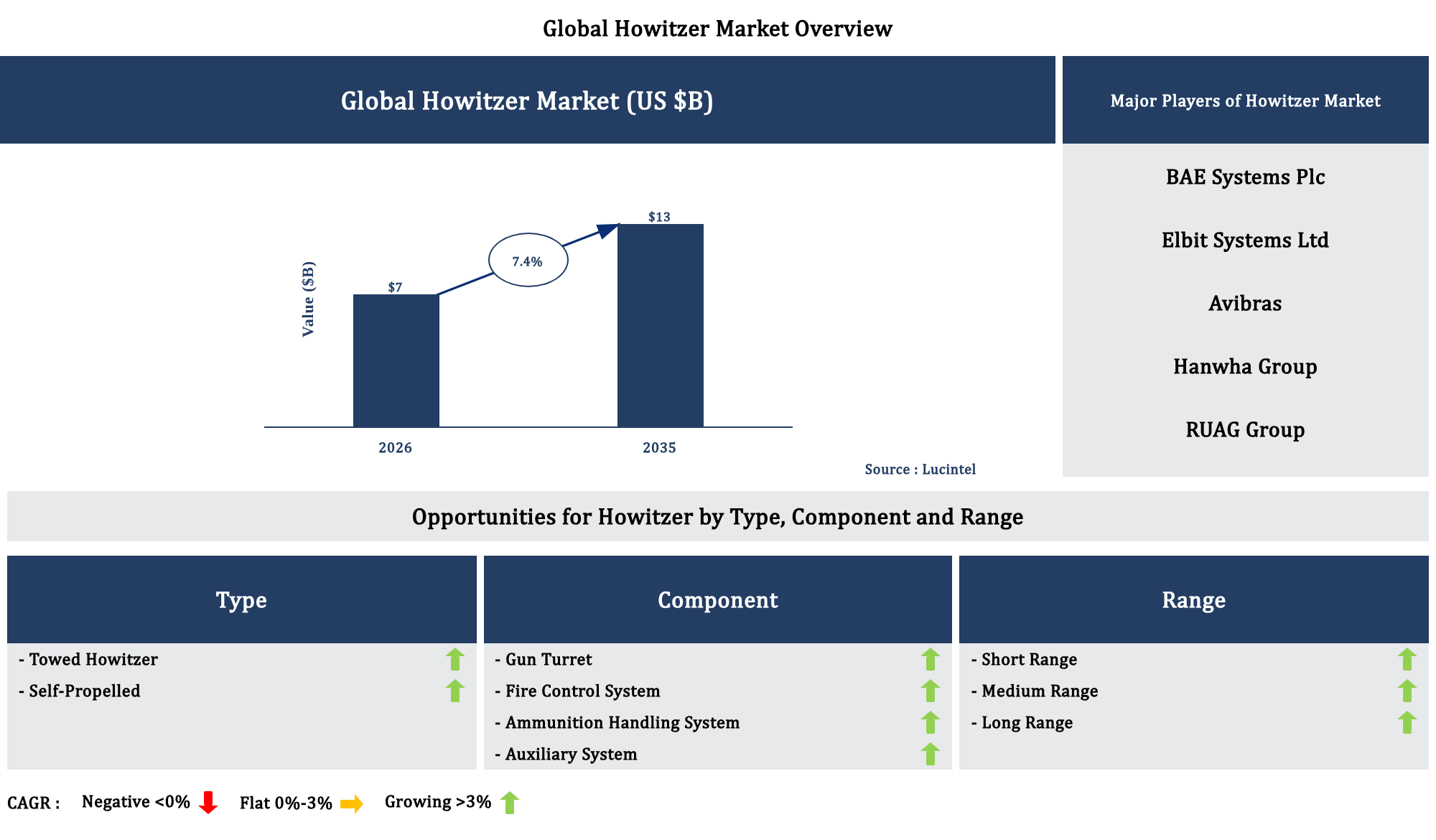
Howitzer Market

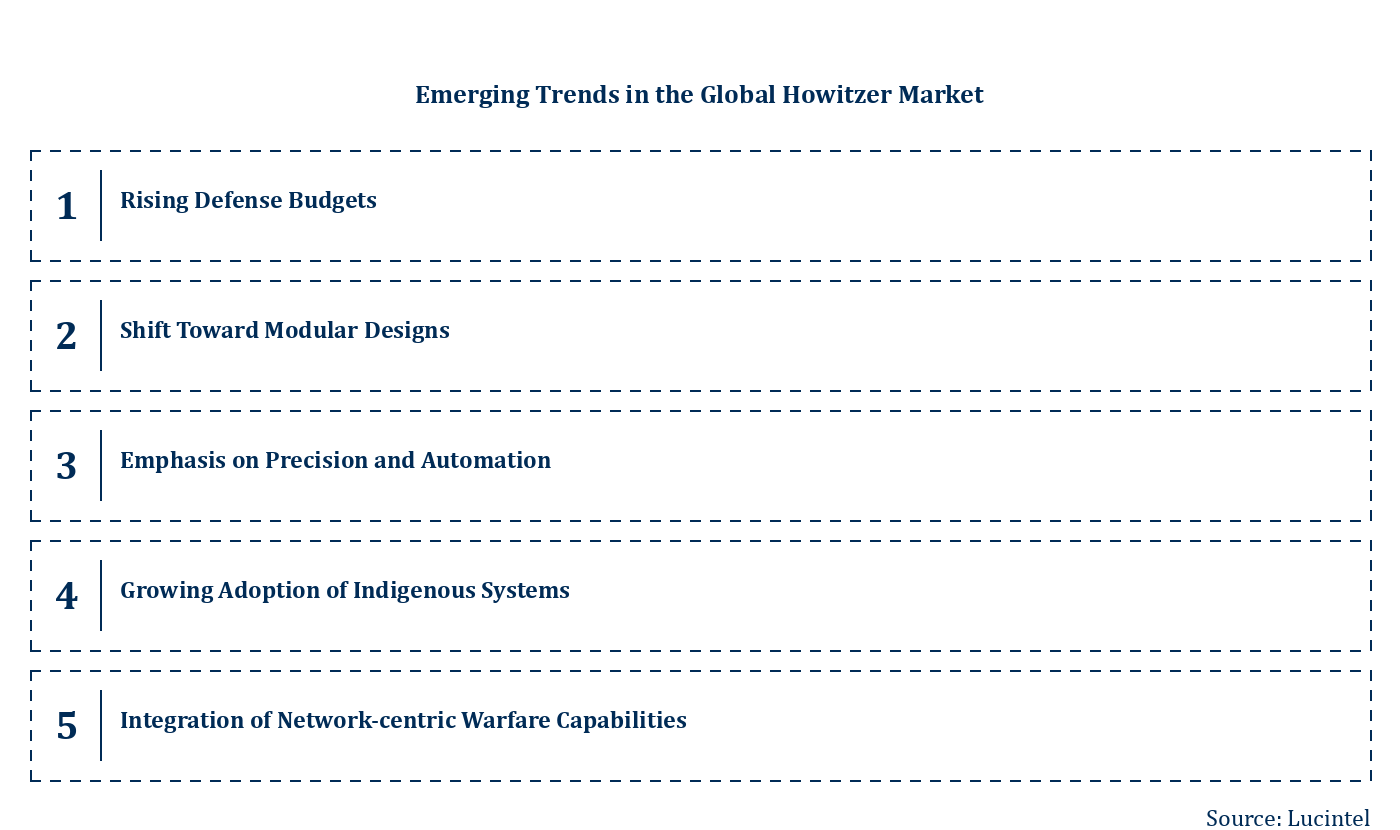
Emerging Trends in the Howitzer Market

The howitzer market is experiencing significant transformation driven by evolving defense needs, geopolitical tensions, and technological progress. As nations seek more effective artillery solutions, manufacturers are adapting to new operational demands and strategic priorities. These developments are fostering innovation in design, deployment, and operational efficiency, ultimately reshaping the competitive landscape. The market's growth is also influenced by increased defense budgets and international collaborations, which facilitate the adoption of advanced artillery systems. Understanding these emerging trends is crucial for stakeholders aiming to capitalize on opportunities and navigate the dynamic environment of modern artillery systems.

  • Rising Defense Budgets: Increased military spending by countries worldwide is fueling market growth. Governments are prioritizing artillery modernization to enhance battlefield capabilities, leading to higher procurement of advanced howitzers. This trend supports research, development, and procurement activities, creating a robust demand pipeline. As defense budgets expand, especially in Asia-Pacific and Middle Eastern regions, the market is expected to see sustained growth, with more countries investing in indigenous and imported artillery systems to strengthen their military arsenals.
  • Shift Toward Modular Designs: The demand for adaptable and customizable artillery systems is increasing. Modular designs allow for easier upgrades, maintenance, and configuration changes, enabling armies to tailor systems to specific operational needs. This flexibility reduces lifecycle costs and enhances operational readiness. Manufacturers are focusing on developing versatile howitzers that can be quickly reconfigured for different missions, such as counter-battery fire or precision strikes, thereby improving tactical effectiveness and extending the lifespan of artillery assets.
  • Emphasis on Precision and Automation: The market is witnessing a move toward highly accurate and automated artillery systems. Integration of advanced fire control systems, GPS guidance, and automated loading mechanisms improves targeting precision and reduces crew workload. These innovations lead to faster response times and increased battlefield survivability. The adoption of such systems is particularly prominent among technologically advanced militaries seeking to modernize their artillery units and gain a strategic edge through enhanced accuracy and operational efficiency.
  • Growing Adoption of Indigenous Systems: Countries are increasingly developing their own artillery systems to reduce reliance on imports and foster self-sufficiency. This trend is driven by geopolitical considerations, cost factors, and the desire for customized solutions. Indigenous development efforts are supported by government initiatives and defense research agencies, leading to a rise in domestically produced howitzers. This shift not only boosts local industries but also encourages innovation tailored to specific national security requirements, impacting global supply chains and market competition.
  • Integration of Network-Centric Warfare Capabilities: Modern howitzers are being integrated into broader battlefield networks for real-time data sharing and coordinated operations. This connectivity enhances situational awareness and allows for more precise and synchronized strikes. Network-centric capabilities enable artillery units to respond swiftly to changing battlefield conditions and collaborate seamlessly with other military assets. This trend is transforming traditional artillery roles into more dynamic and integrated components of modern warfare, significantly improving operational effectiveness and strategic planning.

These emerging trends are fundamentally reshaping the howitzer market by promoting more adaptable, precise, and integrated artillery solutions. Increased defense spending, innovative design approaches, and technological advancements are driving growth and competitiveness. As countries modernize their military forces, the market is poised for continued evolution, emphasizing efficiency, self-reliance, and battlefield connectivity, ultimately redefining how artillery systems are developed, deployed, and utilized in contemporary warfare.
Howitzer Market by country

Recent Developments in the Howitzer Market

The howitzer market is experiencing significant growth driven by technological advancements, increased defense budgets, and geopolitical tensions worldwide. Countries are modernizing their artillery systems to enhance battlefield effectiveness, leading to innovations in design and firepower. The demand for lightweight, mobile, and precision-guided howitzers is rising, creating new opportunities for manufacturers. Additionally, international defense collaborations and procurement programs are fueling market expansion. These developments are reshaping the global artillery landscape, making it more dynamic and competitive, with a focus on enhanced performance and strategic superiority.

  • Technological Innovations in Howitzer Design: The market is witnessing rapid advancements in automation, targeting systems, and materials, leading to more accurate, reliable, and lightweight artillery. These innovations improve operational efficiency and reduce crew fatigue, making modern howitzers more adaptable to various combat scenarios. Countries investing in R&D are gaining a competitive edge, fostering a shift toward smarter, more integrated artillery systems. This evolution is expected to drive increased procurement and modernization efforts worldwide.
  • Rising Defense Budgets and Military Modernization: Governments are allocating higher budgets to modernize their armed forces, emphasizing artillery upgrades. This financial commitment supports the procurement of advanced howitzers, boosting market growth. Countries are prioritizing artillery to strengthen their defense capabilities amid rising regional tensions. Increased military spending also encourages domestic manufacturing and technology transfer, fostering local industry growth and reducing reliance on imports, ultimately expanding the market scope.
  • Geopolitical Tensions and Regional Conflicts: Ongoing conflicts and regional disputes are prompting nations to enhance their artillery capabilities for strategic dominance. The demand for versatile, high-capacity howitzers is surging in conflict zones, leading to increased orders from both state and non-state actors. These tensions accelerate procurement cycles and foster international arms trade, contributing to market expansion. Countries seek to modernize their artillery to ensure quick response and battlefield superiority, further propelling market growth.
  • International Defense Collaborations and Procurement Programs: Countries are engaging in joint development projects and defense alliances to acquire advanced howitzers. These collaborations facilitate technology sharing, cost reduction, and access to cutting-edge systems. Large-scale procurement programs, such as military aid and export deals, are boosting sales and market penetration. Such partnerships foster innovation and standardization, making the market more competitive and globally integrated, while also supporting local industry development.
  • Growing Demand for Lightweight and Mobile Howitzers: The need for portable, easy-to-deploy artillery systems is increasing, especially for rapid deployment and expeditionary forces. Manufacturers are focusing on developing lightweight, modular, and transportable howitzers that can be quickly mobilized in diverse terrains. This trend enhances battlefield flexibility and operational agility, attracting military buyers seeking versatile solutions. The demand is also driven by the need for quick setup and disassembly, making these systems ideal for modern, fast-paced military operations.

These developments are significantly transforming the howitzer market by fostering innovation, increasing procurement, and expanding global trade. Technological advancements and rising defense budgets are driving modernization efforts, while geopolitical tensions are fueling demand for versatile artillery systems. International collaborations are further accelerating growth, making the market more competitive and dynamic. Overall, these opportunities are enhancing military capabilities worldwide, ensuring the market remains robust and poised for continued expansion in the coming years.

Strategic Growth Opportunities in the Howitzer Market

The howitzer market is experiencing significant growth driven by increasing defense budgets, modernization efforts, and geopolitical tensions worldwide. Countries are investing in advanced artillery systems to enhance their military capabilities, leading to technological innovations and expanded applications. The demand for versatile, high-precision artillery is rising across various regions, creating opportunities for manufacturers and suppliers. Strategic partnerships, modernization programs, and regional conflicts further accelerate market expansion, making it a critical component of modern defense strategies globally.

  • Increasing Defense Budgets Drive Market Expansion: Rising defense spending by governments worldwide is fueling the demand for modern howitzers. Countries seek to upgrade their artillery systems to improve battlefield effectiveness, leading to increased procurement and modernization initiatives. This financial commitment supports research, development, and deployment of advanced artillery systems, creating a robust growth environment for the market. The focus on national security and military readiness further amplifies this trend, ensuring sustained market growth.
  • Technological Innovations Enhance Artillery Capabilities: Advances in materials, targeting systems, and automation are transforming howitzers into more precise and reliable weapons. Integration of GPS, fire control systems, and automation improves accuracy and reduces crew requirements. These innovations enable faster deployment and better battlefield responsiveness. Manufacturers investing in R&D are developing next-generation howitzers with enhanced range, mobility, and survivability, which attract military buyers seeking cutting-edge solutions, thus expanding market opportunities.
  • Regional Conflicts and Geopolitical Tensions Increase Demand: Ongoing regional conflicts and geopolitical tensions in areas like the Middle East, Asia-Pacific, and Eastern Europe drive the need for modern artillery systems. Countries seek to bolster their defense capabilities to counter threats and maintain strategic advantages. This heightened demand results in increased procurement, upgrades, and local manufacturing initiatives, contributing significantly to market growth. The persistent nature of regional conflicts ensures a continuous need for advanced artillery solutions.
  • Modernization Programs Promote Market Growth: Many nations are undertaking comprehensive military modernization programs, focusing on upgrading existing artillery fleets with advanced howitzers. These initiatives aim to improve operational efficiency, interoperability, and combat readiness. Governments allocate substantial budgets for procurement and modernization, fostering partnerships with defense contractors. The shift towards modern, multi-role artillery systems supports market expansion and encourages technological development tailored to specific regional needs.
  • Growing Adoption of Autonomous and Remote-Controlled Systems: The integration of autonomous and remote-controlled features in howitzers is gaining traction, driven by safety and operational efficiency concerns. These systems reduce crew exposure to danger and enable precise fire support in complex environments. Military forces are increasingly adopting such technologies, creating new market segments. Manufacturers are investing in developing autonomous artillery systems, which are expected to revolutionize battlefield tactics and significantly boost market growth in the coming years.

The overall impact of these opportunities is a dynamic, expanding howitzer market characterized by technological innovation, increased procurement, and strategic modernization efforts. As countries prioritize defense modernization and technological advancements, the market is poised for sustained growth, offering lucrative opportunities for industry players. This evolution will shape future military capabilities and influence global security dynamics significantly.

Howitzer Market Drivers and Challenges

The howitzer market is influenced by a complex interplay of technological advancements, economic factors, and regulatory frameworks. Rapid innovations in artillery technology, increased defense budgets, geopolitical tensions, and evolving military strategies are shaping market dynamics. Additionally, government policies, international treaties, and procurement regulations significantly impact market growth and product development. The convergence of these factors creates both opportunities and challenges for manufacturers, suppliers, and defense agencies. Understanding these drivers and challenges is essential for stakeholders aiming to navigate the evolving landscape effectively and capitalize on emerging trends while mitigating risks.

The factors responsible for driving the howitzer market include:

  • Technological Innovation: The continuous development of advanced artillery systems, such as precision-guided munitions and automated targeting, enhances operational efficiency and battlefield effectiveness. These innovations attract military investments and expand market opportunities by offering superior performance, longer range, and improved accuracy. As defense forces seek modernized artillery, manufacturers are motivated to invest in R&D, fueling market growth. The integration of digital technologies and automation further accelerates adoption, making technologically advanced howitzers a key driver in maintaining strategic superiority.
  • Increasing Defense Budgets: Many countries are boosting their defense spending to modernize armed forces and enhance national security. Elevated budgets enable procurement of sophisticated artillery systems, including modern howitzers, which directly stimulates market demand. Governments prioritize defense modernization in response to regional conflicts and geopolitical tensions, leading to sustained investments. This financial commitment supports research, development, and procurement activities, creating a favorable environment for market expansion and encouraging manufacturers to innovate and scale production.
  • Geopolitical Tensions and Conflicts: Rising regional conflicts and geopolitical instability drive demand for advanced artillery systems as nations seek to strengthen their military capabilities. The need for rapid deployment and high-precision weaponry becomes critical in conflict zones, prompting increased procurement of modern howitzers. These tensions also lead to increased military readiness and strategic positioning, which directly impact market growth. Countries are investing in artillery to ensure tactical superiority, thus fueling demand and encouraging technological advancements within the market.
  • Strategic Military Modernization: Countries are focusing on modernizing their armed forces to maintain strategic advantages. This includes upgrading existing artillery systems and acquiring new, more capable howitzers. Modernization programs are often driven by evolving warfare tactics, requiring longer-range, more accurate, and versatile artillery. Governments and defense agencies prioritize these upgrades to enhance operational readiness, which significantly propels market growth. The emphasis on interoperability and multi-domain operations further accelerates the adoption of next-generation howitzers, shaping the market landscape.
  • International Defense Alliances and Procurement Policies: Defense alliances and collaborative procurement initiatives influence market dynamics by facilitating joint development and procurement of artillery systems. These policies promote technology sharing, reduce costs, and expand market reach for manufacturers. Countries participating in alliances often standardize equipment, creating a stable demand environment. Additionally, export policies and defense agreements open new markets for manufacturers, fostering growth. Such collaborative efforts and procurement strategies are vital drivers that shape the competitive landscape and expand the global reach of the howitzer market.

The challenges facing the howitzer market are:

  • High Development and Procurement Costs: Developing advanced howitzers involves significant R&D investments, which can be a barrier for manufacturers, especially smaller firms. Procurement costs for modern artillery systems are also high, limiting affordability for some countries. Budget constraints and competing priorities may delay or reduce procurement plans, impacting market growth. Additionally, maintenance and lifecycle costs pose ongoing financial challenges, requiring sustained investment. These economic factors can slow down technological adoption and market expansion, especially in emerging markets with limited defense budgets.
  • Regulatory and Export Restrictions: International treaties, export controls, and regulatory frameworks can hinder the global trade of artillery systems. Countries often impose restrictions to prevent proliferation of military technology, complicating cross-border sales and collaborations. These regulations can delay or block deals, reduce market access, and increase compliance costs for manufacturers. Navigating complex legal environments requires significant resources and expertise, which can act as a barrier to entry and limit market growth, especially for companies seeking to expand internationally.
  • Rapid Technological Obsolescence: The fast pace of technological innovation in artillery systems can render existing models obsolete quickly. Manufacturers face pressure to continuously upgrade and innovate, increasing R&D costs and operational risks. Customers may delay procurement to wait for newer, more advanced systems, leading to market uncertainty. This rapid obsolescence challenges manufacturers to balance innovation with cost-effectiveness and can result in shorter product life cycles, impacting profitability and market stability.

The howitzer market is shaped by dynamic technological, economic, and geopolitical factors that drive growth and innovation. While technological advancements, increased defense spending, and strategic modernization propel the market forward, high costs, regulatory hurdles, and rapid technological changes pose significant challenges. These drivers and challenges collectively influence market stability, competitiveness, and future growth prospects. Stakeholders must navigate these complexities carefully to capitalize on opportunities and mitigate risks, ensuring sustained development and strategic advantage in the evolving defense landscape.

List of Howitzer Market Companies

Companies in the market compete on the basis of product quality offered. Major players in this market focus on expanding their manufacturing facilities, R&D investments, infrastructural development, and leverage integration opportunities across the value chain. Through these strategies howitzer market companies cater increasing demand, ensure competitive effectiveness, develop innovative products & technologies, reduce production costs, and expand their customer base. Some of the howitzer market companies profiled in this report include-

  • BAE Systems Plc
  • Elbit Systems Ltd
  • Avibras
  • Hanwha Group
  • RUAG Group
  • IMI Systems
  • General Dynamics
  • ST Engineering
  • Denel SOC Ltd
  • Saab AB

Howitzer Market by Segment

The study includes a forecast for the global howitzer market by type, component, range, and region.

  • Howitzer Market by Type [Value from 2019 to 2035]:
    • Towed Howitzer
    • Self-Propelled
  • Howitzer Market by Component [Value from 2019 to 2035]:
    • Gun Turret
    • Fire Control System
    • Ammunition Handling System
    • Auxiliary System
  • Howitzer Market by Range [Value from 2019 to 2035]:
    • Short Range
    • Medium Range
    • Long Range
  • Howitzer Market by Region [Value ($B) from 2019 to 2035]:
    • North America
    • Europe
    • Asia Pacific
    • The Rest of the World

Country Wise Outlook for the Howitzer Market

The howitzer market has experienced significant shifts driven by technological advancements, geopolitical tensions, and evolving defense strategies across the globe. Countries are investing heavily in modernizing their artillery capabilities to enhance battlefield effectiveness and strategic deterrence. Innovations include increased automation, precision targeting, and integration with advanced surveillance systems. The market's growth is also influenced by international defense collaborations and procurement policies. As nations seek to bolster their military strength, the demand for advanced howitzers continues to rise, prompting manufacturers to develop more sophisticated and versatile artillery systems tailored to specific operational needs.

  • United States: The US has focused on upgrading its artillery systems with the introduction of the M109A7 Paladin and the development of the Next-Generation Howitzer (NGH), emphasizing automation, mobility, and precision. The US Army is also investing in integrating artificial intelligence and digital fire control systems to improve accuracy and response times.
  • China: China has rapidly expanded its artillery capabilities, deploying domestically produced self-propelled howitzers like the PCL-181 and PCL-171. The country emphasizes modernization through technological innovation, including enhanced targeting systems and increased range, to strengthen its regional military presence.
  • Germany: Germany has been advancing its artillery technology with the Panzerhaubitze 2000 (Ph. 2000), focusing on precision, mobility, and interoperability within NATO. Recent developments include upgrades to fire control systems and integration with NATO command networks to improve operational efficiency.
  • India: India is actively modernizing its artillery fleet with the purchase of the K9 Vajra-T and the development of indigenous systems like the Dhanush howitzer. The focus is on increasing range, accuracy, and mobility to address regional security challenges and border tensions.
  • Japan: Japan has been enhancing its artillery capabilities through the deployment of advanced self-propelled howitzers such as the Type 99 and Type 75. The country emphasizes technological innovation, including improved targeting and fire control systems, to bolster its defense posture amid regional tensions.

Features of the Howitzer Market

  • Market Size Estimates: Howitzer market size estimation in terms of value ($B).
  • Trend and Forecast Analysis: Market trends (2019 to 2025) and forecast (2026 to 2035) by various segments and regions.
  • Segmentation Analysis: Howitzer market size by type, component, range, and region in terms of value ($B).
  • Regional Analysis: Howitzer market breakdown by North America, Europe, Asia Pacific, and Rest of the World.
  • Growth Opportunities: Analysis of growth opportunities in different types, components, ranges, and regions for the howitzer market.
  • Strategic Analysis: This includes M&A, new product development, and competitive landscape of the howitzer market.
  • Analysis of competitive intensity of the industry based on Porter’s Five Forces model.

Top 5 Companies

  • BAE Systems Plc
  • Elbit Systems Ltd
  • Avibras
  • Hanwha Group
  • RUAG Group

Table of Contents

1. Executive Summary
14.1 Competitive Analysis Overview

List of Figures

List of Tables

Methodology

Lucintel has been in the business of market research and management consulting since 2000 and has published over 1000 market intelligence reports in various markets / applications and served over 1,000 clients worldwide. This study is a culmination of four months of full-time effort performed by Lucintel's analyst team. The analysts used the following sources for the creation and completion of this valuable report:

  • In-depth interviews of the major players in this market
  • Detailed secondary research from competitors' financial statements and published data
  • Extensive searches of published works, market, and database information pertaining to industry news, company press releases, and customer intentions
  • A compilation of the experiences, judgments, and insights of Lucintel's professionals, who have analyzed and tracked this market over the years.

Extensive research and interviews are conducted across the supply chain of this market to estimate market share, market size, trends, drivers, challenges, and forecasts. Below is a brief summary of the primary interviews that were conducted by job function for this report.

Lucintel's methodology for market research

Thus, Lucintel compiles vast amounts of data from numerous sources, validates the integrity of that data, and performs a comprehensive analysis. Lucintel then organizes the data, its findings, and insights into a concise report designed to support the strategic decision-making process. The figure below is a graphical representation of Lucintel's research process.

Primary interviews by job function

Buy Now

Choose a license that fits your team. Instant PDF delivery.

Market Report

1 User PDF

$4,850
Buy Now

Market Report

2-5 Users PDF

$6,700
Buy Now

Market Report

Corporate PDF

$8,850
Buy Now

Market Report

Global PDF

$10,000
Buy Now

Prices exclude taxes. Instant delivery. Custom licensing available on request.

Frequently Asked Questions

What is the howitzer market size?
The global howitzer market is expected to reach an estimated $13 billion by 2035.
What is the growth forecast for howitzer market?
The global howitzer market is expected to grow with a CAGR of 7.4% from 2026 to 2035.
What are the major drivers influencing the growth of the howitzer market?
The major drivers for this market are the increasing demand for advanced artillery systems, the rising adoption of precision guided munitions, and the growing need for rapid deployment capabilities.
What are the major segments for howitzer market?
The future of the howitzer market looks promising with opportunities in the gun turret, fire control system, ammunition handling system, and auxiliary system markets.
Who are the key howitzer market companies?

Some of the key howitzer companies are as follows:

  • BAE Systems Plc
  • Elbit Systems Ltd
  • Avibras
  • Hanwha Group
  • RUAG Group
  • IMI Systems
  • General Dynamics
  • ST Engineering
  • Denel SOC Ltd
  • Saab AB
Which howitzer market segment will be the largest in future?
Lucintel forecasts that, within the type category, towed howitzer is expected to witness higher growth over the forecast period.
In howitzer market, which region is expected to be the largest in next 9 years?
In terms of region, North America is expected to witness the highest growth over the forecast period.
Do we receive customization in this report?
Yes, Lucintel provides 10% customization without any additional cost.

Key Questions

  • What are some of the most promising, high-growth opportunities for the howitzer market by type (towed howitzer and self-propelled), component (gun turret, fire control system, ammunition handling system, and auxiliary system), range (short range, medium range, and long range), and region (North America, Europe, Asia Pacific, and the Rest of the World)?
  • Which segments will grow at a faster pace and why?
  • Which region will grow at a faster pace and why?
  • What are the key factors affecting market dynamics? What are the key challenges and business risks in this market?
  • What are the business risks and competitive threats in this market?
  • What are the emerging trends in this market and the reasons behind them?
  • What are some of the changing demands of customers in the market?
  • What are the new developments in the market? Which companies are leading these developments?
  • Who are the major players in this market? What strategic initiatives are key players pursuing for business growth?
  • What are some of the competing products in this market and how big of a threat do they pose for loss of market share by material or product substitution?
  • What M&A activity has occurred in the last 6 years and what has its impact been on the industry?
Why Choose Us

The Lucintel Advantage

Trusted partner for strategic intelligence and business growth

25+ Years Excellence

25+ Years Excellence

Quarter century of proven expertise in management consulting and market research across global markets.
Game-Changer Ideas

Game-Changer Ideas

Innovative strategies and actionable insights that help clients become the smartest in their industry.
Global Reach

Global Reach

Extensive coverage across 50+ industries and markets worldwide with localized expertise.
Start Your Growth Journey

Get Your Free
Market Intelligence
Briefing

Receive a complimentary market analysis tailored to your industry. Our analysts will identify key growth opportunities and competitive dynamics specific to your business.

Custom Market Snapshot

Market size, growth rate, and key trend analysis for your specific sector.

Competitive Landscape Overview

Top competitor positioning and market share analysis.

Growth Opportunity Identification

Strategic recommendations backed by data-driven insights.

Subscribe

Subscribe to our Newsletter

Get curated market intelligence and competitive moves straight to your inbox.

By subscribing, you agree to receive our monthly insights. Unsubscribe anytime.

Industry Trends Market Signals Opportunities Competitor Moves
