
Market Report · July 31, 2026

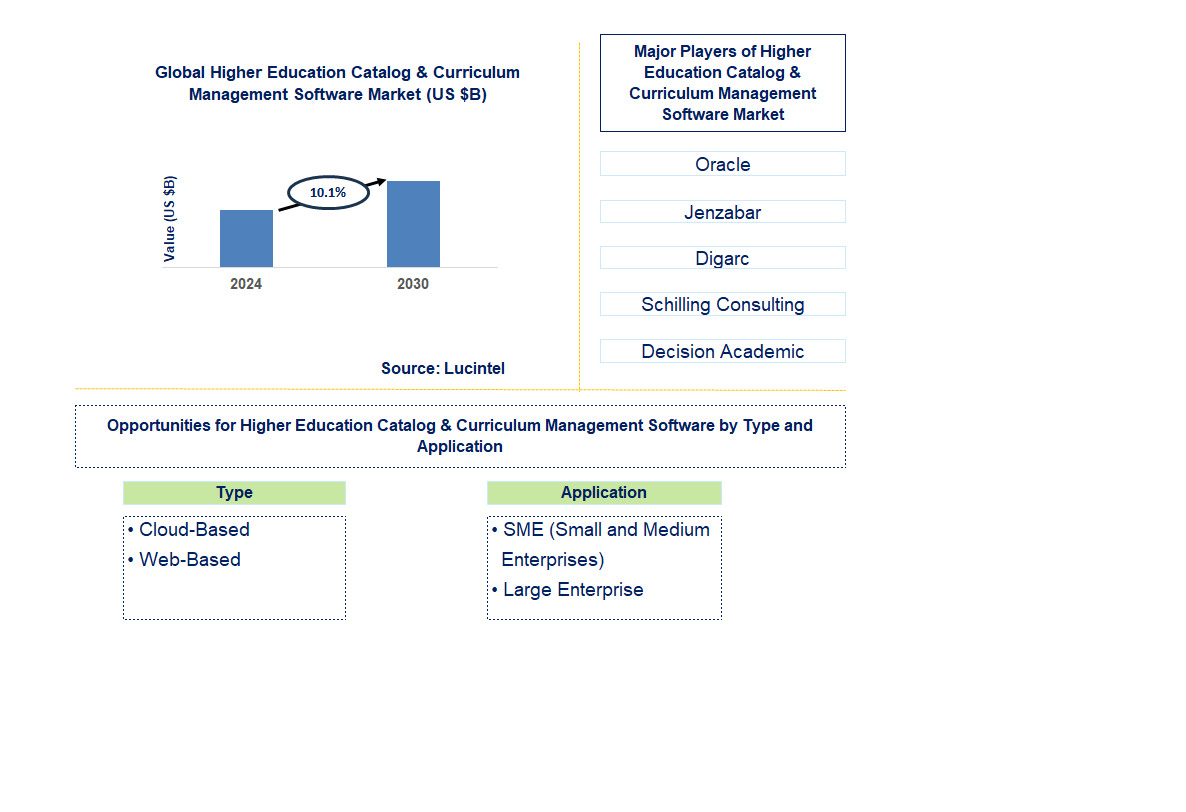
Key data points: The growth forecast = 10.1% annually next 6 years. Scroll below to get more insights. This market report covers trends, opportunities, and forecast in the global higher education catalog & curriculum management software market to 2030 by type (cloud-based and web-based), application (sme (small and medium enterprises) and large enterprise), and region (North America, Europe, Asia Pacific, and the Rest of the World)
We'll send your sample report shortly.
• United States: In the United States, the Higher education catalogue and curriculum management software market has seen significant advancements with the integration of AI and machine learning. Institutions are adopting sophisticated platforms that offer predictive analytics to improve course scheduling and student advising. Enhanced user interfaces and cloud-based solutions are becoming standard, providing greater flexibility and accessibility. Moreover, interoperability with other campus systems and compliance with federal regulations are critical focuses, ensuring seamless integration and data management across various platforms.
• China: China is rapidly advancing in the Higher Education Catalogue and Curriculum Management Software sector, driven by the government's push towards digital transformation in education. New developments include the adoption of big data and AI to personalize learning experiences and optimize curriculum design. Chinese institutions are increasingly integrating these systems with national educational databases to ensure alignment with regulatory standards and educational policies. Additionally, there is a strong emphasis on mobile-friendly platforms to cater to the growing use of smartphones among students.
• Germany: In Germany, the focus is on enhancing interoperability and standardization within the Higher Education Catalogue and Curriculum Management Software market. Recent developments include the adoption of open-source platforms and integration with European educational frameworks to support mobility and cross-border collaborations. German institutions are also investing in user-centered design to improve the accessibility and usability of these systems. There is a notable trend towards sustainability and data privacy, reflecting Germany's broader commitment to environmental and data protection standards.
• India: Indian higher education sector is experiencing rapid growth in the adoption of curriculum management software driven by increasing digitalization and the need for scalable solutions. Recent advancements include the implementation of cloud-based systems that support remote access and collaboration. Indian institutions are also focusing on integrating these systems with local and national educational standards to streamline accreditation and compliance processes. The rise of edtech startups is further accelerating innovation, with new solutions that cater specifically to the diverse and expanding needs of Indian higher education.
• Japan: In Japan, the Higher education catalogue and curriculum management software market is evolving with a strong emphasis on technological integration and user experience. Recent developments include the adoption of advanced analytics and AI to support data-driven decision-making in curriculum planning. Japanese institutions are also focusing on enhancing mobile access and integrating these systems with national educational databases to facilitate better student and administrative interactions. There is a growing trend towards customization and localization of software to meet the specific needs of Japan's unique educational landscape.
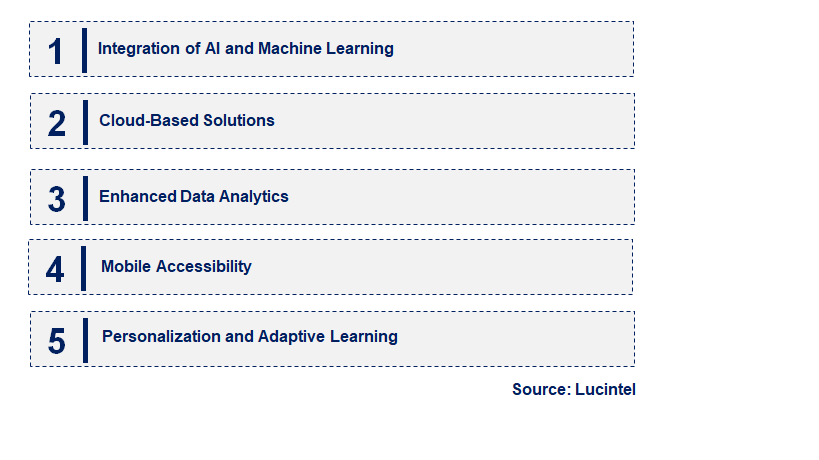
• Integration of AI and Machine Learning: AI and machine learning are becoming integral to curriculum management systems, offering advanced capabilities such as predictive analytics for course scheduling and student performance forecasting. These technologies enable institutions to optimize course offerings, personalize learning experiences, and streamline administrative processes. By analyzing vast amounts of data, AI-driven systems can provide actionable insights that enhance decision-making and improve overall educational outcomes.
• Cloud-Based Solutions: Cloud-based solutions are gaining prominence due to their scalability, flexibility, and cost-effectiveness. Institutions are increasingly adopting cloud platforms to manage their catalogues and curricula, allowing for remote access, real-time updates, and seamless integration with other systems. Cloud-based systems also support collaboration and data sharing among faculty, students, and administrative staff, facilitating a more connected and agile educational environment.
• Enhanced Data Analytics: The use of advanced data analytics in curriculum management is transforming how institutions make strategic decisions. By leveraging data analytics, institutions can gain insights into student enrollment trends, curriculum effectiveness, and program performance. This data-driven approach helps in refining curriculum offerings, optimizing resource allocation, and improving student outcomes, ensuring that educational programs are aligned with institutional goals and student needs.
• Mobile Accessibility: With the growing use of smartphones and tablets, mobile accessibility is becoming a key focus in curriculum management software. Institutions are developing mobile-friendly platforms that allow students and faculty to access course information, manage schedules, and engage with learning materials on the go. Mobile accessibility enhances convenience and engagement, providing users with the flexibility to interact with educational resources anytime and anywhere.
• Personalization and Adaptive Learning: Personalization and adaptive learning technologies are revolutionizing curriculum management by tailoring educational experiences to individual student needs. Systems that incorporate adaptive learning can adjust course content and delivery methods based on student performance and preferences. This personalized approach helps address diverse learning styles and paces, improving student engagement and success rates.
• AI-Powered Predictive Analytics: AI-powered predictive analytics are becoming a cornerstone of modern curriculum management systems. These tools help institutions forecast enrollment trends, identify at-risk students, and optimize course scheduling. By analyzing historical data and identifying patterns, AI-driven systems can provide valuable insights that aid in strategic planning and improve decision-making processes.
• Cloud-Based Integration: Cloud-based integration is revolutionizing curriculum management by offering scalable and flexible solutions. Institutions are increasingly adopting cloud platforms to manage their catalogues and curricula, enabling real-time updates and remote access. This shift facilitates better collaboration, data sharing, and integration with other campus systems, enhancing overall operational efficiency.
• Advanced Data Visualization: Advanced data visualization tools enhance how institutions interact with curriculum data. These tools provide intuitive and interactive ways to analyze and present data, helping administrators and faculty make informed decisions. Improved data visualization supports a better understanding of trends and performance metrics, leading to more effective curriculum management and strategic planning.
• Mobile-Optimized Platforms: The development of mobile-optimized platforms addresses the growing demand for on-the-go access to curriculum information. Institutions are creating mobile-friendly interfaces that allow students and faculty to manage schedules, access course materials, and engage with educational content from smartphones and tablets. This development improves accessibility and convenience for users.
• Enhanced User Experience Design: There is a strong focus on enhancing user experience design in curriculum management software. Institutions are prioritizing user-centered design principles to create intuitive and easy-to-navigate interfaces. This development aims to improve user satisfaction and efficiency, ensuring that both students and faculty can effectively utilize the software for their educational needs.
• AI-Enhanced Curriculum Personalization: AI-enhanced curriculum personalization represents a major growth opportunity by tailoring educational content to individual student needs and learning styles. Through AI algorithms, software can analyze student performance data and adapt curriculum materials accordingly. This personalized approach improves student engagement and outcomes, making education more effective and responsive. Institutions can leverage AI to create adaptive learning pathways and support diverse learning preferences, ultimately leading to more successful and satisfied students.
• Cloud-Based Collaboration Tools: Cloud-based collaboration tools offer significant growth potential by facilitating seamless communication and teamwork among faculty and students. These tools enable real-time updates, document sharing, and collaborative curriculum development from any location. Institutions can enhance their academic programs by integrating cloud solutions that support remote learning and collaborative planning. The flexibility and scalability of cloud-based platforms also allow institutions to efficiently manage and update their curriculum without the limitations of traditional, on-premise systems.
• Advanced Data Analytics for Strategic Planning: Advanced data analytics provides a growth opportunity by enabling institutions to make data-driven decisions for curriculum planning and management. By analyzing enrollment trends, course performance, and student feedback, institutions can optimize course offerings and resource allocation. Data-driven insights help institutions identify gaps in the curriculum, forecast future needs, and develop strategic plans to address evolving educational demands. Enhanced analytics capabilities can lead to more informed decision-making and improved academic program effectiveness.
• Mobile-Optimized Learning Platforms: Mobile-optimized learning platforms present a growth opportunity by addressing the increasing use of smartphones and tablets in education. By developing mobile-friendly interfaces, institutions can ensure that students and faculty have access to curriculum management tools anytime and anywhere. Mobile optimization enhances the flexibility and accessibility of educational resources, supporting remote learning and on-the-go access. This growth opportunity aligns with the increasing demand for mobile access and can improve user engagement and satisfaction.
• Integration with Emerging EdTech Solutions: Integrating higher education catalogue and curriculum management software with emerging EdTech solutions is a key growth opportunity. By connecting with tools like virtual labs, interactive simulations, and online assessment platforms, institutions can enhance their curriculum offerings and provide a more engaging learning experience. Integration with EdTech solutions supports innovation in teaching methods and expands the range of educational resources available to students. This synergy can lead to more dynamic and effective educational programs.
• Oracle
• Jenzabar
• Digarc
• Schilling Consulting
• Decision Academic
• Entrada
• Ellucian
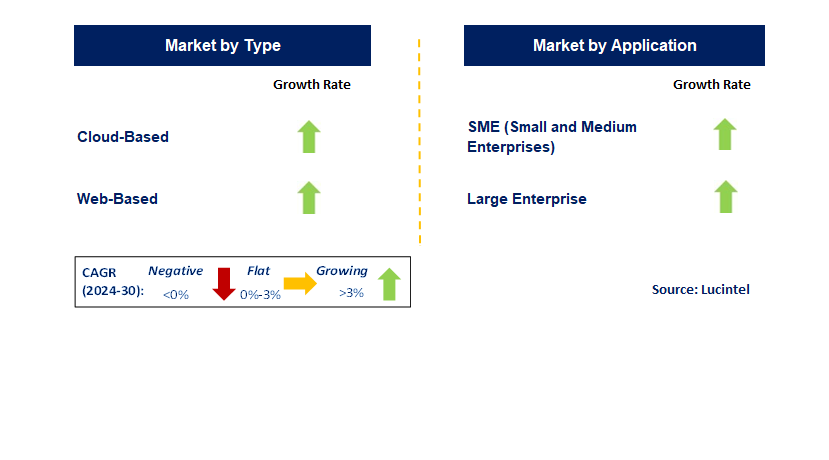
• Cloud-Based
• Web-Based
• SME (Small and Medium Enterprises)
• Large Enterprise
• North America
• Europe
• Asia Pacific
• The Rest of the World
• Lucintel forecasts that, within the type category, cloud-based is expected to witness higher growth over the forecast period.
• Within the application category, large enterprises will remain the larger segment.
• In terms of regions, North America is expected to witness the highest growth over the forecast period.


• Oracle
• Jenzabar
• Digarc
• Schilling Consulting
• Decision Academic
• Entrada
• Ellucian
Q5. Which higher education catalog & curriculum management software market segment will be the largest in the future?

Choose a license that fits your team. Instant PDF delivery.
Prices exclude taxes. Instant delivery. Custom licensing available on request.
Market Report · July 31, 2026
Market Report · July 31, 2026
Market Report · July 31, 2026
Trusted partner for strategic intelligence and business growth


Receive a complimentary market analysis tailored to your industry. Our analysts will identify key growth opportunities and competitive dynamics specific to your business.

Market size, growth rate, and key trend analysis for your specific sector.

Top competitor positioning and market share analysis.

Strategic recommendations backed by data-driven insights.
Get curated market intelligence and competitive moves straight to your inbox.
By subscribing, you agree to receive our monthly insights. Unsubscribe anytime.
Receive a complimentary market analysis tailored to your industry. Our analysts will identify key growth opportunities and competitive dynamics specific to your business.
Market size, growth rate, and key trend analysis for your specific sector.
Top competitor positioning and market share analysis.
Strategic recommendations backed by data-driven insights.
Get curated market intelligence, emerging trends, and competitive moves straight to your inbox each month.
By subscribing, you agree to receive our monthly insights. Unsubscribe anytime.
We'll send your sample report shortly.