
Market Report · July 15, 2026

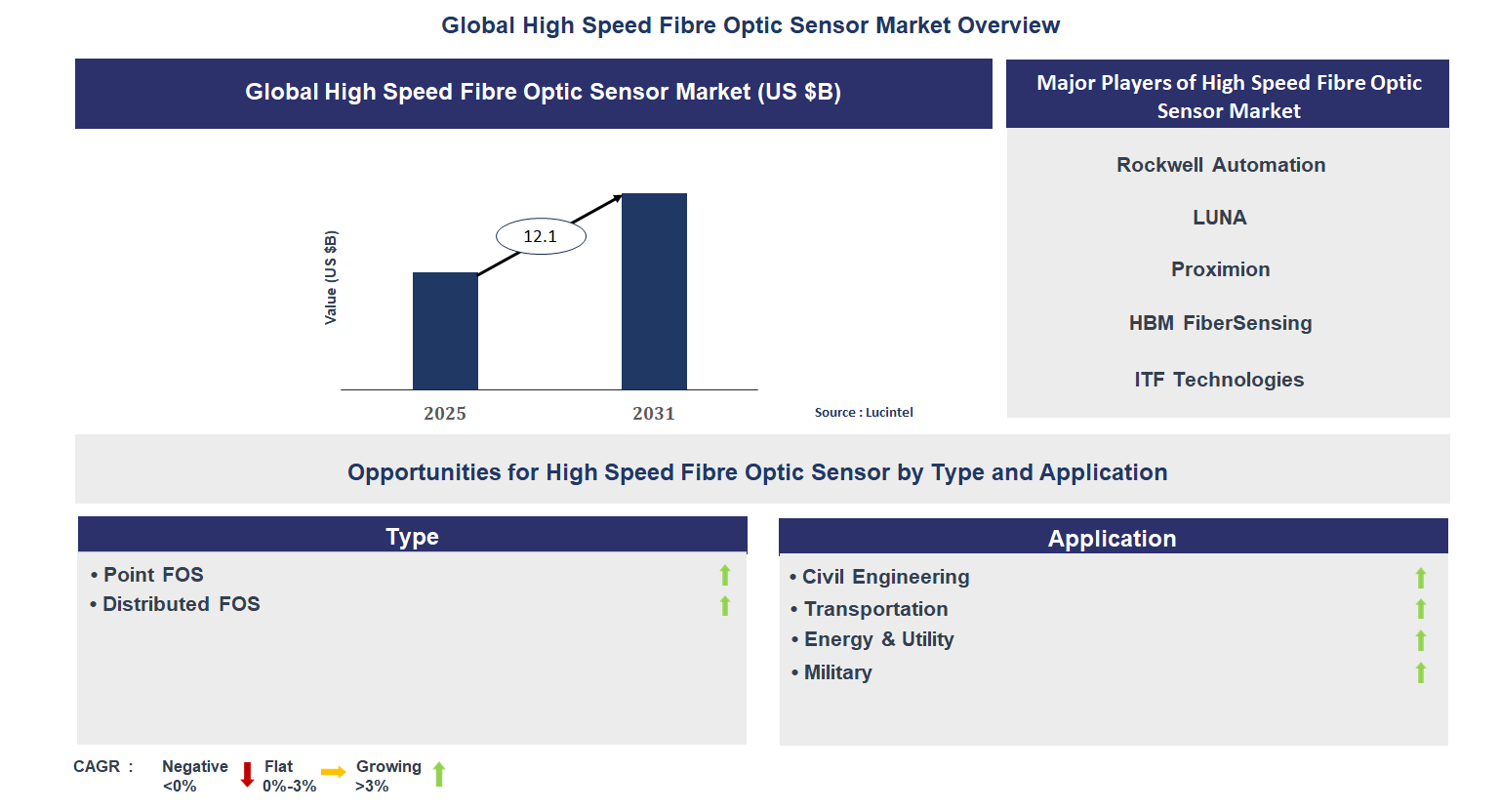
Key data points: The growth forecast = 12.1% annually for the next 7 years. Scroll below to get more insights. This market report covers trends, opportunities and forecasts in high speed fibre optic sensor market to 2031 by type (point FOS and distributed FOS), application (civil engineering, transportation, energy & utility, and military), and region (North America, Europe, Asia Pacific, and the Rest of the World)
We'll send your sample report shortly.
• Lucintel forecasts that, within the type category, distributed FOS is expected to witness higher growth over the forecast period.
• Within the application category, energy & utility is expected to witness the highest growth.
• In terms of region, APAC is expected to witness the highest growth over the forecast period. Gain valuable insights for your business decisions with our comprehensive 150+ page report. Sample figures with some insights are shown below.
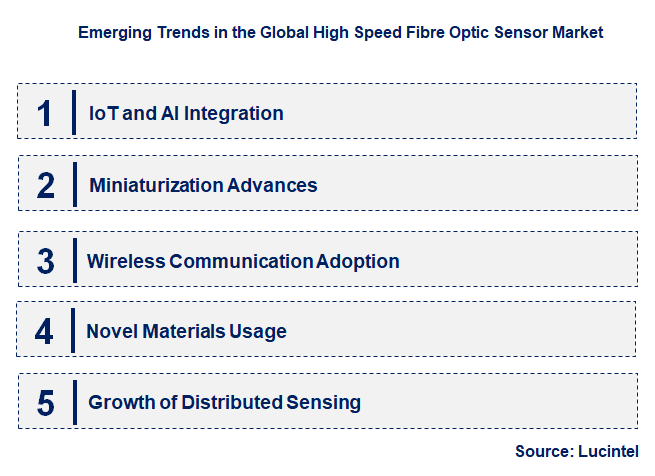
• IoT and AI Integration: Combining fiber optic sensors with IoT and AI improves data analytics, enabling predictive maintenance and real-time decision-making across sectors.
• Miniaturization Advances: Development of smaller, more robust sensors expands use in compact and harsh environments, increasing deployment flexibility.
• Wireless Communication Adoption: Wireless integration facilitates remote monitoring in inaccessible or hazardous locations, enhancing operational safety and convenience.
• Novel Materials Usage: Advanced materials improve sensor sensitivity, durability, and resistance to environmental factors, boosting reliability.
• Growth of Distributed Sensing: DFOS technology’s ability to monitor extensive infrastructures supports applications in pipelines, bridges, and grids, reducing maintenance costs and risks. These trends are reshaping the market by enhancing sensor intelligence, expanding application scopes, and enabling cost-effective, large-scale monitoring solutions adaptable to diverse environments.
• Increased Manufacturing Capacities: Expansion of sensor production facilities worldwide responds to rising demand in energy, transportation, and civil sectors.
• Enhanced Sensor Accuracy and Speed: Technological progress improves sensing resolution and data transmission rates, supporting critical infrastructure monitoring.
• AI-Driven Data Analytics Integration: Advanced algorithms enable actionable insights from sensor data, enhancing operational efficiency and safety.
• Widespread Adoption in Smart Cities: Deployment in traffic management, environmental monitoring, and infrastructure health accelerates sensor market growth.
• Development of User-Friendly Software Platforms: Improved monitoring and control software facilitate ease of use and broader market acceptance. These developments strengthen the high speed fibre optic sensor market by boosting supply capabilities, enhancing technological offerings, and expanding real-world applications.
• Infrastructure and Structural Health Monitoring: Fiber optic sensors enable continuous safety assessments of critical infrastructure, reducing failure risks.
• Smart Transportation Systems: Adoption supports real-time traffic monitoring, accident prevention, and railway safety enhancements.
• Energy and Utilities Management: Sensors optimize power grid reliability, pipeline integrity, and oil & gas operations.
• Defense and Security: High-speed sensors provide surveillance and threat detection capabilities in military applications.
• Industrial Automation: Precision sensing aids process control and maintenance in manufacturing industries for improved productivity. Targeting these sectors fosters market expansion, promotes technological adoption, and addresses critical safety and efficiency challenges.
• Rockwell Automation
• LUNA
• Proximion
• HBM FiberSensing
• ITF Technologies
• NKT Photonics
• FISO Technologies
• Point FOS
• Distributed FOS
• Civil Engineering
• Transportation
• Energy & Utility
• Military
• North America
• Europe
• Asia Pacific
• The Rest of the World
• United States: The US market leads with advanced fiber optic sensor developments focused on civil infrastructure monitoring, energy grid management, and defense applications. Strong investment in R&D and expanding smart city projects drive demand for distributed sensing systems offering extended monitoring capabilities and real-time data analytics, reinforcing the US’s position as an innovation hub.
• China: China is rapidly scaling fiber optic sensor production with government support fueling infrastructure monitoring, transportation safety, and energy sector applications. Emphasis on cost-effective, durable sensors compatible with China’s extensive renewable energy installations and smart city initiatives is accelerating market expansion, accompanied by improvements in manufacturing capacity.
• Germany: Germany focuses on precision engineering and sustainability in fiber optic sensor technologies, primarily serving the energy, transportation, and civil engineering sectors. Integration with Industry 4.0 and adherence to strict environmental standards promote high-performance, energy-efficient distributed fiber optic sensing solutions for infrastructure and industrial automation applications.
• India: India’s growing fiber optic sensor market benefits from smart city programs and infrastructure development projects. The country emphasizes affordable sensor solutions for urban monitoring, energy utilities, and transportation safety. Startups and collaborations with global technology firms foster innovation, while government policies support industry adoption to enhance urban resilience and operational efficiency.
• Japan: Japan advances with specialized high-speed fiber optic sensors targeting robotics, automotive safety, and industrial process control. Efforts include integrating AI for improved signal processing and sensor durability enhancements suited for harsh environments. Strong manufacturing expertise and collaborations support development of compact, high-sensitivity distributed sensing systems.


• Rockwell Automation
• LUNA
• Proximion
• HBM FiberSensing
• ITF Technologies
• NKT Photonics
• FISO Technologies Q5. Which high speed fibre optic sensor market segment will be the largest in future? Answer: Lucintel forecasts that, within the type category, distributed FOS is expected to witness higher growth over the forecast period. Q6. In high speed fibre optic sensor market, which region is expected to be the largest in next 5 years? Answer: In terms of region, APAC is expected to witness the highest growth over the forecast period. Q7. Do we receive customization in this report? Answer: Yes, Lucintel provides 10% customization without any additional cost.


Choose a license that fits your team. Instant PDF delivery.
Prices exclude taxes. Instant delivery. Custom licensing available on request.
Market Report · July 15, 2026
Market Report · July 13, 2026
Market Report · July 13, 2026
Trusted partner for strategic intelligence and business growth


Receive a complimentary market analysis tailored to your industry. Our analysts will identify key growth opportunities and competitive dynamics specific to your business.

Market size, growth rate, and key trend analysis for your specific sector.

Top competitor positioning and market share analysis.

Strategic recommendations backed by data-driven insights.
Get curated market intelligence and competitive moves straight to your inbox.
By subscribing, you agree to receive our monthly insights. Unsubscribe anytime.
Receive a complimentary market analysis tailored to your industry. Our analysts will identify key growth opportunities and competitive dynamics specific to your business.
Market size, growth rate, and key trend analysis for your specific sector.
Top competitor positioning and market share analysis.
Strategic recommendations backed by data-driven insights.
Get curated market intelligence, emerging trends, and competitive moves straight to your inbox each month.
By subscribing, you agree to receive our monthly insights. Unsubscribe anytime.
We'll send your sample report shortly.