
Report Feature
High-Speed Camera Market Trends and Forecast
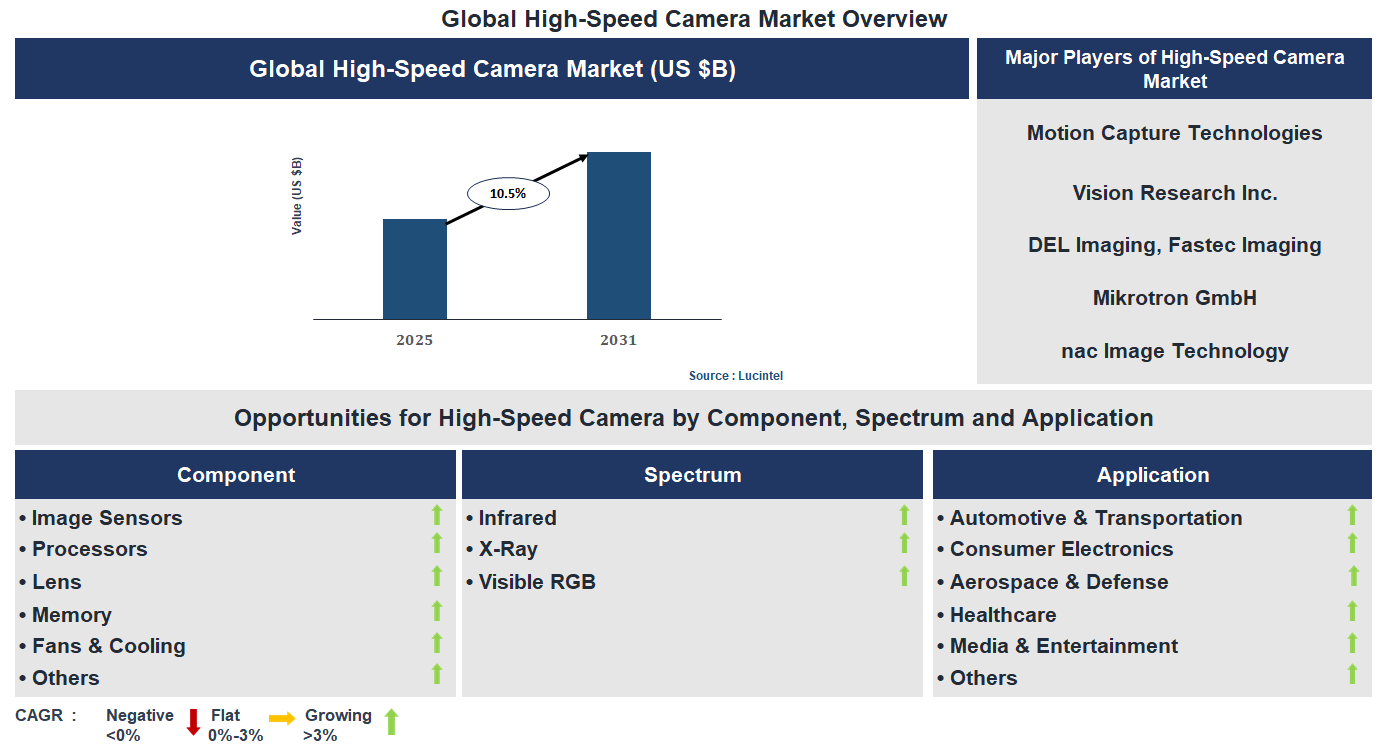
The future of the global high-speed camera market looks promising with opportunities in the automotive & transportation, consumer electronics, aerospace & defense, healthcare, and media & entertainment markets. The global high-speed camera market is expected to grow with a CAGR of 10.5% from 2025 to 2031. The major drivers for this market are the increasing use in motion analysis research, the rising demand for industrial process monitoring, and the growing focus on scientific imaging applications.• Lucintel forecasts that, within the component category, processor is expected to witness the highest growth over the forecast period.
• Within the application category, media & entertainment is expected to witness the highest growth.
• In terms of region, North America is expected to witness the highest growth over the forecast period. Gain valuable insights for your business decisions with our comprehensive 150+ page report. Sample figures with some insights are shown below.
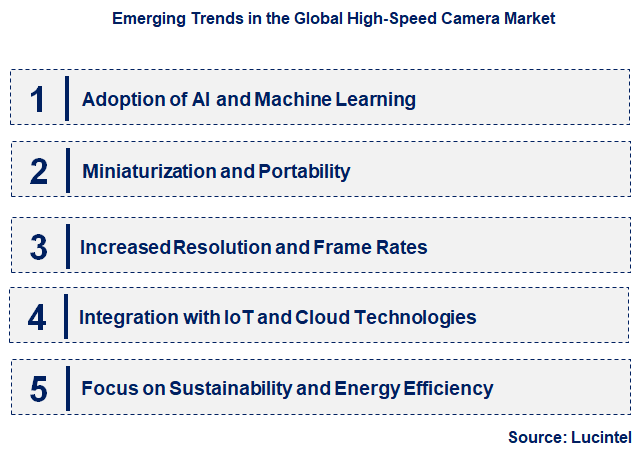
Emerging Trends in the High-Speed Camera Market
The high-speed camera market is experiencing rapid evolution driven by technological advancements, increasing demand across various industries, and the need for precise motion analysis. As industries such as entertainment, automotive, aerospace, and scientific research seek more detailed and faster imaging solutions, the market is witnessing significant innovations. These developments are not only enhancing performance but also expanding the applications of high-speed cameras, making them more accessible and versatile. The following key trends highlight the major shifts shaping this dynamic market, reflecting its trajectory toward greater sophistication, integration, and application diversity.• Adoption of AI and Machine Learning: Integration of AI and machine learning algorithms is revolutionizing high-speed camera capabilities by enabling real-time data processing, automatic object tracking, and enhanced image analysis. This trend improves efficiency, accuracy, and usability, especially in industrial inspections, sports analytics, and scientific research. AI-driven features facilitate faster decision-making and reduce manual intervention, making high-speed cameras more intelligent and adaptable to complex environments. As AI technology advances, expect even more sophisticated automation and predictive analytics in high-speed imaging.
• Miniaturization and Portability: The development of smaller, lightweight high-speed cameras is expanding their usability across diverse fields. Portable designs allow for easier deployment in field conditions, such as outdoor sports, wildlife monitoring, and aerospace testing. Miniaturization also enables integration into drones, handheld devices, and compact systems, broadening application scopes. This trend enhances flexibility, reduces costs, and opens new markets where traditional bulky cameras were impractical. As technology progresses, miniaturized high-speed cameras will become standard tools in many industries requiring mobility and ease of use.
• Increased Resolution and Frame Rates: Advances in sensor technology are enabling high-speed cameras to deliver higher resolutions and faster frame rates. This improvement allows for more detailed and precise capture of rapid phenomena, critical in scientific experiments, quality control, and cinematic productions. Higher resolution enhances image clarity, while increased frame rates provide smoother motion analysis. These capabilities support more accurate diagnostics, detailed visual effects, and comprehensive research data. As demand for detailed visualization grows, manufacturers are investing heavily in developing cameras that push the boundaries of speed and clarity.
• Integration with IoT and Cloud Technologies: The convergence of high-speed cameras with Internet of Things (IoT) and cloud computing is transforming data management and remote monitoring. Cameras connected to IoT networks enable real-time data streaming, remote control, and automated alerts. Cloud integration facilitates large-scale data storage, sharing, and advanced analytics, making high-speed imaging more accessible and collaborative. This trend is particularly impactful in industrial automation, security, and scientific research, where rapid data access and analysis are crucial. It also reduces infrastructure costs and enhances scalability, fostering smarter, more connected systems.
• Focus on Sustainability and Energy Efficiency: As environmental concerns grow, the high-speed camera industry is emphasizing energy-efficient designs and sustainable manufacturing practices. Low-power components, improved battery life, and eco-friendly materials are being adopted to reduce environmental impact. Energy-efficient cameras are especially important for remote or long-term monitoring applications, where power supply is limited. This trend aligns with global sustainability goals and enhances market appeal among environmentally conscious consumers and organizations. Innovations in this area are expected to lead to more sustainable, cost-effective high-speed imaging solutions that support eco-friendly operations. In summary, these emerging trends are significantly reshaping the high-speed camera market by enhancing technological capabilities, expanding application areas, and promoting sustainability. The integration of AI, miniaturization, higher resolutions, IoT connectivity, and eco-friendly practices collectively drive the market toward more intelligent, versatile, and sustainable solutions. These developments are not only meeting current industry demands but also paving the way for innovative applications and broader adoption across multiple sectors.
Recent Development in the High-Speed Camera Market
The high-speed camera market has experienced significant growth driven by technological advancements and increasing applications across various industries. As industries such as entertainment, automotive, aerospace, and scientific research demand faster and more precise imaging solutions, the market continues to evolve rapidly. Innovations in sensor technology, miniaturization, and data processing are shaping the future of high-speed cameras. Additionally, rising investments in research and development and expanding end-user applications are fueling market expansion. These developments are not only enhancing camera performance but also broadening the scope of high-speed camera applications, making them more accessible and versatile across different sectors.• Technological Advancements: Improved sensor sensitivity and frame rates have enhanced image quality and data accuracy, enabling more detailed analysis in scientific research and industrial testing. This has increased the adoption of high-speed cameras in critical applications requiring precise motion analysis, thereby expanding market reach and driving revenue growth.
• Miniaturization of Cameras: The development of compact, lightweight high-speed cameras has facilitated their integration into portable devices and drones. This miniaturization has opened new avenues in sports analytics, wildlife monitoring, and aerospace, significantly broadening application areas and increasing market penetration.
• Integration with AI and Data Analytics: Incorporating artificial intelligence and advanced data processing capabilities has improved real-time analysis and automation. This integration has made high-speed cameras more efficient for quality control, security, and autonomous vehicle testing, boosting demand and operational efficiency.
• Expansion in End-User Industries: Growing adoption in entertainment (film and sports), automotive (crash testing and autonomous vehicles), aerospace, and scientific research has driven market growth. The diversification of applications has increased overall market size and created new revenue streams for manufacturers.
• Rising Investments and Collaborations: Increased funding from government agencies and private firms for research and development, along with strategic collaborations, have accelerated innovation. These investments have led to the launch of advanced high-speed camera models, further fueling market expansion and technological progress. The recent developments in the high-speed camera market are significantly enhancing camera capabilities, expanding application areas, and increasing market competitiveness. These innovations are making high-speed cameras more accessible, efficient, and versatile, which is propelling overall market growth and opening new opportunities across multiple industries.
Strategic Growth Opportunities in the High-Speed Camera Market
The high-speed camera market is experiencing rapid growth driven by technological advancements and increasing demand across various industries. As applications expand, key growth opportunities are emerging that can significantly influence market dynamics. These opportunities are driven by the need for precise imaging, real-time analysis, and innovative applications in sectors such as entertainment, automotive, aerospace, research, and manufacturing. Companies that capitalize on these trends can gain competitive advantages and expand their market share. Understanding these growth opportunities is essential for stakeholders aiming to leverage emerging technologies and meet evolving customer needs in this dynamic landscape.• Enhanced safety and autonomous vehicles: High-speed cameras enable real-time analysis of vehicle behavior, aiding in the development of advanced driver-assistance systems and autonomous vehicle testing, thereby improving safety standards and innovation in automotive design.
• High-quality slow-motion content: The demand for high-resolution, slow-motion footage in sports broadcasting, filmmaking, and live events is increasing, driving the adoption of high-speed cameras to deliver immersive viewing experiences and innovative content creation.
• Advanced testing and surveillance: High-speed cameras are crucial for capturing high-velocity events during aircraft testing, missile launches, and surveillance operations, providing critical data for safety, performance, and security enhancements.
• Precise experimental observations: These cameras facilitate detailed analysis of rapid phenomena in scientific research, such as fluid dynamics, particle physics, and biological processes, accelerating discoveries and technological advancements.
• Quality control and process optimization: High-speed cameras enable real-time monitoring of manufacturing processes, detecting defects and ensuring product quality, which enhances efficiency and reduces costs. In summary, these growth opportunities are significantly impacting the high-speed camera market by expanding its application scope, fostering innovation, and driving demand across multiple sectors. As industries increasingly rely on high-speed imaging for safety, research, and entertainment, the market is poised for sustained growth and technological evolution.
High-Speed Camera Market Driver and Challenges
The high-speed camera market is influenced by a variety of technological, economic, and regulatory factors that shape its growth and development. Advances in imaging technology, increasing demand across diverse industries, and evolving regulatory standards are key drivers. Simultaneously, challenges such as high costs, technological limitations, and regulatory hurdles pose significant obstacles. Understanding these drivers and challenges is essential for stakeholders to navigate the market effectively and capitalize on emerging opportunities. The interplay of these factors determines the pace of innovation, market expansion, and overall competitiveness within the high-speed camera industry. The factors responsible for driving the high-speed camera market include:-• Technological Innovation: The rapid development of high-speed imaging technology has significantly enhanced camera capabilities, enabling detailed analysis in scientific research, industrial inspection, and entertainment. Innovations such as increased frame rates, higher resolutions, and improved data processing have expanded application possibilities. These advancements attract investments and foster market growth by meeting the increasing demand for precise, real-time imaging solutions across sectors.
• Growing Industrial Applications: Industries such as automotive, aerospace, sports, and entertainment are increasingly adopting high-speed cameras for quality control, safety testing, and content creation. The automotive industry uses these cameras for crash testing and autonomous vehicle development, while sports broadcasters utilize them for slow-motion replays. This broadening application base drives demand, encouraging manufacturers to innovate and expand their product offerings.
• Rising Investment in R&D: Significant investments by companies and research institutions in developing advanced high-speed camera technologies fuel market growth. R&D efforts focus on improving image resolution, reducing costs, and enhancing data processing speeds. These investments lead to the development of more efficient, affordable, and versatile cameras, thereby expanding market reach and application scope.
• Increasing Adoption in Scientific Research: High-speed cameras are vital in scientific fields such as physics, biology, and material science for capturing fast phenomena. Their ability to record events at microsecond or nanosecond intervals enables detailed analysis of dynamic processes. Growing research activities worldwide and the need for precise measurement tools are propelling the market forward, fostering innovation and new product development. The challenges facing this high-speed camera market include:-
• High Cost of Equipment: The advanced technology involved in high-speed cameras results in high manufacturing and purchase costs, limiting accessibility for small and medium-sized enterprises. This cost barrier hampers widespread adoption, especially in developing regions, and constrains market growth. Additionally, ongoing maintenance and upgrades further increase total ownership costs, impacting profitability and investment decisions.
• Technological Limitations: Despite advancements, high-speed cameras face limitations such as data storage issues, limited frame rates at higher resolutions, and challenges in miniaturization. These technical constraints restrict their use in certain applications requiring ultra-high frame rates or compact form factors. Overcoming these limitations requires continuous innovation, which can be resource-intensive and time-consuming.
• Regulatory and Standardization Challenges: The lack of uniform standards and regulatory frameworks for high-speed imaging devices complicates market expansion. Compliance with varying international standards increases costs and delays product launches. Additionally, privacy and data security concerns related to high-speed video recording pose regulatory hurdles, necessitating strict adherence to evolving legal requirements, which can impede market growth. In summary, the high-speed camera market is driven by rapid technological advancements, expanding industrial applications, increased R&D investments, and growing scientific research needs. However, high costs, technological constraints, and regulatory complexities present significant challenges. These factors collectively influence market dynamics, requiring stakeholders to innovate continuously and navigate regulatory landscapes carefully. Overall, the markets growth prospects remain promising, provided that technological and regulatory hurdles are effectively managed, enabling broader adoption and application expansion.
List of High-Speed Camera Companies
Companies in the market compete on the basis of product quality offered. Major players in this market focus on expanding their manufacturing facilities, R&D investments, infrastructural development, and leverage integration opportunities across the value chain. With these strategies high-speed camera companies cater increasing demand, ensure competitive effectiveness, develop innovative products & technologies, reduce production costs, and expand their customer base. Some of the high-speed camera companies profiled in this report include-• Motion Capture Technologies
• Vision Research Inc.
• DEL Imaging, Fastec Imaging
• Mikrotron GmbH
• nac Image Technology
• Olympus Corporation
• WEISSCAM GmbH
High-Speed Camera Market by Segment
The study includes a forecast for the global high-speed camera market by component, spectrum, application, and region.High-Speed Camera Market by Component [Value from 2019 to 2031]:
• Image Sensors
• Processors
• Lens
• Memory
• Fans & Cooling
• Others
High-Speed Camera Market by Spectrum [Value from 2019 to 2031]:
• Infrared
• X-Ray
• Visible RGB
High-Speed Camera Market by Application [Value from 2019 to 2031]:
• Automotive & Transportation
• Consumer Electronics
• Aerospace & Defense
• Healthcare
• Media & Entertainment
• Others
High-Speed Camera Market by Region [Value from 2019 to 2031]:
• North America
• Europe
• Asia Pacific
• The Rest of the World
Country Wise Outlook for the High-Speed Camera Market
The high-speed camera market has experienced significant growth driven by technological advancements, increasing demand across various industries, and expanding applications in scientific research, manufacturing, and entertainment. As industries seek to capture fast-moving phenomena with greater precision, countries are investing in innovative solutions and expanding their market presence. The United States, China, Germany, India, and Japan are leading players, each contributing unique developments to this dynamic sector. These countries are focusing on enhancing camera capabilities, integrating AI and machine learning, and expanding their application scope to meet evolving industry needs.• United States: The US market has seen rapid innovation with major companies developing ultra-high-speed cameras capable of capturing millions of frames per second. There is a growing focus on integrating AI for real-time analysis and improving image resolution. The defense, automotive, and entertainment sectors are primary drivers, with increased government funding for research and development. Additionally, startups are pioneering portable and affordable high-speed camera solutions, expanding accessibility across industries.
• China: China is experiencing substantial growth in high-speed camera adoption, driven by advancements in manufacturing, automotive testing, and scientific research. Domestic companies are investing heavily in R&D to develop cost-effective, high-performance cameras. The government’s emphasis on technological self-reliance has spurred innovation, leading to the launch of several new products with enhanced frame rates and resolution. The expanding industrial base and increasing research activities are further propelling market growth.
• Germany: Germany’s high-speed camera market is characterized by a focus on precision engineering and high-quality imaging solutions. Leading firms are integrating advanced sensor technology and improving data processing capabilities. The automotive and manufacturing sectors are significant consumers, utilizing high-speed cameras for quality control and process optimization. Germany’s emphasis on industrial automation and innovation has fostered collaborations between academia and industry, resulting in cutting-edge developments in camera technology.
• India: India’s market is rapidly expanding due to increased investments in scientific research, defense, and manufacturing sectors. Local companies are developing affordable high-speed cameras tailored for educational and industrial applications. The government’s initiatives to promote innovation and manufacturing are supporting market growth. Additionally, rising adoption of high-speed cameras in sports analytics, medical imaging, and security is contributing to the sector’s development, with a focus on cost-effective solutions.
• Japan: Japan remains a key player in high-speed camera technology, emphasizing high precision and reliability. Japanese firms are advancing in areas such as semiconductor inspection, scientific research, and industrial automation. The integration of AI and IoT with high-speed cameras is a notable trend, enhancing data analysis and operational efficiency. Japan’s strong R&D infrastructure and focus on quality have led to the development of sophisticated, high-performance cameras that cater to specialized applications across various industries.

Features of the Global High-Speed Camera Market
Market Size Estimates: High-speed camera market size estimation in terms of value ($B). Trend and Forecast Analysis: Market trends (2019 to 2024) and forecast (2025 to 2031) by various segments and regions. Segmentation Analysis: High-speed camera market size by component, spectrum, application, and region in terms of value ($B). Regional Analysis: High-speed camera market breakdown by North America, Europe, Asia Pacific, and Rest of the World. Growth Opportunities: Analysis of growth opportunities in different components, spectrum, applications, and regions for the high-speed camera market. Strategic Analysis: This includes M&A, new product development, and competitive landscape of the high-speed camera market. Analysis of competitive intensity of the industry based on Porter’s Five Forces model.
FAQ
Q1. What is the growth forecast for high-speed camera market? Answer: The global high-speed camera market is expected to grow with a CAGR of 10.5% from 2025 to 2031. Q2. What are the major drivers influencing the growth of the high-speed camera market? Answer: The major drivers for this market are the increasing use in motion analysis research, the rising demand for industrial process monitoring, and the growing focus on scientific imaging applications. Q3. What are the major segments for high-speed camera market? Answer: The future of the high-speed camera market looks promising with opportunities in the automotive & transportation, consumer electronics, aerospace & defense, healthcare, and media & entertainment markets. Q4. Who are the key high-speed camera market companies? Answer: Some of the key high-speed camera companies are as follows:• Motion Capture Technologies
• Vision Research Inc.
• DEL Imaging, Fastec Imaging
• Mikrotron GmbH
• nac Image Technology
• Olympus Corporation
• WEISSCAM GmbH Q5. Which high-speed camera market segment will be the largest in future? Answer: Lucintel forecasts that, within the component category, processor is expected to witness the highest growth over the forecast period. Q6. In high-speed camera market, which region is expected to be the largest in next 5 years? Answer: In terms of region, North America is expected to witness the highest growth over the forecast period. Q7. Do we receive customization in this report? Answer: Yes, Lucintel provides 10% customization without any additional cost.
Table of Contents
List of Figures
List of Tables
Methodology
- In-depth interviews of the major players in this market
- Detailed secondary research from competitors’ financial statements and published data
- Extensive searches of published works, market, and database information pertaining to industry news, company press releases, and customer intentions
- A compilation of the experiences, judgments, and insights of Lucintel’s professionals, who have analyzed and tracked this market over the years.


Buy Now
Choose a license that fits your team. Instant PDF delivery.
Prices exclude taxes. Instant delivery. Custom licensing available on request.
Key Questions
- • What are some of the most promising, high-growth opportunities for the high-speed camera market by component (image sensors, processors, lens, memory, fans & cooling, and others), spectrum (infrared, X-ray, and visible RGB), application (automotive & transportation, consumer electronics, aerospace & defense, healthcare, media & entertainment, and others), and region (North America, Europe, Asia Pacific, and the Rest of the World)?
- • Which segments will grow at a faster pace and why?
- • Which region will grow at a faster pace and why?
- • What are the key factors affecting market dynamics? What are the key challenges and business risks in this market?
- • What are the business risks and competitive threats in this market?
- • What are the emerging trends in this market and the reasons behind them?
- • What are some of the changing demands of customers in the market?
- • What are the new developments in the market? Which companies are leading these developments?
- • Who are the major players in this market? What strategic initiatives are key players pursuing for business growth?
- • What are some of the competing products in this market and how big of a threat do they pose for loss of market share by material or product substitution?
- • What M&A activity has occurred in the last 5 years and what has its impact been on the industry? For any questions related to High-Speed Camera Market, High-Speed Camera Market Size, High-Speed Camera Market Growth, High-Speed Camera Market Analysis, High-Speed Camera Market Report, High-Speed Camera Market Share, High-Speed Camera Market Trends, High-Speed Camera Market Forecast, High-Speed Camera Companies, write Lucintel analyst at email: helpdesk@lucintel.com. We will be glad to get back to you soon.


