
Market Report · July 29, 2026

Key data points: The growth forecast = 11.2% annually next 6 years. Scroll below to get more insights. This market report covers trends, opportunities, and forecasts in the global high-precision light detector market to 2030 by type (photodiodes and photomultiplier tube), application (optical measurement, communication, medicine, and aerospace), and region (North America, Europe, Asia Pacific, and the Rest of the World)
We'll send your sample report shortly.
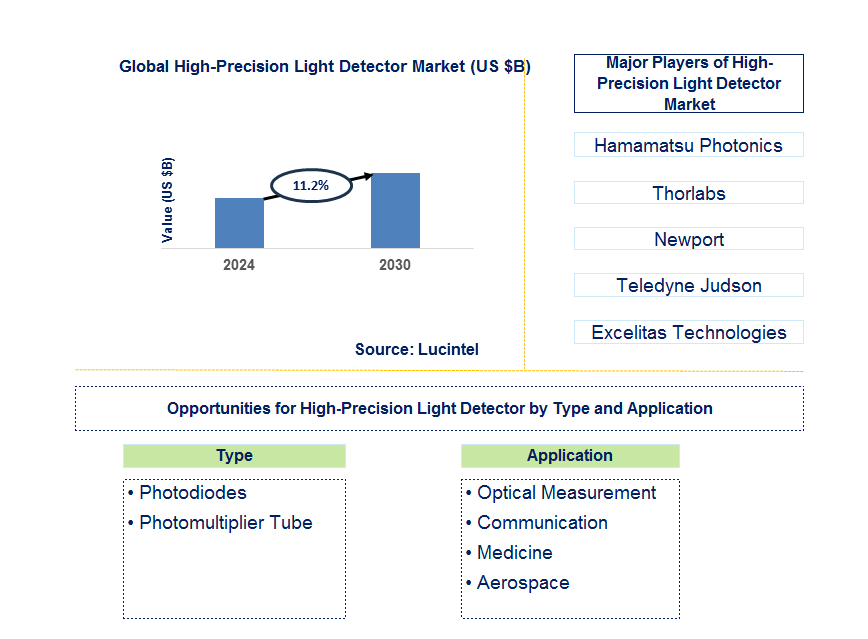
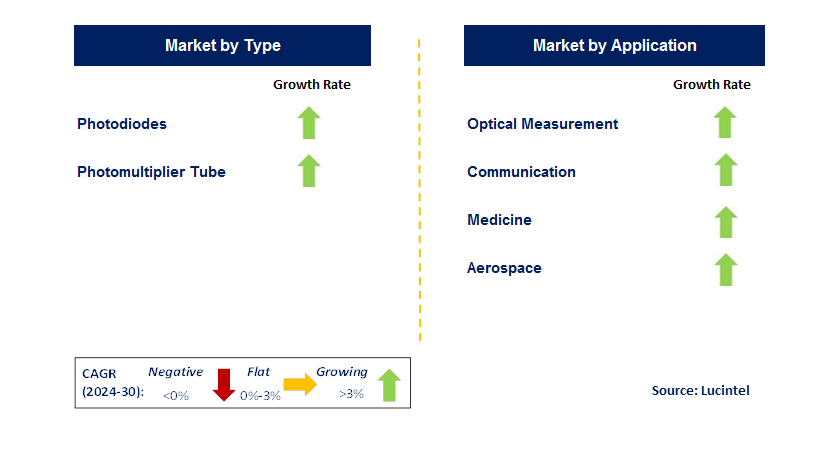
• Advancements in Detector Technology: Recently, important breakthroughs have been made in developing more accurate high-precision light detectors. This includes innovations like quantum-dot detectors, which offer better sensitivity and resolution than traditional models. These detectors can also cover larger wavelength ranges, making them suitable for various applications such as environmental monitoring and medical imaging. Furthermore, improvements in material science have enabled the creation of more efficient and stable light detectors necessary for many highly precise tasks performed today. All these advancements lead to greater accuracy in measurements, allowing for applicability across diverse sectors.
• Integration with AI and Machine Learning: The integration of artificial intelligence (AI) and machine learning with high-precision light detectors is revolutionizing the market. The application of AI algorithms can improve data analysis, image quality, and real-time optimization of detector performance. This combination facilitates advanced pattern recognition, anomaly detection, and predictive maintenance in areas like security, telecommunications, and scientific research. Consequently, companies can realize increased effectiveness when using AI in light detection, translating into enhanced capabilities and new applications.
• Miniaturization of Light Detectors: A growing trend toward smaller and portable devices has led to the miniaturization of high-precision light detectors. Developments in microelectromechanical systems (MEMS) and semiconductor technologies have allowed for the creation of compact detectors without any loss in performance. The use of these miniature detectors is expanding into consumer electronics, wearables, and portable medical instruments. This trend toward reducing size brings new possibilities for users and enhances convenience in utilizing highly precise light-detecting tools.
• Emergence of New Applications: Changing market needs, combined with technological breakthroughs, continue to create several new applications requiring higher precision light detectors. For example, these detectors are increasingly being adapted for use in autonomous vehicles, where accuracy in measuring light is crucial for navigation and safety. Additionally, advancements in medical imaging and diagnostics provide a foundation for using such detectors on a large scale in the healthcare industry. Moreover, exploring these different lines fosters innovation, as emerging fields prompt firms to seek specific solutions.
• A Shift toward Sustainability: The development of high-precision light detectors has increasingly emphasized sustainability. The use of eco-friendly materials and energy-saving technologies that minimize environmental impact is growing rapidly. Companies are researching lower-energy, longer-lived detector designs while also engaging in recycling and waste reduction initiatives. This “green” approach aligns with the environmental consciousness prevalent in society today and influences how products are developed and marketed. Emerging trends, such as integration with AI and machine learning, advancements in quantum-dot technology, miniaturization, sustainability, and improved IoT integration, are reshaping the market for high-precision light detectors. These developments drive innovation and expand applications for light detectors. Advanced AI and ML platforms enhance performance and data analysis, while quantum-dot technology increases sensitivity and resolution. Thus, these trends make detectors more portable through miniaturization and sustainable technologies that address environmental concerns. Interacting with IoT enables smarter systems, leading to new opportunities and challenges in the market that influence product development and shape the future of high-precision light detection technologies.
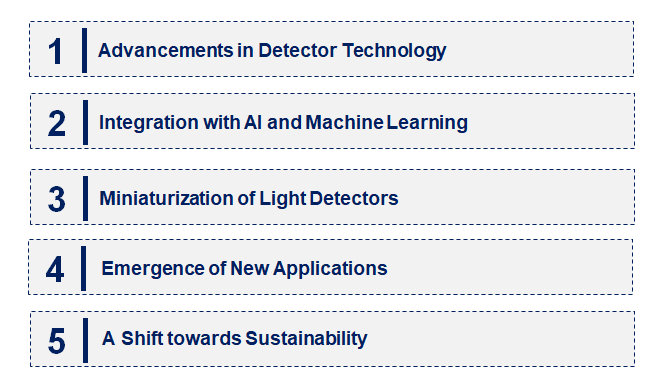
• Quantum Dot Technology Advancements: Quantum dot technology has transformed high-precision light detectors by offering greater sensitivity and resolution compared to earlier systems. For instance, there have been recent breakthroughs in quantum dot photodetectors that can operate across a broad wavelength range with low noise levels. This innovation has improved accuracy in environmental control systems meant for medical imaging, among other uses. Growth in areas necessitating high precision and reliability is being facilitated by better-performing quantum dot detectors.
• Improved Lidar Systems: For example, there have been improvements in lidar, which uses laser light to measure distances. Advances toward higher-resolution lidar systems provide more accurate and detailed spatial information. In applications like unmanned vehicles, where precise distance measurement is critical for navigation, this improvement is essential for developing accurate maps for autonomous vehicles. Enhanced lidars are also used in environmental monitoring systems and urban planning, facilitating their widespread usage.
• Merging AI and Machine Learning: The integration of AI and machine learning into high-fidelity light detectors has revolutionized their functionality. Data analysis is improved, image quality is enhanced, and real-time performance optimization has become possible due to these AI algorithms. For instance, there are now more sophisticated detectors that are energy-efficient and can be used for security purposes, telecommunications, or scientific experiments. The potential of light detection technology has increased significantly due to its ability to process intricate data and adapt to changing circumstances.
• Miniaturization and Wearable Technology: This miniaturization enables the integration of light detectors into smaller, portable devices. Compact detectors with high performance levels have been made possible through advances in MEMS and semiconductor technology. Consequently, wearable technology and portable medical devices, which require small size and certain operational efficiency, are booming. The consumer electronics and healthcare sectors have diversified their applications by adopting the concept of downsized detectors.
• Sustainable Materials and Manufacturing: Sustainability objectives for high-precision light detectors involve switching to environmentally friendly materials and energy-efficient technologies. Companies adopt sustainable materials to minimize their impact on the environment, including recycling and waste reduction practices. This development aligns with global trends toward sustainability, thereby influencing marketing strategies among consumers who prefer environmentally responsible products from businesses. The market has been significantly affected by the latest improvements in high-precision light detector technologies such as quantum dots, lidar, miniaturized sensors, sustainable technologies, and smart system integration. These advancements aim to improve performance, expand applications, and address environmental concerns. Sensitivity and resolution can be enhanced through quantum dots, while advanced lidar systems improve accuracy in critical applications. Miniaturized sensors enable integration into smaller devices, whereas sustainable technologies encourage eco-friendly practices. Enhanced integration with smart systems drives new functions and linked applications. Together, these developments shape the future.
• Medical Diagnostics: In the medical diagnostics sector, high-precision light detectors are critical in advanced imaging technologies such as optical coherence tomography and fluorescence microscopy. These devices offer more detailed images with higher resolution, thus improving diagnostic accuracy. Growing this application will require creating more sensitive detectors for early disease diagnosis and expanding them into other diagnostic sectors. Improved detectors can lead to better patient outcomes, reduced diagnostic errors, and wider adoption of non-invasive imaging techniques.
• Autonomous Vehicles: High-precision light detectors have significant potential in autonomous vehicles, especially in the development of lidar systems. Lidar systems are important in AVs since they enable accurate distance measurement, detect obstacles, and facilitate navigation. As full autonomy approaches in the automotive industry, there will be a higher demand for more reliable light detectors with greater performance. Furthermore, there is an opportunity to improve lidar resolution while reducing detector size and cost, all while incorporating real-time data processing capabilities for enhanced safety and vehicle operation.
• Environmental Monitoring: Environmental monitoring heavily relies on high-precision light detectors that measure pollutants and greenhouse gases, among other environmental parameters. Increasingly, these sensors are required for climate change studies, air quality monitoring, and other environmental research where accurate real-time data is essential. The market for high-precision light detectors, with numerous opportunities, is booming in various applications. Opportunities in medical diagnostics, autonomous vehicles, environmental monitoring, consumer electronics, and industrial automation illustrate the potential for technological advancements and market growth. Each application area has its unique challenges and requirements but also offers significant scope for innovation and development. Key stakeholders can harness these opportunities to enhance their performance and drive market growth while addressing the changing needs of various sectors. Therefore, adapting and innovating will be crucial, as technology continues to advance, to effectively exploit these growth prospects.
• Hamamatsu Photonics
• Thorlabs
• Newport
• Teledyne Judson Technologies
• Excelitas Technologies
• Photodiodes
• Photomultiplier Tube
• Optical Measurement
• Communication
• Medicine
• Aerospace
• North America
• Europe
• Asia Pacific
• The Rest of the World
• United States: Due to its strong research infrastructure and innovation ecosystem, the U.S. continues to dominate high-precision light detector technology. Notable advances include quantum-dot detectors that offer enhanced sensitivity together with lower noise levels. Moreover, American companies are increasingly integrating AI and machine learning into their detector architectures for better detection performance coupled with data analysis capabilities. Lidar, which is vital for autonomous vehicles as well as aerospace applications, has also experienced breakthroughs facilitated by governmental and private sector investment partnerships. Finally, intensive collaborations between tech companies and academia continue to drive incremental improvements and inventions within the field of light detection technologies.
• China: China's rapid technological growth, coupled with large-scale investments, has had a significant impact on the high-precision light detector market. Examples include state-of-the-art photodetectors and imaging sensors funded highly through research and development spending. In this context, Chinese firms emphasize improving the resolution of detectors and response times critical for applications in telecommunications and consumer electronics. The policy support extended by China toward high-tech industries, accompanied by the growth of its domestic semiconductor industry, is pivotal in advancing light detector technologies. Consequently, China emerges as one of the leading players in the global high-precision light detector market.
• Germany: Germany has remained strong in the high-precision light detector market because of its advanced engineering capabilities and focus on quality manufacturing. Notably, examples of recent developments include innovations in laser-based sensors and advancements in photonic crystal technology. German firms are leading efforts in developing detectors for industrial automation and environmental monitoring. The country's focus on precision engineering, coupled with strong industry-academia linkages, has resulted in highly sensitive and reliable light detection systems. Germany’s commitment to sustainability and advanced manufacturing technologies continues to drive progress in this sector.
• India: India is an emerging market that has been growing rapidly due to advancements in electronics and increasing investments in research and development. Indian companies aim to design cost-effective yet high-performance detectors applicable to medical imaging, telecommunications, and defense purposes. Additionally, supportive governmental policies combined with a fast-expanding technology industry promote innovation in photodetectors, including imaging systems. This can be achieved through collaboration between major research organizations in India and industry participants. Consequently, India is enhancing its position on the global stage through its growing expertise in semiconductor technologies and optical engineering.
• Japan: Precision technology has long been a field in which Japan excels, and this is evident in its high-precision light detector industry. For example, compact and highly efficient photodetectors have recently been developed, and semiconductor technology has improved. This progress is also evident in optical sensors for use in robotics, automotive systems, and consumer electronics by Japanese companies. Ongoing advancements in light detection technologies are supported by the country’s strong focus on research and development alongside a culture of technological excellence. Additionally, Japan continues to innovate in materials integration and miniaturization techniques, pushing the boundaries of light detection possibilities.


• Hamamatsu Photonics
• Thorlabs
• Newport
• Teledyne Judson Technologies
• Excelitas Technologies Q5. Which high-precision light detector market segment will be the largest in future? Answer: Lucintel forecasts that photodiodes will remain the larger segment over the forecast period as it ensures better signals with remarkable accuracy. Q6. In high-precision light detector market, which region is expected to be the largest in next 5 years? Answer: North America will remain the largest region over the forecast period due to growing demand from various end-use industries and increasing environmental monitoring and safety regulations. Q7. Do we receive customization in this report? Answer: Yes, Lucintel provides 10% customization without any additional cost.


Choose a license that fits your team. Instant PDF delivery.
Prices exclude taxes. Instant delivery. Custom licensing available on request.
Market Report · July 29, 2026
Market Report · July 20, 2026
Market Report · July 20, 2026
Trusted partner for strategic intelligence and business growth


Receive a complimentary market analysis tailored to your industry. Our analysts will identify key growth opportunities and competitive dynamics specific to your business.

Market size, growth rate, and key trend analysis for your specific sector.

Top competitor positioning and market share analysis.

Strategic recommendations backed by data-driven insights.
Get curated market intelligence and competitive moves straight to your inbox.
By subscribing, you agree to receive our monthly insights. Unsubscribe anytime.
Receive a complimentary market analysis tailored to your industry. Our analysts will identify key growth opportunities and competitive dynamics specific to your business.
Market size, growth rate, and key trend analysis for your specific sector.
Top competitor positioning and market share analysis.
Strategic recommendations backed by data-driven insights.
Get curated market intelligence, emerging trends, and competitive moves straight to your inbox each month.
By subscribing, you agree to receive our monthly insights. Unsubscribe anytime.
We'll send your sample report shortly.