
Market Report · July 29, 2026

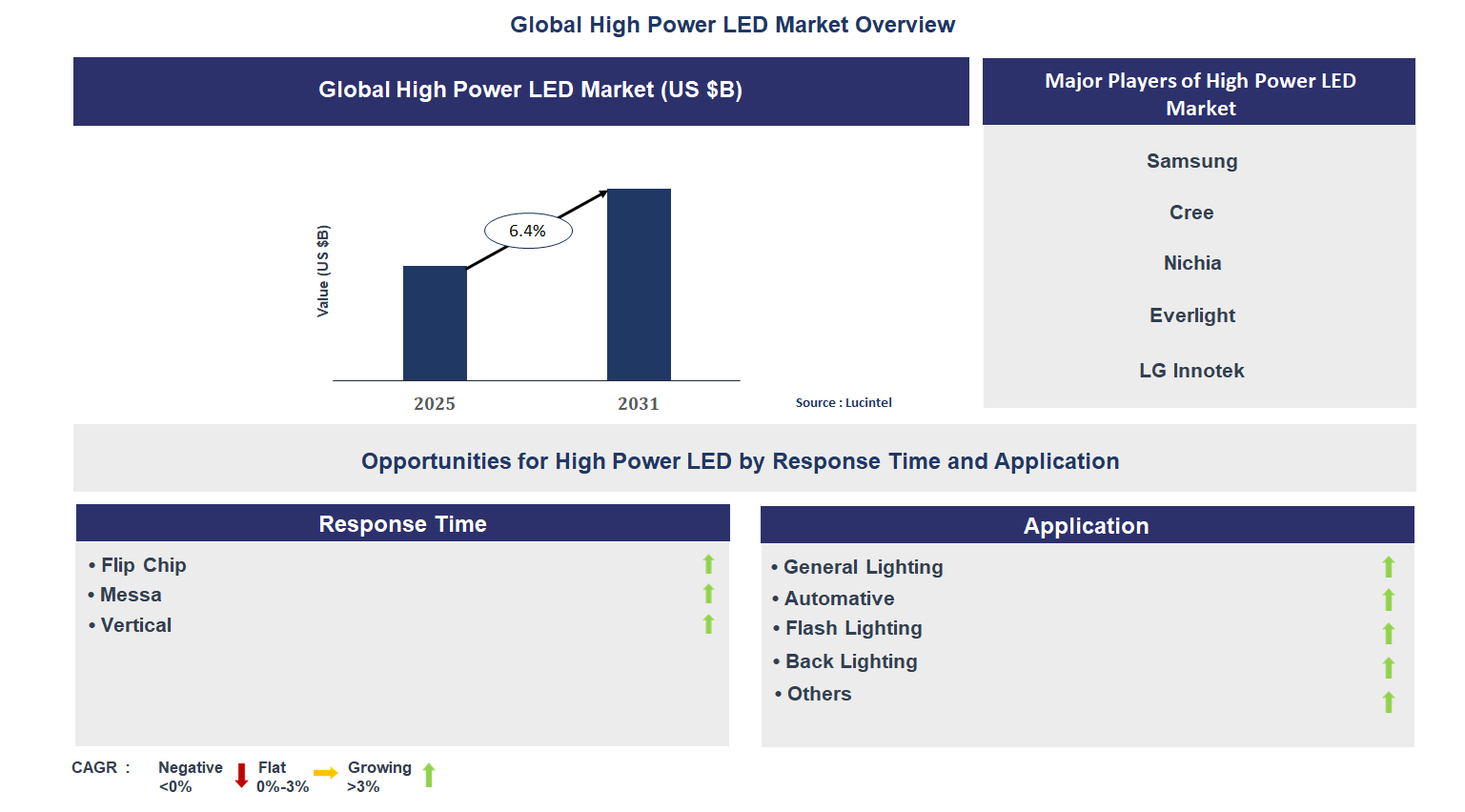
Key data points: The growth forecast = 6.4% annually for the next 7 years. Scroll below to get more insights. This market report covers trends, opportunities and forecasts in high power LED market to 2031 by response time (flip chip, messa, and vertical), application (general lighting, automative, flash lighting, back lighting, and others), and region (North America, Europe, Asia Pacific, and the Rest of the World)
We'll send your sample report shortly.
• Lucintel forecasts that, within the response time category, flip chip is expected to witness the highest growth over the forecast period.
• Within the application category, automative is expected to witness the highest growth.
• In terms of region, APAC is expected to witness the highest growth over the forecast period. Gain valuable insights for your business decisions with our comprehensive 150+ page report. Sample figures with some insights are shown below.
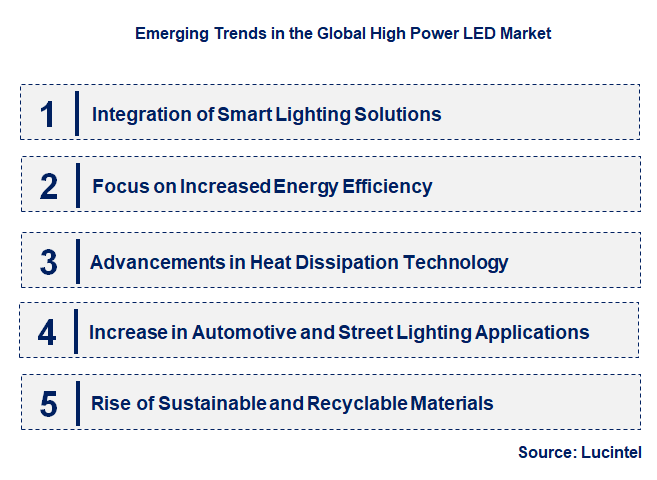
• Integration of Smart Lighting Solutions: Smart high power LEDs are being integrated with Internet of Things (IoT) technology, allowing for remote control, automation, and energy monitoring. This trend is gaining traction in both commercial and residential settings, enhancing energy efficiency and user convenience. Smart systems can adjust light intensity based on occupancy or time of day, further optimizing energy usage.
• Focus on Increased Energy Efficiency: There is a growing emphasis on improving the energy efficiency of high power LEDs. Manufacturers are developing LEDs that consume less power while providing higher brightness and longer life spans. This is in response to increasing energy costs and rising demand for sustainable lighting solutions, especially in commercial and industrial sectors where energy use is significant.
• Advancements in Heat Dissipation Technology: With higher power comes more heat generation, and addressing this challenge is crucial for the longevity and efficiency of high power LEDs. New technologies in heat dissipation, such as improved heat sinks and materials, are becoming essential. This trend is enabling LEDs to achieve better performance while minimizing the risk of overheating, making them more reliable in harsh environments.
• Increase in Automotive and Street Lighting Applications: The automotive industry is adopting high power LEDs for headlamps, tail lights, and interior lighting due to their durability and superior lighting performance. Similarly, the demand for street lighting is growing as cities shift toward energy-efficient solutions. High power LEDs offer longer lifespans, reduce maintenance costs, and contribute to reducing the carbon footprint of urban lighting.
• Rise of Sustainable and Recyclable Materials: With a growing emphasis on sustainability, manufacturers are using eco-friendly, recyclable materials in the production of high power LEDs. This trend is in line with increasing environmental regulations that encourage manufacturers to reduce e-waste. Additionally, LEDs with reduced hazardous materials like mercury are being prioritized for their environmental benefits. Emerging trends in the high power LED market, such as smart lighting integration, energy efficiency, heat dissipation innovations, and sustainability, are shaping the future of the industry. These trends are driving the adoption of high power LEDs across various applications, from commercial lighting to automotive, creating new opportunities and challenges for manufacturers.
• Energy-Efficient Designs with Improved Lumens/Watt: One of the major developments is the push toward higher lumens per watt in high power LEDs. Manufacturers are constantly improving chip designs and efficiency to offer brighter output with lower power consumption. This trend has been driven by the need for energy savings in industrial, commercial, and street lighting applications.
• Introduction of Smart LED Drivers: Smart LED drivers have been introduced to allow better control and flexibility in LED lighting systems. These drivers provide features such as dimming, remote monitoring, and adaptive lighting. They are designed to integrate seamlessly with IoT systems, offering real-time energy usage data, and optimizing light levels based on time of day or occupancy.
• Miniaturization and Increased Power Output: Technological advancements have led to the miniaturization of high power LEDs without compromising their brightness or power output. Smaller, more compact LED units are now capable of delivering the same or better performance than their larger counterparts, enabling new applications in space-constrained environments such as automotive and consumer electronics.
• Improved Color Rendering and Quality: The latest high power LEDs focus on enhancing color rendering properties. Manufacturers are investing in technologies that improve the light quality, making LEDs suitable for a wide range of applications, including retail, hospitality, and healthcare. This improvement in color quality is crucial in industries where accurate color reproduction is essential.
• Reduction in Manufacturing Costs: As production scales and newer manufacturing techniques emerge, the cost of high power LEDs has been significantly reduced. This has made high power LEDs more accessible for a broader range of applications, from consumer electronics to street and industrial lighting. Lower costs also benefit manufacturers, increasing market adoption. Recent developments, such as energy-efficient designs, the introduction of smart drivers, miniaturization, improved color quality, and cost reduction, are revolutionizing the high power LED market. These advancements not only improve performance but also make high power LEDs more accessible across diverse applications, driving market growth globally.
• Smart Building and IoT Integration: The integration of high power LEDs with IoT technology for smart buildings is a significant growth opportunity. These systems enable automated lighting control, energy management, and maintenance alerts. The shift toward smart cities and buildings with advanced lighting controls is expected to drive demand for high power LEDs in commercial and residential sectors.
• Automotive Lighting: The automotive industry presents a growing opportunity for high power LEDs, particularly in headlamps, taillights, and interior lighting. LEDs offer longer lifespans, better brightness, and greater energy efficiency compared to traditional lighting technologies. As vehicle designs continue to evolve, high power LEDs will be critical in meeting lighting requirements while enhancing vehicle aesthetics and safety.
• Urban Street Lighting: With the global shift toward energy-efficient street lighting, municipalities are increasingly replacing traditional streetlights with high power LEDs. LEDs offer superior energy efficiency, longer life spans, and reduced maintenance costs. As urbanization continues and governments look to reduce their carbon footprints, the demand for LED-based street lighting is expected to rise.
• Industrial and Warehouse Lighting: High power LEDs are becoming the standard in industrial and warehouse lighting due to their durability, energy efficiency, and long lifespan. These environments require lighting solutions that can withstand harsh conditions while reducing operating costs. The growing trend toward automated facilities and increased focus on operational efficiency is driving the adoption of LEDs in industrial sectors.
• Retail and Commercial Lighting: Retail spaces are increasingly adopting high power LEDs to enhance the shopping experience while cutting energy costs. LEDs’ superior brightness and color rendering capabilities make them ideal for illuminating products, displays, and showrooms. As retailers focus on energy savings and sustainability, there is significant growth potential for high power LEDs in this sector. The high power LED market is poised for substantial growth across a variety of sectors, from smart buildings and automotive lighting to street lighting and retail applications. By capitalizing on these strategic growth opportunities, manufacturers can tap into emerging demand and ensure long-term success in this rapidly evolving market.
• Samsung
• Cree
• Nichia
• Everlight
• LG Innotek
• MLS
• Epistar
• Broadcom
• Lumileds
• OSRAM
• Flip Chip
• Messa
• Vertical
• General Lighting
• Automative
• Flash Lighting
• Back Lighting
• Others
• North America
• Europe
• Asia Pacific
• The Rest of the World
• United States: In the U.S., the high power LED market is advancing with a strong focus on energy efficiency and sustainability. LED lighting solutions are increasingly replacing traditional lighting in commercial and industrial sectors. Government incentives and environmental policies, such as the Energy Star program, are pushing demand. Additionally, advancements in smart lighting technology, including integration with IoT, are further driving growth.
• China: China remains the largest producer and consumer of high power LEDs, with significant developments in both domestic and international markets. The government has been pushing for energy-efficient lighting solutions as part of its "Made in China 2025" initiative. Local manufacturers are focusing on reducing costs while improving the performance of LEDs, making them more accessible for various applications, from automotive to general lighting.
• Germany: Germany continues to lead in high power LED technology, particularly in industrial and automotive applications. German manufacturers are focusing on improving light quality and extending lifespan. The market is driven by the EU’s stringent energy-saving regulations, which encourage the adoption of high power LEDs in commercial and residential lighting. Additionally, the growing popularity of smart lighting solutions in cities like Berlin is fueling demand.
• India: In India, the high power LED market is seeing rapid growth due to the government’s push for energy-efficient solutions under the “National LED Program.” LEDs are increasingly being used in street lighting, industrial applications, and rural electrification projects. The market is also benefiting from local manufacturing initiatives aimed at reducing the cost of high power LEDs for widespread adoption.
• Japan: Japan’s high power LED market is thriving due to technological innovations focused on increasing LED efficiency and heat dissipation. Japan is investing heavily in the automotive sector, where high power LEDs are used for headlamps and interior lighting. Additionally, Japan’s commitment to energy-saving technologies and reducing carbon emissions is spurring the development of LEDs for both commercial and residential applications.


• Samsung
• Cree
• Nichia
• Everlight
• LG Innotek
• MLS
• Epistar
• Broadcom
• Lumileds
• OSRAM Q5. Which high power LED market segment will be the largest in future? Answer: Lucintel forecasts that, within the response time category, flip chip is expected to witness the highest growth over the forecast period. Q6. In high power LED market, which region is expected to be the largest in next 5 years? Answer: In terms of region, APAC is expected to witness the highest growth over the forecast period. Q7. Do we receive customization in this report? Answer: Yes, Lucintel provides 10% customization without any additional cost.


Choose a license that fits your team. Instant PDF delivery.
Prices exclude taxes. Instant delivery. Custom licensing available on request.
Market Report · July 29, 2026
Market Report · July 20, 2026
Market Report · July 20, 2026
Trusted partner for strategic intelligence and business growth


Receive a complimentary market analysis tailored to your industry. Our analysts will identify key growth opportunities and competitive dynamics specific to your business.

Market size, growth rate, and key trend analysis for your specific sector.

Top competitor positioning and market share analysis.

Strategic recommendations backed by data-driven insights.
Get curated market intelligence and competitive moves straight to your inbox.
By subscribing, you agree to receive our monthly insights. Unsubscribe anytime.
Receive a complimentary market analysis tailored to your industry. Our analysts will identify key growth opportunities and competitive dynamics specific to your business.
Market size, growth rate, and key trend analysis for your specific sector.
Top competitor positioning and market share analysis.
Strategic recommendations backed by data-driven insights.
Get curated market intelligence, emerging trends, and competitive moves straight to your inbox each month.
By subscribing, you agree to receive our monthly insights. Unsubscribe anytime.
We'll send your sample report shortly.