
Report Feature
Hematology Analyzer and Reagent Market Trends and Forecast
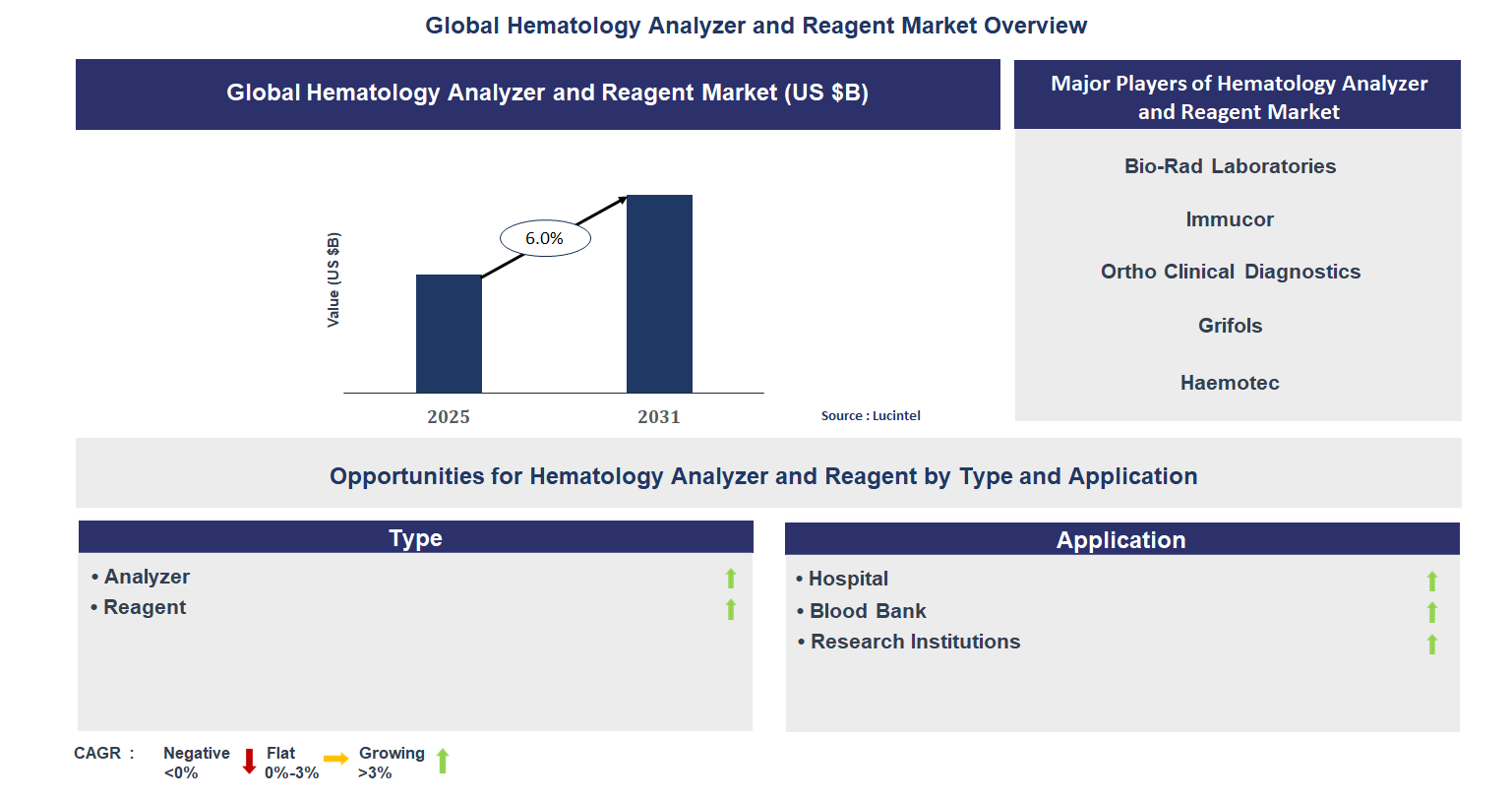
The future of the global hematology analyzer and reagent market looks promising with opportunities in the hospital, blood bank, and research institution markets. The global hematology analyzer and reagent market is expected to grow with a CAGR of 6% from 2025 to 2031. The major drivers for this market are the increasing prevalence of blood related disorders, the rising adoption of automated diagnostic systems, and the growing demand for accurate hematology testing.• Lucintel forecasts that, within the type category, reagent is expected to witness higher growth over the forecast period.
• Within the application category, hospital is expected to witness the highest growth.
• In terms of region, APAC is expected to witness the highest growth over the forecast period. Gain valuable insights for your business decisions with our comprehensive 150+ page report. Sample figures with some insights are shown below.
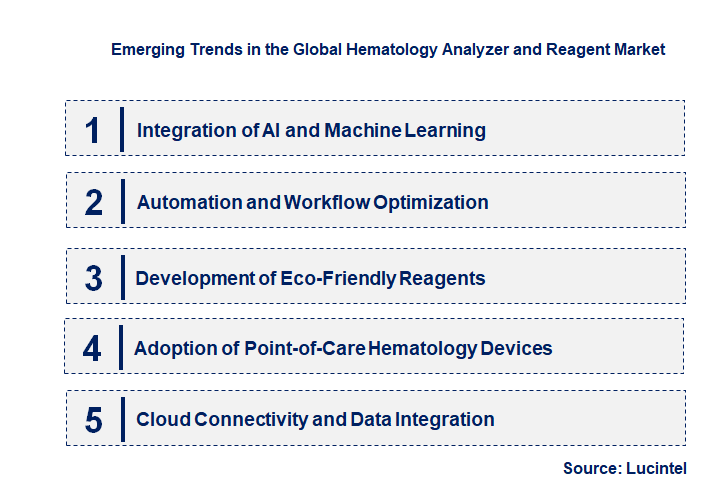
Emerging Trends in the Hematology Analyzer and Reagent Market
The hematology analyzer and reagent market is undergoing a transformation fueled by automation, artificial intelligence, and advanced reagent technologies. These innovations aim to improve diagnostic precision, efficiency, and accessibility in laboratories worldwide, aligning with the growing demand for personalized and data-driven healthcare.• Integration of AI and Machine Learning: AI-powered hematology analyzers are improving diagnostic accuracy by enabling automated identification of abnormal cells and blood disorders. This minimizes human error and speeds up reporting in both small and large laboratories.
• Automation and Workflow Optimization: Fully automated systems are gaining prominence for reducing manual intervention and improving consistency. These systems enhance laboratory throughput and enable better management of high testing volumes with minimal operator dependency.
• Development of Eco-Friendly Reagents: Manufacturers are focusing on sustainable and non-toxic reagent formulations. These innovations reduce environmental impact and ensure compliance with global safety and sustainability regulations.
• Adoption of Point-of-Care Hematology Devices: Compact and portable hematology analyzers are expanding access to blood testing in remote and resource-limited areas. They enable faster diagnostics and improved patient outcomes in primary care settings.
• Cloud Connectivity and Data Integration: The integration of cloud-based data management systems allows remote monitoring, real-time analytics, and seamless connectivity across laboratories, improving operational efficiency and compliance. Emerging trends such as AI integration, automation, and eco-friendly reagent development are redefining hematology testing. These innovations enhance accuracy, sustainability, and accessibility, transforming diagnostics into a more efficient and data-centric process.
Recent Development in the Hematology Analyzer and Reagent Market
Recent innovations in hematology analyzers and reagents are focusing on automation, connectivity, and environmentally responsible solutions. These developments are enhancing laboratory efficiency and advancing diagnostic precision through digital integration and reagent optimization.• Launch of Integrated Multi-Parameter Analyzers: New multi-parameter analyzers enable comprehensive blood analysis in a single platform, improving diagnostic workflow and accuracy.
• Advancement in Smart Reagent Technologies: Manufacturers are introducing reagents with extended stability and higher sensitivity, improving test reliability and cost efficiency.
• Introduction of AI-Powered Diagnostic Features: AI-integrated systems enhance cell classification accuracy and assist in early disease detection.
• Expansion of Portable and Compact Analyzers: Compact analyzers are increasingly used in clinics and field diagnostics, supporting quick and accessible testing.
• Enhanced Laboratory Connectivity Solutions: Cloud-linked platforms facilitate seamless communication between analyzers and laboratory information systems, improving traceability and data accuracy. Recent developments in the hematology analyzer and reagent market highlight technological innovation, automation, and sustainability. These advancements strengthen the diagnostic ecosystem, making testing faster, smarter, and more reliable.
Strategic Growth Opportunities in the Hematology Analyzer and Reagent Market
The hematology analyzer and reagent market offers significant opportunities across diverse healthcare applications. Rising demand for diagnostic accuracy and automation across hospitals, research centers, and clinics drives market growth and innovation in hematology testing.• Hospitals and Diagnostic Laboratories: Growing need for high-throughput systems in hospitals and laboratories supports adoption of automated hematology analyzers for efficient disease screening.
• Point-of-Care Testing: Portable analyzers create opportunities for rapid testing in emergency and remote care environments, ensuring quicker decision-making.
• Research and Academic Institutions: Increased focus on hematology research fosters demand for specialized analyzers with advanced data analytics and reagent precision.
• Blood Banks and Transfusion Centers: Hematology analyzers help ensure safe and compatible blood components, enhancing operational efficiency in blood screening processes.
• Veterinary Diagnostics: Growing adoption of hematology analyzers in animal healthcare supports accurate blood analysis and improved veterinary diagnostics. Strategic growth opportunities across clinical, research, and veterinary applications are expanding market potential. Advancements in automation and portability continue to enhance the accessibility and performance of hematology analyzers globally.
Hematology Analyzer and Reagent Market Driver and Challenges
The hematology analyzer and reagent market is driven by technological innovation, rising diagnostic demand, and regulatory standardization. However, high system costs and complex maintenance requirements pose challenges to widespread adoption. The factors responsible for driving the hematology analyzer and reagent market include: 1. Rising Prevalence of Blood Disorders: Increasing cases of hematological conditions are fueling the need for efficient diagnostic testing and advanced analyzers. 2. Advancements in Automation and AI: Automation and AI integration are improving accuracy, reducing errors, and streamlining laboratory operations. 3. Growing Focus on Preventive Healthcare: The emphasis on early disease detection encourages adoption of hematology testing in preventive healthcare programs. 4. Expanding Diagnostic Infrastructure: Investments in diagnostic facilities and laboratory modernization are enhancing access to high-quality hematology services. 5. Regulatory Standardization and Quality Assurance: Stringent global standards are driving adoption of certified analyzers and reagents to ensure reliability and safety. Challenges in the hematology analyzer and reagent market are: 1. High Cost of Advanced Equipment: Expensive analyzers and reagent systems limit access in low-resource healthcare settings. 2. Complex Maintenance Requirements: Regular calibration and maintenance increase operational complexity, affecting smaller laboratories. 3. Limited Technical Expertise in Developing Regions: Lack of trained professionals hinders efficient use of advanced analyzers and data integration tools. The hematology analyzer and reagent market is advancing through automation, AI, and robust quality standards. Overcoming cost and skill-related challenges will be vital to achieving broader adoption and diagnostic precision across global healthcare systems.List of Hematology Analyzer and Reagent Companies
Companies in the market compete on the basis of product quality offered. Major players in this market focus on expanding their manufacturing facilities, R&D investments, infrastructural development, and leverage integration opportunities across the value chain. With these strategies hematology analyzer and reagent companies cater increasing demand, ensure competitive effectiveness, develop innovative products & technologies, reduce production costs, and expand their customer base. Some of the hematology analyzer and reagent companies profiled in this report include-• Bio-Rad Laboratories
• Immucor
• Ortho Clinical Diagnostics
• Grifols
• Haemotec
• Hemo bioscience
• Institut de Biotechnologies Jacques Boy
• Sysmex Corporation
• Beckman Coulter
• Abbott Laboratories
Hematology Analyzer and Reagent Market by Segment
The study includes a forecast for the global hematology analyzer and reagent market by type, application, and region.Hematology Analyzer and Reagent Market by Type [Value from 2019 to 2031]:
• Analyzer
• Reagent
Hematology Analyzer and Reagent Market by Application [Value from 2019 to 2031]:
• Hospital
• Blood Bank
• Research Institutions
Hematology Analyzer and Reagent Market by Region [Value from 2019 to 2031]:
• North America
• Europe
• Asia Pacific
• The Rest of the World
Country Wise Outlook for the Hematology Analyzer and Reagent Market
The hematology analyzer and reagent market is evolving with advancements in automation, digital diagnostics, and reagent innovation. Growing demand for precise, rapid, and reliable blood analysis has prompted manufacturers to introduce systems with advanced data integration, AI-based diagnostics, and compact designs to improve clinical efficiency and diagnostic accuracy across major healthcare markets.• United States: The United States is experiencing increased adoption of high-throughput hematology analyzers featuring AI-based cell classification and cloud connectivity. Hospitals and laboratories are integrating multi-parameter systems for better diagnostic precision. Strategic collaborations between diagnostic firms and reagent manufacturers are also enhancing workflow efficiency and expanding access to advanced hematology testing.
• China: China’s hematology diagnostics sector is progressing through domestic innovation and increased production capacity. Local companies are investing in automated hematology systems and high-quality reagents that align with international standards. The government’s focus on healthcare modernization is encouraging partnerships between hospitals and equipment providers to ensure affordable, reliable blood testing solutions.
• Germany: Germany’s market emphasizes smart, automated analyzers that improve laboratory throughput and ensure accuracy. Integration with laboratory information systems supports efficient data management and traceability. German manufacturers are advancing reagent formulations that enhance precision and reduce environmental impact, aligning with the country’s focus on sustainable healthcare innovation.
• India: India is witnessing rapid adoption of cost-effective hematology analyzers and reagents across hospitals and diagnostic centers. Domestic manufacturers are developing compact, user-friendly systems suited for regional and rural healthcare settings. Growing government initiatives to expand diagnostic infrastructure are supporting wider accessibility to reliable hematology testing solutions.
• Japan: Japan continues to lead in hematology automation through compact, high-precision analyzers. Integration of robotics and AI-driven diagnostics enables real-time decision-making in laboratories. Japanese manufacturers are also focusing on reagent standardization and quality control to ensure consistent performance across healthcare facilities.

Features of the Global Hematology Analyzer and Reagent Market
Market Size Estimates: Hematology analyzer and reagent market size estimation in terms of value ($B). Trend and Forecast Analysis: Market trends (2019 to 2024) and forecast (2025 to 2031) by various segments and regions. Segmentation Analysis: Hematology analyzer and reagent market size by type, application, and region in terms of value ($B). Regional Analysis: Hematology analyzer and reagent market breakdown by North America, Europe, Asia Pacific, and Rest of the World. Growth Opportunities: Analysis of growth opportunities in different types, applications, and regions for the hematology analyzer and reagent market. Strategic Analysis: This includes M&A, new product development, and competitive landscape of the hematology analyzer and reagent market. Analysis of competitive intensity of the industry based on Porter’s Five Forces model.
FAQ
Q1. What is the growth forecast for hematology analyzer and reagent market? Answer: The global hematology analyzer and reagent market is expected to grow with a CAGR of 6% from 2025 to 2031. Q2. What are the major drivers influencing the growth of the hematology analyzer and reagent market? Answer: The major drivers for this market are the increasing prevalence of blood related disorders, the rising adoption of automated diagnostic systems, and the growing demand for accurate hematology testing. Q3. What are the major segments for hematology analyzer and reagent market? Answer: The future of the hematology analyzer and reagent market looks promising with opportunities in the hospital, blood bank, and research institution markets. Q4. Who are the key hematology analyzer and reagent market companies? Answer: Some of the key hematology analyzer and reagent companies are as follows:• Bio-Rad Laboratories
• Immucor
• Ortho Clinical Diagnostics
• Grifols
• Haemotec
• Hemo bioscience
• Institut de Biotechnologies Jacques Boy
• Sysmex Corporation
• Beckman Coulter
• Abbott Laboratories Q5. Which hematology analyzer and reagent market segment will be the largest in future? Answer: Lucintel forecasts that, within the type category, reagent is expected to witness higher growth over the forecast period. Q6. In hematology analyzer and reagent market, which region is expected to be the largest in next 5 years? Answer: In terms of region, APAC is expected to witness the highest growth over the forecast period. Q7. Do we receive customization in this report? Answer: Yes, Lucintel provides 10% customization without any additional cost.
Table of Contents
List of Figures
List of Tables
Methodology
- In-depth interviews of the major players in this market
- Detailed secondary research from competitors’ financial statements and published data
- Extensive searches of published works, market, and database information pertaining to industry news, company press releases, and customer intentions
- A compilation of the experiences, judgments, and insights of Lucintel’s professionals, who have analyzed and tracked this market over the years.


Buy Now
Choose a license that fits your team. Instant PDF delivery.
Prices exclude taxes. Instant delivery. Custom licensing available on request.
Key Questions
- • What are some of the most promising, high-growth opportunities for the hematology analyzer and reagent market by type (analyzer and reagent), application (hospital, blood bank, and research institutions), and region (North America, Europe, Asia Pacific, and the Rest of the World)?
- • Which segments will grow at a faster pace and why?
- • Which region will grow at a faster pace and why?
- • What are the key factors affecting market dynamics? What are the key challenges and business risks in this market?
- • What are the business risks and competitive threats in this market?
- • What are the emerging trends in this market and the reasons behind them?
- • What are some of the changing demands of customers in the market?
- • What are the new developments in the market? Which companies are leading these developments?
- • Who are the major players in this market? What strategic initiatives are key players pursuing for business growth?
- • What are some of the competing products in this market and how big of a threat do they pose for loss of market share by material or product substitution?
- • What M&A activity has occurred in the last 5 years and what has its impact been on the industry? For any questions related to Hematology Analyzer and Reagent Market, Hematology Analyzer and Reagent Market Size, Hematology Analyzer and Reagent Market Growth, Hematology Analyzer and Reagent Market Analysis, Hematology Analyzer and Reagent Market Report, Hematology Analyzer and Reagent Market Share, Hematology Analyzer and Reagent Market Trends, Hematology Analyzer and Reagent Market Forecast, Hematology Analyzer and Reagent Companies, write Lucintel analyst at email: helpdesk@lucintel.com. We will be glad to get back to you soon.


