
Market Report · July 31, 2026

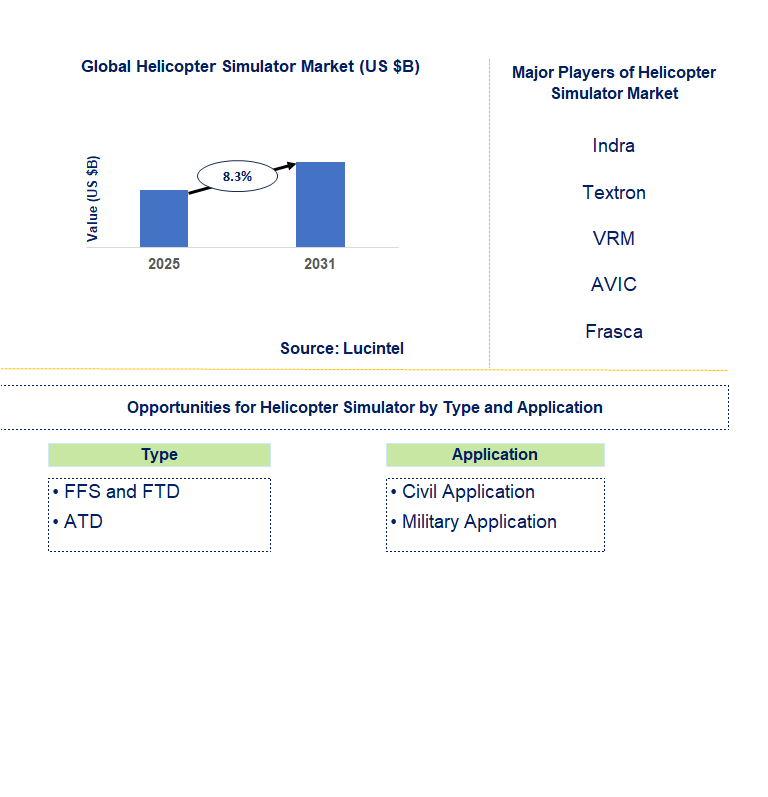
Key data points: The growth forecast = 0.083 annually for the next 7 years. Scroll below to get more insights. This market report covers Trends, opportunities and forecasts in helicopter simulator market to 2031 by type (ffs and ftd and atd), application (civil application and military application), and region (North America, Europe, Asia Pacific, and the Rest of the World)
We'll send your sample report shortly.
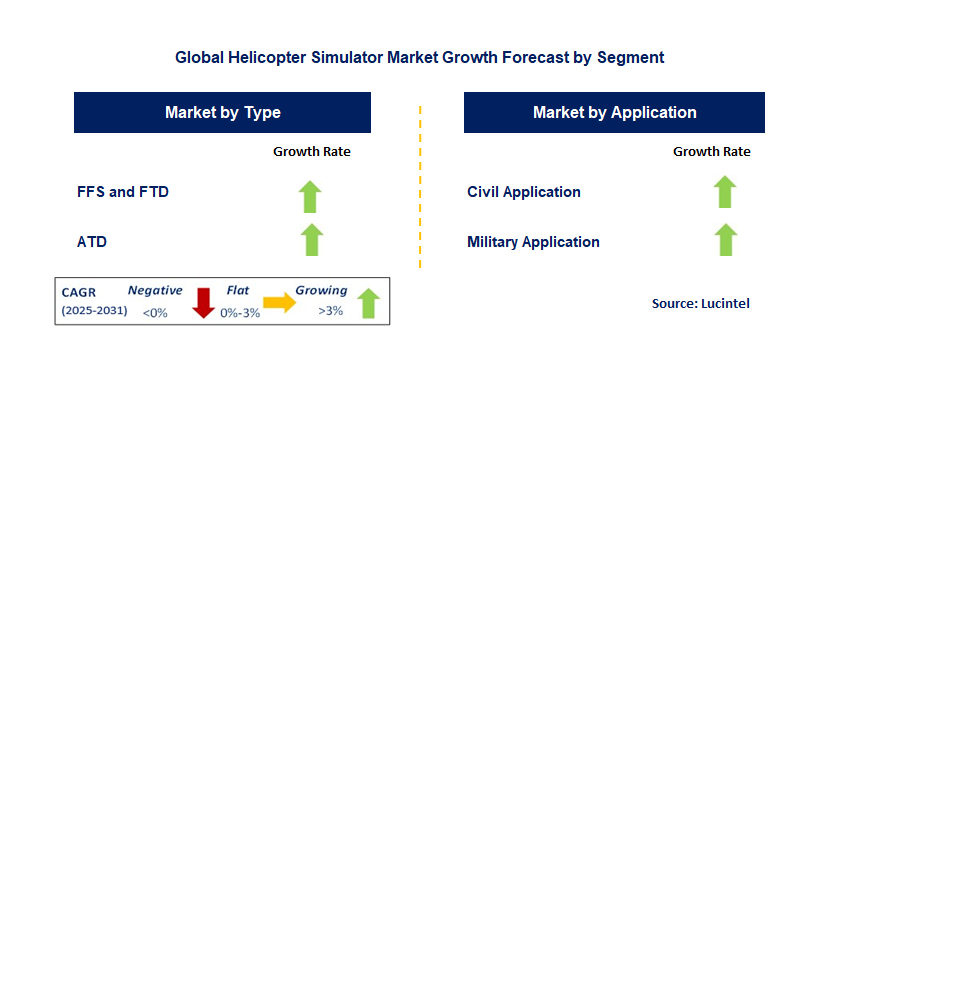
• Lucintel forecasts that, within the type category, ftd is expected to witness higher growth over the forecast period due to cost-effectiveness and increasing demand for pilot training.
• Within the application category, military application is expected to witness the highest growth due to increased defense training and technological advancements.
• In terms of region, APAC is expected to witness the highest growth over the forecast period due to expanding defense budgets and modernization efforts.
• VR and AR Integration: Virtual reality and augmented reality are enhancing the realism in helicopter simulators. These provide immersive environments through which pilots may experience lifelike scenarios of adverse weather, emergency landings, and complicated terrains that would otherwise involve risks associated with live flight training.
• AI in Adaptive Training: AI-powered helicopter simulators are being developed for personalizing the training sessions for a pilot's skill level. AI can alter scenarios and feedback based on performance in real time, ensuring pilots are always challenged and engaged during training while also improving efficiency and reducing costs.
• Cloud-Based Simulation Platforms: Cloud-based helicopter simulators have become more popular with time since they offer flexibility in the ability to operate training programs remotely. Trainees with cloud-based solutions can access simulators any time, from any place, thereby improving accessibility and reducing the costs of costly on-site infrastructure.
• High-Fidelity Simulators with Real-Time Data Integration: There is an increasing demand for helicopter simulators that translate high fidelity as closely as possible to real-time conditions. High fidelity in helicopter simulators is witnessed in real-time data integration, which can include weather reports and information from air traffic control. This creates authentic training conditions for pilots with regard to real-time decision making.
• Simulator-as-a-Service (SaaS) Model: The SaaS model is becoming more prevalent and allows users to take simulation training on a subscription basis. This can significantly reduce upfront capital expenditure, making simulators more accessible to small organizations, flight schools, and countries with limited budgets. It also allows flexibility and cost efficiency in terms of maintenance and software updates.
Emerging trends in the helicopter simulator market are changing the methods of training with the help of advanced technologies like VR, AR, AI, and cloud-based solutions. The innovations are adding realism, flexibility, and cost-effectiveness to the training systems, thus creating new opportunities for organizations and countries to improve pilot readiness.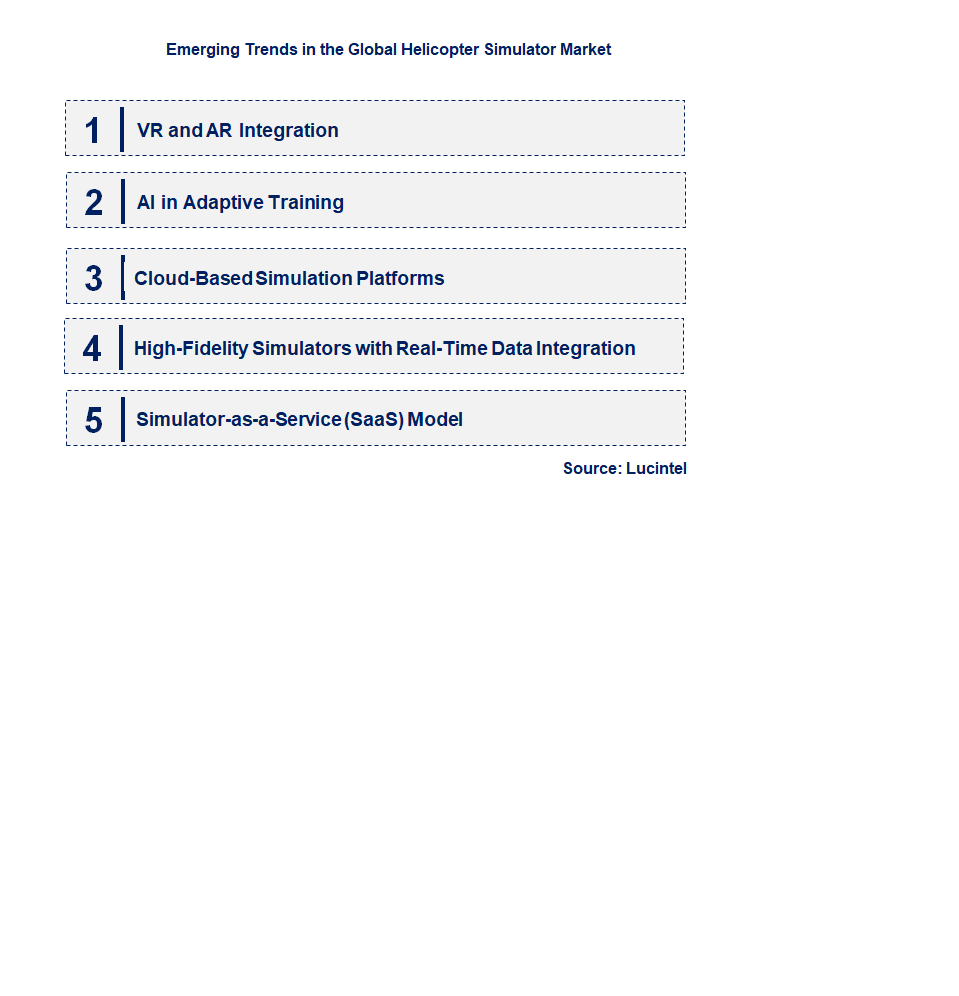
• Incorporation of VR/AR for Realistic Training: Advanced helicopter simulators integrate new VR and AR technologies, allowing the trainee to have an immersive experience. These advanced systems present the complex, high-risk scenario to the pilots without requiring actual flight, thereby reducing training costs and increasing safety.
• Use of High-Fidelity Simulators in Military Training: Military applications are also becoming predominant in high-fidelity helicopter simulators. They replicate actual conditions of flight with ever higher levels of fidelity, thus making it possible for military pilots to train in a variety of challenging environments without the expense and risks associated with actual missions.
• Cloud-Based Simulations for Remote Training: Cloud-based helicopter simulators are gaining more popularity these days, especially in organizations that demand flexibility. With this technology, trainees can access high-quality simulators remotely, opening the training to people and minimizing costly hardware infrastructure.
• AI-Driven Customization in Pilot Training: Artificial intelligence is being integrated into helicopter simulators to offer adaptive training experiences. AI algorithms can assess pilot performance and adjust scenarios to match their skill levels, enabling personalized training sessions that enhance learning efficiency and effectiveness.
• Cost-Effective Simulator Solutions for Emerging Markets: The development of low-cost helicopter simulators is also being focused on for emerging markets. This provides a more cost-effective solution for pilot training in countries with limited aviation budgets, thereby improving pilot proficiency without the high costs associated with traditional flight training.
Recent trends in helicopter simulator market revolutionize pilot training with new technology. Incorporation of VR/AR, AI, and cloud-based technologies has transformed the helicopter simulators to become realistic, accessible, and cost-efficient in fulfilling diverse needs in the military, commercial, and emergency sectors of different parts of the world.• Growth in Military Simulation Needs: Military simulation requirements are on the rise; actually, military organizations in the world now acquire high-end simulators meant for training purposes. Combat and emergency scenario simulators have been found to be in rising demand, which create abundant opportunities for the manufacture of high-fidelity systems.
• Expansion of Commercial Aviation Training: An increase in world-wide air travel naturally demands better-trained commercial helicopter pilots. Development of helicopter simulators will train pilots on several types of flight operations, such as emergency procedures, creating the opportunity for growth in commercial helicopter training programs.
• Development of Cloud and Remote Training Solutions. Remote training solutions for helicopters are attracting more organizations because they can access helicopter simulators anywhere from there. Remote training solutions reduce the cost associated with a traditional training center, thus increasing access to global markets.
• Cost-effective simulators: Emerging markets- The emergence of new markets, especially in Southeast Asia and Africa, also open up for developing and deploying low-cost helicopter simulators. As the region becomes increasingly thirsty for affordable training systems that enable them to train proficient pilots with relatively lower cost without the burdensome traditional flight training.
• Simulator Solutions for Emergency Response and Disaster Relief: Helicopter simulator solutions are becoming increasingly important in training pilots for emergency response, search-and-rescue, and disaster relief. This is one of the most significant growth opportunities, because it is now the need of the hour to provide well-trained pilots to manage situations in times of emergencies with an improved response time.
Demand from the military, commercial aviation, emerging markets, and emergency response sectors drives strategic growth opportunities in the helicopter simulator market. Technological innovations in training solutions and the need for cost-effective, flexible systems open new avenues for growth in the global market.• Indra
• Textron
• VRM
• AVIC
• Frasca
• Redbird FMX
• Bluesky
• FFS and FTD
• ATD
• Civil Application
• Military Application
• North America
• Europe
• Asia Pacific
• The Rest of the World
• United States: The United States is still the leader in the helicopter simulator market, with a focus on integrating virtual reality (VR) and augmented reality (AR) technologies into training simulators. The military and commercial aviation sectors are investing heavily in advanced simulators to improve training efficiency, reduce operational costs, and enhance safety protocols for helicopter pilots.
• China: The helicopter simulator market in China is increasing due to the growing demand from military and civil aviation for pilot training. The government is heavily invested in advanced simulators and training, with an emphasis on higher quality commercial and military pilot programs. China will also be pursuing the use of AI and VR to maximize the immersive nature of the experience.
• Germany: Germany is making significant progress in developing high-fidelity helicopter simulators. The focus areas are training programs for military as well as civilian pilots. Germany's market will be on digital technologies and integration of real-time data into the simulators. Germany has a strong aerospace industry and aims at providing cost-effective solutions to clients both locally and internationally.
• India: Increasing demand for helicopter simulators to train military as well as civil pilots is on the rise. The Indian government has been boosting its investments in aviation safety. More simulators are being designed to support helicopter operations, mainly in remote and challenging environments. The demand within the country is rising for affordable, locally-designed simulators.
• Japan: In terms of market and technological development for Japan, some commercial and military markets are implementing the advanced helicopters with simulators. These simulate helicopter training along with maintenance issues. The future emphasis for advanced graphics and related hardware technology continues to be advanced for improved accuracy in simulation techniques. Disaster responses and search operations will also come under simulation tool utilization.


• Indra
• Textron
• VRM
• AVIC
• Frasca
• Redbird FMX
• Bluesky
Q5. Which helicopter simulator market segment will be the largest in future?

Choose a license that fits your team. Instant PDF delivery.
Prices exclude taxes. Instant delivery. Custom licensing available on request.
Market Report · July 31, 2026
Market Report · July 31, 2026
Market Report · July 31, 2026
Trusted partner for strategic intelligence and business growth


Receive a complimentary market analysis tailored to your industry. Our analysts will identify key growth opportunities and competitive dynamics specific to your business.

Market size, growth rate, and key trend analysis for your specific sector.

Top competitor positioning and market share analysis.

Strategic recommendations backed by data-driven insights.
Get curated market intelligence and competitive moves straight to your inbox.
By subscribing, you agree to receive our monthly insights. Unsubscribe anytime.
Receive a complimentary market analysis tailored to your industry. Our analysts will identify key growth opportunities and competitive dynamics specific to your business.
Market size, growth rate, and key trend analysis for your specific sector.
Top competitor positioning and market share analysis.
Strategic recommendations backed by data-driven insights.
Get curated market intelligence, emerging trends, and competitive moves straight to your inbox each month.
By subscribing, you agree to receive our monthly insights. Unsubscribe anytime.
We'll send your sample report shortly.