
Market Report · May 18, 2026

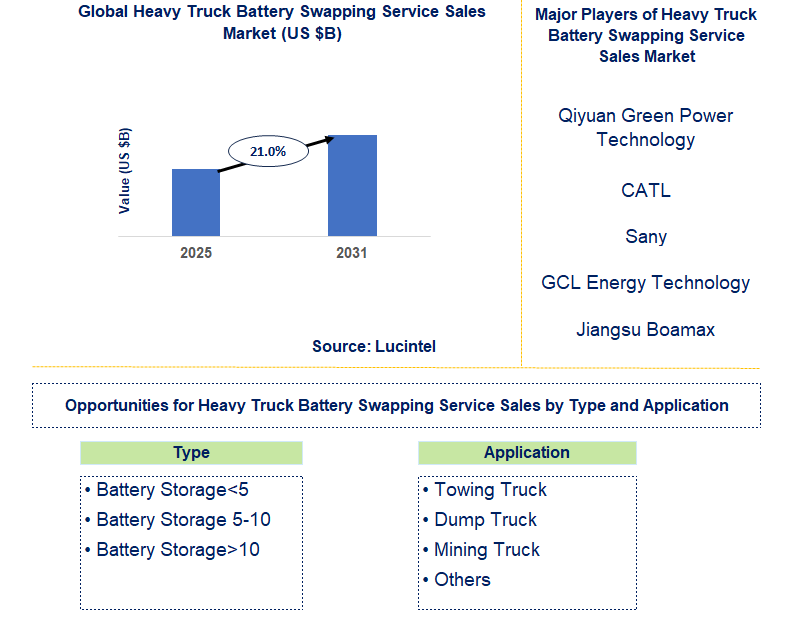
Key data points: The growth forecast = 21% annually for the next 7 years. Scroll below to get more insights. This market report covers Trends, opportunities and forecasts in heavy truck battery swapping service sales market to 2031 by type (battery storage<5, battery storage 5-10, and battery storage>10), application (towing truck, dump truck, mining truck, and others), and region (North America, Europe, Asia Pacific, and the Rest of the World)
We'll send your sample report shortly.
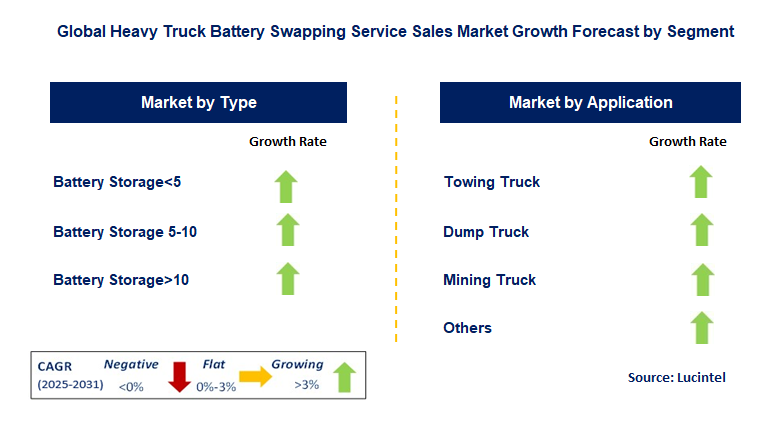
• Lucintel forecasts that, within the type category, battery storage>10 is expected to witness the highest growth over the forecast period due to its longer operational life.
• Within the application category, mining truck is expected to witness the highest growth due to the increasing electrification in mining operations.
• In terms of region, APAC is expected to witness the highest growth over the forecast period due to the growing adoption of electric vehicles.
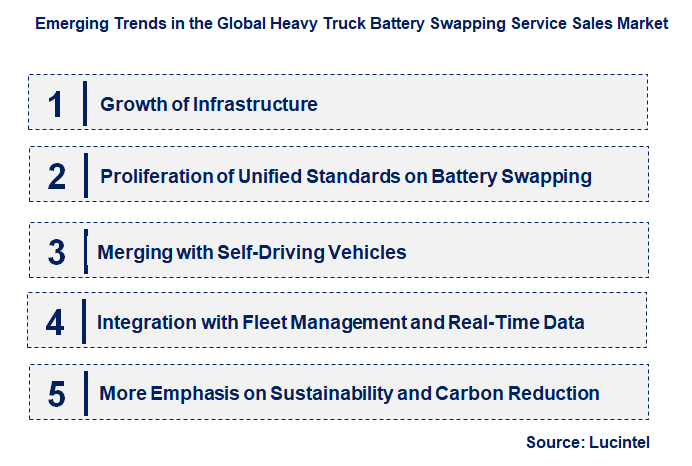
• Growth of Infrastructure: One of the most notable trends in the market is the growth of infrastructure related to battery swapping. Private sector firms and the government are spending large amounts of money to build a network of battery swap stations along the Interstates, particularly for long-haul trucking regions. This infrastructure development solves the range anxiety issue and enhances the practicality of using electric heavy trucks for businesses. A strong network of these infrastructures would also promote the use of electric vehicles as it minimizes the idle time of the truck fleet and guarantees the supply of electricity.
• Proliferation of Unified Standards on Battery Swapping: The adoption and proliferation of unified standards on battery swapping are critical now more than ever. For battery swapping stations to be efficient and economically viable, there needs to be interoperability between vehicles and batteries from different manufacturers. Work is being done on defining battery sizes, shapes, and the devices used to perform the swap. Standardization would streamline set up of infrastructures, minimize the costs incurred, and guarantee that users would be able to swap out batteries no matter what truck model or manufacturer they have.
• Merging with Self-Driving Vehicles: The merging of battery swapping services with self-driving autonomous heavy trucks is a new trend. With the increasing use of self-driving vehicles, there is greater demand for automated systems that can perform battery swapping. They will be able to carry out swaps without any human involvement, which will decrease the amount of downtime and improve operational efficiency. Fully electric self-driving trucks will need to seamlessly perform long hauls, and battery swapping will be critical in achieving this for logistics and freight transport.
• Integration with Fleet Management and Real-Time Data: Another trend that is changing the market is the use of real-time data and fleet management systems. Battery swapping services are now being offered with fleet management software that tracks the location of vehicles along with their operational efficiency and battery status. This integration enables improved efficiency in battery utilization, scheduling of battery swaps, and fleet performance monitoring. It also helps to better plan routes so that trucks which need to have their batteries swapped do not run low on power and are able to get to the battery swapping stations.
• More Emphasis on Sustainability and Carbon Reduction: There is increased attention towards sustainability in the heavy truck battery swapping market. Governments around the globe are moving towards carbon neutrality and are viewing battery swapping services as a fundamental method to mitigate the carbon emissions associated with transportation. Corporations are integrating battery swapping capabilities into their business models to achieve sustainability targets. Businesses utilizing battery electric vehicles with battery swapping capabilities exceed environmental protection expectations, emissions mitigation, and support global environmental policies. These trends enhance sustainability, automation, and infrastructure development along with operational efficiency to transform the heavy truck battery swapping service sales market. Increased adoption of battery swapping services along with other sustainable and automated features has the potential to change the future of heavy-duty transportation.
• Opening of High-Speed Battery Swapping Stations: The introduction of battery swapping high-speed stations is a market game changer. These stations operate to swap out batteries in just minutes, reducing the wait period for trucks to get back on the road. This has been vital for long-haul trucking for which downtime can be very costly. These high-speed swapping stations also contribute to alleviating range anxiety, making it possible for electric heavy trucks to be used by companies with complex logistical needs.
• Support from the State and Other Subsidies: Governments are providing support incentives and subsidies for the adoption of Electric Vehicles (EVs), including heavy trucks. Such investments are making it easier for companies to adopt battery swapping infrastructure and electric truck fleets. In China, there is already a program providing incentives for the purchase of electric trucks and the construction of battery swapping stations. The EU and the U.S. are providing tax rebates along with funding clean energy infrastructure. All of these factors had a significant impact on electric truck’s market growth and adoption.
• Partnerships of Electric Car Manufacturers and Battery Swapping Facilities Providers: There is a growing partnership between the battery swapping service providers and automakers to offer solutions for heavy trucks. In China, companies like NIO and BYD together with Tesla in the U.S. have partnered with battery swapping providers to come up with effortless electric truck solutions. Partnerships are formed to ensure truck compatibility with swapping stations, improve battery technologies, and user experience. These collaborations facilitate the expansion of regions that offer battery swapping services.
• Progress in Battery Technology: Fulfilling the growing need for fast electric truck charging, lightweight and high-capacity batteries have been developed. In addition, battery swapping stations are becoming more advanced and can now swap out spent batteries for charged ones in a shorter amount of time while also servicing multiple trucks at the same time. These improvements in battery technology are essential in enhancing the cost effectiveness of electric heavy trucks and making battery swapping services efficient for customers.
• Proliferation of Battery Swapping Services: Network expansion is one of the most important aspects boosting the development of the market. Businesses are increasingly building swapping stations in big cities and along main trucking routes as the demand for electric trucks continues to grow. For instance, China has implemented a country-wide network of battery swap stations, and other countries in Europe and North America are also starting to build these networks. This will ensure that electric trucks receive enough useful charging services to make their usage in long distance driving more practical. The growth of the Heavy Truck Battery Swapping Service market is being propelled by growth in the battery swapping technology, government subsidies, industry collaborations, and infrastructure development. With more regions embracing electric trucks and building battery swapping networks, this market will continue to grow and will change the face of logistics and transportation.
• Growth of Urban Delivery Fleets: One potential growth opportunity lies within the extension of battery swapping services to urban delivery fleets. In the cities, there is a rising need for electric delivery vehicles because of the stringent emission policies. Offering battery swapping services in urban areas guarantees speedy turnaround times and lower downtime. Urban environments that often experience traffic congestion are ideal locations for battery swapping stations to be set up because they eliminate the long wait times associated with charging delivery trucks. The adoption of electric vehicles for urban fleets is becoming vitally important as sustainability and efficiency in operations are being highly regarded by logistics companies and city authorities.
• Combined Fright and Logistics Services with the Swapping of Batteries: An additional area of growth is the merging of battery swapping services with both logistical operations and freight transport. Long-haul trucks often struggle with efficiency when it comes to traditional charging methods since they require long breaks to recharge. Battery swapping is a faster and better approach. Installing battery swapping stations along major freight corridors and logistics hubs would lower truck idle time and ensure the smooth continuation of freight activities. The growing usage of e-commerce as well as the increasing demand for rapid deliveries make this a vital opportunity for companies to improve their logistics efforts while simultaneously achieving sustainability objectives.
• Collaborations with Public and Private Sectors: Collaborations between the public and private sectors offer an important opportunity that could significantly hasten the development of the battery swapping infrastructure. Currently, governments pay subsidize clean energy initiatives while private firms contribute with innovation and capital, The Joint efforts will facilitate the scaling of the infrastructure for battery swap stations in different regions and countries. These partnerships can focus on high-demand routes, urban areas, and industrial hubs where the demand for electric trucks is growing. In turn, this cooperation can stimulate the development of general economic applicability of battery swapping as a service that is cost effective for both users and providers.
• Adoption by Autonomous Truck Fleets: The appearance of self-driving truck fleets is a new opportunity for the market of battery swapping services. These trucks will most likely be deployed in the future, which makes these services all the more important. Battery swapping stations have the potential to be strategically placed in autonomous fleet operations, where trucks may be able to swap batteries out on their own. This extreme level of automation can help enhance operational efficiency, reduce expenses, and support nonstop long-haul operations. Self-driving vehicles will boost the demand for battery swapping services. As this demand rises, so will the need for self-driving truck fleets.
• Progress in Battery Swapping Technology Development: There is an opportunity to grow with the relentless development of faster and more efficient battery swapping technologies. The progress made in battery servicing is due to the better battery’s capacity, charging speed, and modular design. Businesses can focus on time-to-replace innovations while ensuring high-time reliability is achieved. High-level swapping stations that can serve several trucks at once will also enhance the speed at which battery swapping services can be provided. Technologies aimed at aiding the adoption of electric trucks by fleet operators through easier battery swapping will need investment. These opportunities indicate the ever-changing landscape of the market for sales of services related to heavy truck battery swapping. The changes in urban fleets and logistics, autonomous trucks, public-private partnerships, and advanced battery swapping technology will drive the market demand to grow at a very high pace. Any company that is able to act within these provided opportunities will be able to offer more solutions for the environment while satisfying the needs for sustainable and effective industry development.
• Qiyuan Green Power Technology
• CATL
• Sany
• GCL Energy Technology
• Jiangsu Boamax
• Enneagon
• SPIC
• Battery Storage<5
• Battery Storage 5-10
• Battery Storage>10
• Towing Truck
• Dump Truck
• Mining Truck
• Others
• North America
• Europe
• Asia Pacific
• The Rest of the World
• USA: In the USA, the Heavy Truck Battery Swapping Service market is evolving due to the adoption of electric commercial trucks. Companies are actively working towards putting into place the necessary infrastructure for fast battery swaps on long haul trucks. California’s efforts are noteworthy, with additional funding being channeled towards EV adoption and the building of supporting infrastructure. There is also a growing focus on standardization of battery swapping systems to facilitate multilateral adoption, which is essential. The development of self-driving electric trucks further fuels the interest in battery swapping systems designed to improve efficiency by reducing downtime.
• China: As a trailblazer in the heavy truck battery swapping service market, China has a well-established infrastructure in place. The Electric Vehicles (EV) subsidy provided by the government, alongside urban logistics transitions, have propelled the construction of battery swapping stations. Moreover, CATL and NIO are working towards developing cost-efficient and rapid battery swap technologies. The battery swap service demand in China is growing from heavy industry sectors such as logistics and mining. Furthermore, a network of highways throughout the country is gradually being fitted with battery swap stations, providing an effective solution for long-distance carriers.
• Germany: As part of the green energy transition, Germany is actively pursuing Heavy Truck Battery Swapping Service market opportunities. To stimulate the adoption of commercial EVs, the government is also trying to put in place an effective charging and battery swapping system for heavy trucks. In the quest for the most effective solutions to satisfy the rising demand in freight and logistic tasks, German leaders like VW and Daimler are adopting battery swapping technologies and incorporating them into their heavy-duty vehicles. In Germany, the goal is to minimize the waiting time for freight trucks caused by refueling and to improve the overall effectiveness of logistic processes and environmental impact of the trucking industry.
• Indian Subcontinent: Although the usage of electric vehicles, which includes heavy trucks, is still at its initial stage in India, there remains a considerable scope for progress. The limited charging infrastructure available in the country makes battery swapping services attractive in the commercial transport industry. Many large and small Indian companies are joining together to construct battery swap stations in cities which are particularly difficult for delivery trucks to operate. Government programs like the Faster Adoption and Manufacturing of Hybrid and Electric Vehicles (FAME) scheme are helping to foster electric vehicle battery swapping infrastructure.
• Japan: Japan has been among the early adopters of electric and hybrid vehicles, and is now working towards implementing heavy truck battery swapping services. Japanese firms, notably Toyota and Panasonic, are working together to develop efficient and quick battery swapping stations for industry and transport. Japan’s emphasis on innovation and sustainability, while needing to reduce carbon emissions, makes implementing battery swapping services almost inevitable. The country's highly developed industrial network, particularly in regions like automotive and electronics production, serves as the launching pad for installing battery swapping stations for heavy trucks.


• Qiyuan Green Power Technology
• CATL
• Sany
• GCL Energy Technology
• Jiangsu Boamax
• Enneagon
• SPIC Q5. Which heavy truck battery swapping service sales market segment will be the largest in future? Answer: Lucintel forecasts that, within the type category, battery storage>10 is expected to witness the highest growth over the forecast period due to its longer operational life. Q6. In heavy truck battery swapping service sales market, which region is expected to be the largest in next 5 years? Answer: In terms of region, APAC is expected to witness the highest growth over the forecast period due to the growing adoption of electric vehicles. Q7. Do we receive customization in this report? Answer: Yes, Lucintel provides 10% customization without any additional cost.


Choose a license that fits your team. Instant PDF delivery.
Prices exclude taxes. Instant delivery. Custom licensing available on request.
Market Report · May 18, 2026
Market Report · May 18, 2026
Market Report · May 18, 2026
Trusted partner for strategic intelligence and business growth


Receive a complimentary market analysis tailored to your industry. Our analysts will identify key growth opportunities and competitive dynamics specific to your business.

Market size, growth rate, and key trend analysis for your specific sector.

Top competitor positioning and market share analysis.

Strategic recommendations backed by data-driven insights.
Get curated market intelligence and competitive moves straight to your inbox.
By subscribing, you agree to receive our monthly insights. Unsubscribe anytime.
Receive a complimentary market analysis tailored to your industry. Our analysts will identify key growth opportunities and competitive dynamics specific to your business.
Market size, growth rate, and key trend analysis for your specific sector.
Top competitor positioning and market share analysis.
Strategic recommendations backed by data-driven insights.
Get curated market intelligence, emerging trends, and competitive moves straight to your inbox each month.
By subscribing, you agree to receive our monthly insights. Unsubscribe anytime.
We'll send your sample report shortly.