
Report Feature
Healthcare Supply Chain Management Market Trends and Forecast
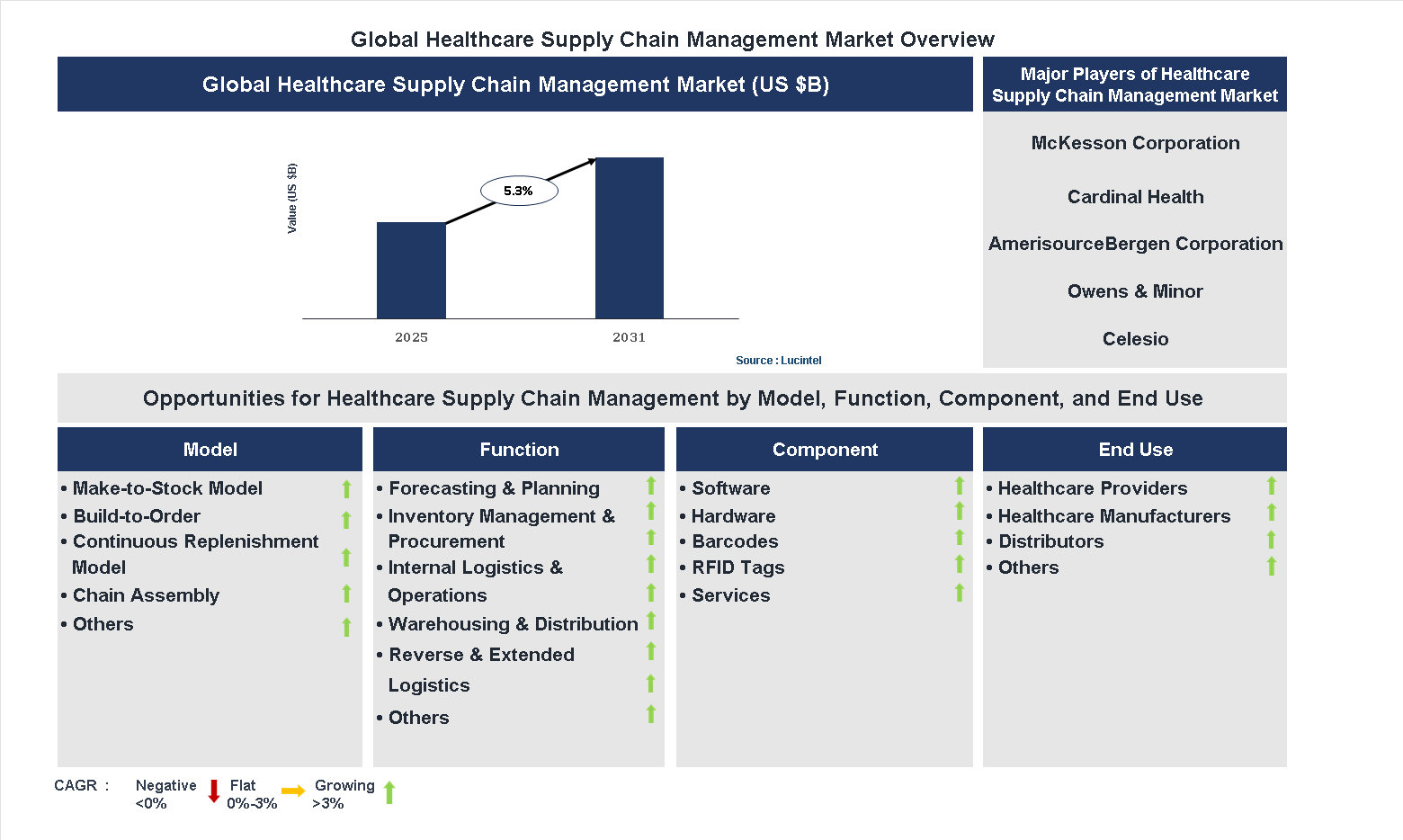
The future of the global healthcare supply chain management market looks promising with opportunities in the healthcare provider, healthcare manufacturer, and distributor markets. The global healthcare supply chain management market is expected to grow with a CAGR of 5.3% from 2025 to 2031. The major drivers for this market are the increasing demand for efficient inventory management, the rising adoption of digital supply solutions, and the growing focus on cost reduction strategies.• Lucintel forecasts that, within the model category, make-to-stock model is expected to witness the highest growth over the forecast period.
• Within the end use category, healthcare provider is expected to witness the highest growth.
• In terms of region, APAC is expected to witness the highest growth over the forecast period. Gain valuable insights for your business decisions with our comprehensive 150+ page report. Sample figures with some insights are shown below.
Emerging Trends in the Healthcare Supply Chain Management Market
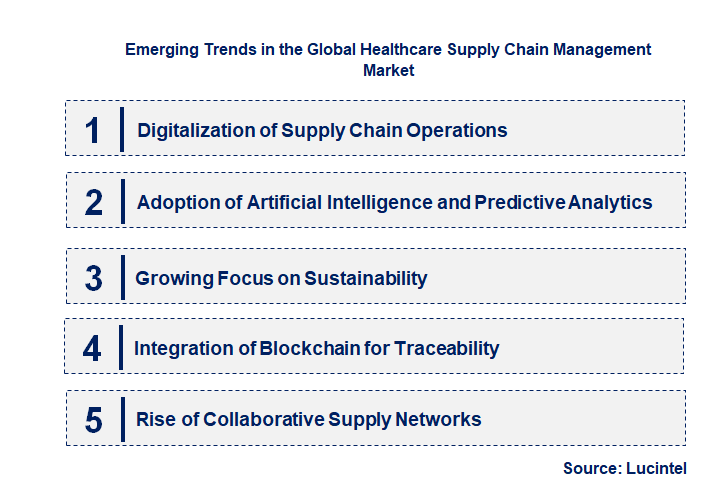
The healthcare supply chain management market is evolving through digital transformation, data-driven decision-making, and sustainability initiatives. These trends are driven by the need for operational efficiency, risk reduction, and better patient care outcomes. The following five key trends illustrate how innovation is reshaping healthcare logistics and procurement globally.• Digitalization of Supply Chain Operations: Automation, cloud computing, and advanced analytics are revolutionizing supply chain management. Digital tools provide real-time insights, streamline procurement, and enhance data accuracy. This digital shift reduces errors, strengthens supplier coordination, and ensures better resource allocation across hospitals and healthcare organizations.
• Adoption of Artificial Intelligence and Predictive Analytics: AI-driven predictive tools are helping healthcare providers forecast demand accurately. These technologies optimize inventory levels, reduce wastage, and anticipate supply disruptions. The trend ensures smoother operations and minimizes the risk of shortages, enhancing supply chain resilience and patient care reliability.
• Growing Focus on Sustainability: Sustainability initiatives are gaining traction with the adoption of green logistics, eco-friendly packaging, and waste reduction measures. Healthcare organizations are aligning supply chain practices with environmental goals, improving both operational efficiency and public health outcomes through responsible resource utilization.
• Integration of Blockchain for Traceability: Blockchain technology is improving product traceability and reducing counterfeit risks. It ensures secure and transparent tracking of medical products across suppliers, distributors, and healthcare facilities. This enhances trust, ensures regulatory compliance, and safeguards the authenticity of healthcare goods.
• Rise of Collaborative Supply Networks: Healthcare institutions are forming integrated networks with suppliers and logistics partners to enhance coordination. These collaborations improve visibility, streamline procurement, and reduce operational delays. Shared data and joint planning lead to improved efficiency and better patient care outcomes. These emerging trends are redefining healthcare supply chain management by merging technology, sustainability, and collaboration. As the sector evolves, digital and data-driven systems are becoming essential for enhancing efficiency, ensuring quality, and building a resilient healthcare logistics ecosystem worldwide.
Recent Development in the Healthcare Supply Chain Management Market
The healthcare supply chain management market has seen major advancements focused on improving transparency, efficiency, and responsiveness. The following five key developments highlight how technology and strategic planning are transforming healthcare logistics and procurement processes across global markets.• Expansion of Cloud-Based Logistics Platforms: Healthcare organizations are adopting cloud-enabled systems to manage data centrally and monitor product flow efficiently. These platforms improve coordination between stakeholders and enhance supply visibility.
• Growth of AI-Driven Forecasting Solutions: AI-powered predictive models are being integrated to anticipate inventory needs. This helps reduce wastage, prevent shortages, and ensure timely product availability for critical healthcare services.
• Implementation of RFID and IoT Tracking: Advanced tracking technologies are improving real-time visibility of goods. These tools ensure transparency, enhance regulatory compliance, and reduce the risk of counterfeit medical products.
• Strengthening of Supplier Collaboration: Enhanced partnerships between healthcare providers and suppliers are improving communication and delivery accuracy. This results in cost optimization and faster fulfillment cycles.
• Increased Investment in Cold Chain Infrastructure: The rise of temperature-sensitive pharmaceuticals has led to improved cold chain logistics systems. These developments ensure product stability and safety throughout the supply chain. These developments are creating a more transparent, efficient, and technology-driven healthcare supply chain. The market is shifting toward digital ecosystems that prioritize collaboration, sustainability, and patient-centered service delivery.
Strategic Growth Opportunities in the Healthcare Supply Chain Management Market
The healthcare supply chain management market presents strong growth potential across multiple applications. From hospitals to pharmaceutical logistics, technology-driven solutions are enabling better resource planning, cost control, and delivery performance. The following areas represent five major strategic growth opportunities in this market.• Hospitals and Clinics: Enhanced supply management systems enable hospitals to track inventory accurately, reduce waste, and ensure timely availability of medical supplies, improving operational efficiency and patient care.
• Pharmaceutical Manufacturing: Advanced logistics systems are helping pharmaceutical manufacturers manage raw materials, streamline production scheduling, and ensure compliance with global distribution standards.
• Medical Device Distribution: Supply chain optimization for medical devices improves visibility, traceability, and regulatory adherence, ensuring timely delivery of essential equipment to healthcare providers.
• Biotechnology Research and Development: Efficient supply chain systems support the transport and handling of biological materials and laboratory equipment, ensuring research continuity and compliance with safety protocols.
• Home Healthcare Services: With growing demand for home-based care, logistics networks are expanding to deliver medicines and devices efficiently, enhancing accessibility and patient satisfaction. Strategic opportunities in healthcare supply chain applications are driving efficiency, precision, and resilience across healthcare sectors. Technology integration and specialized logistics systems are enabling better care delivery and long-term market sustainability.
Healthcare Supply Chain Management Market Driver and Challenges
The healthcare supply chain management market is shaped by multiple technological, economic, and regulatory factors. Key drivers such as digital transformation, sustainability, and globalization are propelling market growth, while challenges like data security and cost pressures continue to influence operational efficiency and adoption. The factors responsible for driving the healthcare supply chain management market include: 1. Technological Innovation: Digital platforms, AI, and IoT technologies are improving efficiency, real-time visibility, and decision-making across the healthcare supply chain. 2. Rising Demand for Transparency: The need for traceability and accountability in healthcare logistics is driving adoption of advanced tracking and data-sharing systems. 3. Increasing Focus on Cost Reduction: Supply chain optimization helps reduce operational costs while maintaining quality and timely delivery of healthcare products. 4. Globalization of Healthcare Operations: Expansion into new markets requires robust supply networks and compliance with varied regulatory standards, fueling outsourcing and integration. 5. Growing Emphasis on Sustainability: Healthcare providers are adopting eco-friendly logistics and packaging to minimize environmental impact while enhancing brand reputation. Challenges in the healthcare supply chain management market are: 1. Data Security Concerns: Increased digitalization exposes supply chains to cybersecurity threats, requiring strict data protection protocols. 2. High Implementation Costs: Advanced supply chain technologies demand substantial investment, which may limit adoption among smaller healthcare facilities. 3. Complex Regulatory Requirements: Diverse regional compliance rules create operational challenges and increase the burden of regulatory management. The interplay of strong drivers and persistent challenges defines the healthcare supply chain management market’s growth trajectory. While technology and sustainability fuel innovation, addressing cost and security concerns remains essential for achieving a resilient and efficient healthcare supply ecosystem.List of Healthcare Supply Chain Management Companies
Companies in the market compete on the basis of product quality offered. Major players in this market focus on expanding their manufacturing facilities, R&D investments, infrastructural development, and leverage integration opportunities across the value chain. With these strategies healthcare supply chain management companies cater increasing demand, ensure competitive effectiveness, develop innovative products & technologies, reduce production costs, and expand their customer base. Some of the healthcare supply chain management companies profiled in this report include-• McKesson Corporation
• Cardinal Health
• AmerisourceBergen Corporation
• Owens & Minor
• Celesio
• Henry Schein
• B. Braun Melsungen
Healthcare Supply Chain Management Market by Segment
The study includes a forecast for the global healthcare supply chain management market by model, function, component, end use, and region.Healthcare Supply Chain Management Market by Model [Value from 2019 to 2031]:
• Make-to-Stock Model
• Build-to-Order
• Continuous Replenishment Model
• Chain Assembly
• Others
Healthcare Supply Chain Management Market by Function [Value from 2019 to 2031]:
• Forecasting & Planning
• Inventory Management & Procurement
• Internal Logistics & Operations
• Warehousing & Distribution
• Reverse & Extended Logistics
• Others
Healthcare Supply Chain Management Market by Component [Value from 2019 to 2031]:
• Software
• Hardware
• Barcodes
• RFID Tags
• Services
Healthcare Supply Chain Management Market by End Use [Value from 2019 to 2031]:
• Healthcare Providers
• Healthcare Manufacturers
• Distributors
• Others
Healthcare Supply Chain Management Market by Region [Value from 2019 to 2031]:
• North America
• Europe
• Asia Pacific
• The Rest of the World
Country Wise Outlook for the Healthcare Supply Chain Management Market
The healthcare supply chain management market is experiencing major advancements driven by technology, digitalization, and the growing need for resilient logistics systems. Healthcare providers and manufacturers are focusing on optimizing inventory, ensuring product traceability, and maintaining uninterrupted supply of critical medical goods. These developments are reshaping healthcare delivery systems across leading economies such as the United States, China, Germany, India, and Japan.• United States: In the United States, healthcare organizations are rapidly adopting cloud-based systems for real-time visibility and inventory optimization. These platforms enhance collaboration among hospitals, suppliers, and distributors, improving transparency and cost efficiency. Integration of analytics and AI tools is further helping to predict supply needs, reduce wastage, and streamline procurement operations across diverse healthcare networks.
• China: China’s healthcare supply chain is strengthening through enhanced integration between local manufacturing and distribution channels. Government policies emphasizing digital transformation and localization have encouraged the use of automated logistics and data-driven tracking systems. This progress is increasing supply reliability, reducing dependency on imports, and supporting the expansion of domestic medical product availability.
• Germany: Germany is leading in implementing eco-friendly and efficient healthcare logistics systems. Hospitals and distributors are adopting digital platforms for monitoring emissions and optimizing transportation routes. The focus on sustainability and compliance with European standards is enhancing efficiency while reducing the environmental impact of healthcare distribution processes across medical institutions.
• India: India’s healthcare supply chain is rapidly digitizing through smart inventory systems and AI-based forecasting tools. Growing partnerships between hospitals and logistics providers are helping streamline product distribution and minimize stockouts. The development of regional distribution centers is improving accessibility and reducing delivery time for essential medicines and medical devices.
• Japan: Japan’s healthcare supply chain is advancing through the integration of IoT and RFID-based tracking technologies. These systems enable precise monitoring of pharmaceuticals and medical equipment across the supply chain. Enhanced data transparency and regulatory compliance are improving operational efficiency and ensuring timely delivery of critical healthcare supplies.

Features of the Global Healthcare Supply Chain Management Market
Market Size Estimates: Healthcare supply chain management market size estimation in terms of value ($B). Trend and Forecast Analysis: Market trends (2019 to 2024) and forecast (2025 to 2031) by various segments and regions. Segmentation Analysis: Healthcare supply chain management market size by various segments, such as by model, function, component, end use, and region in terms of value ($B). Regional Analysis: Healthcare supply chain management market breakdown by North America, Europe, Asia Pacific, and Rest of the World. Growth Opportunities: Analysis of growth opportunities in different models, functions, components, end uses, and regions for the healthcare supply chain management market. Strategic Analysis: This includes M&A, new product development, and competitive landscape of the healthcare supply chain management market. Analysis of competitive intensity of the industry based on Porter’s Five Forces model.
FAQ
Q1. What is the growth forecast for healthcare supply chain management market? Answer: The global healthcare supply chain management market is expected to grow with a CAGR of 5.3% from 2025 to 2031. Q2. What are the major drivers influencing the growth of the healthcare supply chain management market? Answer: The major drivers for this market are the increasing demand for efficient inventory management, the rising adoption of digital supply solutions, and the growing focus on cost reduction strategies. Q3. What are the major segments for healthcare supply chain management market? Answer: The future of the healthcare supply chain management market looks promising with opportunities in the healthcare provider, healthcare manufacturer, and distributor markets. Q4. Who are the key healthcare supply chain management market companies? Answer: Some of the key healthcare supply chain management companies are as follows:• McKesson Corporation
• Cardinal Health
• AmerisourceBergen Corporation
• Owens & Minor
• Celesio
• Henry Schein
• B. Braun Melsungen Q5. Which healthcare supply chain management market segment will be the largest in future? Answer: Lucintel forecasts that, within the model category, make-to-stock model is expected to witness the highest growth over the forecast period. Q6. In healthcare supply chain management market, which region is expected to be the largest in next 5 years? Answer: In terms of region, APAC is expected to witness the highest growth over the forecast period. Q7. Do we receive customization in this report? Answer: Yes, Lucintel provides 10% customization without any additional cost.
Table of Contents
List of Figures
List of Tables
Methodology
- In-depth interviews of the major players in this market
- Detailed secondary research from competitors’ financial statements and published data
- Extensive searches of published works, market, and database information pertaining to industry news, company press releases, and customer intentions
- A compilation of the experiences, judgments, and insights of Lucintel’s professionals, who have analyzed and tracked this market over the years.


Buy Now
Choose a license that fits your team. Instant PDF delivery.
Prices exclude taxes. Instant delivery. Custom licensing available on request.
Key Questions
- • What are some of the most promising, high-growth opportunities for the healthcare supply chain management market by model (make-to-stock model, build-to-order, continuous replenishment model, chain assembly, and others), function (forecasting & planning, inventory management & procurement, internal logistics & operations, warehousing & distribution, reverse & extended logistics, and others), component (software, hardware, barcodes, RFID tags, and services), end use (healthcare providers, healthcare manufacturers, distributors, and others), and region (North America, Europe, Asia Pacific, and the Rest of the World)?
- • Which segments will grow at a faster pace and why?
- • Which region will grow at a faster pace and why?
- • What are the key factors affecting market dynamics? What are the key challenges and business risks in this market?
- • What are the business risks and competitive threats in this market?
- • What are the emerging trends in this market and the reasons behind them?
- • What are some of the changing demands of customers in the market?
- • What are the new developments in the market? Which companies are leading these developments?
- • Who are the major players in this market? What strategic initiatives are key players pursuing for business growth?
- • What are some of the competing products in this market and how big of a threat do they pose for loss of market share by material or product substitution?
- • What M&A activity has occurred in the last 5 years and what has its impact been on the industry? For any questions related to Healthcare Supply Chain Management Market, Healthcare Supply Chain Management Market Size, Healthcare Supply Chain Management Market Growth, Healthcare Supply Chain Management Market Analysis, Healthcare Supply Chain Management Market Report, Healthcare Supply Chain Management Market Share, Healthcare Supply Chain Management Market Trends, Healthcare Supply Chain Management Market Forecast, Healthcare Supply Chain Management Companies, write Lucintel analyst at email: helpdesk@lucintel.com. We will be glad to get back to you soon.


