
Report Feature
Head Musculature Model Market Trends and Forecast
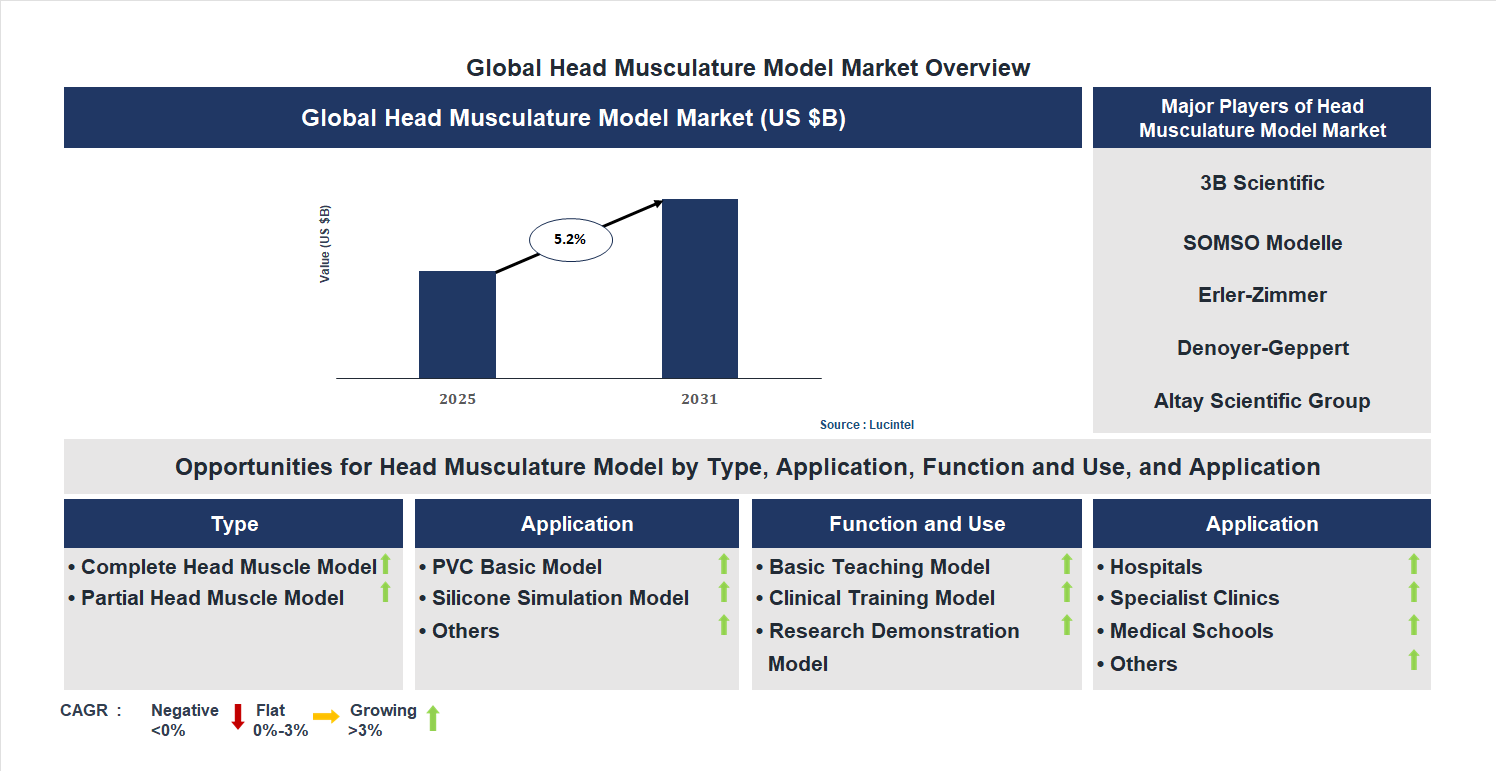
The future of the global head musculature model market looks promising with opportunities in the hospital, specialist clinic, and medical school markets. The global head musculature model market is expected to grow with a CAGR of 5.2% from 2025 to 2031. The major drivers for this market are the increasing demand for anatomy education tools, the rising use in medical training programs, and the growing focus on realistic musculature visualization.• Lucintel forecasts that, within the type category, complete head muscle model is expected to witness higher growth over the forecast period.
• Within the application category, medical school is expected to witness the highest growth.
• In terms of region, APAC is expected to witness the highest growth over the forecast period. Gain valuable insights for your business decisions with our comprehensive 150+ page report. Sample figures with some insights are shown below.
Emerging Trends in the Head Musculature Model Market
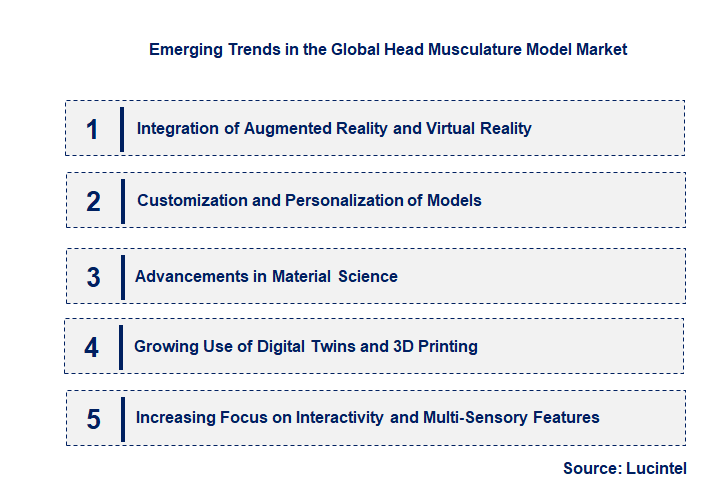
The head musculature model market is experiencing rapid evolution driven by technological advancements, increasing demand for realistic educational tools, and innovations in medical training. As healthcare professionals and educators seek more accurate and interactive models, the industry is shifting towards more sophisticated, customizable, and digitally integrated solutions. These developments are not only enhancing the quality of anatomical education but also improving surgical planning and patient outcomes. The following key trends highlight the transformative changes shaping this market, reflecting a move towards more precise, accessible, and innovative head musculature models.• Integration of Augmented Reality (AR) and Virtual Reality (VR): The adoption of AR and VR technologies is revolutionizing anatomical education and surgical planning. These immersive tools allow users to interact with 3D models in real-time, providing a deeper understanding of complex musculature structures. AR and VR integration enhances training efficiency, reduces the need for cadaveric specimens, and offers remote learning opportunities. As technology becomes more affordable and accessible, the market is witnessing increased adoption, leading to more engaging and effective educational experiences.
• Customization and Personalization of Models: There is a growing demand for tailored head musculature models that cater to specific educational, research, or clinical needs. Manufacturers are offering customizable options, including different muscle layers, pathological conditions, and patient-specific features. This trend improves the relevance and accuracy of models, enabling better surgical simulation and diagnosis. Personalized models also facilitate targeted training, helping practitioners develop skills relevant to individual patient anatomies, thereby enhancing clinical outcomes.
• Advancements in Material Science: The development of new, durable, and flexible materials is significantly impacting model realism and longevity. Innovative materials mimic the texture, elasticity, and appearance of actual muscles more accurately, providing a more authentic tactile experience. These advancements allow for repeated use without significant wear and tear, reducing costs and increasing accessibility. Enhanced material properties also enable models to better withstand surgical simulations, making them invaluable tools for hands-on training and research.
• Growing Use of Digital Twins and 3D Printing: Digital twin technology and 3D printing are enabling the creation of highly detailed, anatomically precise head musculature models. Digital twins allow for virtual replication and manipulation of models, facilitating pre-surgical planning and educational demonstrations. 3D printing offers rapid, cost-effective production of complex structures, including patient-specific models. These technologies are improving the accuracy of models, reducing production time, and expanding access to high-quality educational and clinical tools, thereby transforming traditional approaches to anatomy and surgery.
• Increasing Focus on Interactivity and Multi-Sensory Features: The market is shifting towards models that incorporate interactivity and multi-sensory feedback. Features such as movable muscles, embedded sensors, and haptic feedback systems enhance user engagement and realism. These models support dynamic simulations of muscle movements and responses, providing a more comprehensive understanding of musculature function. The focus on interactivity improves training outcomes, aids in surgical rehearsals, and enhances patient education by offering more tangible and relatable experiences. In summary, these emerging trends are collectively reshaping the head musculature model market by making models more realistic, customizable, and technologically integrated. They are expanding the scope of educational and clinical applications, improving training efficacy, and ultimately leading to better healthcare outcomes. As innovation continues, the market is poised for further growth and sophistication, driven by the increasing demand for precise, interactive, and accessible anatomical models.
Recent Development in the Head Musculature Model Market
The head musculature model market is experiencing rapid advancements driven by technological innovations and increasing demand for detailed anatomical models in medical education, surgical planning, and research. These developments are enhancing the accuracy, realism, and accessibility of models, thereby improving training outcomes and patient care. As the healthcare sector emphasizes precision and personalized treatment, the market is poised for significant growth, attracting investments and expanding applications across various medical disciplines.• Growing Demand for Medical Education and Training: The increasing need for realistic anatomical models in medical schools and training programs is fueling market growth. Advanced head musculature models provide detailed, accurate representations that enhance learning and surgical preparation. This demand is driven by the rising number of medical students and professionals seeking effective training tools, ultimately improving clinical skills and patient outcomes.
• Technological Innovations in 3D Printing: The adoption of 3D printing technology has revolutionized model manufacturing, enabling highly detailed, customizable, and cost-effective head musculature models. These innovations allow for rapid prototyping and personalized models tailored to specific patient anatomies, improving surgical planning and simulation. The technologys growth is expanding the market by making models more accessible and precise, benefiting medical practitioners and educators.
• Integration of Augmented Reality (AR) and Virtual Reality (VR): AR and VR integration with head musculature models is transforming medical visualization and training. These immersive technologies provide interactive, three-dimensional experiences that enhance understanding of complex anatomy. The impact includes improved surgical accuracy, better educational engagement, and reduced training costs, which are driving increased adoption across hospitals, universities, and research institutions.
• Rising Investment in Healthcare Infrastructure: Increased funding from governments and the private sector for healthcare infrastructure development is boosting the market. Investments are directed toward acquiring advanced anatomical models for hospitals, clinics, and research centers. This financial support facilitates the adoption of high-quality head musculature models, improving diagnostic and surgical capabilities, and fostering innovation in medical device development.
• Expansion of Market Applications in Cosmetic and Reconstructive Surgery: The use of head musculature models in cosmetic and reconstructive surgery is expanding, providing surgeons with detailed anatomical references for planning procedures. These models improve surgical precision, reduce operative time, and enhance patient outcomes. The growing demand for aesthetic procedures and reconstructive interventions is significantly contributing to market growth and diversification. The overall impact of these developments is a more sophisticated, accessible, and effective head musculature model market. Enhanced technological integration and increased investment are driving innovation, improving medical training, surgical planning, and patient care, ultimately fostering a more dynamic and competitive industry landscape.
Strategic Growth Opportunities in the Head Musculature Model Market
The head musculature model market is experiencing significant growth driven by advancements in medical education, surgical planning, and rehabilitation techniques. Increasing demand for realistic anatomical models enhances training accuracy and patient outcomes. Technological innovations such as 3D printing and virtual simulations are expanding application scopes. Market players are investing in research to develop detailed, durable, and cost-effective models. These developments are creating new opportunities for healthcare providers, educators, and manufacturers to improve understanding, diagnosis, and treatment of head musculature-related conditions.• Enhanced Medical Education and Training Opportunities: The development of detailed head musculature models provides medical students and professionals with realistic, hands-on learning tools. These models improve understanding of complex anatomy, facilitate surgical practice, and reduce training costs. As educational institutions prioritize experiential learning, demand for high-fidelity models increases, creating a substantial growth avenue. The integration of digital and physical models further enhances training effectiveness, making this a key opportunity for market expansion.
• Advancements in Surgical Planning and Simulation: Precise head musculature models enable surgeons to plan complex procedures with higher accuracy. These models assist in preoperative simulations, reducing intraoperative risks and improving patient outcomes. The adoption of 3D printed and virtual models allows for personalized surgical strategies tailored to individual anatomy. As surgical techniques evolve, the need for realistic, customizable models grows, presenting a significant opportunity for manufacturers to cater to the healthcare sector’s increasing precision requirements.
• Rising Demand for Customized and Patient-Specific Models: Personalized head musculature models are increasingly used for preoperative planning and patient education. These models help visualize individual anatomical variations, improving communication between clinicians and patients. The ability to produce patient-specific models using advanced imaging and 3D printing technologies offers a competitive edge. Growing awareness of personalized medicine and the need for tailored treatment approaches drive this market segment’s expansion, opening avenues for innovation and collaboration.
• Growing Use in Rehabilitative and Therapeutic Applications: Head musculature models are valuable in designing targeted rehabilitation programs for patients with muscular or neurological disorders. They assist therapists in understanding muscle function and planning effective interventions. Additionally, models are used to develop assistive devices and prosthetics, enhancing patient recovery. The increasing prevalence of neurological conditions and the focus on non-invasive therapies bolster demand, making this a promising growth area for market stakeholders.
• Integration of Digital Technologies and Virtual Reality: The incorporation of virtual reality (VR) and augmented reality (AR) with physical models enhances training, surgical planning, and patient engagement. These technologies enable immersive visualization of head musculature, improving comprehension and decision-making. The convergence of digital and physical models reduces costs and increases accessibility. As technological adoption accelerates, the market benefits from innovative solutions that improve accuracy, efficiency, and user experience, fostering long-term growth opportunities. In conclusion, these growth opportunities collectively drive the expansion of the head musculature model market by enhancing educational, clinical, and rehabilitative applications. Technological innovations and personalized approaches are key factors shaping future developments. As stakeholders capitalize on these opportunities, the market is poised for sustained growth, ultimately improving healthcare outcomes and advancing anatomical understanding across various medical disciplines.
Head Musculature Model Market Driver and Challenges
The head musculature model market is influenced by a variety of technological, economic, and regulatory factors that shape its growth and development. Advances in 3D printing and simulation technologies have enhanced the accuracy and realism of models, driving demand among educational institutions and healthcare providers. Economic factors such as increasing healthcare expenditure and rising awareness about anatomy contribute to market expansion. Regulatory standards for medical training and education also impact product development and adoption. Additionally, the growing focus on personalized medicine and surgical planning fuels innovation in musculature models. However, the market faces challenges related to high manufacturing costs, regulatory hurdles, and rapid technological obsolescence, which could hinder growth prospects. The factors responsible for driving the head musculature model market include:• Technological Advancements: The integration of 3D printing, augmented reality, and virtual simulation has revolutionized model manufacturing, enabling highly detailed and customizable musculature models. These innovations improve training outcomes and surgical planning accuracy, attracting healthcare providers and educational institutions. As technology continues to evolve, the market benefits from increased product realism and reduced production times, fostering growth and expanding application scope.
• Rising Healthcare Expenditure: Increasing investments in healthcare infrastructure and medical education worldwide are boosting demand for high-quality anatomical models. Hospitals, medical schools, and training centers seek realistic models for effective teaching and surgical preparation, which drives market expansion. The willingness to invest in advanced training tools reflects a broader trend toward improving patient outcomes and surgical success rates.
• Growing Focus on Medical Education and Training: The emphasis on hands-on learning and simulation-based training in medical curricula has heightened the need for accurate musculature models. These models facilitate a better understanding of complex anatomy, improving practitioner skills and confidence. As medical education standards evolve, demand for sophisticated models is expected to rise, supporting market growth.
• Increasing Adoption in Surgical Planning and Preoperative Simulation: Surgeons increasingly rely on detailed musculature models for preoperative planning, reducing operative times and improving precision. This application enhances surgical outcomes and patient safety, making musculature models indispensable in complex procedures. The trend toward personalized surgical planning further propels market demand.
• Expansion of Research and Development Activities: Continuous R&D efforts aim to develop more realistic, durable, and cost-effective musculature models. Innovations such as biodegradable materials and multi-material printing enhance model functionality. Increased R&D investment by market players fosters product diversification and technological breakthroughs, fueling overall market growth. The challenges facing this head musculature model market include:
• High Manufacturing Costs: Producing anatomically accurate and detailed musculature models involves advanced materials and sophisticated manufacturing processes, leading to high costs. These expenses can limit affordability for some end-users, restricting market penetration, especially in developing regions. Cost barriers may slow adoption rates and impact overall market growth.
• Regulatory and Certification Hurdles: Compliance with medical device regulations and obtaining necessary certifications can be time-consuming and costly. Regulatory uncertainties and varying standards across regions pose challenges for manufacturers seeking global market access. These hurdles can delay product launches and increase development costs, hindering market expansion.
• Rapid Technological Obsolescence: The fast pace of technological innovation in simulation and modeling tools can render existing products outdated quickly. Companies face pressure to continually update and upgrade models, which increases R&D expenses and inventory risks. This rapid obsolescence can impact profitability and market stability. In summary, the head musculature model market is driven by technological innovations, increased healthcare investments, and a focus on advanced medical training and surgical planning. However, high production costs, regulatory complexities, and rapid technological changes present significant challenges. These factors collectively influence market dynamics, requiring stakeholders to innovate strategically and navigate regulatory landscapes effectively. Overall, the markets growth prospects remain promising, provided these drivers are harnessed and challenges are managed efficiently.
List of Head Musculature Model Companies
Companies in the market compete on the basis of product quality offered. Major players in this market focus on expanding their manufacturing facilities, R&D investments, infrastructural development, and leverage integration opportunities across the value chain. With these strategies head musculature model companies cater increasing demand, ensure competitive effectiveness, develop innovative products & technologies, reduce production costs, and expand their customer base. Some of the head musculature model companies profiled in this report include-• 3B Scientific
• SOMSO Modelle
• Erler-Zimmer
• Denoyer-Geppert
• Altay Scientific Group
• Xincheng Scientific Industries
• Shanghai Honglian Medical Instrument Development
• Rupali Instruments
• Sawbones
• Limbs & Things
Head Musculature Model Market by Segment
The study includes a forecast for the global head musculature model market by type, application, function and use, application, and region.Head Musculature Model Market by Type [Value from 2019 to 2031]:
• Complete Head Muscle Model
• Partial Head Muscle Model
Head Musculature Model Market by Application [Value from 2019 to 2031]:
• PVC Basic Model
• Silicone Simulation Model
• Others
Head Musculature Model Market by Function and Use [Value from 2019 to 2031]:
• Basic Teaching Model
• Clinical Training Model
• Research Demonstration Model
Head Musculature Model Market by Application [Value from 2019 to 2031]:
• Hospitals
• Specialist Clinics
• Medical Schools
• Others
Head Musculature Model Market by Region [Value from 2019 to 2031]:
• North America
• Europe
• Asia Pacific
• The Rest of the World
Country Wise Outlook for the Head Musculature Model Market
The head musculature model market has experienced significant growth driven by advancements in medical education, simulation technology, and increased demand for accurate anatomical models for training and research. As healthcare professionals and educational institutions seek more realistic and detailed models, countries are investing in innovative solutions to enhance learning and surgical planning. The markets evolution reflects technological progress, rising healthcare expenditure, and the global emphasis on improving medical training standards. These developments vary across regions, influenced by local healthcare infrastructure, research initiatives, and technological adoption rates, shaping the future landscape of head musculature modeling.• United States: The US market has seen rapid adoption of 3D printing and virtual reality technologies for head musculature models, improving surgical planning and medical training. Leading companies are collaborating with hospitals and universities to develop highly detailed, customizable models. Increased funding from the government and private sectors supports innovation, and there is a growing focus on patient-specific models for personalized medicine. The demand for realistic models in medical education continues to rise, driving market expansion.
• China: China is experiencing substantial growth in the head musculature model market, fueled by expanding healthcare infrastructure and a large medical research community. The country emphasizes cost-effective, locally produced models to meet the needs of its vast population. Technological advancements such as augmented reality integration are being adopted to enhance training. Government initiatives to improve medical education and research are further propelling market development, with a focus on developing affordable, high-quality models.
• Germany: Germanys market is characterized by high-quality, precision-engineered head musculature models used primarily in surgical simulation and training. The country’s strong medical device industry and emphasis on innovation contribute to the development of advanced models with detailed anatomical accuracy. Collaborations between academia and industry are common, fostering technological advancements. The focus on minimally invasive procedures and personalized medicine is driving demand for sophisticated models that aid in complex surgical planning.
• India: The Indian market is rapidly growing, driven by increasing healthcare expenditure and a rising number of medical colleges and training institutes. Cost-effective, durable models are prioritized to cater to a large and diverse population. The adoption of digital technologies such as 3D printing and virtual simulations is increasing, improving the quality of training. Government initiatives to improve medical education standards are also supporting market growth, with a focus on affordable solutions for widespread use.
• Japan: Japans market is characterized by the integration of advanced simulation technologies and high-precision models for medical training and surgical planning. The country emphasizes innovation, with a focus on developing models that incorporate realistic tissue properties and detailed musculature. Collaborations between research institutions and industry players are common, fostering technological advancements. The aging population and increasing prevalence of complex surgical procedures are driving demand for sophisticated, realistic head musculature models to improve outcomes and training efficiency.

Features of the Global Head Musculature Model Market
Market Size Estimates: Head musculature model market size estimation in terms of value ($B). Trend and Forecast Analysis: Market trends (2019 to 2024) and forecast (2025 to 2031) by various segments and regions. Segmentation Analysis: Head musculature model market size by various segments, such as by type, application, function and use, application, and region in terms of value ($B). Regional Analysis: Head musculature model market breakdown by North America, Europe, Asia Pacific, and Rest of the World. Growth Opportunities: Analysis of growth opportunities in different types, applications, functions and uses, applications, and regions for the head musculature model market. Strategic Analysis: This includes M&A, new product development, and competitive landscape of the head musculature model market. Analysis of competitive intensity of the industry based on Porter’s Five Forces model.
FAQ
Q1. What is the growth forecast for head musculature model market? Answer: The global head musculature model market is expected to grow with a CAGR of 5.2% from 2025 to 2031. Q2. What are the major drivers influencing the growth of the head musculature model market? Answer: The major drivers for this market are the increasing demand for anatomy education tools, the rising use in medical training programs, and the growing focus on realistic musculature visualization. Q3. What are the major segments for head musculature model market? Answer: The future of the head musculature model market looks promising with opportunities in the hospital, specialist clinic, and medical school markets. Q4. Who are the key head musculature model market companies? Answer: Some of the key head musculature model companies are as follows:• 3B Scientific
• SOMSO Modelle
• Erler-Zimmer
• Denoyer-Geppert
• Altay Scientific Group
• Xincheng Scientific Industries
• Shanghai Honglian Medical Instrument Development
• Rupali Instruments
• Sawbones
• Limbs & Things Q5. Which head musculature model market segment will be the largest in future? Answer: Lucintel forecasts that, within the type category, complete head muscle model is expected to witness higher growth over the forecast period. Q6. In head musculature model market, which region is expected to be the largest in next 5 years? Answer: In terms of region, APAC is expected to witness the highest growth over the forecast period. Q7. Do we receive customization in this report? Answer: Yes, Lucintel provides 10% customization without any additional cost.
Table of Contents
List of Figures
List of Tables
Methodology
- In-depth interviews of the major players in this market
- Detailed secondary research from competitors’ financial statements and published data
- Extensive searches of published works, market, and database information pertaining to industry news, company press releases, and customer intentions
- A compilation of the experiences, judgments, and insights of Lucintel’s professionals, who have analyzed and tracked this market over the years.


Buy Now
Choose a license that fits your team. Instant PDF delivery.
Prices exclude taxes. Instant delivery. Custom licensing available on request.
Key Questions
- • What are some of the most promising, high-growth opportunities for the head musculature model market by type (complete head muscle model and partial head muscle model), application (PVC basic model, silicone simulation model, and others), function and use (basic teaching model, clinical training model, and research demonstration model), application (hospitals, specialist clinics, medical schools, and others), and region (North America, Europe, Asia Pacific, and the Rest of the World)?
- • Which segments will grow at a faster pace and why?
- • Which region will grow at a faster pace and why?
- • What are the key factors affecting market dynamics? What are the key challenges and business risks in this market?
- • What are the business risks and competitive threats in this market?
- • What are the emerging trends in this market and the reasons behind them?
- • What are some of the changing demands of customers in the market?
- • What are the new developments in the market? Which companies are leading these developments?
- • Who are the major players in this market? What strategic initiatives are key players pursuing for business growth?
- • What are some of the competing products in this market and how big of a threat do they pose for loss of market share by material or product substitution?
- • What M&A activity has occurred in the last 6 years and what has its impact been on the industry? For any questions related to Head Musculature Model Market, Head Musculature Model Market Size, Head Musculature Model Market Growth, Head Musculature Model Market Analysis, Head Musculature Model Market Report, Head Musculature Model Market Share, Head Musculature Model Market Trends, Head Musculature Model Market Forecast, Head Musculature Model Companies, write Lucintel analyst at email: helpdesk@lucintel.com. We will be glad to get back to you soon.


